Article Summary
What this article covers: What the Book of Kells is, where it is kept, how it survived twelve centuries of raids and wars, and how to plan a visit to see it at Trinity College Dublin.
Who this is for: Travellers planning a trip to Dublin, visitors with an interest in Irish heritage and early Christian art, and readers researching Ireland’s most famous medieval manuscript.
Key takeaway: The Book of Kells is a Gospel book made around the year 800 by Columban monks, and the questions scholars still argue over, including where it was actually made, are more interesting than the settled version most guidebooks repeat.
Expert insight: “Most visitors hurry through to see the open pages under glass, then leave. The part worth slowing down for is the Old Library itself, standing in a room built to hold books and thinking about the scribes who spent years on two or three pages.” , Ciaran Connolly, Founder of ConnollyCove
Quick facts:
- The manuscript holds 340 surviving folios, or 680 pages, of calfskin vellum, now measuring roughly 330 by 255 millimetres after 19th-century trimming (Library of Trinity College Dublin).
- The Annals of Ulster record its theft in 1007, when it was described as the chief treasure of the western world; it was recovered after more than two months buried under a sod.
- Trinity’s own curators date its writing to around 800 and state plainly that there is no way of knowing whether it was made at Iona, at Kells, or partly at each.
Table of Contents
To understand the Book of Kells is to understand Ireland, old and new, a little better. It is a masterwork of the illuminator’s craft and a symbol of Irishness recognised worldwide, which is why its presence at Trinity College draws a near-constant stream of visitors through the middle of Dublin.
It is also a book with a story that most short guides get wrong. The dates of the Viking raids, the theft, the journey to Dublin: these have all been pinned down by Trinity’s own manuscript curators, and the real sequence is stranger and better than the tidy version. Then there is the argument that broke into the open in 2025, when an archaeologist argued the most famously Irish object in the world may not have been made in Ireland at all.
This guide covers what the manuscript is, how it survived, what to look for on the pages, and what a visit actually involves in practice. If you are building a wider trip around it, our guide to what makes Dublin iconic sets out the other landmarks within walking distance. ConnollyCove is an Ireland-based travel and culture platform, and the Book of Kells sits at the point where our two long-running interests meet: Irish heritage and the practical business of going to see it.
What Is the Book of Kells?
The Book of Kells is an illuminated Gospel book, written in Latin around the year 800, and held today at the Library of Trinity College Dublin as manuscript MS 58. It contains the four Gospels of Matthew, Mark, Luke and John, based on the Vulgate text St Jerome completed in 384 AD with readings mixed in from the older Old Latin translation.
The text is prefaced by canon tables, which cross-reference passages appearing in more than one Gospel, along with summaries of the Gospel narratives and short prefaces describing each evangelist. The script is insular majuscule, a bold and highly disciplined hand developed in the monasteries of Ireland and Britain, and paleographers believe at least three different scribes worked on it.
What made it famous is the decoration. Ten full pages are given over entirely to ornament, and the text pages carry decorated initials and small figures worked into the lines themselves. The whole apparatus exists to glorify the Gospel text and keep the symbols of Christ constantly in front of the reader’s eye.
In Irish the manuscript is called Leabhar Cheanannais, and in Latin it appears as the Codex Cenannensis. For centuries before Bishop James Ussher gave it the name we use now, it was known simply as the Great Gospel Book of Colum Cille.
The Physical Manuscript
| Feature | Detail |
|---|---|
| Surviving folios | 340 (680 pages); the manuscript was longer originally |
| Material | Calfskin vellum, estimated at around 180 to 185 hides |
| Page size | Approximately 330 x 255 mm, trimmed and gilded during 19th-century rebinding |
| Script | Insular majuscule, at least three scribes |
| Text | Four Gospels in Latin (Vulgate with Old Latin readings), plus canon tables and prefaces |
| Binding | Rebound in four separate volumes in 1953 to reduce strain on the vellum |
| Current shelfmark | Trinity College Dublin MS 58 |
Pages are missing from the beginning and the end, and Trinity’s curators think they may have been lost at the point of the 1007 theft, torn away with the binding.
How It Reached Trinity College Dublin
The Book of Kells has been at Trinity College since the mid-17th century, and it got there by a long run of luck. Trinity’s Senior Curator of Manuscripts, Dr Jane Maxwell, makes the point that its survival was very much against the odds: of the many thousands of manuscripts produced in the first millennium and a half of Christian history, some estimates put survival as low as one in ten.
Iona and Colum Cille
The story starts on Iona, a small island off the west coast of what is now Scotland, which in the 6th century was part of the Irish kingdom of Dál Riata. St Colum Cille, known in English as Columba, founded a monastery there, and it grew into one of the most important religious centres in western Europe. It is on Iona that the Book of Kells is traditionally thought to have been written, around the year 800.
Ireland at the time held almost all its learning in the monasteries. Books were copied and painted by hand, one at a time, and the skills involved were concentrated in a small number of wealthy houses. A book like this represented years of work and an enormous outlay of material.
The Viking Raids and the Crossing to Ireland
Vikings targeted monasteries because monasteries held portable wealth: chalices, crucifixes, jewelled book shrines. Iona, being an island, was badly exposed. After a particularly brutal attack in 806 in which nearly 70 monks were killed, the surviving community set off by boat to bring the relics of Colum Cille to safety in Ireland.
Whether the manuscript was in that consignment is not known. It may have crossed later, in 878, when the annals record that the shrine and precious objects of Colum Cille were brought from Iona to escape the Norsemen. Either way it made the crossing in an open boat, and the risk was real: other relics of Colum Cille and St Patrick went overboard on just such a voyage in 1034.
The Theft of 1007
The manuscript was in the town of Kells, County Meath, from the 9th century, and the abbey there was raided by Vikings several times without the book coming to harm. Its luck ran out in 1007, when the Annals of Ulster record the theft of the great Gospel book of Colum Cille, calling it the chief treasure of the western world.
It was not stolen for the text. It was stolen for the gold shrine or jewelled binding it was kept in. The thieves stripped off the valuable cover and buried the manuscript under a sod, where it lay for more than two months before it was found.
From Kells to Dublin
The abbey church at Kells was dissolved in the 12th century and became a parish church, with the manuscript still kept there. That church was destroyed in the 1641 Rebellion, and in the 1650s Cromwell’s soldiers were quartered in the ruins. The governor of the town, the Earl of Cavan, is thought to have sent the book to Dublin Castle for safekeeping, probably in 1653. Henry Jones, the Anglican bishop who later held the see of Meath, then sent it on to Trinity College Dublin, where it has stayed ever since.
You will see the date given as 1661 in a great many places, sometimes with Charles II presenting it in person. Trinity’s own records are less tidy than that, dating the gift variously to the 1650s and the 1660s, and Jones, not the king, was the man who handed it over.
Ireland, Scotland or Pictland? The Origin Debate
Nobody knows where the Book of Kells was made, and in 2025 the question opened up again. The traditional account has it begun on Iona and possibly finished at Kells. Trinity College Library states the position without decoration: it must have been written close to the year 800, but there is no way of knowing whether it was produced wholly at Iona, wholly at Kells, or partly at each.
For more than a century the candidates have included Iona, the Northumbrian monastery at Lindisfarne, and various Columban houses in Ireland. The archaeologist and art historian Victoria Whitworth has since put forward a different one: Pictish eastern Scotland, and specifically the monastery at Portmahomack in Easter Ross.
Her argument rests on two things. Excavations at Portmahomack between 1994 and 2007 produced the first known evidence of large-scale parchment manufacture in northern Europe, at a site no surviving manuscript had ever been attributed to. And Pictish carved stones show designs and letterforms that closely parallel the Book of Kells. In one case, two mermen in the Gospel of Luke are echoed by mermen carved on stones at a Pictish royal site in Perthshire.
Whitworth is not the first to notice the resemblance. Isabel Henderson set out the shared traits of composition and decoration between Pictish art and the manuscript back in the 1980s. What is new is the argument that the Pictish case now deserves equal footing rather than a footnote.
Not everyone is persuaded. Rachel Moss, professor at Trinity College Dublin, points out that monks, scribes, pigments and techniques all moved freely around the Insular world, which muddies any attempt to draw a clean map. Without a colophon or a contemporary reference naming a specific scriptorium, some ambiguity is likely to remain permanently.
For travellers, the useful thing about this argument is what it says about the period. This was a shared Gaelic and Insular culture spanning the Irish Sea, not a set of national traditions. Iona was Irish territory. Scribes trained in one house worked in another. Our guides to Celtic mythology creatures and the Tuatha Dé Danann cover the same cross-border cultural world from the mythological side.
How the Monks Made It: Vellum, Pigments and Poison
The materials in the Book of Kells were dangerous to work with and expensive to obtain, which tells you how much the project mattered to whoever commissioned it.
The pages are vellum, prepared calfskin. Each hide was soaked in lime, scraped with a blunt knife to remove hair and fat, then stretched and dried under tension. Scholars estimate somewhere around 180 to 185 calves went into the surviving folios. Examination of the vellum shows the artists had preferences: two gatherings use slightly thicker skins, taken from calves killed at roughly two or three months old, and those pages carry major decoration.
The pigments came from minerals, plants and insects, and several were toxic. Yellow came from orpiment, which is arsenic sulphide. Red came from red lead, and in places from organic sources Trinity’s conservators still cannot identify with confidence. A copper green reacted with damp over the centuries and has eaten holes clean through the vellum on a number of folios. The artists layered as many as three pigments over a base coat to get relief effects, much of which was flattened out when the leaves were wetted during 19th-century rebinding.
| Colour | Source | Note |
|---|---|---|
| Yellow | Orpiment (arsenic sulphide) | Toxic to handle |
| Red | Red lead, plus unidentified organic sources | Poisonous |
| Blue | Indigo or woad | Native to northern Europe |
| Green | Copper green | Has perforated the vellum where damp |
| Black ink | Iron gall | From oak galls |
One correction worth making, because it appears in most popular accounts including our own earlier version of this page: the blue was probably not lapis lazuli. Research at Trinity College Library has indicated that lapis, long assumed to have been imported from Asia for the manuscript, was most likely not used at all. The blues appear to be woad, a European plant. The supply chain was less exotic than the legend, and the results are no less remarkable for it.
Symbols and Hidden Details Worth Looking For
The decoration rewards slow looking, and knowing three or four things to search for changes the experience entirely.
The Chi Rho Page
The Chi Rho page is the best known in the manuscript. It opens Matthew’s account of the nativity with the words Christi autem generatio, giving Christ’s name in its abbreviated Greek form, and the monogram swells to fill almost the whole page. Worked into it are an otter with a fish, a peacock, and two mice fighting over a eucharistic host while two cats watch from below.
The outer frame holds interlacing snakes, birds, vines and chalices, painted so finely they are hard to pick out at all. The page works at two distances: read from across a medieval church it reads as bold geometry, and studied under a lens it dissolves into detail. Six small onlookers at the bottom right are there to pull the reader’s eye across to the facing page, a device used repeatedly through the book.
The Four Evangelists
The manuscript gives each evangelist an animal symbol: Matthew the Man, Mark the Lion, Luke the Calf, and John the Eagle. On the four-symbols page they are arranged around a cross, each enclosed in a circle.
In the 6th century St Gregory read the four symbols as stages of Christ’s life: a man at his birth, a calf in his death, a lion in his resurrection, and an eagle in his ascension. That reading was current when the book was made, and it is the reason the symbols recur throughout rather than appearing once.
The Marginalia
Look at the edges. Cats chase rats around the text, otters carry fish, snakes knot themselves together, and human figures appear where a scribe had space to fill. The decoration is dense enough that scholars are still identifying new motifs nearly 1,200 years on.
The Manuscript in Popular Culture
The best known modern treatment is The Secret of Kells, the 2009 animated film from the Kilkenny studio Cartoon Saloon, which was nominated for the Academy Award for Best Animated Feature and won the European Animated Feature Award at the British Animation Awards. It is a good primer for children before a visit, and it takes the 806 flight from Iona as its emotional starting point.
The Scribes Were Human: Errors in the Text
The text of the Book of Kells is, in Trinity College Library’s own assessment, remarkably careless. This is not a modern debunking. The library says so plainly, and it is one of the most revealing things about the manuscript.
Whole letters and words are omitted, in many cases through eye-skip, where a scribe copying from an exemplar lost his place. On folio 218v a passage was copied out, then repeated on the following page, folio 219r. Rather than scrape the vellum, someone marked the duplicated text on 218v with small red crosses, cancelling it elegantly and leaving the mistake visible for the next twelve hundred years.
The most quoted error sits in Matthew 10:34. The Latin should read “Non veni pacem mittere, sed gladium”, meaning “I came not to send peace, but the sword”. The Book of Kells has gaudium, joy, in place of gladium, sword. The verse in this manuscript reads that Christ came not to send peace, but joy.
That single slip explains what the book was for. It was never a working text for study. It was an altar book, made to be seen, carried in procession and venerated as a relic of Colum Cille. In a society where almost nobody could read Latin, and where kings themselves were often illiterate, the appearance of the page carried the meaning. A word out of place did not matter. The gold and the geometry did.
Visiting the Book of Kells Experience
The Book of Kells is on display seven days a week at Trinity College Dublin, and since 2024 the visit runs across two buildings on a timed ticket you should book online in advance. The single most useful piece of planning advice is to take the earliest slot of the day; the exhibition is busy from mid-morning onwards through most of the year.
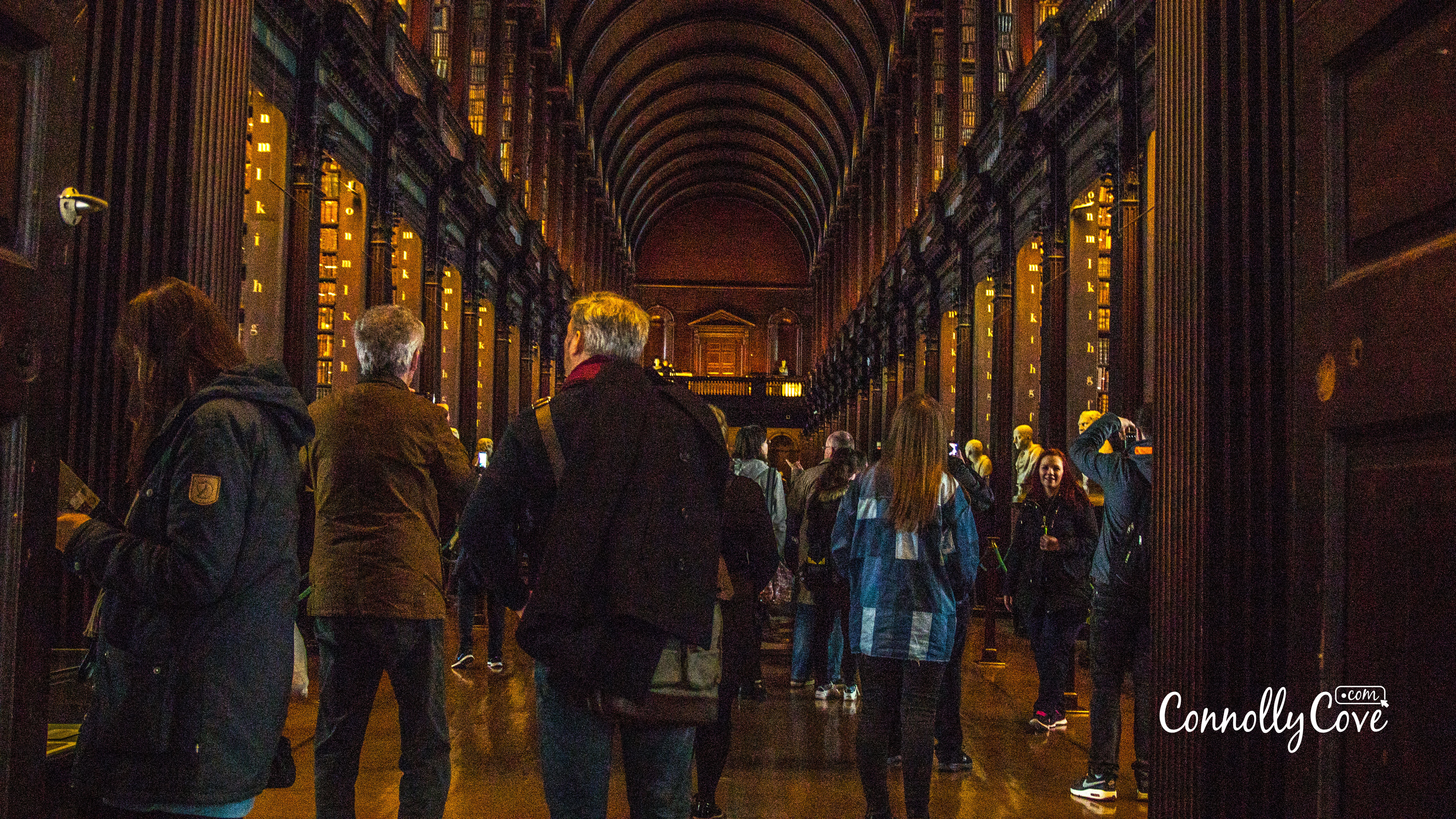
The route starts in the Old Library, where you see the manuscript itself and then go up into the Long Room. From there it is a walk of about a minute to the Red Pavilion, which houses three digital exhibitions and the gift shop. Trinity recommends allowing 90 minutes for the full visit. A free audio guide is available in thirteen languages, accessed by QR code on arrival.
| Ticket | Includes | From |
|---|---|---|
| Book of Kells Experience (self-guided) | Old Library, the manuscript, Long Room, Red Pavilion digital exhibitions, audio guide | €26 |
| Book of Kells and Old Library only | Manuscript and Long Room, no digital exhibitions | €19 |
| Trinity Trails and Book of Kells Experience | 45-minute guided campus walking tour plus the full Experience | €39 |
| Guided Book of Kells Experience | Guided Old Library tour, maximum 16 people | €65 |
Prices are the starting rates published by Visit Trinity at the time of writing and vary by slot. Check current pricing and availability on the official Book of Kells Experience site before booking. Tickets are non-refundable once purchased. Concessions are available for students and senior citizens, and students need to bring a valid card.
What You Actually See
Two pages. That is worth knowing in advance, because visitors who expect to leaf through a medieval manuscript come away disappointed. One volume lies open in a case in a deliberately dark room, and the pages are turned several times a year for conservation. Visit Trinity publishes which folios are currently on view, so you can check before you go and read up on the specific pages you will be looking at.
Photography is not allowed in the room where the manuscript is displayed. Non-flash photography is fine elsewhere, including the Long Room, and tripods are not permitted anywhere.
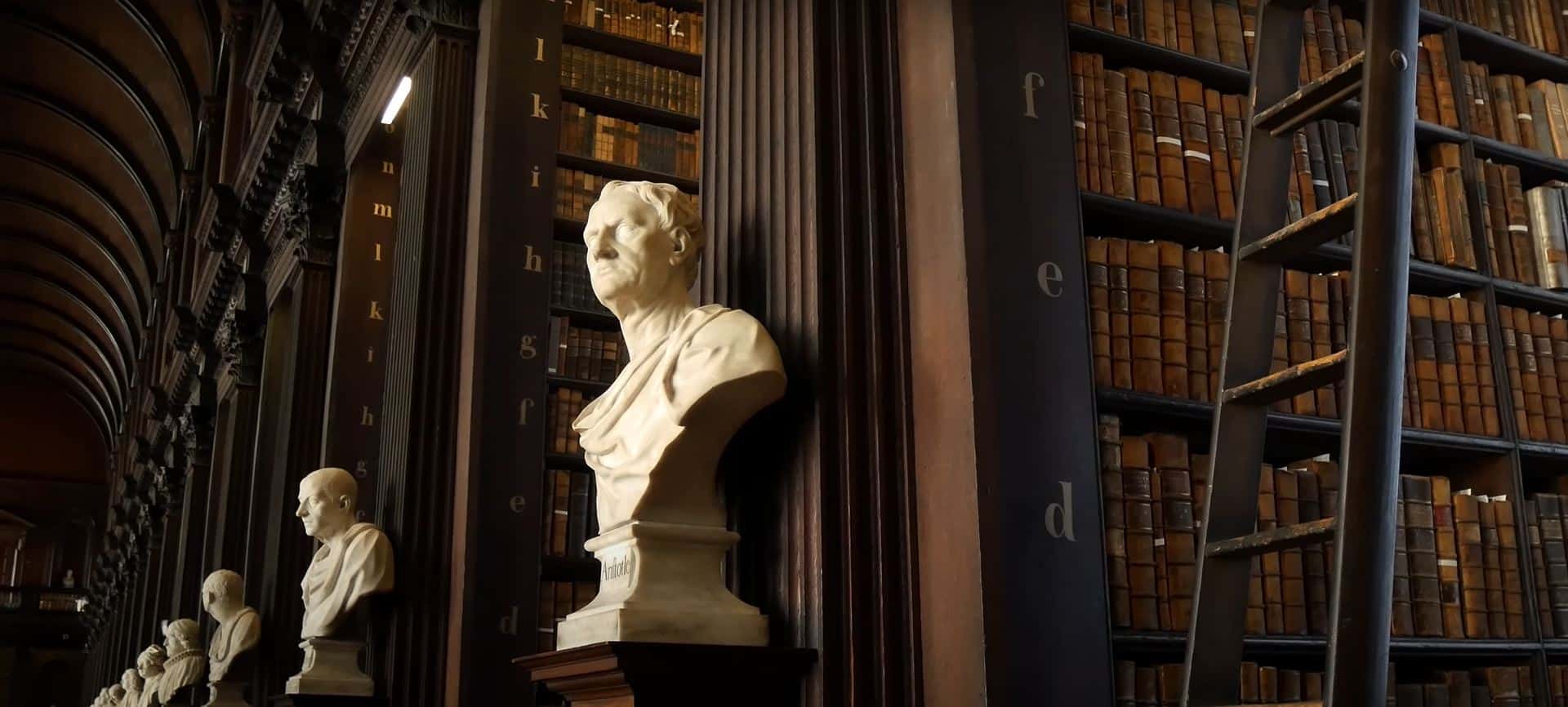
The Long Room is a 65-metre chamber under a barrel-vaulted ceiling, and it is the part most visitors remember. Two things to know before you arrive. First, the books are gone. Almost all 200,000 volumes have been moved into secure storage as part of the Old Library Redevelopment Project, with only the first four bays left stocked to show what the shelves looked like. Second, Luke Jerram’s seven-metre Gaia sculpture, a suspended globe, currently hangs in the space. Whether that trade is worth it is a matter of taste, and it is better to know than to be surprised.
Also in the Long Room are the harp known as the Brian Boru harp, which dates from around the 14th or 15th century rather than from Brian Boru’s lifetime and is the model for the harp on Irish coins, and an original 1916 Proclamation of the Irish Republic.
Walking the Trinity campus itself is free. It was founded in 1592, and the cobbled squares, the Campanile and Arnaldo Pomodoro’s bronze Sphere Within Sphere are all open to the public without a ticket.
Current Conditions and Seasonal Information
Opening hours: Monday to Thursday 8:30am to 6:30pm, Friday and Saturday 8:30am to 7:00pm, Sunday 9:00am to 6:30pm. Hours change seasonally and around public holidays, so confirm before travelling.
Best time of day: The first slot after opening is consistently the quietest, followed by late afternoon. Mid-morning to early afternoon is the crush.
Best time of year: April to May and September to October give you lighter crowds with reasonable Dublin weather. July and August slots sell out days ahead and sometimes weeks ahead for weekends. Winter is quiet but the days are short, which matters if you are pairing the visit with other sights.
Booking: Timed entry is required and online booking is strongly recommended. Book several weeks ahead for summer weekends.
Access: Both the Old Library and the Red Pavilion are fully wheelchair accessible; ask staff on arrival to be directed to the lift. There are no toilets in the Old Library and no bag storage anywhere in the Experience, so leave luggage at your accommodation.
Ahead of 2027: Trinity has said the manuscript will move to the refurbished 18th-century Printing House when conservation work on the Old Library begins, currently expected in 2027. If you are planning a trip around it, check the official site rather than relying on older guides, this one included.
Seeing the Book of Kells Online for Free
Every page of the Book of Kells can be viewed free of charge in Trinity College Dublin’s Digital Collections repository, rescanned from the 1990 transparencies using modern imaging. You can zoom to a level of detail no display case allows, and it is the only way to see the folios that are not currently open.
One thing to be clear about, because plenty of articles get this wrong: free to view is not the same as free to use. Trinity’s terms state that the images are made available for single-use academic purposes, and that publication, transmission or display requires formal written approval from the Library. If you want to use a folio in anything you publish, including a blog post or a print, write to the Library first.
Frequently Asked Questions
What is the Book of Kells and why is it important?
The Book of Kells is an illuminated manuscript of the four Gospels in Latin, made by Columban monks around the year 800 and held at Trinity College Dublin. Its importance rests on the decoration, which is the finest surviving example of Insular art, the style that developed across Ireland and Britain between the 6th and 9th centuries. It also survives from a period that left very little behind, which makes it a rare direct link to early Christian Ireland and the monasteries that kept learning alive.
Where is the Book of Kells kept?
The Book of Kells is kept in the Old Library at Trinity College Dublin, on College Green in the centre of Dublin. It has been at Trinity since the mid-17th century, when it was sent to Dublin for safekeeping during the wars of the 1640s and 1650s and then given to the college by Bishop Henry Jones. Trinity plans to move it to the refurbished Printing House on the same campus when conservation work on the Old Library begins.
Who wrote the Book of Kells, and where was it made?
At least three scribes worked on the manuscript, and none of them is named. Where they worked is genuinely unresolved. The traditional account places the work on Iona, off the Scottish coast and then part of the Irish kingdom of Dál Riata, with possible completion at Kells in County Meath. Trinity College Library states that there is no way of knowing whether it was produced wholly at either site or partly at each, and recent research by Victoria Whitworth argues for a Pictish monastery in eastern Scotland instead.
Is the Book of Kells the oldest book in the world?
No. This claim is common online and it is wrong. The Book of Kells dates from around 800 AD, and a good many older books survive, including the Codex Sinaiticus from the 4th century and, from Ireland, the Cathach of St Columba. What sets the Book of Kells apart is the quality and density of its decoration rather than its age.
How much does it cost to see the Book of Kells?
Standard self-guided admission to the Book of Kells Experience starts at €26 per adult, covering the Old Library, the manuscript, the Long Room and the digital exhibitions in the Red Pavilion. A cheaper option covering the Old Library alone starts at €19, and guided options run from €39 upwards. Concessions are available for students and senior citizens. Prices change, so check the official Visit Trinity site before booking, and note that walking the Trinity campus itself costs nothing.
Can I see the Book of Kells online for free?
Yes. Trinity College Dublin has digitised the whole manuscript in high resolution and made it viewable free of charge through its Digital Collections repository. You can move through all 680 pages and zoom in far closer than the display case permits. Viewing is free, but reuse is not automatically permitted: the images are provided for single-use academic purposes, and publishing or displaying them requires written approval from the Library.
How did the Book of Kells survive the Vikings?
Nobody knows, which is part of its appeal. Iona was attacked repeatedly, and in 806 nearly 70 monks were killed there before the survivors carried the community’s relics to Ireland by open boat. The abbey at Kells was then raided several times without the manuscript being destroyed. It came closest to being lost in 1007, when it was stolen for its jewelled cover, stripped and buried under a sod, and recovered more than two months later.
What language is the Book of Kells written in, and what is its Irish name?
The Book of Kells is written in Latin, using the Vulgate translation with readings from the earlier Old Latin version mixed in. In Irish it is Leabhar Cheanannais, and in Latin it appears as the Codex Cenannensis. If you would like more Irish-language terms and phrasing before a trip, our collections of traditional Irish proverbs and ways to say goodbye in Irish are a practical place to start.
Explore More Irish Heritage
The Book of Kells repays a bit of preparation. Knowing which page is on display, what to look for in the margins, and why the Long Room looks half empty turns a 90-minute queue into something you will remember. ConnollyCove produces in-depth guides to Irish heritage, Celtic mythology and travel destinations worldwide, and Ciaran Connolly founded the platform to help travellers find the cultural depth behind the landmarks.
For the wider trip, read our guide to Dublin’s landmarks and cultural life, or watch our Ireland travel films on the ConnollyCove YouTube channel.