
Article Summary
Irish authors, from the four Nobel laureates to recent Booker Prize winners, are the subject of this guide, along with the places in Ireland where you can still follow their footsteps.
Who this is for: Readers looking for their next Irish book and travellers planning a literary trip around Ireland.
Key takeaway: Irish authors make more sense once you have seen the streets, farms and coastlines they wrote about, and most of those places are open to visitors.
Expert insight: “Reading Heaney at home is one thing, but standing in the fields around Bellaghy changes how the poems sound. The farm work he describes is right there, and the language suddenly feels practical rather than decorative.”- Ciaran Connolly, Founder of ConnollyCove.
Quick facts:
- Ireland has four Nobel laureates in literature: W.B. Yeats, George Bernard Shaw, Samuel Beckett and Seamus Heaney.
- Dublin was named a UNESCO City of Literature in 2010.
- Two Irish novelists, Anna Burns and Paul Lynch, have won the Booker Prize since 2018.
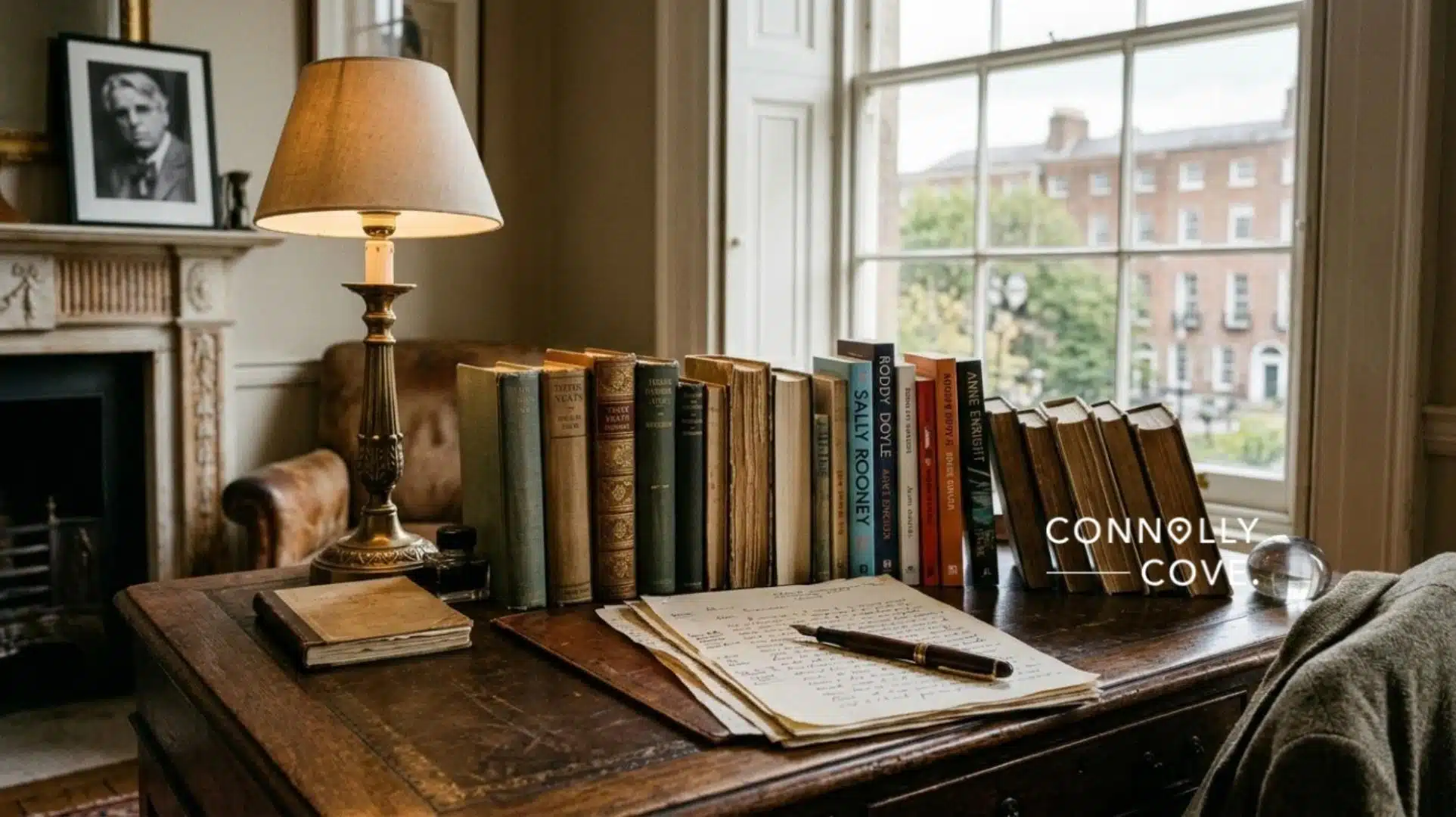
Irish authors have shaped world literature far beyond what you might expect from an island of around seven million people. James Joyce changed what a novel could do, and Bram Stoker gave the world its most famous vampire from a writing desk in London, a long way from his Dublin childhood.
At ConnollyCove, an Ireland-based travel and culture platform, we have always been curious about where these writers came from. This guide covers the famous Irish writers most readers know, a few they may have missed, and the museums, graves and trails you can visit when you travel.
Table of Contents
Why Has Ireland Produced So Many Famous Writers?
Ireland’s literary strength comes from a long storytelling tradition and, more recently, genuine public support for writers. Long before printed novels, the seanchaí (pronounced shan-a-key), a travelling storyteller, kept history and folklore alive by word of mouth. Many of the tales they told survive in our guide to legendary creatures from Celtic mythology, and the same plain wisdom runs through traditional Irish proverbs.
Language played its part too. During the Celtic Revival of the late nineteenth century, Yeats and his circle drew heavily on Irish-language stories, while later writers took on censorship, emigration and the Church. In 1969, Ireland introduced a tax exemption for artists’ earnings, and the Arts Council and Aosdána still support working writers. The result is a country where writing is taken seriously as work.
Ireland’s Four Nobel Laureates in Literature
Ireland has won the Nobel Prize in Literature four times, a striking record for a country of its size.
W.B. Yeats (1865 to 1939)
Yeats was born in Sandymount, Dublin, but Sligo was the place he loved. He spent childhood holidays there with his mother’s family, and Lough Gill, Benbulben and Innisfree run through all his poems. He won the prize in 1923 and is buried in Drumcliffe churchyard beneath Benbulben.
George Bernard Shaw (1856 to 1950)
Shaw grew up on Synge Street in Dublin and became the sharpest playwright of his era. Start with Pygmalion. He won the prize in 1925.
Samuel Beckett (1906 to 1989)
Beckett was born in Foxrock, went to school in Enniskillen and spent most of his adult life in Paris. Waiting for Godot made his name, and the Nobel followed in 1969.
Seamus Heaney (1939 to 2013)
Heaney is the best-known of all authors from Derry. He grew up on a farm near Castledawson, studied at Queen’s University Belfast and won the prize in 1995. Death of a Naturalist (1966) is the natural place to start. All four sit comfortably alongside the politicians, scientists and rebels in our guide to famous Irish people.
Gothic Masters and Modernists From Dublin
Dublin produced several writers still studied worldwide, and the city keeps their memory visible on its streets.
James Joyce (1882 to 1941) wrote almost entirely about Dublin, even though he lived abroad for most of his adult life. Begin with Dubliners (1914) before attempting Ulysses (1922). Fans celebrate Bloomsday every 16 June, and the James Joyce Tower in Sandycove is where Ulysses opens.
Oscar Wilde (1854 to 1900) was born on Westland Row, and a colourful statue of him lounges in Merrion Square opposite his childhood home. Jonathan Swift, author of Gulliver’s Travels, served as Dean of St Patrick’s Cathedral and is buried inside it.
Bram Stoker (1847 to 1912) was born in Clontarf and studied at Trinity College, as did Wilde and Beckett, so a visit to see the Book of Kells puts you on the same campus. Stoker worked as a civil servant at Dublin Castle before moving to London, and his mother’s accounts of the 1832 cholera outbreak in Sligo are often linked to the dread in Dracula (1897). Some readers also hear echoes of Irish otherworld lore, including the stories of the Tuatha Dé Danann, in his undead count. Dublin’s Bram Stoker Festival takes place each October.
Twentieth-Century Storytellers and Pioneering Women
The twentieth century brought Irish authors who wrote honestly about ordinary lives, often at real personal cost.
Edna O’Brien (1930 to 2024) saw her first novel, The Country Girls (1960), banned in Ireland and reportedly burned in her home parish in County Clare. Maeve Binchy (1939 to 2012), from Dalkey, found fame with warm novels about small-town life, starting with Light a Penny Candle (1982). Both appear among the famous Irish women who changed the country.
Frank McCourt (1930 to 2009) was born in New York but grew up in poverty in Limerick, the setting of his memoir Angela’s Ashes, which won the Pulitzer Prize in 1997. The Frank McCourt Museum is based in Leamy House, his old school.
Máirtín Ó Cadhain (1906 to 1970) wrote Cré na Cille (1949) in Irish. Narrated by the dead in a Connemara graveyard, it is darkly funny and available in English as The Dirty Dust.
Contemporary Irish Authors Readers Love Today
Contemporary Irish authors are winning major prizes and topping bestseller lists, which keeps the tradition very much alive.
Sally Rooney, from Castlebar in County Mayo, reached a global audience with Normal People (2018). Claire Keegan writes short, exact books, and Small Things Like These was shortlisted for the Booker Prize in 2022. Paul Lynch won the Booker in 2023 with Prophet Song, about a Dublin family caught in the country’s slide into authoritarian rule. Cecelia Ahern’s P.S. I Love You became a Hollywood film in 2007 and sent plenty of viewers looking up the Wicklow Mountains.
If you would rather read about the past, our list of Irish historical fiction worth reading pairs well with any of these.
Northern Irish Authors and Belfast’s Literary Trail
Northern Irish authors deserve their own place in the story, and Belfast makes them easy to follow.
C.S. Lewis (1898 to 1963) was born in east Belfast, and local tradition holds that Dunluce Castle on the Antrim coast helped inspire Cair Paravel in Narnia. Seven sculptures of his characters stand in C.S. Lewis Square in east Belfast, open at any hour, and a Narnia Trail winds through Kilbroney Park in Rostrevor.
Anna Burns, one of the best-known authors from Belfast, won the Booker Prize in 2018 for Milkman, set during the Troubles. Louise Kennedy’s Trespasses covers similar ground in a small town outside the city. Further west, the Seamus Heaney HomePlace in Bellaghy lets you hear Heaney reading his own work.
Where to Follow Irish Authors on a Trip to Ireland
Most of Ireland’s literary sites sit within a few hours of each other, so a long weekend covers Dublin, Sligo and the North comfortably.
| Place | Author | What You Will Find |
|---|---|---|
| MoLI, St Stephen’s Green, Dublin | James Joyce and others | Copy No. 1 of Ulysses and exhibitions on living writers |
| James Joyce Tower, Sandycove | James Joyce | The tower where Ulysses opens |
| Drumcliffe Churchyard, County Sligo | W.B. Yeats | His grave beneath Benbulben |
| Frank McCourt Museum, Limerick | Frank McCourt | His former school |
| Seamus Heaney HomePlace, Bellaghy | Seamus Heaney | Exhibitions, readings and events |
| C.S. Lewis Square, Belfast | C.S. Lewis | Narnia sculptures, open daily |
Locals always appreciate a few words in their own language, so learning how to say goodbye in Irish is a nice touch before you set off. ConnollyCove, the Ireland-based travel and culture platform founded by Ciaran Connolly, covers Irish heritage and the places behind the stories, so explore our other guides before you plan your route.
FAQs About Irish Authors
Irish authors raise plenty of questions for new readers and literary travellers. Here are quick answers to the ones we hear most.
Who is the most famous Irish author?
James Joyce is usually named first, thanks to Ulysses and Dubliners. Oscar Wilde and W.B. Yeats follow close behind.
Who are the four Irish Nobel Prize winners for literature?
W.B. Yeats (1923), George Bernard Shaw (1925), Samuel Beckett (1969) and Seamus Heaney (1995).
Is C.S. Lewis considered an Irish author?
Yes, he was born and raised in Belfast, although he spent his working life in England.
Who is the most famous female Irish writer?
Edna O’Brien is often named first, while Maeve Binchy and Sally Rooney have reached the widest audiences.
What are the best books by Irish authors to start with?
Dubliners, Angela’s Ashes and Small Things Like These are all short and approachable.
Who are the best contemporary Irish writers?
Sally Rooney, Claire Keegan, Paul Lynch and Anna Burns lead most current reading lists.