


Jardin des Plantes, Paris (Ultimate Guide)
Updated On: April 22, 2024 by  Aya Radwan
Paris Jardin des Plantes is the French name for Garden of the Plants of Paris. This once 17th-century medicinal garden under the name of Jardin Royal des Plantes médicinales or Royal Garden of Medicinal Plants is the main botanical garden in Paris, France. The first garden; the Medicinal Garden was established in 1635.
This 280,000 square meters garden lies on the left bank of the River Seine, in the 5th arrondissement in Paris. The garden encloses the headquarters of the Muséum national d’histoire naturelle (National Museum of Natural History).
In addition to several gardens, a menagerie, archives, works of art, specimen collections and several other buildings of historical importance. Jardin des Plantes de Paris became a national historic landmark on March 24th, 1993.
In this article, we will get through everything you need to know before visiting Jardin des Plantes de Paris. From its history, the best time to visit the garden, the ticket price, the opening times, the Festival of Lights at the garden and what nearby facilities and services you can take advantage of.
Jardin des Plantes Paris History
The Garden of the Plants of Paris has a rich history that be divided into several eras. From the date of its establishment in 1635 as the Royal Garden for Medicinal Plants, the structure and plan of Jardin des Plantes had been altered many times under different directors, and buildings and other facilities have been added to the vicinity of the garden as well.
The Royal Garden of Medicinal Plants (1635 – beginning of the 18th century)
Under the care and authority of the King’s Physician; Guy de la Brosse, King Louis XIII ordered signed the edict of the establishment of a Royal Garden of Medicinal Plants. The main purpose of the garden was to house, study, and understand the work of medicinal plants. In the beginning, the garden was provided with a group of teachers or demonstrators in order to train future physicians and pharmacists in the fields of botany, chemistry, and geology with live demonstrations of the garden’s collections.
The new amphitheatre added to the structure of the garden in 1673 was aimed at housing dissections of the plants along with carrying out extensive medical research. This was under the direction of the new garden director Guy-Crescent Fagon. Fagon was the Royal Physician of King Louis XIV.
Another floor was added at the beginning of the 18th century, to house the collection of the medical plants of the royal botanist. Many changes were carried out afterwards, the new floor was transformed into viewing galleries in addition to the enlargement of the greenhouses on the west and the south to encompass the new plants brought in from abroad by the envoys of scientific expeditions.
The new plants brought in from abroad were studied, dried and catalogued. A group of artists made books with illustrations of the plants in each collection. The plants were then studied for their potential medical or culinary uses. A prominent example of these plants was the coffee beans brought back from Java to Paris which were later planted in the French colonies of North America.
The Buffon Period (1739 – 1788)
Georges-Louis Leclerc – Comte de Buffon was a French naturalist, mathematician, cosmologist and encyclopédiste, he is the most celebrated head of the Jardin des Plantes. Even though he had a booming business of iron works in Burgundy, Buffon lived in the garden in the house that now carries his name; the Maison Buffon.
Under Buffon’s leadership, the garden almost doubled in size reaching the banks of the Seine. The cabinet of Natural History was also enlarged with the addition of a new gallery to the south. An important team of naturalists and botanists were brought into the scientific team of the garden to assist in studying and understanding the different plants housed in the garden.
Buffon sent scientists to different parts of the world with the mission to gather specimens and bring them back to study in the garden. One of the most notable expeditions were those by Michel Adanson who was sent to Senegal and La Perouse who was sent to the islands of the Pacific. The study of the specimens found during these expeditions caused a great debate regarding the theory of Evolution.
The scientists of the Royal Gardens, led by Buffon and his team argued that natural species evolved through time. While professors of the Sorbonne insisted that nature and natural species have been the exact same as they were at the time of Creation. However, since Buffon and the scientists of the Royal Gardens had the backing of the royal court, this enabled them to proceed with their studies and publish them.
The French Revolution and the 19th Century – The Menagerie (1793 – 1944)
In the light of the French Revolution, all royal buildings were completely transformed by order of the National Convention; the new government. The Royal Garden was joined with the Cabinet of Natural Sciences to create the Museum of Natural History. The new institution; the museum received some valuable collections that were confiscated from aristocratic families. One important item to join the museum was a group of illustrious wax models of anatomy made by André Pinson.
Two major collections of valuable specimens were added to the museum in the following years. The first collection was the outcome of the 1798 expedition launched by Napoleon Bonaparte to Egypt. The military expedition was accompanied by 154 botanists, astronomers, archaeologists, chemists, artists and other scholars.
Drawings and paintings of the expedition findings are among the collections of the Natural History Museum including those found by famous scholars Gaspard Monge, Joseph Fourier and Claude Louis Berthollet. The second valuable collection to be added was that of Joseph Tournefort. The 6,963 specimens collection was donated upon Tournefort’s death to the Jardin du Roi.
The Menagerie
The main reason for the addition of the Menagerie du Jardin des Plantes was to rescue the abandoned animals from several abandoned royal properties around the country. Animals at the royal menageries at the Palace of Versailles and animals from the private zoo of the Duke of Orleans were all abandoned. The government had ordered the rounding up of all animals put on public display by circuses as well.
In 1795 after the acquisition of the Hôtel de Magné which was next to the gardens, the government initially installed cages for the animals procured from the Versailles Palace but due to the lack of funding and care, many animals died. By orders from Napoleon, sufficient funds and suitable structures were built to accommodate the animals. Animals brought back to France from scientific expeditions were also housed at the new building including a famous giraffe given to King Charles X by the Sultan of Cairo in 1827.
Focus on Research and New Buildings (Late 19th and 20th centuries)
Significant and scientifically important research was carried out at the garden and museums at the end of the 19th century and the beginning of the 20th century. Examples of such scientific studies include the isolation of fatty acids and cholesterol by chemist Eugene Chevreul who also studied the chemistry of vegetable dyes. Physiologist Claude Bernard studied the functions of glycogen in the liver.
It was in these laboratories that a discovery was made that will change the history and shape of humanity for years to follow. The discovery of radioactivity was made in 1896 by wrapping uranium salts with an unexposed photographic plate wrapped in black cloth to prevent the entry of sunlight. When Henri Becquerel unwrapped the cloth, the radiation from the salts caused the colour of the photographic plate to change. Becquerel received the Noble Prize for this discovery in 1903.
Construction of the Gallery of Zoology started in 1877 with the purpose of holding the massive zoological collections of the museum. Construction finished in 1888 and even though the building’s design is very elegant; the central hall’s iron construction was compared to that of the Grand Palais and Musée D’Orsay, the building later suffered from low maintenance and closed in 1965.
Between 1980 and 1986, the construction of the Zoothêque to be the new home for the zoology collection took place. After its completion, the building is only accessible to scientists and researchers. Housed inside are 30 million specimens of insects, 500,000 fish and reptiles, 150,000 birds and 7,000 other animals. The above building houses the updated Grand Gallery of Evolution.
Another addition to the garden area was the Gallery of Paleontology and of Comparative Anatomy. It was built to be home to the thousands of skeletons collected over the years. The buildings of the menagerie were expanded by the building of the massive Bird House which was 12 meters high, 37 meters long by 25 meters.
Jardin des Plantes Map
The five buildings of the National Museum of Natural History are within the garden in addition to other different buildings containing exhibited specimens. Under French law, these buildings are considered and called museums while the National Museum of Natural History calls them galleries. Besides the main five buildings, there is a small zoo and a botanical school.
1. The Grande Galerie de L’Évolution (Grand Gallery of Evolution):
Before 1994, this gallery was known as the galerie de Zoologie (Gallery of Zoology) since its inauguration in 1889. The exhibits in the gallery were organized in a certain way that tells the story of Evolution as being the subject thread of the gallery.
2. The Galerie de Minéralogie et de Géologie (Gallery of Mineralogy and Geology):
This mineralogy museum was built in 1833 and was inaugurated in 1837.
3. The Galerie de Paléontologie et d’Anatomie Comparée (Gallery of Paleontology and Comparative Anatomy):
Inaugurated in 1898, the Comparative Anatomy museum is located on the ground floor while the first and second floors are dedicated to the Paleontology museum.
4. The Galerie de Botanique (Gallery of Botany):
This building was inaugurated in 1935 and in addition to containing botany laboratories, it also houses the French Museum’s National Herbarium. The Herbarium is the biggest in the world with samples of almost 8 million plants. A small permanent exhibition about botany is also in the building.
5. Ménagerie du Jardin des Plantes (Menagerie of the Garden of the Plants):
This small-scale zoo was established in 1795 in order to house the abandoned animals from the menagerie that was at the Versailles palace. The animals were abandoned after the French Revolution.
6. The Botanical School:
The aim of this school is to train botanists, construct demonstration gardens and exchange seeds to maintain biotic diversity.
Other structures and buildings in the garden include a plot of 10,000 square meters holding 4,500 plants arranged by family, there are horticultural displays of decorative plants and there is an Alpine garden housing 3,000 species from around the world. There’s an Art Deco Winter Garden and Mexican and Australian Hothouses with regional plants that are not native to France. Plus, there’s a Rose Garden with hundreds of species of roses and rose trees.
Best Time to Visit Jardin des Plantes
The best time to visit the Jardin des Plantes is from 8:00 am to 5:30 pm. Please notice that the Jardin is cleared 15 minutes before closing time.
What are Jardin des Plantes Opening Times?
While the Jardin is open daily from 8:00 am to 5:30 pm, there are different opening hours for different facilities encompassed by the Jardin. Here are the opening hours of the other gardens in the Jardin des Plantes. You’d like to know that in general, the garden is cleared 15 minutes prior to closing time. Also, in the event of any severe weather conditions such as rain, snow or a heatwave, the garden will be closed indefinitely until the severe weather conditions have passed.
- The Botanical School, the Rose and Rock Garden, the Peony Garden and the Alpine Garden are all open daily at the same hours as the Garden. Except that the Alpine Garden has an annual closing season which is from December 1st to March 1st. The Iris and Perennials Garden is open daily from 10:00 am to 4:00 pm all week and closes on the weekends.
- The Grand Gallery of Evolution: Open daily except on Tuesdays from 10:00 to 6:00 pm. The gallery is closed every year on January 1st, May 1st and December 25th. The last ticket is sold 45 minutes before closing time.
- Children’s Gallery (Part of the Grand Gallery of Evolution): Open on Wednesdays, Saturdays, Sundays and on holidays from 10:00 am to 6:00 pm. On holidays, the gallery is open every day except on Tuesdays. The last admission is 45 minutes before closing time.
- Palaeontology and Comparative Anatomy Gallery: Open daily except on Tuesdays from 10:00 am to 6:00 pm. The gallery closes yearly on January 1st and December 25th. The last tickets are sold 45 minutes before closing and in the event of a heatwave striking, the gallery may be partially or completely closed to the public.
- Geology and Mineralogy Gallery: Open daily except on Tuesdays from 10:00 am to 5:00 pm. The gallery closes every year on January 1st, May 1st and December 25th. The last ticket is sold 45 minutes before closing.
- The Menagerie du Jardin des Plantes: Open daily from 10:00 am to 5:00 pm. In the case of severe weather conditions such as snow, rain or a heatwave the Zoo can be closed indefinitely. The last ticket is sold an hour before closing time.
- The Greenhouses: Open daily except on Tuesday from 10:00 am to 5:00 pm. The last admission is 45 minutes before closing time. The Greenhouses close every year on January 1st, May 1st and December 25th. In the case of severe weather conditions, Greenhouses can be closed for an indefinite period.
Jardin des Planets Paris Tickets and Entrance Fee
Entrance to the Jardin des Plantes is free, though there are different ticket rates for the different galleries in the vicinity of the Jardin. Tickets can be bought online depending on availability. Those who have concessions and are allowed to visit the galleries with reduced ticket rates are usually the visitors who are aged between 3 and 25 and are still students, pass education holders and groups of more than 20 people in temporary exhibitions.
- The Grand Gallery of Evolution: The entrance fee to the main gallery is 10 Euros and is reduced to 7 Euros for those with concessions. The entrance fee to the other exhibitions in the Grand Gallery of Evolution; the Temporary Exhibition, the Children’s Gallery, the Revivre extinct species in augmented reality and the Cabinet of Virtual Reality is 13 Euros and is reduced to 10 Euros for those with concessions.
- Palaeontology and Comparative Anatomy Gallery: Tickets are 7 Euros and 5 Euros for visitors aged 3 to 25 and still students and Pass Education Holders.
- Geology and Mineralogy Gallery: The ticket price is 7 Euros and 5 Euros for Pass Education Holders.
- The Greenhouses: Ticket is 7 Euros and 5 Euros for visitors aged 3 to 25 and still students, Pass Education Holders, and groups of more than 20 people visiting the Menagerie, the greenhouses, the Gallery of Botany and temporary exhibitions.
- The Menagerie: Ticket price is 13 Euros and 10 Euros for visitors aged 3 to 25 and still students, Pass Education Holders, groups of more than 20 people visiting the Menagerie, the Greenhouses, the Gallery of Botany, temporary exhibitions and job seekers.
Can you visit Jardin des Plantes without a Ticket?
Yes, you can!
There are several categories of visitors that are exempted from buying entrance tickets. In general, these groups are children under 3 years old, visitors with disabilities and their carers, job seekers, welfare beneficiaries, teachers preparing a visit with the presentation of their ID, journalists on a professional visit, ICOM members, Amis du Muséum (Society of Friends of the Museum) members.
Of the people allowed free admission to the Menagerie, the EAZA (European Association of Zoos and Aquaria) and AFDPZ (Association Francaise des Parcs Zoologiques) members and annual Ménagerie annual pass holders. Young people under 26 from the European Union are granted free admission to all galleries except the Children’s Gallery, the Greenhouses and the Menagerie.
The Gardens of the Jardin des Plantes
The Jardin des Plantes is divided into five main gardens including the main or formal garden and in addition to the greenhouses.
- The Formal Garden:
Covering an enormous area of more than 200,000 square meters, the formal garden has the River Seine on the east, Rue Geofroy-Saint-Hilaire to the west, Rue Buffon to the south and Rue Cuvier to the north. The streets surrounding the garden were named after French scientists who carried out studies and valuable work in the garden and its museums.
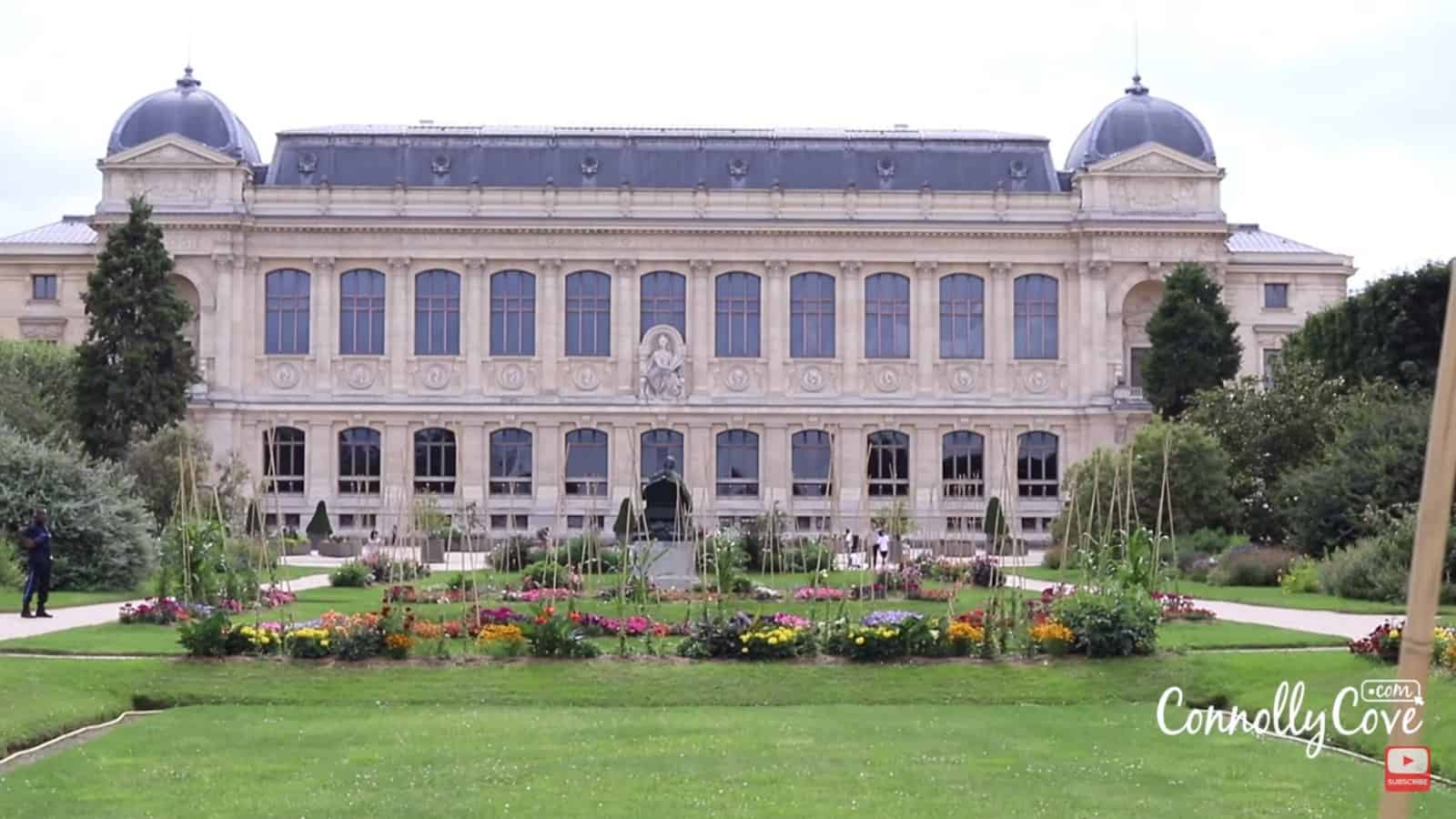
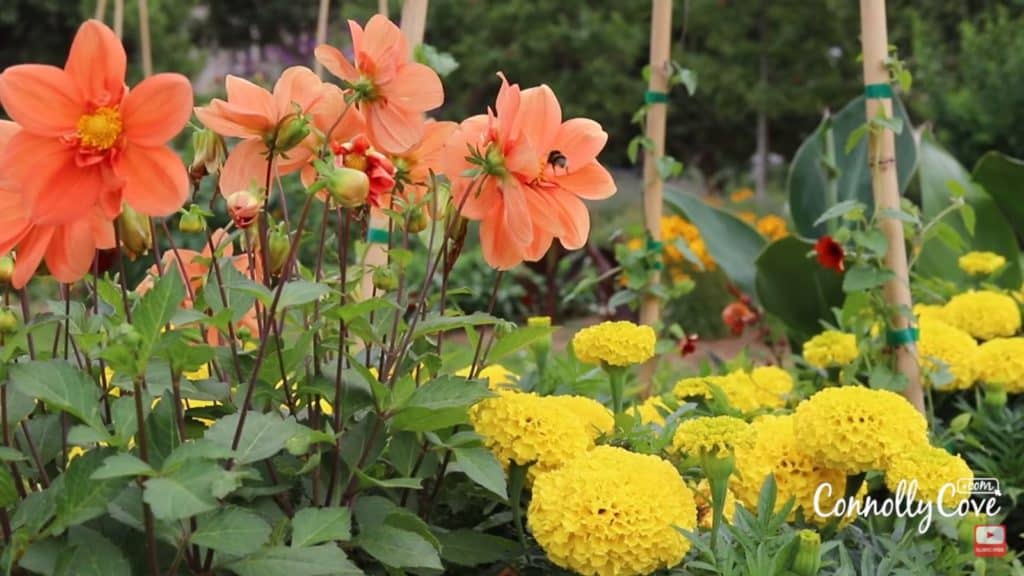
The main entrance to the French formal-styled garden is to the east and it also directly reaches the Grand Gallery of Evolution. This part of the garden is situated between two rows of platane trees with rectangular-shaped flower beds containing over a thousand plants. On the left, there are galleries and to the right, there is the School of Botany, the Alpine Garden and the greenhouses.
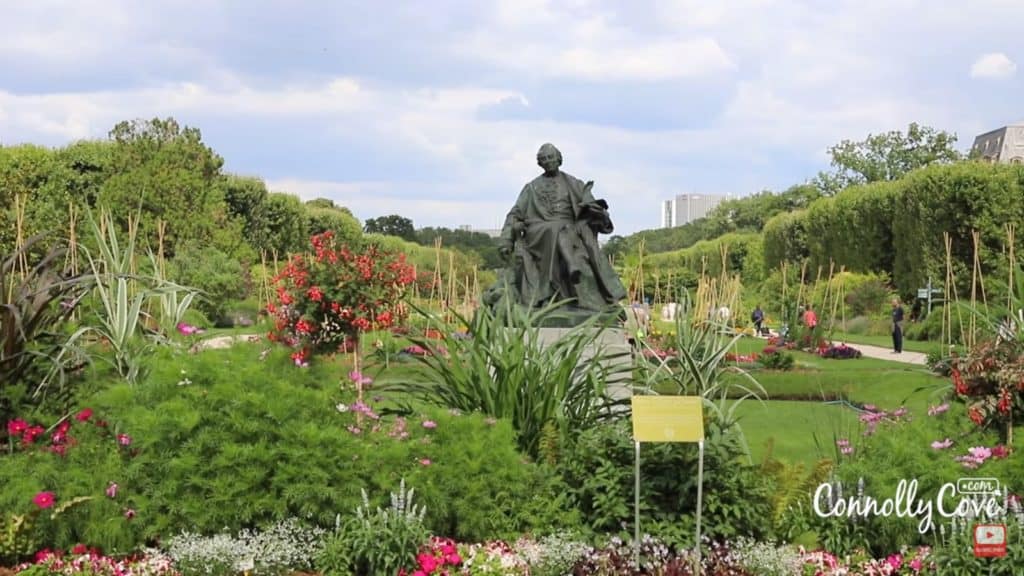
There are several statues of notable people in the history of the Jardin des Plantes dotted in the formal garden. A statue of botanist Jean Baptiste Lamarck; the director of the School of Botany from 1788 and best known for formulating the first coherent theory of biological evolution. Another statue is that of Georges-Louis Leclerc Comte de Buffon; a naturalist and scientist who under his supervision the garden expanded and flourished.
- The Greenhouses:
There are four huge greenhouses placed in a row to the right of the front of the Grand Gallery of Evolution. The greenhouses were built to replace the earlier greenhouses built back in the early 18th century. The serres were built to house the plants brought back by French scientists and explorers from tropical climates.
The magnificent glass and iron architectural style used in building the Mexican Greenhouse and the Australian Greenhouse was an advanced technique preceding the time they were built; between 1834 and 1836. The Mexican greenhouse houses succulents while the Australian one houses Australian plants, both greenhouses were built by architect Rohault de Fleury.
The Jardin d’hiver or the Winter Garden is in the same area and is 750 square meters. It was designed by René Berger and finished in 1937. The Art Deco entrance of the Winter Garden features two illuminated glass and iron pillars designed for nighttime visits. The temperature inside the Winter Garden is maintained at 22 degrees Celsius all year round, making it the perfect environment for the growth of tropical plants such as bananas and bamboo.
Distributed between different greenhouses, there’s a large number of fossil plants collected from all over the world. An example is the fossil of a Ginkgo found in Yorkshire that is 170 million years old.
- The Alpine Garden:
Created in 1931, the Alpine Garden is about three meters higher than the other parts of the garden. The garden is divided into two zones and contains several microclimates controlled by water distribution, orientation towards the sun, the type of soil and the distribution of rocks. Plants from Corsica, the Caucasus, North America and the Himalayas. Two of the most ancient trees in the Alpine Garden are a pistachio tree and a metasequoia.
- The School of Botany Garden:
Located alongside the formal garden, this garden is home to plants with medicinal or economic benefits. Created in the 18th century, the School of Botany Garden now houses more than 3,800 species organized by genus and family. This part of the garden is toured with the help of a guide and of the wonders you’ll see is a black pine tree planted in 1774.
- The Small Labyrinth:
Located behind the Winter Garden greenhouse, this small garden is most known for the large platane tree planted by Buffon in 1785. Another prominent tree is a Ginkgo biloba which comes from China and is considered a living fossil planted in 1811, botanists believe this tree existed in the Second Era of living things. A statue dedicated to botanist Bernardin de Saint-Pierre; creator of the Menagerie and the last director of the garden named by the king before the French Revolution, is situated in the middle of the small garden.
- The Butte Copeaux and the Grand Labyrinth:
The Grand Labyrinth is built atop a hill overlooking the entire garden. The Labyrinth was initially created under Louis XIII but was redone by Buffon for Louis XVI. The winding path of the labyrinth leads to the top of the Butte Copeaux which was once the site of an old garbage dump.
Trees from the Mediterranean constitute the majority of the trees planted in the Butte, including an old erable tree from Crete planted in 1702 and still in its place. At the beginning of the winding path, there’s a Cedar tree from Lebanon that was planted in 1734 with a trunk measuring 4 meters.
A viewing platform called Gloriette de Buffon is at the top, made from cast iron, bronze and copper weaved in a neo-classical style between 1786 and 1787. The platform which was made using metal from Buffon’s foundry is considered to be the oldest metal structure in Paris. The Gloriette is made of 8 metal columns carrying a roof shaped like a Chinese hat topped with a lantern decorated with swastikas which was a popular motif during that period of time.
The National Museum of Natural History
Called the Louvre of the Natural Sciences, the five buildings comprising the National Museum of Natural History are located in the parameter of the Jardin des Plantes. The museum is a grand établissement or grand establishment of higher education and is part of the Sorbonne Universities. The museum comprises four galleries and a laboratory for the study of insects; the Laboratory of Entomology.
- The Grand Gallery of Evolution:
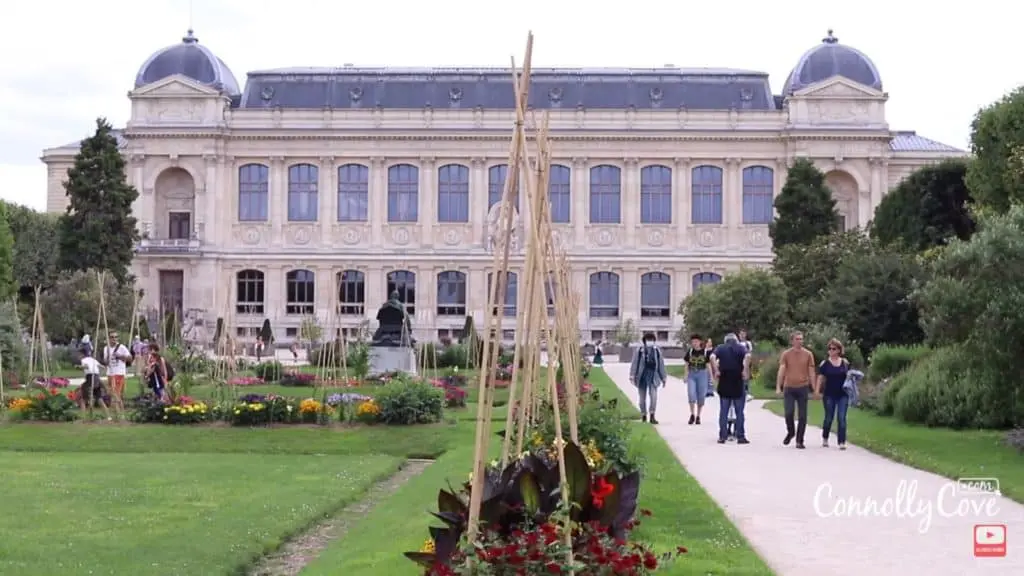
A prominent example of Beaux Arts Architecture is the Grand Gallery of Evolution which is located at the end of the central alley facing the main garden. The original building was built in 1877 and then demolished in 1935. The new building closed in 1965 due to technical problems and received total restoration from 1991 until it was presented in its current façade in 1994.
The great central hall which was enlarged during the modernization houses marine animals on the lower sides, full-size African mammals are on display on a platform in the centre including a rhinoceros. Another hall to the side is devoted to animals that have disappeared or are in danger of extinction such as a Dodo bird reconstitution.
- Gallery of Mineralogy and Geology:
Constructed between 1833 and 1837, the Gallery of Mineralogy and Geology has the rose garden directly in front of it. The gallery looks across the formal garden and closes to the Grand Gallery of Evolution. The gallery is home to over 600,000 stones and fossils.
The gallery is well known for its collection of giant crystals such as colourful examples of azurite, Malachite and Ammonite. There’s a large collection of meteorites including a large fragment of the Canyon Diablo meteorite which fell in Arizona about 550,000 years ago creating the Meteor Crater.
- Gallery of Botany:
Facing the centre of the garden, the Gallery of Botany is between the Gallery of Mineralogy and the Gallery of Paleontology. The Gallery of Botany was built between 1930 and 1935 by a donation from the Rockefeller Foundation. At the corner of the gallery is one of the two oldest trees in Paris; a Robinia pseudoacacia or black locust.
The Gallery of Botany is dedicated to Herbier National with a collection consisting of 7.5 million plants collected since the gallery’s establishment. The plants are divided into two categories; Spermatophytes or plants which reproduce with seeds and cryptogams or plants which reproduce with spores. The ground floor of the gallery is dedicated to temporary exhibits in the form of Art Deco and Neo-Egyptian-styled vestibules.
- The Gallery of Paleontology and Comparative Anatomy:
Facing the Iris Garden, this gallery was built between 1894 and 1897, the gallery is another work of art built by Ferdinand Dutert who is famous for building the Gallery of Machines at the 1889 Paris Exposition. The gallery’s completion was in 1961 with the addition of a brick expansion. On display inside the gallery is a large collection of fossilized skeletons of dinosaurs and other large vertebrates.
Menagerie du Jardin des Plantes de Paris (Le Menagerie Le zoo du Jardin des Plantes)
Starting in 1794, the Menagerie is the second largest oldest zoo that is still operational in Europe after the Tiergarten Schönbrunn Zoo in Vienna. The main goal of the start of the zoo was to house the animals abandoned in the Versailles Palace and other noble palaces after the French Revolution. The current layout of the menagerie was set between 1798 and 1836.
The Menagerie not only displays and studies animals but also helps preserve the genetic pool of certain endangered species. In cooperation with zoos from other European cities, the Menagerie works for the long term of re-introducing some of the endangered species back into nature.
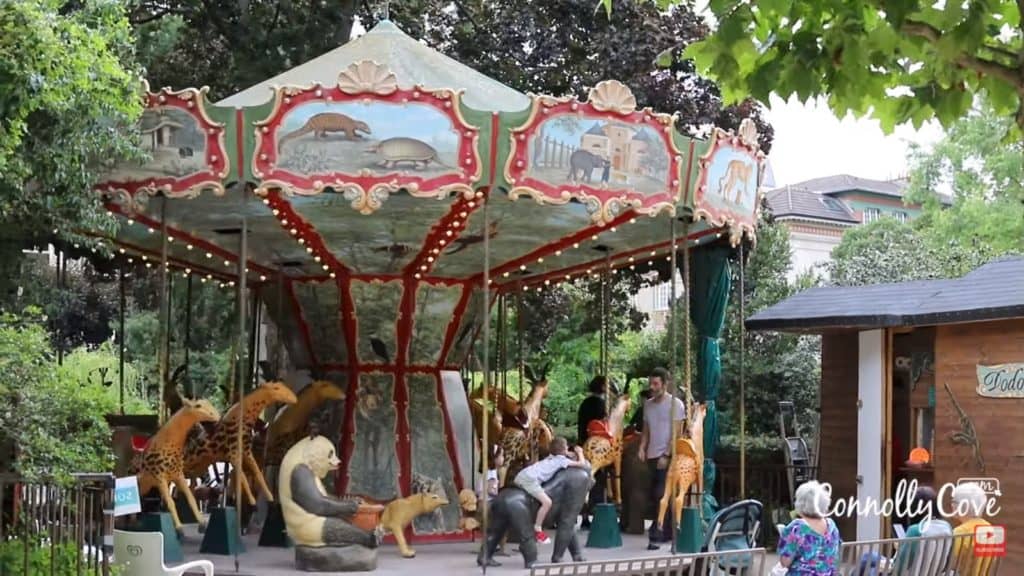
The Menagerie was built in the 19th-century style zoo composed of a series of fenced areas, connected by paths containing animal shelters built in different styles such as rustic and Art Deco. The largest building in the zoo is the Rotunda which was built in brick and stone between 1804 and 1812 and was said to have housed large animals such as elephants. Now, after the Rotunda’s restoration in 1988 and the moving of the animals to another zoo, it is used for events and receptions.
Other major structures in the Menageries include an oval-shaped Grand Volerie built with iron, stone and wood in 1888 in a neo-classical style as a home for flying animals. The Volerie was built by Louis-Jules André who also built the Palace of Reptiles between 1870 and 1874. There’s the Vivarium which is a modernist version of a Classical Greek villa by Emmanuel Pontremoli.
Other Buildings in the Vicinity of the Jardin des Plantes
There are several other important buildings located in the Jardin beside the galleries and the menagerie. These buildings are:
- The Hotel de Magny:
This is the administrative building of the gardens located at 57 Rue Cuvier. The estimated time of construction goes back to the year 1700 under Louis XIV as a residence. Buffon bought the building in 1787 to help expand the garden. It was turned into a boarding school after the revolution. The hotel is not open to the public.
- The Amphitheater:
The Amphitheater was constructed between 1787 and 1788 in the garden of the Hôtel de Magny on Rue Cuvier. Buffon had instructed the construction with the aim of using the building for lectures on natural science and discoveries made in the garden. The Amphitheater was built in a neoclassical or Paladian style with decorations of 18th-century sculpture depicting natural sciences. Restoration works took place between 2002 and 2003.
- The Maison Buffon:
Also known as the Maison de l’Intendance is located at the garden entrance at 36 Rue Geoffroy-Saint-Hilaire. The building used to be the residence of Georges-Louis Leclerc, Comte de Buffon who was the director of the Jardin des Plantes from 1739 until his death in 1788. Buffon lived in the house until his death but the Maison is not open to the public.
- The Cuvier House:
This was the home of the Father of Paleontology and Comparative Anatomy; Georges Cuvier until his death in 1832. Cuvier was the first to identify the skeleton of a mastodon as a prehistoric animal. “The hours pass and science progresses”; Cuvier’s motto is inscribed on the façade of the building.
It was in this house where Henri Becquerel conducted the experiment that led to the discovery of uranium. This event is marked by a plaque on the façade as well. The Cuvier House is not open to the public.
- The Cuvier Fountain:
Located across the street from the iron gates of the garden, the fountain is at the intersection between Rue Linné and Rue Cuvier. The fountain was built in honour of Georges Cuvier and it depicts his statue being surrounded by different types of animals. The Cuvier Fountain was built by the park architect Vigoureux and sculptor Jean-Jacques Feuchère in 1840.
- The Pavillion of New Converts:
This is what remains of the Convent of New Converts which was used to protect Protestants who converted to Catholicism. The convent was founded in 1622 by Father Hyacinth of Paris and moved to its current site in 1656. The building contained the refectory, a parlour and bedrooms.
The building served as the residence and laboratory of the National Museum of Natural History’s assistant director Eugene Chevreul. It was Chevreul who developed the use of colour wheels to resolve the definition of colours. Eugene Chevreul died in this house in 1899 aged 103 years.
Paris Festival of Lights at Jardin des Plantes (Les Animaux Illuminés Jardin des Plantes)
The first annual Festival of Lights at Jardin des Plantes took place in the 2018/ 2019 season. The Garden is illuminated at night with structures of hundreds of creatures. The theme of the festival changes every season, previous themes included Océan en voie d’illumination and Espèces en voie d’illumination. The festival runs from November 29th to January 30th of the following year.
The third edition of the festival returns for the season of November 29th 2021 and January 30th, 2022. The theme for this new season is Evolution en voie d’illumination which will take you on a journey back through time. Go back 500 million years and enjoy the company of extinct animals that never existed side by side with man.
Be prepared to see animals and creatures you’ve never seen before, with structures almost 30 meters long. Enjoy the walk-through history with your family and friends as you read the descriptive plates explaining each animal and giving you more information about them. Walk among dinosaurs or dive into the depths of the ocean with a fascinating and capturing event. Be sure to take a look at the hand-painted lanterns that light up the path in the Menagerie.
Stylish 4-Star Hotels Close to Jardin des Plantes
1. Hotel OFF Paris Seine (86 Quai D’Austerlitz, 13th arr., 75013 Paris):
On the bank of the River Seine, enjoy the best view of the beautiful river and a lively city view of Paris. Just minutes away from Jardin des Plantes, this is the ideal hotel to stay in. A double room with a dock view costs 749 Euros for a four-day stay plus taxes and charges.
2. Villa Pantheon (41 Rue Des Ecoles, 5th arr., 75005 Paris):
In the heart of Paris, this four-star hotel is located in the centre of the historic district of Saint-Germain-des-Prés. Main sights such as the Pantheon and the Notre-Dame Cathedral, the Odéon Theatre and the Arabic World Institute are just minutes away on foot. A classic room with your choice of a double bed or two single beds, for a stay of 4 days will cost 549 Euros plus taxes and charges.
3. Hotel Elysée Gare de Lyon (234 rue de Bercy, 12th arr., 75012 Paris):
This hotel might be on the other bank of the River Seine but it’s close to all the places you’d want to visit including the Notre-Dame Cathedral, the Louvre Museum, the Eiffel Tower and on the other side of the Seine you have the Jardin des Plantes. An economy double room for the duration of four days costs 579 Euros plus taxes and charges.
Hotel du Jardin des Plantes Paris
This fairytale wouldn’t be complete without the existence of a hotel carrying the name of the Jardin. Located right on the opposite side of the Jardin, is the delightful three-star hotel Hotel du Jardin des Plantes. This hotel offers you everything the City of Light can give you, close to the famous Notre-Dame Cathedral, the Pantheon and even the weekly market held in Place Monge which is held three times a week.
Some of the hotel’s services are a refreshing and delicious breakfast serving and a relaxing terrace filled with different plants to give you a sense of nature. There’s a library as part of the lounge and are both under your disposal. The hotel has been designed in a way to help you feel at home and make sure to tend to your every need.
Be sure to check their website for seasonal offers that must not be missed!
Coffee Shops near Jardin des Plantes
1. DOSE – Coffee Dealer (Vegetarian friendly):
Located in the Latin Quarter, this coffee shop offers you just about the best coffee in the quarter with a selection of delicious pastries to choose from. Prices range from 2 Euros to 12 Euros including some vegetarian-friendly options as well.
2. Les Baux de Paris (Vegetarian friendly):
This is a café and restaurant suitable for quick coffee, brunch or main meals. They offer a variety of French and European dishes with a good range of prices of up to 13 Euros. Be sure to ask about the dish of the day for a new twist on traditional dishes.
3. La Salle a Manger (Vegetarian Friendly):
Another great place that offers a variety of cuisines; French, European, International and vegetarian-friendly dishes. With a price range of 9 Euros to 22 Euros, this place will offer you great food, desserts or just coffee if you’re looking to refuel to continue your tour in the city.
4. Crepe de La Joie (Organic – Vegetarian friendly):
If you’re looking for delicious food and equally yummy desserts, this is the restaurant to head to. Prices range from 3 Euros to 23 Euros. With a variety of savoury and sweet dishes, you are guaranteed to have a great time, the crepes are extraordinary.
Have you visited Paris’ Jardin des Plantes before? Or attended the Light Festival in the garden? We hope this article encourages you to pay the garden a visit and share your experience with us!
An Ultimate Guide to 6 of the Finest Castle Tours in England
England
26/04/2024
Unveiling the Most Terrifying Haunted Tours in Scotland
Scotland
25/04/2024

7 Top Amusement Parks in England for an Unforgettable Adventure
England
25/04/2024

Miami Tourism Statistics: A Comprehensive Overview of Visitor Numbers and Revenue
Travel Statistics
25/04/2024

The Enchanting Charm of Scotland Wedding Castles!
Scotland
25/04/2024