
Updated on:
by
 Marwa Alaa
 Marwa Alaa
Article Summary
What this article covers: A practical, climate-aware guide to snow holiday destinations across six continents, focused on altitude-driven snow reliability, cultural context, and travel logistics for readers in Ireland and the UK.
Who this is for: Skiers, non-skiers and culturally curious travellers planning a winter break who want snow they can actually count on, not just a nice-looking brochure.
Key takeaway: Altitude, not price or popularity, is the single biggest factor in whether a snow holiday delivers real snow. Travellers who check a resort’s base elevation before booking avoid the most common winter travel disappointment.
Expert insight: “The biggest mistake we see people make when booking a snow holiday is choosing a resort by price alone. Altitude tells you far more about whether you’ll actually get snow than the brochure photos do.” – Ciaran Connolly, Founder of ConnollyCove
Quick facts:
- Val Thorens, in the French Alps, rises to around 2,300 metres, making it one of the highest ski resort bases in Europe.
- Glacier-fed ski areas above Zermatt in Switzerland can offer skiable snow at altitudes close to 3,900 metres, even outside the main winter months.
- The Eurostar’s dedicated ski train runs directly from London St Pancras to the French Alps during the winter season, without a change of station in Paris.
Table of Contents
Fancy building a snowman this winter? Somewhere in the world, it’s snowing for nearly the whole year. The Equator splits the planet into two hemispheres, so when one half is deep in summer, the other is buried in snow, meaning there’s always a winter to catch if you know where to look. Buy the ticket, pack the bags, and let the plane take off.
Snow holiday destinations are no longer a simple matter of booking whichever resort is cheapest that year. As European winters grow more unpredictable at lower elevations, the difference between a holiday full of powder and one spent watching brown slopes from a balcony often comes down to a single number: altitude. Get this right before you book, and you’ll dodge the most common, most avoidable disappointment in winter travel.
At ConnollyCove, an Ireland-based travel and culture platform, we look at snow holidays the way we look at every destination: through what’s actually worth knowing before you go, not just what looks good in a brochure. In this guide, we’ll walk you through the destinations most likely to deliver reliable conditions, from the glacier-backed resorts of the Alps to Patagonia’s reversed winter and the Australian Alps, along with the practical routes you’ll need if you’re travelling from Ireland or the UK.
Why Altitude Matters for a Reliable Snow Holiday

Altitude is the clearest sign of whether you’ll actually find snow on the ground when you arrive, more telling than a destination’s reputation or how far north it is. Book a resort above roughly 1,800 metres, and you’re booking cold enough temperatures to hold snow cover through the season, even as winters shift and lower slopes see more rain than snow.
This matters more each year. You’ve probably seen the headlines: several well-known lower-altitude resorts in the Alps and the Pyrenees have faced short, patchy seasons in recent winters, leaning hard on snowmaking machines to cover the pistes closest to the resort base. Snowmaking works, up to a point, but it cannot replicate a genuinely snow-covered village, and it says nothing about the walking trails, frozen lakes, or backcountry routes you might actually want to explore.
Glacier-backed resorts sit at the top of the reliability scale. Zermatt in Switzerland, for example, has ski areas reaching around 3,900 metres, high enough to offer skiable snow across most of the year. Val Thorens, at around 2,300 metres, holds the record as the highest resort base in the Alps, and its season regularly runs from late November into May. ConnollyCove checks a resort’s base and peak altitude before recommending it in any winter guide, and we’d encourage you to do the same rather than relying on marketing photos taken in a good year.
A quick search for a resort’s base altitude gives you the number in seconds, and it tells you more about your chances of real snow than almost anything else in the listing.
Snow Holiday Destinations in Europe: Alpine Tradition and Guaranteed Powder

Europe is enchanting in winter when almost everything is covered by snow. It is also the cheapest time of year. Enjoying the chillier months and embracing the cold weather in these magical European winter wonderlands is thrilling and blissful.
Zermatt and Saas-Fee, Switzerland
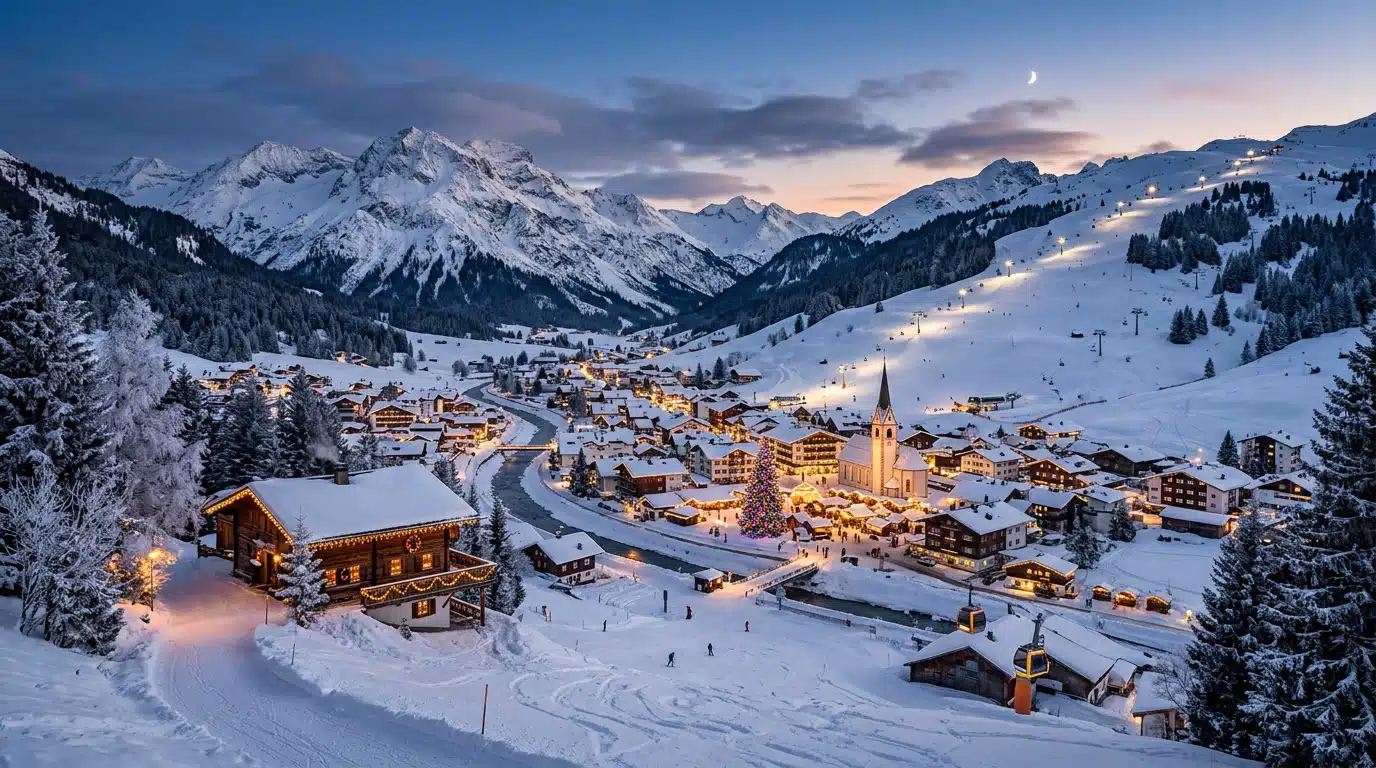
Zermatt in Switzerland is one of Europe’s most reliable snow resorts because its ski area rests on a glacier. The Matterhorn Glacier Paradise cable car climbs to nearly 3,900 metres, putting skiers above the snow line for almost the entire year. Down in the car-free village, the air stays remarkably clean and quiet compared with most Alpine resorts.
The town’s winter character owes as much to its history as its altitude. Zermatt grew from a farming settlement into an Alpine resort over the course of the 19th century. Its older wooden barns, raised on stone pillars to keep grain away from rodents, still stand alongside the newer hotels. If you want the same altitude reliability without Zermatt’s crowds, nearby Saas-Fee occupies a similarly high, glacier-ringed valley and offers a quieter, smaller-scale alternative.
Spend an extra day for the journey here. You’ll reach Zermatt by train from Täsch, since private cars aren’t permitted in the village, and the switch from road to rail is itself part of the arrival experience.
Val Thorens and Chamonix, France
Val Thorens holds the record as the highest ski resort base in Europe, at approximately 2,300 metres, which is exactly why its season runs longer and more reliably than most of its French neighbours. It’s part of the Trois Vallées, the largest interconnected ski area in the world. So from a single base, you can access hundreds of kilometres of groomed and off-piste terrain.
Chamonix, at a lower altitude but overlooked by Mont Blanc, trades some snow certainty for dramatic scenery and a long-established mountaineering town, first developed as a resort in the 1700s.
If you’re travelling from Ireland or the UK, this region has one real advantage: rail access. The Eurostar’s winter ski service runs directly from London St Pancras to stations in the Tarentaise Valley, connecting you to Val Thorens, Méribel, and Courchevel without a change of station in Paris; this option suits anyone who would rather not fly. ConnollyCove recommends booking these tickets as early as availability allows, since the most popular dates sell out months ahead.
Söll and the Wilder Kaiser, Austria
Söll lies within the SkiWelt Wilder Kaiser-Brixental, one of the largest interconnected ski areas in Austria. Its lower prices compared with Switzerland or France make it worth a look if you’re weighing cost against reliability. The trade-off is altitude: at around 700 metres in the valley, Söll leans more heavily on snowmaking in a mild early winter than the high-altitude resorts further west.
What Söll offers instead is cultural depth. Time your visit around the Tyrol region’s Perchten and Krampus runs, processions of costumed figures that take place in the weeks around St Nicholas’s Day and midwinter. You’ll see a side of Alpine winter most ski brochures leave out entirely, rooted in older beliefs about frightening away the spirits of the dark half of the year.
Local food culture is worth building time for too. Order Tiroler Grostl, a hearty pan-fried dish of potato, onion and leftover meat, in one of the mountain huts, and you’ll understand why it makes far more sense after a cold day outdoors than it does described on a menu at home.
Cairngorms National Park, Scotland
Fancy a snow holiday without the flight? The Cairngorms offer UK and Irish travellers that option, though conditions here are considerably more variable than in the Alps, so treat any specific snow forecast as provisional until you’re close to your travel date. Scotland’s largest national park has a lower average altitude than the major Alpine resorts, which means its snow cover depends far more on the particular winter than on any long-term guarantee.
What the Cairngorms offer that the Alps cannot is a direct line into Celtic winter mythology. In Scottish and Irish folklore, the Cailleach, sometimes called the Queen of Winter, is said to shape the season itself, striding across the land and hardening the ground with a touch of her staff as the year turns dark. ConnollyCove’s guide to the legend of the Cailleach in Ireland traces her story across both countries in more depth.
“Standing on a ridge in the Cairngorms in January, with the light already fading by mid-afternoon, you understand instantly why the Cailleach was imagined as the one who ruled that season. Scotland’s winter has a weight to it, and knowing the folklore before you go changes how the walk feels.”, Ciaran Connolly, Founder of ConnollyCove
Swedish Lapland: Kiruna and Abisko
If you’re chasing the aurora borealis rather than ski runs, Swedish Lapland is where you want to be. Abisko in particular benefits from a distinct microclimate that keeps its skies unusually clear even when the surrounding regions are under cloud, so you’ll have a real chance of a clear sighting. Add dog-sledging and a night at the original Icehotel in Jukkasjärvi, rebuilt from river ice and snow every winter, and you’ve got a trip that asks nothing of you beyond warm clothing and patience.
Nearby, Treehotel in Harads takes the design angle further. Pick a room shaped like a UFO, a mirror cube or a bird’s nest, all built into the forest canopy above the Lule River valley, and you’ve got one of the more distinctive places to sleep in this entire guide.
This region is also home to the Sami, an Indigenous people whose traditional relationship with reindeer herding and the Arctic landscape predates the tourist industry by many centuries. ConnollyCove’s guide to Indigenous cultures under the Northern Lights covers this connection in more depth. Choose a responsible operator running Sami-led experiences that explain this culture in the community’s own terms, and you’ll be making a genuine difference to who benefits from the visit, instead of settling for a generic reindeer photo stop.
Hallstatt and Lake Bled: Austria and Slovenia
If you’d rather move at walking pace than ski pace, Hallstatt and Lake Bled are built for you: castle visits, lakeside photography, and slow winter walks, no lift pass required. Lake Bled’s lake doesn’t freeze solid every year, so you’ll often find a temporary rink set up beside it for skating and curling when natural ice doesn’t form. Hallstatt’s lakeside village, set beneath steep alpine cliffs, is best explored on foot along the narrow shoreline paths early in the morning, before the day-trip crowds arrive.
Both destinations cost considerably less than the major ski resorts nearby, since neither depends on lift infrastructure to justify its prices.
Neuschwanstein Castle, Germany
Not every entry on this list is a snow holiday in the ski-and-lift sense, and Neuschwanstein Castle is a good example of why that’s fine. Visit this 19th-century Bavarian castle in winter, and you’ll trade the summer crowds for something closer to a snow globe: white slopes, dusted turrets, and a short queue. It is in the foothills of the German Alps, and the last stretch of the walk up is on foot regardless of season, so pack proper winter boots rather than anything you’d bring for a city break.
Don’t build a ski trip around this one. Come here for the scenery and the history, ideally as a day trip from Munich or paired with one of Bavaria’s smaller ski areas, rather than as a standalone snow holiday.
Vosges Mountains, France
If the Alps feel like overkill for a first snow trip, the Vosges Mountains give you a gentler, lower-altitude alternative, easy to reach from Alsace. Head to family-friendly regional resorts such as Lac Blanc or Schnepfenried and you’ll find snowshoeing, dog-sledging, and downhill skiing pitched at beginners and families.
Altitude here tops out well below the major Alpine resorts, so treat this as a solid regional option for a short break. Check conditions closer to your travel dates, since lower altitude leaves a thinner margin in a mild winter.
Livigno, Italy
Livigno is at around 1,800 metres in the Italian Alps, high enough to give you a genuinely dependable season without the price tag of its Swiss or French neighbours. Its duty-free status, a legacy of the valley’s historical isolation, also makes it one of the cheaper places to pick up ski gear.
You’ll find snowboarding, fat-tyre snow biking, and ice climbing here alongside conventional Alpine skiing. The valley’s natural bowl shape opens up genuine off-piste terrain without demanding the technical experience you’d need for backcountry routes elsewhere in this guide.
Arachova, Greece
Not somewhere you’d automatically associate with snow, Arachova is on the slopes of Mount Parnassos and gives Greece a legitimate, if modest, ski scene, complete with a small resort and coaching schools if you’re skiing for the first time. The town has real cultural depth to go with the snow: cobbled streets, traditional woodwork and textiles, and Formaela, a PDO sheep’s and goat’s milk cheese made only in this area, worth seeking out in one of the local restaurants.
Book this as a cultural short break with skiing attached, and you’ll get more out of it.
Snow Holiday Destinations in Asia

Asia attracts many tourists each year to visit its breathtaking destinations. Here are Asia’s best snow holiday destinations you will enjoy visiting this winter.
Niseko and Hokkaido, Japan
Hokkaido’s snow is famously dry and deep because Siberian winds cross the Sea of Japan and lose their moisture as fine, low-density snow before reaching the island, quite unlike the heavier, wetter falls typical of the Alps. Ski both, and you’ll understand why ‘Japow’ is one of the few snow qualities that genuinely lives up to its reputation.
The wider culture around Japanese winter travel is as much a draw as the skiing itself. Find an onsen, a natural hot spring bath, and soak in one after a day on the slopes; it’s close to essential. Most onsen ask you to wash thoroughly before entering the communal water, and some traditional establishments may ask you to cover tattoos, so check a venue’s policy before you go. When you’re hungry, look for nabe, a shared hot pot built around local seafood and vegetables that suits the cold far better than anything you’d eat standing up on a mountain.
If you’re planning the long-haul trip, Hokkaido’s season runs reliably from December through to early April, giving you considerably more flexibility on travel dates than many shorter European seasons.
The Himalayas, Nepal and India
Altitude gives the Himalayas the same reliability advantage it gives everywhere else on this list, with several trekking regions sitting well above 4,000 metres and holding snow for most of the year regardless of what a given winter does at sea level. The trade-off is access: most snow-focused trips here are trekking and mountaineering journeys. You’ll need to take altitude sickness seriously above 3,000 metres, building proper acclimatisation days into your itinerary.
If you want a more conventional skiing experience, head to Solang Valley or Gulmarg in the Indian Himalayas, both with lift infrastructure. If you’d rather take in the snow scenery on foot, Nepal’s Everest region and Annapurna Circuit will suit you better. Experienced skiers can also book heli-skiing trips from Kathmandu for terrain few other destinations can match.
Give yourself proper time to acclimatise and travel with a licensed guide. This isn’t a destination where you can treat altitude reliability casually; the same elevation that guarantees snow also brings real physiological risk.
Gudauri, Georgia
Gudauri, in Georgia’s Greater Caucasus range, has become one of Europe’s fastest-growing ski destinations largely because it gives you Alpine-level altitude, a base of around 2,200 metres, at lower Western European prices. If you’re an intermediate or advanced skier, you’ll find the terrain suits you particularly well, with wide off-piste bowls that are still relatively uncrowded compared with the established Alpine resorts.
Tbilisi, Georgia’s capital, is roughly two hours away by road. Its old town and thermal bathhouses make a natural add-on either side of your skiing. Direct flights from several European hubs have made Georgia considerably more accessible in recent years, though from Ireland or the UK you should still expect at least one connection.
Sapa, Vietnam
Sapa isn’t a conventional ski destination, and that’s exactly its appeal if you’re curious about snow turning up somewhere you wouldn’t expect it. Snowfall here is occasional, typically between December and February, and it transforms Sapa’s terraced rice valleys and mountain villages into a genuinely unusual sight.
Take the cable car up Fansipan, the highest peak in Indochina, if you want the view without the multi-day trek. In the surrounding villages, the H’mong and Dao communities keep up agricultural and craft traditions that have little to do with the region’s brief winter cold snaps. Come here if you’re curious about snow as a rare event, not if you’re planning an actual ski trip.
Mountain Ranges, Lebanon
Lebanon’s ski scene lies almost entirely within an hour or two of Beirut, which makes it one of the more accessible snow holiday destinations in the Middle East. Oyoun El Simane, also known as Mzaar Kfardebian, is the largest ski resort in the region, built in 1960 when Lebanon imported its first ski lift from Switzerland, and its higher slopes hold snow reliably enough to support a season running from around mid-December to April.
Zaarour Club, closer still to Beirut, gives you a smaller, more low-key alternative if you want a day on the slopes without committing to a full resort trip. However, El Laqlouq, northeast of the capital at over 1,700 metres, rounds out the main cluster with its own lift network and a slightly quieter atmosphere.
For something with more cultural weight attached, head to Bsharri and the Cedars of God, or Al Arz as it’s known locally. This UNESCO-listed forest of ancient cedar trees, some claimed to be over a thousand years old, borders a small ski area. So you can combine a day of snowshoeing or skiing with a walk through one of Lebanon’s most significant natural landmarks.
Cappadocia, Türkiye
Cappadocia, in central Türkiye, isn’t a ski destination, but it’s worth a mention if you’re building a winter trip around Türkiye more broadly. Snow dusts the region’s cave dwellings and rock formations between December and February. Hot air balloon flights over the valley still run in winter, weather permitting, alongside stays in the area’s cave hotels. This is a scenic add-on to a longer Türkiye itinerary rather than a snow holiday in its own right.
Snow Holiday Destinations in North America

From enjoying winter landscapes to skiing and building a snowman or igloo, North America offers many splendid snow holiday destinations with many snow activities.
Banff and Lake Louise, Canada
Banff National Park gives you high-altitude, dependably dry snow set against frozen glacial lakes, not just resort villages. Lake Louise itself freezes solid enough most winters that you can skate directly on the lake surface, with the Victoria Glacier behind you as a backdrop few other skating rinks anywhere can match.
You’ll notice the Rockies’ snow is lighter and drier than the Alps, partly because the region is far from any large body of open water, keeping humidity, and therefore snow weight is relatively low. That suits you if you want faster, easier powder turns on skis, and it suits you just as well if you’d rather snowshoe through the park’s older pine forests, where you might spot elk or even a wolf pack from a respectful distance.
Plan around Banff’s high season, from December to March, with the coldest temperatures typically arriving in January. Pack for genuinely sub-zero conditions here; you can’t get away with the lighter kit that sometimes works in milder parts of the Alps.
Quebec, Canada
Quebec City pairs reliably cold Canadian winters with a genuinely historic, UNESCO-listed old town, so you get a snow holiday built around walking, ice skating, and winter festival culture. Time your visit for February, and you’ll catch the Winter Carnival, one of the oldest winter festivals in the world, which turns the city’s public squares into ice sculpture galleries and toboggan runs for several weeks.
Book a night at the Hôtel de Glace (ice hotel), rebuilt from ice and snow each winter at Valcartier Vacation Village outside the city, if you want the novelty without committing to a full week in sub-zero temperatures. For a more accessible thrill, try the toboggan run on Dufferin Terrace beside the Château Frontenac. And don’t skip the food: French-Canadian winter cuisine gives you plenty to do that has nothing to do with snow sports, maple taffy poured over fresh snow being the obvious example.
Quebec’s season runs reliably from December to March, and you can fly there directly from Dublin or several UK airports via Toronto or Montreal.
Lake Tahoe, USA
Lake Tahoe straddles the California-Nevada border and combines dependable Sierra Nevada snowfall with a genuinely striking backdrop: a deep blue alpine lake ringed by snow-covered peaks. Its resorts sit at a range of altitudes, and the higher ones hold their season longer than the lower lake-level areas, so check a specific resort’s base elevation before you book.
If you want a gentler pace, cross-country routes wind through sugar pine forest, and since the lake itself rarely freezes, you can still take a boat tour or a lakeside walk even in the coldest months. Tahoe’s season typically runs from December to April, and you’ll reach it via Reno or Sacramento airports, both served from Dublin, Belfast, or UK hubs via a single US connection.
Nunavut, Canada
Nunavut gives the most reliable snow and cold on this entire list, thanks to sheer latitude. Eureka, the coldest recorded spot in Canada, averages around minus 19.7 degrees Celsius in winter, and once the ground is under snow here, it stays that way for the whole season.
Baffin Island is the main draw for adventurous travellers. It’s the fifth-largest island in the world, home to more than 100 bird species, including snowy owls. It’s also the jumping-off point for Sirmilik National Park, where you can walk the floe edge, the line where frozen sea meets open water. You can also spot polar bears, ringed seals, and snowy owls here, often in a single trip. Katannilik Territorial Park, further south on the island, adds hiking and cross-country skiing along the Soper River, a designated Canadian Heritage River.
Book a cruise along the Northwest Passage if you want to see icebergs and Arctic wildlife from the water, and stay out after dark between October and April for some of the clearest aurora viewing in North America. Go with a local operator, since conditions here can turn quickly and the infrastructure is far sparser.
Niagara Falls, Canada and the USA
Niagara Falls doesn’t actually freeze, even in the coldest months, so don’t come here expecting a frozen waterfall. What you do get is mist and spray hardening into a crust of ice around the falls, occasional ice chunks breaking loose from the top, and a genuinely dramatic winter version of a place most people only picture in summer. Late January and February give you your best odds of seeing this at its most striking.
Outdoor and indoor skating rinks around the Niagara region let you build a half-day of activity around the falls themselves, and short, family-friendly hiking trails are manageable if you dress properly for the cold. This is a winter add-on to a wider Ontario or New York trip, since there’s no snow-reliability story here beyond the region’s ordinary winter weather.
Palouse Falls, Washington, USA
Palouse Falls gives you one of the more dramatic winter sights in the Pacific Northwest. The cascading water partially freezes while the surrounding basalt canyon turns white, creating a stark contrast you won’t get here in any other season. The cold at this exposed, high-desert location can be brutal, so dress for wind as much as for snow.
Hike the trails around the falls for the main view, or walk down to the Snake River if you want to try winter fly-fishing in genuinely cold conditions. There’s no resort or lodging built around the falls itself, so treat this as a day-trip destination from a base in Spokane or the wider Palouse region, rather than a holiday in its own right.
Snow Holiday Destinations in South America

South America has great snow holiday destinations, from fantastic highlands and mountains to outstanding resorts and countries. It is in the Southern Hemisphere, and its seasons are at opposite times. That is why winter starts in June and ends in August.
Argentine Patagonia: Bariloche and El Calafate
Want a second snow holiday in the same calendar year? San Carlos de Bariloche, in Argentina’s Lake District, is at the foot of the Andes and gives you reliable snow from June to September, since the Southern Hemisphere’s winter falls opposite Europe’s. Cerro Catedral, the resort above the town, is South America’s largest ski area and holds its snow well thanks to Andean altitude.
A guided hike from Neumeyer Refuge in Challhuaco Valley, around 40 minutes from town, takes you through snow-covered beech forest to Laguna Congelada, a frozen lagoon where you can try sledging, snowshoeing or simply walking out onto the ice.
Head further south and El Calafate puts you at the gateway to Los Glaciares National Park and the Perito Moreno Glacier, one of the few glaciers in the world still advancing rather than retreating. Stand near the lake, and you’ll hear the ice calving, a sound few other snow holiday destinations can offer you.
Argentina also carries a lesser-known Irish connection worth knowing about. During the 19th century, the country took in a significant wave of Irish sheep-farming emigrants, concentrated in Buenos Aires province; our guide to Irish emigration covers this history in more depth. Most Patagonia travel guides leave this out entirely, despite Argentina holding one of the largest Irish diaspora communities outside the English-speaking world.
Portillo, Chile
Portillo is at around 2,880 metres in the Chilean Andes, high enough to give one of the most dependable snow records in South America. Its position beside the turquoise Laguna del Inca makes it one of the more striking settings on this list. The resort has hosted World Cup skiing events, so if you’re a serious skier, you’ll find steep, high-altitude terrain here to test yourself against. Its relative isolation -the nearest town is over two hours away- means you’ll most likely book directly at the resort rather than arranging a self-catered trip.
Chile’s season mirrors Argentina’s, running from June to September, so pairing the two countries makes sense if you’re planning a longer Southern Hemisphere winter trip.
The Andes Mountains
Beyond the resorts covered in this guide, the Andes as a whole is the longest continental mountain range on Earth, running through seven countries, with around 100 peaks above 6,000 metres and nearly 900 above 5,000 metres. You’ll likely spot llamas or alpacas grazing at altitude here, one of the more unexpected sights for anyone used to European ski wildlife.
Snow Holiday Destinations in Africa

Africa is not the first place that comes to your mind if you want to spend a wonderful vacation in snow holiday destinations. You will be surprised to know that some areas in Africa experience freezing weather in winter, even snow.
Since the equator runs through the middle of Africa, the weather in the northern and southern hemispheres is reversed. In North Africa, winter usually starts in November. However, in South Africa, winter begins in June and lasts until August.
The Atlas Mountains, Morocco
If you associate Morocco with desert heat, the Atlas Mountains will surprise you. Jebel Toubkal, North Africa’s highest peak at over 4,000 metres, holds snow from around December to April, and the ski resort of Oukaimeden, roughly an hour from Marrakech, has North Africa’s highest lift-served skiing.
Base yourself in Imlil, a Berber village at the foot of Toubkal, and you’ll get a genuine sense of Amazigh mountain culture, distinct from the medina-focused tourism most Morocco trips are built around. Take a guide for anything beyond the groomed slopes at Oukaimeden; the terrain and weather here can change quickly, and rescue infrastructure is limited compared with the Alps.
Marrakech’s airport, served directly from several UK cities, makes this one of the more accessible snow holiday destinations on this list if you’re after a short winter break.
Ifrane, Morocco
Further north in the Middle Atlas, Ifrane gives you a different side of Moroccan winter altogether. Nicknamed “Little Switzerland” for its sloped, red-tiled roofs and European-style architecture, the town lies close to Michlifen Resort, which has real ski lifts and groomed slopes, unlike Oukaimeden’s more basic set-up. It suits you if you want a tidier, more conventional ski base than Imlil’s rougher, more adventurous character.
Saint Catherine, Egypt
Saint Catherine (St. Katherine), in Egypt’s South Sinai, rises to around 1,600 metres above sea level. Its surrounding peaks reliably see snow between December and February, including on Mount Catherine, Egypt’s highest point at over 2,600 metres. The UNESCO-listed Saint Catherine Monastery, one of the oldest continuously inhabited monasteries in the world, stands at the mountain’s base and gives the region a cultural depth that few snow holiday destinations can match.
This is a destination for hiking and cultural visits; there is no lift infrastructure. Climbing Mount Catherine or nearby Mount Sinai in winter conditions requires a licensed guide and proper cold-weather gear, since temperatures at altitude drop well below what visitors expect from Egypt’s desert reputation.
Indoor Snow: Ski Egypt and Snow City, Egypt
If you want guaranteed snow without leaving Cairo, Ski Egypt in the Mall of Egypt and Snow City in Citystars Mall give you an artificial alternative. Both are indoor ski parks built around real snow rather than fake powder, with slopes, instructors, and beginner-friendly runs regardless of the weather outside.
Ski Egypt is the larger of the two, with a longer tube run, a dedicated Snow Cavern, and scheduled encounters with resident penguins, alongside standard skiing and snowboarding lessons. Snow City runs shorter, timed visits, not an open session, and adds ice bumper cars and its own tubing area to the usual ski and snowboard options. Neither offers anything like the altitude, scale, or natural scenery, so treat them as a novelty day out in Cairo rather than snow holiday destinations in their own right.
Mount Kilimanjaro, Tanzania
Mount Kilimanjaro, Africa’s tallest peak at 5,895 metres, is the highest free-standing mountain in the world and, like the snow holiday destinations that follow, a trekking and climbing destination. Tanzania’s winter runs from June to October, but you can climb year-round with a licensed guide. The driest conditions and the best visibility come between December and March.
Kilimanjaro’s glaciers are retreating too, though more slowly than some of East Africa’s other high peaks, and current projections put their disappearance within the coming decades. Pack for genuine extremes: sunscreen and a hat for the lower slopes, a proper cold-weather jacket for the summit, and rain gear regardless of season, since Kilimanjaro’s weather can shift from scorching to freezing within a single day’s climb.
Mount Kenya, Kenya
Mount Kenya, Africa’s second-highest peak, is a trekking and climbing destination, and that’s truer now than it’s ever been. Its glaciers have shrunk by around 96% since 1900, and recent assessments from the World Meteorological Organization suggest the remaining ice could disappear entirely within the next few years. If you want to see Africa’s vanishing high-altitude ice while it’s still there, this is one of the last chances.
Point Lenana, at just under 4,985 metres, is the summit most visitors aim for. It’s reachable without technical climbing experience if you go with a licensed guide, unlike the technical peaks of Batian and Nelion above it. Winter here runs from June to October, opposite the Northern Hemisphere’s season. You’ll want a jacket built for genuine cold alongside sun protection, since conditions swing hard between scorching days and freezing nights. Watch for elephants, buffalo, and the occasional leopard on the lower slopes as you climb.
Hogsback, Eastern Cape
Hogsback, in the Eastern Cape’s mountains, gives Africa’s snow holiday destinations a Southern Hemisphere entry, though snow here is occasional, so come for the scenery and treat any snow as a bonus. June to September provides the best odds, when the village’s forests and waterfalls take on a different character under a covering of white.
Hike up to the three flat-topped Hogsback Mountains for panoramic views, or spend a slower day exploring the surrounding indigenous forest on foot. If your visit lines up with the first Saturday of the month, the local farmers’ market gives you a reason to stick around beyond the walking trails.
Snow Holiday Destinations in Australia
Australia has an alpine region that receives significant snowfall each winter. With plenty of snow holiday destinations, it offers many fun winter activities. Since Australia is in the Southern Hemisphere, its seasons are reversed; winter here is from June to August.
The Snowy Mountains, New South Wales
The Snowy Mountains, part of the Australian Alps, hold Australia’s most reliable snow thanks to their relatively high altitude for the continent. Resorts including Thredbo, Perisher, and Charlotte Pass run their season from June to early October, opposite the Northern Hemisphere’s winter. Reach Charlotte Pass, Australia’s highest resort, by snowcat once the season’s snow settles in, and you’ll get a genuine sense of arrival most drive-up resorts elsewhere can’t offer you.
Mount Kosciuszko, Australia’s highest peak, is within the same range and draws hikers once trails are accessible later in the season. If you’re travelling from Ireland or the UK, remember Australia’s winter falls during your summer, making it one of the few genuine options for snow sports outside the usual November-to-April window.
Victoria’s High Country
Want something quieter than the Snowy Mountains? Victoria’s High Country, part of the same Australian Alps range, provides that. Mount Hotham and Falls Creek are the region’s main resorts, both suited to intermediate and advanced skiers more than complete beginners.
At Falls Creek, you’ll get one of the more convenient ski-in, ski-out villages in Australian skiing. Head to Mount Hotham instead, and you’ll find backcountry access for terrain beyond the groomed runs. Both resorts depend on a good Southern Hemisphere winter to deliver consistent cover, since Australia’s overall altitude is modest by global standards, so check seasonal snow reports closer to your travel dates. Ireland and Australia share a longer history than skiing alone; our guide to Irish-Australian cultural links traces that connection if you want the fuller picture.
Tasmania
Tasmania offers a different kind of Australian snow experience, built around Cradle Mountain-Lake St Clair National Park‘s snow-dusted wilderness rather than resort skiing. The island’s clean air and relatively low tourist density make it a good option for travellers who want snow scenery and wildlife spotting, including wallabies and the occasional Tasmanian devil, over lift passes and groomed runs.
Attempt the Overland Track, a multi-day hike between Cradle Mountain and Lake St Clair, outside the coldest weeks unless you’re experienced with winter hiking conditions, since Tasmania’s weather can shift quickly at altitude. This is a destination for slow, scenery-focused winter travel, not a conventional ski holiday.
Planning Your Trip from Ireland and the UK
Getting to a snow holiday destination from Ireland or the UK usually means choosing between flying and taking the train, and the right choice depends on where you’re headed and how much time you have. Heading to the French Alps? The Eurostar’s winter ski service is a genuine alternative to flying, running directly from London St Pancras into the Tarentaise Valley without changing stations in Paris, a route that also appeals to travellers weighing up the carbon cost of a ski trip.
From Dublin, Belfast, or most UK regional airports, you’ll find direct or one-stop winter routes to Geneva, Zurich, Innsbruck, and Salzburg, the main gateway airports for the Alpine resorts covered here. Land in Geneva or Zurich and you’re two to three hours by train or coach from Zermatt, Val Thorens, or Chamonix.
Post-Brexit travel rules are different. If you’re a UK passport holder visiting the EU, including Alpine countries such as France, Switzerland, and Austria, check your passport validity in advance and expect separate queues at EU border control. If you’re travelling on an Irish passport within the EU, this won’t affect you in the same way.
For long-haul destinations such as Hokkaido, the Himalayas or Banff, connecting through a major hub, typically Tokyo, Delhi or Toronto, adds a day to the journey each way, so building in a buffer night before and after the main trip is worth the extra cost.
Southern Hemisphere destinations -Argentina, Chile and Australia among them- run their snow season from June to September or October, opposite the European winter. This makes them a genuine option for a snow holiday during the Irish and UK summer months, not a substitute for a Christmas or February trip. You should check hemisphere and season together before booking and don’t assume winter means the same months everywhere.
Whichever destination you choose, book your accommodation and lift passes several months ahead, particularly for the Christmas and February half-term weeks in the Northern Hemisphere. You’ll avoid inflated last-minute prices and dodge the disappointment of a fully booked high-altitude resort with no reliable low-altitude alternative nearby.
Destination Snow Reliability and Transit Matrix
| Destination | Approx. Peak Altitude | Best Snow Window | Key Access Point | Best Suited To |
| Zermatt / Saas-Fee, Switzerland | ~3,900m | Nov to May | Geneva or Zurich, then train via Täsch | Reliable snow seekers, all abilities |
| Val Thorens / Chamonix, France | ~2,300m (Val Thorens base) | Late Nov to May | Eurostar ski train or Geneva | UK/Irish travellers avoiding flights |
| Söll / Wilder Kaiser, Austria | ~700m valley, higher slopes above | Dec to March | Innsbruck or Salzburg | Budget-conscious, cultural travellers |
| Cairngorms, Scotland | ~1,300m | Dec to March (variable) | Direct from UK/Ireland, no flight | Short breaks, folklore enthusiasts |
| Swedish Lapland (Kiruna/Abisko) | Near sea level | Dec to March | Stockholm, then domestic flight | Non-skiers, aurora seekers |
| Hallstatt / Lake Bled | Near sea level | Dec to Feb | Vienna, or Salzburg/Ljubljana | Slow travel, non-skiers |
| Vosges Mountains, France | Low altitude | Dec to March | Strasbourg, then road transfer | Beginners, families |
| Livigno, Italy | ~1,800m | Dec to April | Milan or Bergamo, then road transfer | Reliable snow seekers on a budget |
| Neuschwanstein, Germany | Foothills, low altitude | Dec to March | Munich, then road transfer | Sightseeing, not skiing |
| Arachova, Greece | ~1,600 to 1,900m (resort area) | Dec to March | Athens, then road transfer | Cultural short breaks with skiing |
| Vermosh, Albania | Remote, high valley | Dec to Feb (~100 days snow cover) | Shkodër, then road transfer | Experienced, self-sufficient travellers |
| Niseko / Hokkaido, Japan | Sea level to ~1,300m | Dec to early April | Tokyo, then domestic flight | Powder skiers, onsen culture |
| The Himalayas (Nepal/India) | 3,000m+ (trekking regions) | Dec to March (varies by route) | Kathmandu or Delhi | Trekkers, mountaineers, experienced travellers |
| Gudauri, Georgia | ~2,200m base | Dec to April | Tbilisi, then road transfer | Budget-conscious intermediate/advanced skiers |
| Sapa, Vietnam | Sea level to ~3,000m (Fansipan) | Occasional, Dec to Feb | Hanoi, then road transfer | Curious travellers, not for skiing |
| Mount Lebanon (Mzaar/Zaarour/Laqlouq/Cedars) | Up to ~2,000m+ | Mid-Dec to April | Beirut, then road transfer | Accessible Middle East skiing, cultural add-on |
| Cappadocia, Türkiye | Low altitude | Dec to Feb | Kayseri or Nevşehir, then road transfer | Scenic add-on, not a snow holiday |
| Banff / Lake Louise, Canada | ~1,600 to 2,700m | Dec to March | Calgary | Wildlife, dry powder, frozen lakes |
| Québec City, Canada | Low altitude, reliably cold | Dec to March | Toronto or Montreal, then transfer | Winter festival culture, families |
| Lake Tahoe, USA | Varies by resort | Dec to April | Reno or Sacramento | Skiers wanting a scenic lake setting |
| Nunavut, Arctic Canada | Sea level, extreme latitude cold | Oct to April | Ottawa or Iqaluit, then domestic flight | Wildlife, aurora, adventurous travellers |
| Niagara Falls, Canada/USA | Low altitude | Late Jan to Feb (best ice) | Toronto or Buffalo | Short winter add-on, not a snow holiday |
| New York City, USA | Low altitude | Dec to Feb (variable snow) | JFK/Newark, direct from Dublin/UK | Urban winter breaks, families |
| San Juan Islands, USA | Sea level, mild maritime climate | Dec to Feb (inconsistent snow) | Seattle, then ferry | Wildlife and scenery, not snow sports |
| Palouse Falls, USA | High desert, exposed | Dec to Feb | Spokane, then road transfer | Day-trip scenery, not a holiday base |
| Bariloche / El Calafate, Argentina | Andean altitude, varies | June to Sept (Southern Hemisphere) | Buenos Aires, then domestic flight | Southern Hemisphere winter, Irish diaspora interest |
| Portillo, Chile | ~2,880m | June to Sept (Southern Hemisphere) | Santiago, then road transfer | Serious skiers, high-altitude terrain |
| Atlas Mountains / Ifrane, Morocco | Up to ~4,000m+ (Toubkal) | Dec to April | Marrakech | Short breaks, trekking and skiing combined |
| Ski Egypt / Snow City, Cairo | Indoor, artificial snow | Year-round | Cairo | Guaranteed snow novelty, not a real destination |
| Saint Catherine, Egypt | ~1,600 to 2,600m | Dec to Feb | Sharm El Sheikh or Cairo | Hiking and cultural visits, not skiing |
| Kilimanjaro, Tanzania | 5,895m (summit) | Year-round, best Dec to March | Kilimanjaro International Airport | Trekkers and climbers, not skiers |
| Mount Kenya, Kenya | Up to ~4,985m (Point Lenana) | June to Oct (Southern Hemisphere) | Nairobi, then road transfer | Trekkers, vanishing-glacier interest |
| Hogsback, South Africa | Modest altitude | June to Sept (Southern Hemisphere) | East London or Port Elizabeth | Scenery and hiking, occasional snow |
| Snowy Mountains, Australia | Up to ~2,000m | June to early Oct (Southern Hemisphere) | Sydney or Canberra, then road transfer | Southern Hemisphere skiers |
| Victoria High Country, Australia | Modest altitude | June to Sept (Southern Hemisphere) | Melbourne, then road transfer | Intermediate/advanced skiers |
| Tasmania, Australia | Modest altitude | June to Sept (Southern Hemisphere) | Hobart or Launceston | Slow travel, wildlife, non-skiers |
A reliable snow holiday starts with altitude, not appearance. From Zermatt’s glacier slopes to Patagonia’s reversed winter and the folklore-rich hills of the Cairngorms, every destination in this guide gives you a strong chance of real snow when you arrive, plus something worth doing when you’re not on skis at all. Whichever region and hemisphere you choose, check the base altitude, book early for peak weeks, and build in an honest travel buffer for long-haul routes; it’ll do more for your trip than any single resort choice.
Explore More Winter Travel and Celtic Culture
Planning your next trip? ConnollyCove covers winter travel, Celtic mythology, and practical trip planning from Ireland and beyond. Read our guide to the legend of the Cailleach in Ireland, plan a Highland break with our guide to the Scottish Highlands, or explore our wider guide to Celtic mythology creatures before you go.
FAQs About Snow Destinations
Here are the questions travellers ask most often when planning a snow holiday, based on real search patterns and enquiries ConnollyCove receives from readers.
Where is snow guaranteed in Europe during winter?
No resort can guarantee you snow with total certainty, but high-altitude, glacier-backed resorts come closest. Zermatt and Saas-Fee in Switzerland, along with Val Thorens in France, sit above 2,000 metres and hold snow cover from late November through to spring in most years. Book somewhere at a lower altitude, however reputable, and you’re far more exposed to a mild or wet winter.
Can you enjoy a snow holiday without skiing?
Yes, and a growing number of destinations are built specifically for you if skiing isn’t your thing. Try Swedish Lapland for dog-sledging, aurora viewing and ice hotel stays, or Hallstatt and Lake Bled for walking, castle visits, and lakeside scenery. None of these needs any previous winter sports experience.
Who is the Cailleach in Celtic winter mythology?
The Cailleach is a divine hag figure from Irish and Scottish folklore associated with winter, weather, and the shaping of the landscape. She’s said to rule the darker months, loosening her grip on the land only as the days lengthen after midwinter. You’ll find her story across both Irish and Scottish mountain traditions, including around the Cairngorms.
How can Irish and UK travellers reach the Alps without flying?
The Eurostar runs a dedicated winter ski service from London St Pancras directly into the Tarentaise Valley in France, serving resorts including Val Thorens, Méribel, and Courchevel without a change of station in Paris. Irish travellers can connect via London or via ferry and rail routes through France, though flying into Geneva remains the faster option from Dublin or Belfast.
Where is the cheapest snow holiday destination with reliable snow?
Söll and the wider SkiWelt Wilder Kaiser region in Austria offer a reasonable balance of affordability and snow reliability, particularly at higher points within the ski area. Lower-altitude budget resorts elsewhere in Eastern Europe are cheaper still but carry a higher risk of a thin or late snow season.
When is the best time to book a snow holiday?
Booking four to six months ahead, ideally by early autumn, secures better accommodation choices and avoids the price spikes that hit the Christmas and February half-term weeks. Early booking also matters more at high-altitude resorts, which fill first precisely because they offer the most reliable conditions.
Can you go on a snow holiday during the Irish and UK summer?
Yes. Look to the Southern Hemisphere: Argentina, Chile, and Australia run their ski season from June to September or October, opposite the European winter. It’s one of the few realistic ways to get a proper snow holiday without needing time off during the Northern Hemisphere’s peak season.
Is Antarctica a realistic snow holiday destination?
Antarctica is better understood as an expedition cruise destination than a conventional snow holiday. Trips typically depart from South America between October and March, focus on wildlife and glacier scenery rather than skiing, and require significant advance booking and budget. It suits travellers seeking a genuinely remote experience rather than a resort-based break.