

The Shamrock Diaspora: Fostering Global Irish Traditions and Heritage
Updated On: April 22, 2024 by  Panseih Gharib
The shamrock, a trefoil plant that has come to symbolise Ireland and its diaspora, has deep-seated roots in Irish tradition and folklore. The shamrock diaspora has carried the essence of Irish identity across oceans and borders, flourishing wherever Irish emigrants have set down their roots. We delve into the significance of the shamrock as a national symbol, embodying not just the allure of ‘the luck of the Irish’ but also the resilience and adaptability of the Irish people and their culture.
As we reflect on the historical account of the shamrock, it intertwines with the stories of emigration and the diaspora, outlining the challenges and triumphs of Irish communities abroad. The shamrock’s presence in religious, cultural, and social spaces highlights a commitment to preserving Irish heritage worldwide. Our exploration also touches on the role of the Irish government in engaging with its global diaspora and fostering connections through shared symbols and traditions.
The Significance of the Shamrock in Irish Tradition
As we explore the emblematic role of the shamrock in Irish culture, it’s apparent that this little plant goes beyond mere decoration. Its profound connection to Irish identity, religious symbolism, and historical narratives is an integral part of the heritage that Irish communities worldwide strive to preserve.
Shamrock Diaspora as a National Symbol
The shamrock is irrevocably linked with the Irish identity. Historians mention that Irish botanist Caleb Threlkeld recognized the shamrock as Ireland’s national symbol in his early 18th-century writings. Adorning everything from literature to emblems, the shamrock diaspora signifies Irishness on a global scale, seamlessly weaving into the fabric of Irish tradition and culture.
St. Patrick and the Shamrock
St. Patrick, Ireland’s patron saint, is said to have used the shamrock to eloquently explain the concept of the Holy Trinity to the Irish. This legend, deeply entrenched in Irish lore, showcases the shamrock as more than flora; it’s a historic teaching tool that has become synonymous with St. Patrick’s Day celebrations.
Trinity and Religious Significance
For those of us keeping Irish traditions alive, the shamrock holds religious significance, representing the Trinity in Christianity. Each leaf signifies an element of the Holy Trinity: the Father, the Son, and the Holy Spirit. Thus, the simple clover has evolved to embody a profound spiritual symbol within Irish Christianity.
The shamrock resonates not only within Ireland but also the world over, as the Irish diaspora share their vibrant customs and stories, creating a global tapestry rich with Irish heritage.
Historical Account of the Shamrock and Irish Identity
The first inklings of the shamrock in Irish culture stem from its Celtic roots. The druids of ancient Ireland held the shamrock in high regard, seeing its three leaves as a symbol of the natural elements—earth, water, and air—or as manifestations of past, present, and future. Our ancestors unearthed a deep resonance with the number three, embedding it into the fabric of Irish folklore and imbuing the shamrock with mystical significance.
In exploring the shamrock’s journey through time, we unearth the profound connection between this humble plant and the soul of Ireland, underpinning aspects of religion, folklore, and fervent national pride.
The Shamrock Diaspora in Ancient Religion and Mythology
Legend suggests that St. Patrick, during his mission to bring Christianity to Roman Britain, employed the shamrock as a visual metaphor to explain the concept of the Trinity. This humble plant, once entwined with pre-Christian beliefs, now served to illustrate an integral aspect of the Church of Ireland. The shamrock’s transition from a pagan emblem to a Christian symbol reflects its adaptability and lasting presence in our collective identity.
Shamrock and Irish Nationalism
Fast forward to more recent centuries, the shamrock evolved once more—this time, as a symbol of Irish nationalism. It blossoms as an emblem of resistance and self-determination, emerging prominently during the political turmoil and fight for independence. The insignia of the shamrock found its way onto the uniforms of soldiers and into the hearts of the people, merging our history and tradition with a sense of defiant hope. Its image, forever rooted in the struggle and pride of Ireland, showcases our enduring spirit and the green resilience that characterises our nation even today.
Emigration and the Irish Shamrock Diaspora
The Irish diaspora extends globally, with historical migrations shaping Irish communities, particularly in America. The legacies of these movements continue to influence trade, tourism, and cultural exchange worldwide.
Historical Waves of Irish Migration
17th-19th Centuries: We’ve seen large-scale movements from Ireland since the 17th century, but the most poignant was the Great Famine (1845-1851), which resulted in over a million Irish people emigrating. During economic downturns, many left the Emerald Isle seeking jobs and better living conditions abroad.
20th Century to Present: Subsequent waves occurred in the 1950s and 1980s, further establishing the Irish presence overseas. The profile of the Irish emigrant has evolved, reflecting changes in global economies and opportunities.
Irish America: Culture and Influence
- Preserving Heritage: Irish Americans have been instrumental in preserving Irish customs, from St. Patrick’s Day parades to traditional music and dance.
- Economic Influence: They also play a significant role in the economy, with the United States and Ireland sharing strong trade links, enhanced by the diaspora’s dedication to fostering connections with their ancestral home.
Shamrock Diaspora Worldwide
Global Reach: The shamrock diaspora isn’t confined to America; it’s a global phenomenon, with populations in Australia, Canada, and other parts of Europe. The Gathering in 2013 was a tourism initiative inviting the diaspora worldwide to return to Ireland, strengthening ties and contributing to the local economy.
Cultural Exchange: This dispersion contributes to a diverse cultural exchange, where Irish heritage enriches the communities they join, and in turn, Ireland embraces the elements of other cultures brought back by returning emigrants.
Cultural Preservation and Irish Traditions Abroad
The global Irish community has made a significant impact on preserving and promoting Irish heritage through various cultural expressions. This preservation is most evident in annual festivals and parades, as well as the continued influence of Irish music and literature across the world.
Festivals and Parades
Irish festivals and parades serve as cornerstones for celebrating Irish heritage abroad, with St Patrick’s Day being the most iconic. On 17 March, cities from Dublin to New York transform into seas of green as people of all backgrounds come together to honour Ireland’s patron saint. These parades are not just a spectacle; they actively reinforce the Irish identity and offer a connection to Irish roots, especially in places like England, where a significant Irish diaspora resides. Parades also often feature elements of Irish folklore, bringing to life stories and characters from Ireland’s rich mythological tapestry.
Irish Music and Literature
The melodies of Irish music and the narratives of Irish literature have resonated beyond Ireland’s shores, finding a place in the hearts of people around the world. Traditional Irish music sessions are a staple in Irish pubs from Boston to Brisbane, fuelled by the timeless appeal of instruments such as fiddles, tin whistles, and bodhráns. Irish literature, led by giants like James Joyce, continues to be celebrated and studied abroad, keeping Irish storytelling traditions alive. Joyce’s works, among others, have paved the way for Irish literary appreciation, influencing a breadth of readers and writers internationally.
The Botany of the Shamrock
The shamrock holds a storied place in Irish tradition, and its botany is equally fascinating. Various species are candidates for the title of the true shamrock.
Classification of Shamrock Species
The term ‘shamrock’ itself is not a definitive botanical category but rather a common name that traditionally refers to several plants capable of symbolising Irish heritage. Botanists often debate its precise classification, but it is generally agreed that Trifolium, particularly Trifolium dubium (lesser trefoil or lesser hop clover) and Trifolium repens (white clover), along with Medicago lupulina (black medick), are most commonly associated with the shamrock. Caleb Threlkeld, an Irish botanist and cleric, provided one of the earliest references to the shamrock in his work dating back to the 18th century, but even then, no single species was definitively identified.
Common Varieties and Misconceptions
Though many might believe that any three-leafed plant can be deemed a shamrock, this is untrue. True shamrocks are often tied to the genus Trifolium. The white clover, recognisable by its white flowers and trifoliate leaves, is a perennial that thrives in many environments and is frequently identified as a shamrock. The red clover (Trifolium pratense) is less commonly referred to as a shamrock due to its larger size and pink blooms. Another plant often misconceived as a shamrock is Oxalis or wood sorrel, which is sold commercially, particularly around St. Patrick’s Day, for its similar appearance. However, despite its three-heart-shaped leaves, which may remind one of the shamrock motif, botanists do not classify it as a true shamrock.
Shamrock Symbolism in Christianity and Other Beliefs
In this section, we explore the shamrock’s significant role in religious symbolism, particularly within Christianity, and its connection to Irish tradition.
Shamrock and the Holy Trinity
The shamrock is intrinsically linked with the Christian doctrine of the Holy Trinity. It is said that St. Patrick, an iconic figure in the Roman Catholic religion, utilised the three leaves of a shamrock to illustrate the complex concept of the Trinity – the Father, the Son, and the Holy Spirit – as separate elements that form a single entity. This metaphor sheds light on an abstract religious principle in a practical and tangible manner. The shamrock, thus, has become synonymous with St. Patrick and the teachings of Christianity in Ireland.
Legends and the Spiritual Aspects
Beyond its theological symbolism, the shamrock is shrouded in legends that underscore its spiritual significance. It is believed to carry various meanings, from hope and faith to love and luck. On St. Patrick’s Day, it’s common to see the shamrock embraced widely across the globe, a testament to the Irish diaspora preserving their heritage. This day is more than just a cultural festivity; it’s a spiritual nod to the patron saint and the beliefs he espoused. The shamrock’s ties to Irish identity are strengthened by these layers of spiritual meaning, cementing its place as a revered symbol in both religion and the collective imagination of the Irish people, a topic articulated with reverence on platforms like Connolly Cove.
Folklore and Myth Surrounding the Shamrock Diaspora
Delving into the shamrock’s lore reveals a tapestry of Irish beliefs, from St. Patrick’s teachings to symbols of good fortune.
St. Patrick Banishing Snakes
According to popular legend, St. Patrick, the patron saint of Ireland, utilised the shamrock in his mission to rid the Emerald Isle of snakes. This tale intertwines with the idea that he used the shamrock to illustrate the Roman Catholic religion’s Holy Trinity to the Irish. While no historical evidence supports the existence of snakes in Ireland during the post-glacial period, this metaphor is believed to signify the eradication of pagan ideologies.
Shamrocks in Irish Tales and Superstitious Beliefs
The shamrock, often associated with leprechauns and the Irish folklore surrounding them, has long been considered a charm against evil spirits. In tales, a three-leafed shamrock can break a leprechaun’s spell and offer protection. Beyond the world of mythology, shamrocks signify good luck and are an intrinsic part of Irish identity and celebrations across the globe, resonating with the Emerald Isle‘s diaspora.
Shamrock Diaspora and Its Global Influence
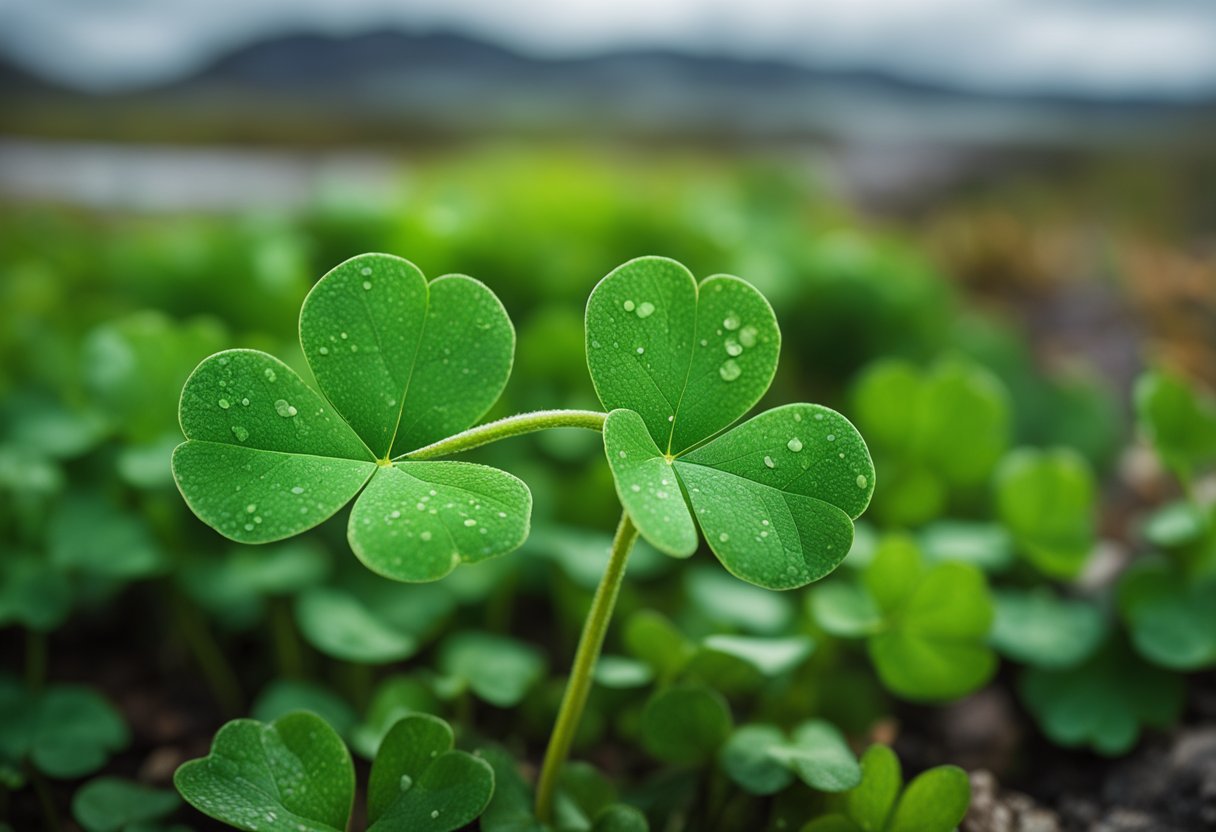
The shamrock continues to be an emblem of Irish identity, flourishing within modern-day Ireland and the wider global community.
Contemporary Celebrations of St. Patrick’s Day
The shamrock takes centre stage each year on St. Patrick’s Day, a cultural and religious celebration held on 17 March. St. Patrick, Ireland’s patron saint, is said to have used the shamrock as a metaphor for the Holy Trinity when preaching Christianity. Today, the three-leaved plant is an enduring symbol of Irish culture and heritage.
In Ireland, festivities around St. Patrick’s Day include parades, wearing of green attire or shamrocks, and enjoying traditional Irish music and dance. But the shamrock’s influence isn’t confined to Ireland alone; it is an emblem of identity for the Irish diaspora worldwide. On this day, major landmarks across the globe are bathed in green light, reflecting the sun’s glow much like the shamrocks basking in the gentle sun on Croagh Patrick.
As Irish communities have spread globally, so too do celebrations of St. Patrick’s Day, with parades and events held in cities from New York to Sydney. It’s not just the Irish or those of Irish descent who partake in the celebration, demonstrating the shamrock’s broad appeal and the acceptance of Irish culture globally. By embracing the customs associated with St. Patrick’s Day, people worldwide acknowledge and respect the history and traditions that the day and the shamrock represent.
Through our own experiences and explorations at Connolly Cove, we have witnessed the cultural significance of the shamrock. Whether it’s in the form of an accessory worn on a lapel or integrated into festive decorations, its global presence on St. Patrick’s Day is unmistakable. Our efforts to document these traditions’ beauty help us convey this symbol’s importance to a worldwide audience, encouraging a deep appreciation for the history behind the diminutive yet powerful shamrock.
The Role of the Irish Government in Diaspora Engagement
The Irish Government plays a crucial role in connecting with the global Irish community, preserving our shared customs, and fostering a sense of unity across the worldwide diaspora.
Policies and Initiatives for Global Irish Communities
We, the Irish Government, have undertaken a range of policies and initiatives specifically aimed at supporting and engaging with Irish individuals and communities abroad. Recognising the profound impact of migration on our nation’s story and the importance of the shamrock as a symbol of our heritage, we have committed resources and established strategic positions within government.
The appointment of the Minister of State for the Diaspora represents our dedicated effort to link the Irish at home with those overseas, forging connections that support cultural, economic, and social ties. Through this position, the Irish Government not only acknowledges the critical role of the diaspora but also actively works to involve them in Ireland’s development.
Our efforts include implementing the “Global Ireland—Ireland’s Diaspora Strategy 2020-2025,” a robust framework that outlines our approach to nurturing the bond between Ireland and its global community. This strategy reflects our commitment to appreciate and uphold the contributions Irish migrants make worldwide, ensuring that our culture continues to flourish across continents.
By coordinating with organisations that celebrate Irish customs, such as those fostering the sharing of our traditional music and dance, we help maintain the vibrancy of Irish culture globally. Our support extends to various programmes that empower Irish communities internationally to keep our traditions, like the wearing of the shamrock on St. Patrick’s Day, alive and well.
Are our core initiatives:
- Cultural Support: Sponsorship of global festivities that highlight Irish heritage.
- Social Welfare: Assistance for Irish nationals abroad who are facing difficulties.
- Business Links: Promotion of trade and entrepreneurship within Irish networks.
- Youth Engagement: Programmes that connect young members of the diaspora with Ireland.
Through these actions, we ensure the longevity and integrity of our unique culture. Our reinforced presence on the global stage is a testament to the enduring spirit and resilience of the Irish identity, one that the Irish Government is proud to represent and serve.
Connections Between Irish and Celtic Christian Churches
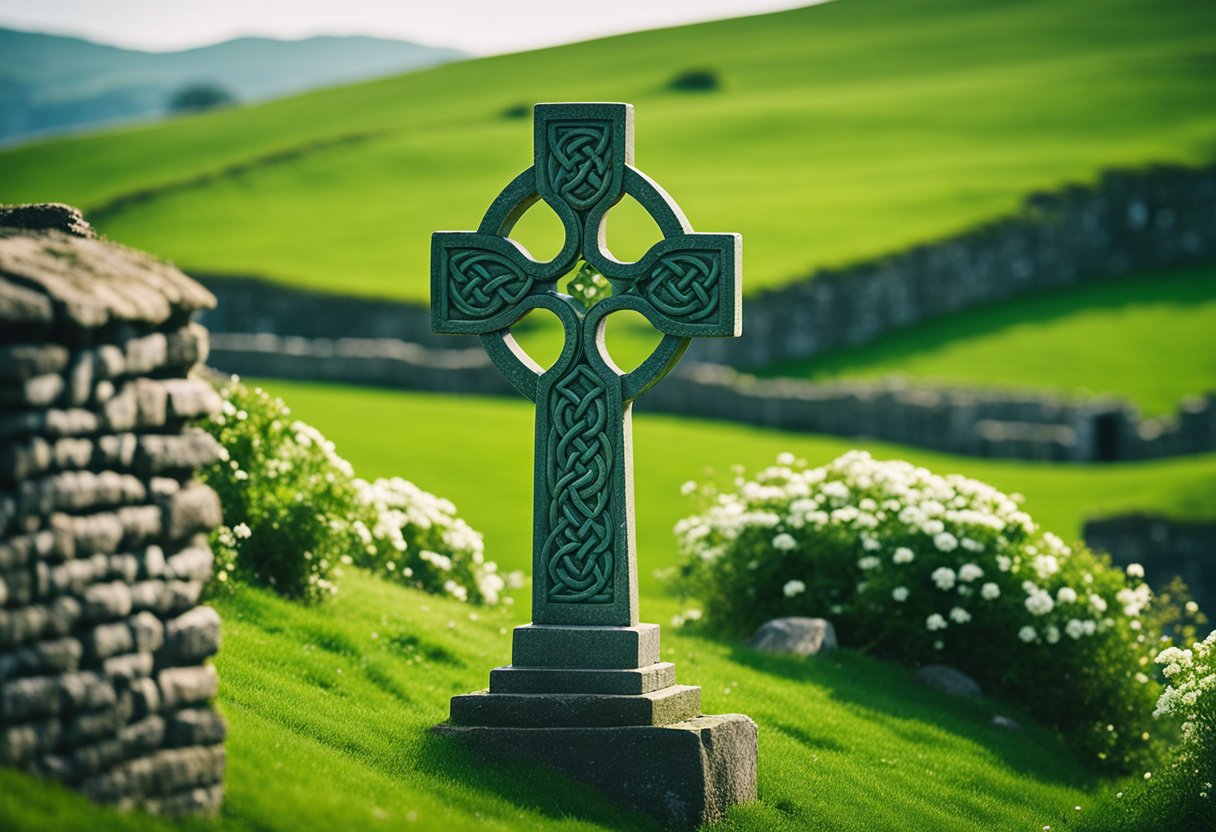
In exploring Irish customs and their spread worldwide, the intertwining histories of the Irish and Celtic Christian Churches play a pivotal role. Our examination focuses on their evolution from the Early Middle Ages through to the Norman Invasion, highlighting how these ecclesiastical traditions have contributed to the preservation of Irish identity abroad.
Early Middle Ages to Norman Invasion
In the Early Middle Ages, Ireland became a bastion of Christianity, and its unique form of worship—the Celtic Church—emerged. This period saw the flowering of a distinct ecclesiastical tradition that was intertwined with the native culture of the Gaels and Celts. Nurtured in Ireland’s monastic settlements, the Celtic Church’s practices differed from Roman traditions primarily in the calculation of Easter and the style of tonsure.
The Irish saint, popularly known as St. Patrick, is often credited with using the shamrock to explain the concept of the Holy Trinity, thus intertwining Irish identity with Christian symbolism. The influence of Ireland’s spiritual leadership extended beyond its shores, with Irish monks and scholars venturing to Scotland and the continent. The Scotti, Irish diaspora who settled in Scotland, brought their Gaelic language and Christian practices with them, contributing to the establishment of what would later become the Church of Scotland.
By the time of the Norman Invasion in the 12th century, the Church of Ireland had become well-established. However, this event marked the beginning of a closer alignment of Ireland’s ecclesiastical institutions with the mainstream Roman Catholic Church. This convergence was influenced by various reforms aimed at strengthening the central authority and doctrinal consistency of the Church throughout Europe, yet the Celtic Christian traditions continued to be practised in more remote areas.
The Irish diaspora, along with their Christian customs, became an integral component of preserving their identity in new lands. The intertwining of Ireland’s religious traditions with those of Celtic origin ensured that Irish customs would survive and thrive globally, carrying the essence of Ireland to the far corners of the world.
The Socioeconomic Impact of Irish Emigration
Irish emigration has had profound socioeconomic impacts within Ireland and in the nations where the diaspora has settled. Our exploration delves into how the identity of the Irish abroad has evolved in tandem with the economic conditions they have encountered.
Evolving Irish Identity and Economic Conditions
The Irish diaspora is not a recent phenomenon. Over centuries, massive waves of emigration have led to Irish communities proliferating around the globe. The 2008 economic downturn compelled a new generation to leave Ireland for jobs and stability. This exodus sparked not only a transfer of population but also a diffusion of culture, reshaping both the homeland and host countries.
Emigration has extensive effects on the Irish economy. The loss of a working-class population has presented challenges in various sectors, including shortages in trade, tourism, and job markets. Simultaneously, the Irish diaspora has established strong economic networks, leading to reciprocal benefits through remittances and the establishment of Irish businesses overseas.
The diaspora serves as cultural ambassadors, fostering a unique Irish identity that blends traditional customs with the adopted nuances of their new homes. These cultural exchanges have enriched the global perception of Ireland, promoting an interest in Irish history and heritage, from the legacy of the United Irishmen to the rural charms of Ulster and Meath.
The influence of the Irish diaspora extends to political spheres as well, with descendants of the diaspora serving in various roles within the Irish parliament and abroad. This political engagement has ensured that issues pertinent to the diaspora and Ireland remain in focus, affecting policies and fostering bilateral relationships.
While the socioeconomic impacts of emigration are multifaceted, the endurance of the Irish culture among the diaspora—reinforced by the resilience of communities in the face of change—stands as a testament to the enduring spirit of the Irish nation and its people.
FAQ
Why is the shamrock a significant symbol in Irish culture?
The shamrock is deeply ingrained in Irish history and folklore, symbolising good luck and the country’s natural beauty. It is renowned for associating with St. Patrick, Ireland’s patron saint, who is said to have used it as a metaphor for the Christian Holy Trinity.
What does the three-leafed shamrock stand for in Irish tradition?
In Irish tradition, the three leaves of the shamrock are thought to represent hope, faith, and love. Some also include a fourth leaf for luck, although this is actually a rare variety of the plant.
How have Irish communities around the world preserved the use of the shamrock in their customs?
Irish communities have maintained the use of the shamrock by incorporating it into their celebrations, particularly on St. Patrick’s Day. It is used in parades and the arts and as a way to connect with their Irish heritage, no matter where they may be in the world.
What are the differences between a shamrock and a clover?
The key difference between a shamrock and a clover is that a shamrock refers specifically to a young sprig of clover bearing three leaves, which is used as a symbol of Ireland, whereas clover can have more than three leaves and is a general term for the plants in the genus Trifolium.
Can you explain the connection between the shamrock and the Holy Trinity in Christianity?
The shamrock is often used to explain the concept of the Holy Trinity in Christianity. Each leaf represents one of the three divine persons—the Father, the Son, and the Holy Spirit—yet remains one plant—just as the Trinity is three persons in one God.
In which ways does the shamrock feature in celebrations of St. Patrick’s Day internationally?
Internationally, the shamrock is a ubiquitous emblem of St. Patrick’s Day, adorning everything from clothing and accessories to decorations at events. It is a symbol of national pride and a reminder of the Irish origins of the holiday.
Viking History: Insight into the Age of Phantom Travellers
History and Heritage
28/04/2024

The Symbolism and Meaning of the Dara Knot
Culture Exploration
28/04/2024

An Overview of Michigan Tourism Statistics: Visitor Spending, Growth, and Industry Impact
United States
28/04/2024

Top Things To Do in Hamburg: A Hamburger’s Guide!
Germany
27/04/2024

Take a Look at the Astounding Scenery of County Kerry
County Kerry
27/04/2024