


Sherlock’s London: Detective Trails Through the Capital’s Historic Streets
Updated On: March 03, 2024 by  Maha Yassin
London’s streets hold a touch of mystery, a lingering echo of Sherlock Holmes. Our journey through Sherlock’s London will be a blend of past and present, exploring Victorian-era London through the lens of this legendary detective. We’ll navigate foggy alleys and iconic landmarks, all locations that inspired countless adaptations. It’s a chance to experience the enduring legacy of Sir Arthur Conan Doyle’s creation.
Visiting these sites offers a unique perspective on London. These locations, from the famous 221B Baker Street to hidden gems, brim with Sherlockian history. Modern adaptations highlight how Holmes continues influencing the city’s cultural landscape, shaping how we view its criminal past.
This exploration goes beyond sightseeing – it’s a chance to hone your detective skills. Themed tours and tributes like exhibitions and statues allow you to immerse yourself truly in Sherlock’s world. Each step unveils new details: the characters who shaped him, the cultural influences, and the city that continues to be defined by the Great Detective.
The Life and Works of Arthur Conan Doyle

In this section, we explore the genius of Sir Arthur Conan Doyle, the Scottish author who gave the world its most celebrated fictional detective and examine the lasting impact of his creative works, particularly those featuring Sherlock Holmes.
Inception of Sherlock Holmes
Sir Arthur Conan Doyle introduced Sherlock Holmes to readers in the novel A Study in Scarlet, published in Beeton’s Christmas Annual in 1887. This marked the beginning of a series that would engrave Holmes as an icon of detective fiction. Sherlock Holmes, renowned for his astute logical reasoning, was based on Doyle’s university professor, Dr. Joseph Bell, whose extraordinary skills in observation inspired the character’s hallmark deductive techniques.
Literary Significance
The literary significance of Arthur Conan Doyle’s work extends beyond Sherlock Holmes. He wrote numerous novels and short stories that span a variety of genres. Conan Doyle’s creations have not only defined the mystery and detective genre but have also had a considerable influence on popular culture. His works have been celebrated for vividly portraying Victorian and Edwardian London and have been the subject of numerous adaptations into films, television series, and stage productions.
Sherlock’s London: The City is Afoot!
Sherlock Holmes’ adventures have immortalised certain London locations, intertwining the fictional detective’s legacy with the city’s historical tapestry.
Fictional and Historical Blends
We often find the lines between fiction and history blurred within the confines of Sherlock Holmes’ London. 221B Baker St stands as the symbolic address that cemented its place in literature and the hearts of mystery enthusiasts. While the street is accurate, the specific 221B number was a product of Sir Arthur Conan Doyle’s imagination. Yet, today, a museum dedicated to Holmes sits at what is now officially recognised as 221B, celebrating the detective’s influence on Marylebone and beyond in Sherlock’s London.
Victorian London provided the perfect backdrop for the fascinating mysteries that Holmes solved. The era’s gaslit streets, horse-drawn carriages, and the palpable divide between the wealthy and the working classes echoed the complex social backdrop against which Holmes operated. In many ways, our perception of Victorian London is shaped by Conan Doyle’s descriptive narration of the bustling city life, the cobbled streets, and the foggy atmosphere that served as a canvas for Holmes and Watson’s escapades.
Victorian London as a Backdrop
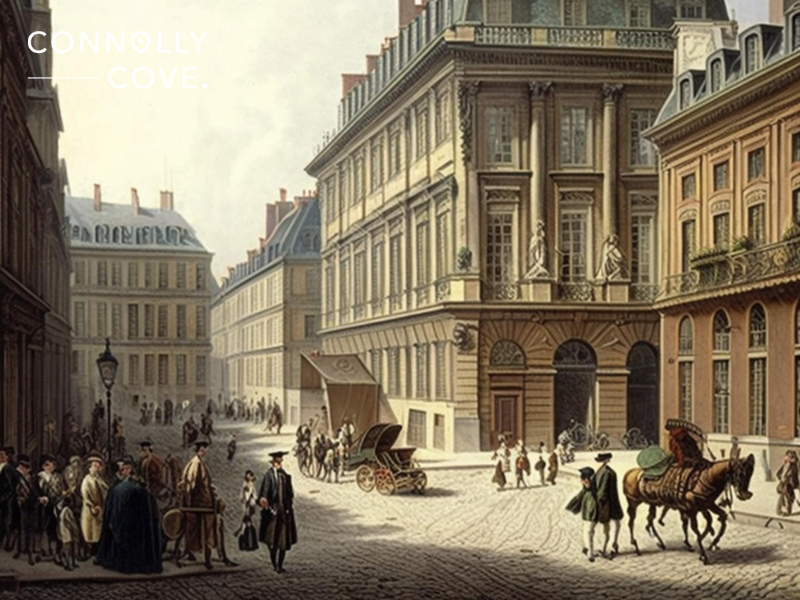
Sherlock’s London was the epitome of the Victorian age, a fascinating and tumultuous period. The stories thrust us into bustling Marylebone, past gentlemen in top hats, and through the thick smog characteristic of 19th-century industrial London. Holmes’ astute observations often reflect the societal norms and the architectural grandeur of the time, with the Victorian setting playing more than just a passive role. It’s as if the city’s foggy laneways, majestic towers, and mysterious crowds were active participants in the narrative, setting a mood as intrinsic to the stories as the plot itself.
Conan Doyle’s writing reveals a London ripe with intrigue, where every alleyway and parlour could cloak a vital clue. This texture of historical authenticity and fictional drama cements Sherlock Holmes’ place in literature and the rich tapestry of London’s cultural heritage.
Iconic Locations in Holmes’ Investigations
When retracing the steps of the great detective, there are a few sites across London that no fan should miss, for they form the backdrop to some of Sherlock Holmes’s most thrilling cases.
Baker Street and the Museum
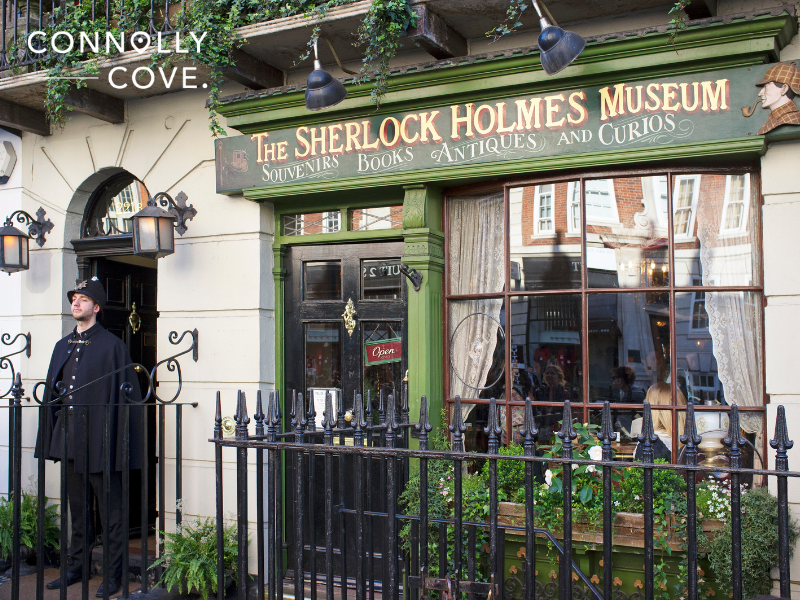
Baker Street is indelibly associated with Sherlock Holmes. One cannot think of Holmes without picturing the famous 221B Baker Street, the fictional residence he shared with Dr John Watson in Sherlock’s London. This address is home to the Sherlock Holmes Museum, a Victorian abode meticulously kept in the style of Holmes’ era, offering a tangible connection to the atmosphere detailed in Conan Doyle’s stories.
Visiting Details:
- Address: 221B Baker Street, London
- Hours: Open daily from 9:30 am to 6:00 pm
- Exhibits: A recreation of Holmes’ study, Victorian-era artefacts
Holmes’ Haunts and The Sherlock Holmes Pub
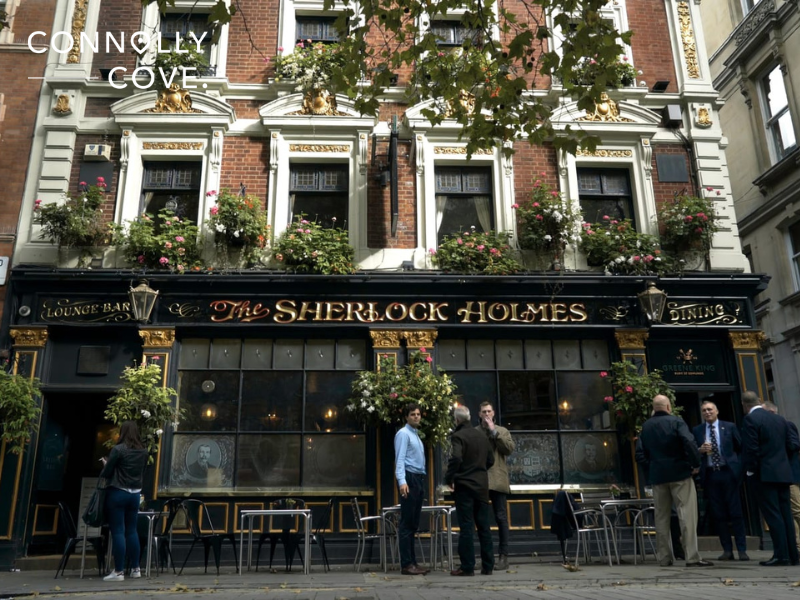
Aside from his Baker Street quarters, Sherlock Holmes frequented several other spots, one of which has been commemorated by The Sherlock Holmes Pub. Situated near Trafalgar Square, this establishment is steeped in Holmesian lore and serves as a shrine to the detective’s adventures, adorned with memorabilia and Victorian charm. It’s a favourite for enthusiasts looking to immerse themselves in the world of Holmes over a pint.
Visiting Details:
- Address: 10 Northumberland St, London
- Nearby: Just a stone’s throw from Trafalgar Square
- Features: Themed dining rooms, a replica of Holmes’ study
While exploring Sherlock’s London, one should also take a moment to appreciate Trafalgar Square, a significant landmark often featured as a bustling backdrop in the Holmes canon. Although Holmes was a man of precise habits, Trafalgar Square’s energy starkly contrasts the detective’s poised demeanour, reflecting London’s vibrant and sometimes chaotic pulse.
Trafalgar Square Highlights:
- Landmark: Central to historical London
- Significance: Frequent reference in Sherlock Holmes stories
- Atmosphere: Captures the vibrancy of the city
Sherlock Holmes in Modern Media
The depiction of Sherlock Holmes has transitioned seamlessly into modern media, capturing the essence of Sir Arthur Conan Doyle’s work and adapting it to resonate with contemporary audiences.
On the Big Screen
In recent years, Robert Downey Jr. has brought a unique charisma to the role of Sherlock Holmes in films. His portrayal is known for combining wit, physicality, and a certain flair, which has contributed to the character’s enduring appeal. Notably, in Sherlock Holmes (2009) and Sherlock Holmes: A Game of Shadows (2011), audiences were treated to a Holmes who was as much an action hero as a cerebral detective.
The Television Phenomenon
Television has also seen its share of Sherlock adaptations, and none more influential than the BBC series Sherlock. The show reimagines the classic stories in present-day London with Benedict Cumberbatch as the titular detective and Martin Freeman as Dr John Watson. The series climax, The Final Problem, has received critical acclaim and fan adoration, cementing this character iteration in the annals of TV history.
Through forensic technology and clever scriptwriting, Sherlock melds Victorian-era cases with modern-day sensibilities, showcasing how Holmes’s methods can still solve the most perplexing of modern puzzles.
Exploring the Influences of Sherlock Holmes
Sherlock Holmes has left an indelible mark on literature, culture, and the genre of mystery itself. His impact extends from the pages of Sir Arthur Conan Doyle’s novels to various facets of popular culture, influencing how we perceive the detective archetype.
Literary and Cultural Impact
Holmes is a cultural icon whose fame has transcended literature, inspiring adaptations in theatre and opera. The detective is known for his signature deerstalker hat, which has become synonymous with the image of a detective. His influence is such that specific locations from the stories, like the Hound of the Baskervilles moors, draw fans seeking to walk in the detective’s footsteps.
The Deduction Method and Mystery Genre
Holmes’s method of deduction revolutionised the mystery genre. Careful observation and logical reasoning characterise his approach to solving crimes. This method has shaped the detective narrative in literature and across media, establishing a blueprint for mystery storytelling that emphasises the intellectual prowess of the protagonist.
The Art of Detection
In the fog-laden streets of London, the prowess of deduction and acute attention to detail distinguished Sherlock Holmes as a fictional master of a criminal investigation. Our exploration reveals a subtle craft grounded in scrutinising traces left behind and connecting disparate threads to uncover truths buried within the city’s shadowy corners.
Clues and Deductive Reasoning
Clues are the bedrock of any investigation. We meticulously scan the environment, uncovering a breadcrumb trail of evidence. Each discovery, from the depth of a footprint to the placement of a fallen object, inches us closer to the heart of the mystery. Deductive reasoning allows us to infer conclusions from these clues logically. It’s like piecing together a complex jigsaw puzzle, where each fragment harmonises with others to reveal the obscured picture of events past.
Critical Analysis of Clues:
- Evidence Location: Assess the immediate surroundings for anything abnormal.
- Timeframe: Determines the relevance of evidence in chronological sequence.
Holmes’ Approach to Crime-solving
Holmes’s approach to crime-solving is punctuated by a meticulous dissection of mysteries that confound the mind. We embrace his methods, observing keenly and cataloguing minutiae often overlooked. Our deductions are never haphazard; they culminate in thoughtful deliberation and an unrivalled understanding of the human psyche’s complexities.
Strategies Employed:
- Thorough Examination: Every element of the crime scene warrants careful inspection.
- Logical Interpretation: Theories are only as robust as the logic that underpins them.
Walking in Sherlock’s Footsteps: Themed Tours
We invite fans of the great detective to immerse themselves fully in the world of Sherlock Holmes through a dedicated Sherlock Walking Tour.
Sherlock Walking Tour
On this guided excursion, participants will experience the historical backdrop of Sherlock Holmes’s adventures. We begin at the famed 221b Baker Street, the canonised residence of the detective. Participants can admire the outside of the iconic address, which houses the Sherlock Holmes Museum, carefully preserved to replicate the Victorian-era home described in Arthur Conan Doyle’s stories.
The tour then escorts enthusiasts through the streets that Holmes and Doctor Watson traversed on their quests to unravel London’s most mysterious cases. As you stroll through these historic alleys and byways, you’ll follow the paths that have inspired the original works and numerous film and television adaptations.
It’s not simply a walk but a narrative-rich journey connecting you to the detective’s logical prowess and keen observation skills.
Please note, this tour is as much an experience for history buffs as it is for fans of the detective — it’s a chance to visualise London through a Victorian lens, enriched by the lore of literature’s most esteemed sleuth.
Film and TV Location Trail
We invite you on a trail to discover the iconic filming locations of London as seen through the lens of the Sherlock series. This journey unveils the very spots that frame the modern reimagining of Conan Doyle’s legendary detective.
221b Baker Street
Literary history and screen presence converge at this renowned address, which, in television, is represented by North Gower Street. Here, fans can visualise the life of the modern-day detective, portrayed by actors Benedict Cumberbatch and Martin Freeman. This location is the external view of the famous flat in the BBC’s adaptation, providing a real touchstone for fans.
Speedy’s Cafe
Adjacent to the stand-in for 221b Baker Street, Speedy’s Cafe has become almost as iconic as the detective’s residence. The eatery frequently appears in the Sherlock series and attracts fans for coffee or a sandwich, all while soaking in the show’s atmosphere.
South Bank Skate Park
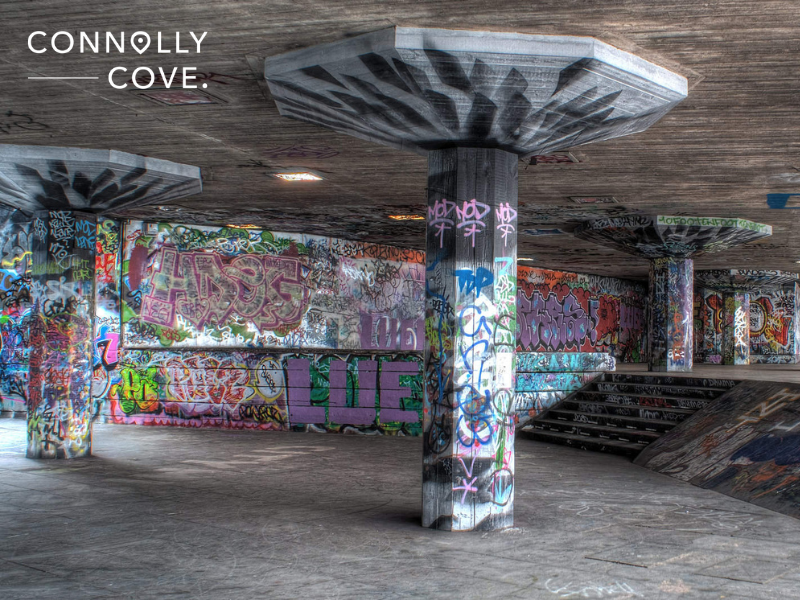
For an experience that captures London’s urban vibe, the South Bank Skate Park emerges as an unexpected but memorable setting featured in the show. Skateboarders and BMX riders add to the authentic energy of this location, which serves as a backdrop for some of the series’ most dramatic sequences.
Treasures and Tributes to Sherlock Holmes
In the heart of London, tributes to the esteemed detective Sherlock Holmes abound, with enriching experiences and coveted collectables that invite us into his legendary world.
Statues and Immersive Experiences
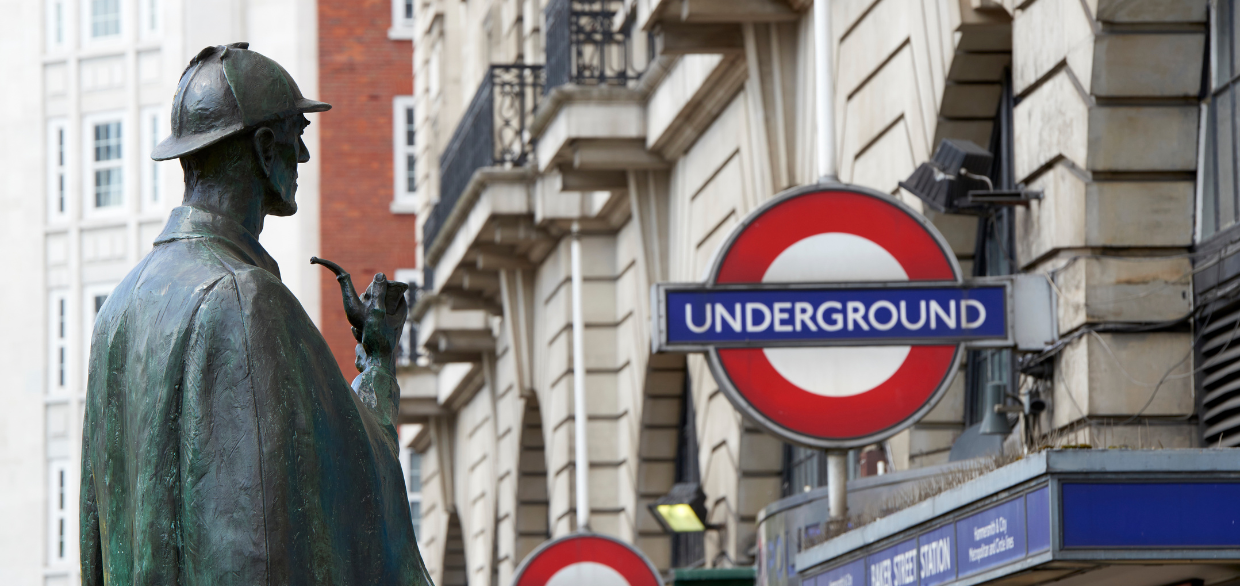
London honours its fictional son with the prominent Sherlock Holmes statue situated at the entrance of Baker Street underground station. This robust bronze figure stands guard, a permanent reminder of Holmes’s enduring legacy on the city. For those seeking to step into his shoes, an immersive escape room awaits. Here, participants can put their deductive skills to the test, solving mysteries in a meticulously constructed Victorian London setting.
Collectibles and Memorabilia
Die-hard fans and curious visitors alike are drawn to the wealth of memorabilia, from classic novels and themed chess sets to replica pipes and deerstalker hats. The pinnacle of this collection is found at 221B Baker Street, where the Sherlock Holmes Museum houses an array of artefacts and trinkets, creating a tangible connection to the tales that have captivated us for generations.
Sherlock’s Associates and Antagonists
In the tales of Sherlock Holmes, characters ranging from faithful allies to cunning adversaries bring Victorian London to life. The relationships and dynamics between Holmes, his cohort, and his rivals are complex, reflecting the intricate web of London’s society during that era.
The Illustrious Dr. Watson
Dr John Watson is not merely a companion to Holmes; he’s an indispensable associate in his investigative endeavours. With his military background as a former army surgeon, Watson brings practicality and a moral compass to Holmes’ sometimes cold and analytical approach to solving cases. Together, they occupy the famous residence of 221b Baker Street, which today is celebrated as a museum honouring the fictional detective and his chronicler.
- Role: Chronicler, confidant, and participating detective
- Military Rank: Army Surgeon
- Characteristics: Loyal, brave, and somewhat naive
Nemesis and Noteworthy Characters
Among the litany of characters, few have matched wits with Sherlock Holmes as formidably as his nemesis, Professor Moriarty, who is often considered to be Holmes’ intellectual equal. In contrast, Mycroft Holmes, Sherlock’s elder brother, possesses a brilliant mind that surpasses even the great detective himself. Mycroft often remains distanced from fieldwork, preferring to play a role in matters of national importance. Another noteworthy character is Irene Adler, who stands out as a woman who impresses Holmes with her ingenuity and resourcefulness, earning his lifelong respect.
- Professor Moriarty: The Napoleon of crime and Holmes’ intellectual counterpart
- Mycroft Holmes: Government official with extraordinary deductive powers
- Irene Adler: The Woman who captured Holmes’ admiration
The diverse cast that populates the stories of Sherlock Holmes offers a glimpse into the very fabric of London society, giving readers a tour through the capital’s gritty and compelling landscape.
Beyond Baker Street: Other Notable Venues
While Baker Street is synonymous with Sherlock Holmes, London boasts an array of other exceptional venues steeped in cultural and literary history. These locations offer myriad experiences that complement the detective’s London trail.
The British Museum

It’s a treasure trove of world history and artefacts. We find ourselves lost in time amongst the exhibits, each piece telling its unique story. Visiting this iconic museum within the Bloomsbury area of London allows us to enter a world where history and literature converge.
The Langham Hotel
This grand establishment is more than a luxurious stay; it carries a legacy. Frequented by literary figures such as Sir Arthur Conan Doyle, we can enjoy afternoon tea in the same rooms that once harboured great minds.
West End
Royal Opera House and The Lyceum Theatre in Covent Garden anchor the West End’s reputation as a cultural hotspot. We watch world-class performances unfold in these historical venues, where the vibrancy of London’s theatre scene is palpable.
Here, the arts come alive. We immerse ourselves in the latest shows and find that the real magic happens behind those illuminated marquees. Each theatre in the West End has stories etched into its walls, creating a memorable part of London’s cultural landscape.
Whether you’re a literary enthusiast or enjoy a good mystery, retracing Sherlock Holmes’ steps through London is a delightful way to experience the city. From the iconic 221B Baker Street to the atmospheric back alleys where Holmes conducted his investigations, London offers a treasure trove of locations that bring the detective’s world to life. So grab your deerstalker hat, hone your observational skills, and embark on your Sherlockian adventure in the foggy streets of London.

Take a Look at the Astounding Scenery of County Kerry
County Kerry
27/04/2024
Famous Haunted Houses in Egypt: Spooky Stories for Halloween
Destinations
27/04/2024

St. Paul’s Cathedral – London Attractions
England
27/04/2024
Great Scotland Yard – London Attractions
England
27/04/2024

Bangor Town: The Colorful Open House Festival
Northern Ireland
27/04/2024