When Claire Randall placed her hand on the standing stones at Craigh na Dun, she didn’t just travel through time, she transported millions of viewers straight into the heart of Scotland. The Outlander filming locations have become pilgrimage sites for fans worldwide, drawing travellers eager to walk the same cobblestones as Jamie Fraser and experience the misty Highlands where this epic story unfolds. What many visitors don’t realise is that every Outlander filming location in Scotland tells two stories: the fictional drama we see on screen and the genuine historical narrative etched into these ancient landscapes.
At ConnollyCove, we’ve spent years exploring Scotland’s most cinematic corners, from the wind-battered castles of the Highlands to the hidden forests that doubled as 18th-century North Carolina. This comprehensive guide goes beyond the standard tourist itinerary to reveal the reality behind the romance, the muddy paths, the booking requirements, the best times to visit, and the real Jacobite history that makes these Outlander filming locations so compelling.
Whether you’re a dedicated “Sassenach” planning your first Scottish adventure or a seasoned traveller looking to explore locations from the later seasons, this guide provides everything you need to experience these magical sites for yourself.
Table of Contents
Planning Your Visit: Practical Considerations for Outlander Filming Locations
Before you set off on your Outlander filming location adventure, proper planning will transform your experience from frustrating to magical. Scotland’s weather, rural infrastructure, and seasonal variations require thoughtful preparation that can make the difference between a disappointing day trip and the journey of a lifetime.
Best Time to Visit
Spring (April-May): The landscape bursts into colour, crowds remain manageable, and most Outlander filming locations have reopened after winter maintenance. Scottish spring can still bring sudden rain showers.
Summer (June-August): Peak season means longer opening hours but also coaches full of tourists at popular sites like Doune Castle. Be prepared for midges (tiny biting insects) in woodland areas during warm, still evenings.
Autumn (September-October): Golden foliage provides stunning photography opportunities, crowds thin out, and the moody atmosphere matches the show’s aesthetic perfectly. Some remote Outlander filming locations may have reduced hours.
Winter (November-March): Several sites close or operate limited hours. However, if you can brave the cold, you’ll have these atmospheric locations largely to yourself.
Getting Around: Self-Drive vs Guided Tours
Self-Drive: Offers freedom to spend as much time as you want at each Outlander filming location and ability to visit lesser-known sites from Seasons 4-7. However, Scottish single-track roads require confidence with “passing place” etiquette, and parking can be extremely limited at popular sites.
Guided Tours: Provide expert commentary connecting fictional storylines to real history, no parking stress, and often include locations on private estates not accessible individually. Tours follow fixed itineraries with less flexibility than self-guided exploration.
“When we first explored these locations for our YouTube series, we quickly learned that the magic isn’t just in seeing the castle, it’s in understanding the real people who lived there. That’s what separates a quick photo stop from a meaningful travel experience.” – Ciaran Connolly, Founder of ConnollyCove
Money-Saving Strategies
Historic Environment Scotland Explorer Pass: If visiting three or more HES sites (Doune Castle, Blackness Castle, Linlithgow Palace), this pass pays for itself. Available for 3, 5, or 7 consecutive days.
Advance Booking: Sites like Midhope Castle (Lallybroch) require pre-purchased vehicle passes. Booking online in advance often provides modest discounts and guarantees entry during peak season.
Accessibility Considerations
Medieval castles weren’t built with modern accessibility in mind. Doune Castle’s courtyard is accessible, but upper floors require steep spiral staircases. Midhope Castle offers exterior viewing only with uneven approach paths. Blackness Castle has limited wheelchair access. Highland Folk Museum provides excellent accessibility with flat paths throughout.
Highland Locations Guide: The Heart of Outlander
Scotland’s Highlands provide the dramatic backdrop for the show’s most memorable moments, from Claire’s fateful touch of the standing stones to the tragic aftermath of Culloden. These Outlander filming locations capture the wild, untamed beauty that makes the series so visually striking, offering visitors a chance to walk through landscapes where history and fiction blend seamlessly.
Kinloch Rannoch: The Standing Stones of Craigh na Dun
Location: Perthshire, Central Highlands
Travel Reality Check: The standing stones themselves don’t exist
This Outlander filming location represents the show’s most significant “movie magic” moment. The production team erected temporary Styrofoam stones for filming, removed after each shoot. However, the landscape itself-with Loch Rannoch stretching into the distance and mountains rising beyond-provides the atmospheric setting that makes Claire’s time travel feel plausible.
The area embodies the Celtic concept of “thin places”, locations where the boundary between the physical and spiritual worlds feels permeable. Scotland has genuine ancient standing stone circles (like Calanais in the Outer Hebrides or the Ring of Brodgar in Orkney) that inspired the fictional Craigh na Dun.
Practical Tips: Park in Kinloch Rannoch village and walk along Loch Rannoch’s shoreline. The exact filming spot changes between seasons, but the general area offers spectacular views. Visit during golden hour (early morning or late evening) for the most atmospheric photographs.
Culloden Battlefield: Where History and Fiction Converge
Location: Near Inverness
Historical Significance: Site of the final Jacobite defeat in 1746
Culloden represents the emotional climax of Outlander’s historical timeline, the battle that shaped Jamie Fraser’s entire life. This Outlander filming location deserves respectful, thoughtful engagement rather than casual tourism.
The 1746 battle lasted less than an hour but ended the Jacobite cause forever. Walking the battlefield today, marked flags indicate where different clan regiments stood. The flat, boggy moorland that seemed like a tactical disadvantage for the Highlanders becomes viscerally clear when you stand there yourself.
Visiting Guidelines: Allow minimum 2-3 hours for the visitor centre and battlefield. Audio guides available in multiple languages. The site is a war grave, behave respectfully and follow marked paths. Free admission to the battlefield itself; museum requires ticket.
Highland Folk Museum: Recreating 18th-Century Life
Location: Newtonmore, Cairngorms
Featured As: Various MacKenzie clan village scenes
This Outlander filming location provides the most immersive experience of what 18th-century Highland life actually looked like. The museum features reconstructed historical buildings spanning 300 years of Highland history, including thatched cottages, working blacksmith demonstrations, and costumed interpreters explaining daily life.
The Folk Museum illustrates the harsh realities behind Outlander’s romantic moments, peat smoke-filled cottages, shared sleeping arrangements, and constant labour required for survival provide context for understanding character choices.
Practical Information: Free admission (donations welcomed). Extensive site requiring 2-3 hours to explore. Limited opening season (typically April-October). Excellent accessibility with flat, well-maintained paths.
Castle Filming Sites: The Iconic Fortresses
Scotland’s castles provide Outlander’s most recognisable locations, from the imposing walls of Castle Leoch to the derelict charm of Lallybroch. These sites offer the most complete visitor experience, with detailed historical information, well-developed facilities, and the opportunity to stand exactly where Jamie, Claire, and the other characters brought Diana Gabaldon’s story to life on screen.
Fiction vs. Reality: Quick Reference
| Show Name | Real Location | Open to Public? | Accessibility Rating (1-5) |
|---|---|---|---|
| Lallybroch | Midhope Castle | Exterior only (booking required) | 2 |
| Castle Leoch | Doune Castle | Yes (HES managed) | 3 |
| Fort William | Blackness Castle | Yes (HES managed) | 2 |
| Wentworth Prison | Linlithgow Palace | Yes (HES managed) | 3 |
| Versailles Gardens | Drummond Castle Gardens | Yes (seasonal) | 4 |
| L’Hôpital des Anges | Glasgow Cathedral | Yes (free admission) | 5 |
(Accessibility Rating: 1=Very Limited, 5=Fully Accessible)
Midhope Castle: Lallybroch in Reality
Location: South Queensferry, West Lothian
Featured As: Lallybroch/Broch Tuarach, Jamie Fraser’s family home
Access: Requires advance booking, exterior only
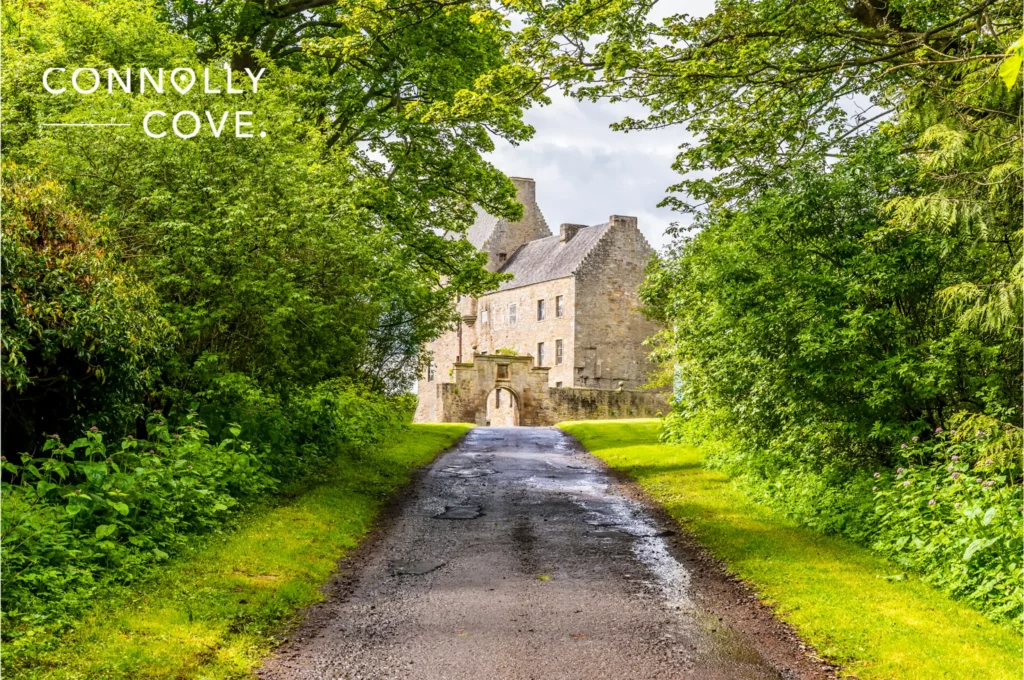
Midhope Castle represents the emotional heart of Outlander, Jamie’s ancestral home. However, this Outlander filming location requires significant expectation management. Midhope is a derelict 16th-century tower house on the working Hopetoun Estate. All interior Lallybroch scenes were filmed on studio sets in Cumbernauld. Visitors can only photograph the exterior from the courtyard area.
Essential Booking Information: You cannot simply arrive at Midhope. Access requires purchasing a vehicle pass online in advance (approximately £5-10). The estate frequently closes for farming activities, private events, or additional filming. Check the Hopetoun Estate website before travelling.
What You’ll See: The distinctive archway framing the tower house appears exactly as on screen. The surrounding estate provides beautiful walking opportunities, with glimpses of the grand Hopetoun House (worth visiting separately).
Tower houses like Midhope represent Scotland’s turbulent 16th-century history. Built primarily for defence, they feature thick walls, narrow windows, and strategic defensive positions, reminders that the Fraser family’s militaristic lifestyle wasn’t fictional invention but historical necessity.
Doune Castle: Castle Leoch and Beyond
Location: Doune, near Stirling
Featured As: Castle Leoch, seat of Clan MacKenzie
Famous For: Multiple film and TV appearances
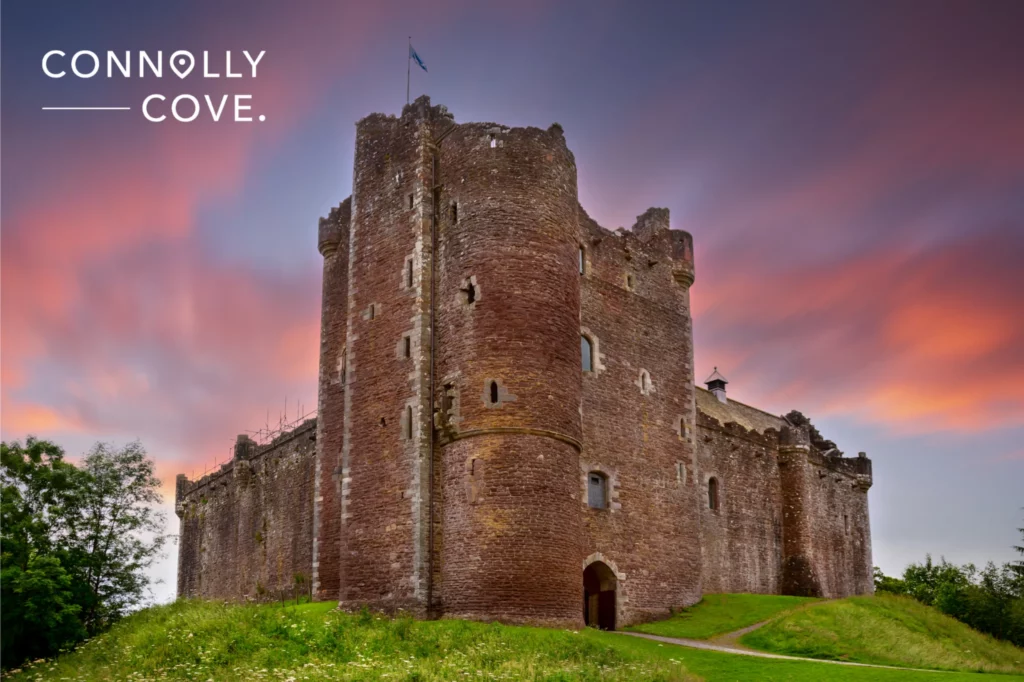
Of all Outlander filming locations, Doune Castle offers the most satisfying visitor experience. This imposing 14th-century fortress played a pivotal role in Scottish history before becoming one of Britain’s most filmed castles.
Built by Robert Stewart, Duke of Albany, who served as Scotland’s uncrowned king during his nephew’s imprisonment in England, the castle’s architecture reflects both defensive necessity and aristocratic aspiration, a combination that makes it cinematically perfect.
The Outlander Experience: Historic Environment Scotland fully embraces the site’s fame. The audio guide, narrated by Sam Heughan (Jamie Fraser), provides behind-the-scenes filming anecdotes whilst you stand in the actual locations where scenes were shot. Before Outlander, Doune Castle achieved cult status as the primary filming location for Monty Python and the Holy Grail (1975).
Visiting Practicalities: Arrive before 10:00 AM during summer months to secure parking. Allow 1.5-2 hours for a thorough visit. The Great Hall, kitchen, and lord’s chambers are accessible via stone spiral staircases. Wear sturdy footwear, stone floors can be slippery. Free entry with Historic Environment Scotland Explorer Pass.
Local Dining Recommendation: After exploring Doune Castle, head to The Woodside Hotel in nearby Dunblane (15 minutes’ drive) for authentic Scottish cuisine including Cullen Skink, haggis, and locally sourced venison. Alternatively, The Birds and the Bees in Stirling offers seasonal Scottish dishes in a traditional pub setting. Both provide genuine Highland dining experiences without tourist mark-ups.
Blackness Castle: Fort William’s Dark Reality
Location: Near Linlithgow, West Lothian
Featured As: Fort William, headquarters of Black Jack Randall
Distinctive Feature: Unique ship-shaped design
Blackness Castle serves as one of Outlander’s most oppressive locations, the military fort where Jamie endures torture and imprisonment. In reality, this Outlander filming location has an equally dark history as one of Scotland’s most infamous state prisons.
Built in the 15th century, Blackness served as a royal castle, garrison fortress, ammunition depot, and prison. Its position on the Firth of Forth made it strategically vital for controlling maritime access to Stirling and Edinburgh. The castle’s ship-like shape, with a pointed “bow” jutting into the water, makes it instantly recognisable.
Visiting Information: Managed by Historic Environment Scotland (included in Explorer Pass). Limited interior access due to historic structure. Steep stairs and uneven surfaces throughout. Spectacular views from the battlements across the Firth of Forth. Small site, 30-45 minutes provides ample time for exploration.
Linlithgow Palace: Wentworth Prison
Location: Linlithgow, West Lothian
Featured As: Wentworth Prison
Historical Status: Birthplace of Mary, Queen of Scots
Linlithgow Palace appears in Outlander’s most harrowing episodes as Wentworth Prison. In reality, this Outlander filming location represents one of Scotland’s finest examples of Renaissance palace architecture.
Linlithgow served as a principal residence for Scottish monarchs from the 15th to the 17th centuries. Mary, Queen of Scots was born here in 1542. Television magic transforms this elegant palace into a brutal prison through camera angles, lighting, and set dressing, testament to skilled location filming.
Visitor Experience: Extensive ruins allowing several hours of exploration. Interpretive panels explaining royal history. Beautiful position beside Linlithgow Loch. The adjacent St. Michael’s Church features a striking modern crown spire. Entry via Historic Environment Scotland (included in Explorer Pass).
The French Connection: Paris in Scotland
Outlander’s second season moves to France, but the production remained firmly in Scotland, demonstrating the versatility of Scottish architecture and landscapes. These Outlander filming locations showcase creative location scouting, transforming Scottish gardens and Gothic cathedrals into convincing 18th-century Parisian settings that fooled millions of viewers worldwide.
Drummond Castle Gardens: The Gardens of Versailles
Location: Muthill, near Crieff, Perthshire
Featured As: Gardens of the Palace of Versailles
When Outlander needed to depict the magnificent gardens of Versailles, the production team chose Drummond Castle Gardens, widely considered among Britain’s finest examples of formal garden design.
Created in the 17th century and substantially redesigned in the 19th, Drummond Castle Gardens showcase the Italian parterre style. The intricate geometric patterns formed by precisely clipped box hedges, colourful flower beds, and carefully positioned statuary create a spectacular visual effect when viewed from the elevated terrace.
Visiting Information: Open seasonally (typically May-October). Photography permitted for personal use. The gardens are best viewed from the castle terrace above. Allow 1-2 hours for a thorough visit. Entry fee required (not included in heritage passes).
Seasonal Highlights: Spring (May-June) brings spectacular displays of tulips and early perennials. Summer (July-August) sees the roses at their peak, whilst autumn (September-October) offers changing foliage colours. The gardens close after October throughout winter for maintenance. Check the official website before visiting, as weather conditions can occasionally necessitate closures.
Glasgow Cathedral: L’Hôpital des Anges
Location: Glasgow city centre
Featured As: L’Hôpital des Anges (Paris hospital)
Glasgow Cathedral transforms into the Parisian hospital where Claire volunteers during Season 2. The only Scottish mainland cathedral to survive the Reformation substantially intact, Glasgow Cathedral dates from the 13th century. Its Gothic architecture, dark stone, and atmospheric interior provide the gravitas required for Outlander’s hospital scenes.
Visitor Information: Free admission. Active place of worship, respectful behaviour required. Self-guided tours available during opening hours. Adjacent necropolis (cemetery) provides additional atmospheric exploration. Excellent public transport access.
The American Colonies in Scotland: Seasons 4-7
The later Outlander seasons present a significant challenge: depicting 18th-century North Carolina without leaving Scotland, requiring the production team to find Scottish forests that could convincingly double for Appalachian wilderness. These woodland Outlander filming locations receive far less attention than the famous castles, yet they’re crucial to understanding the show’s visual storytelling and represent some of the most atmospheric settings in the entire series.
Fraser’s Ridge: Finding North Carolina in Perthshire
Primary Locations: Various Perthshire forests and estates
Featured As: Fraser’s Ridge cabin and surrounding wilderness
The Fraser family’s North Carolina homestead couldn’t actually be filmed in America. Instead, the production team identified specific Scottish forests that could convincingly double for Appalachian wilderness. Cambusbarron and Faskally Forest near Stirling and Pitlochry provided the dense woodland required. The production constructed temporary sets (including Jamie and Claire’s cabin) on location, removing them after filming completed.
Visiting Realities: Unlike castles with clear addresses and opening hours, these woodland Outlander filming locations present challenges. Exact filming spots aren’t publicly advertised, sets no longer exist, and there’s no interpretive signage. Muddy paths require proper walking boots, and midges can be ferocious during summer evenings.
Recommended Approach: The Hermitage near Dunkeld offers well-maintained woodland walks in similar forest to filming locations. Faskally Forest near Pitlochry provides marked trails through mature mixed woodland. Callander Crags offers elevated viewpoints across wooded landscapes. All are publicly accessible via Forestry Commission land.
The Hermitage: Waterfall Scenes
Location: Near Dunkeld, Perthshire
Featured In: Multiple woodland and waterfall sequences
Access: Free, publicly accessible National Trust for Scotland site
The Hermitage provides one of the few “North Carolina” Outlander filming locations that visitors can definitively identify and easily access. This wooded gorge with its dramatic waterfall appears in several seasons.
The Black Linn Falls, tumbling through a rocky gorge surrounded by towering Douglas firs, creates a dramatic natural setting. The combination of ancient native woodland and 18th-century designed landscape provides production designers with versatile backdrops.
Practical Visiting: Well-maintained circular walk (approximately 1.5 miles). Suitable for most fitness levels (some steep sections). Can be muddy after rain, wear appropriate footwear. Free parking with donation requested. Year-round access.
Seasonal Visiting: Spring (April-May) sees the woodland floor carpeted with bluebells. Summer (June-August) provides the fullest canopy coverage. Autumn (September-October) brings spectacular foliage colours as the larch trees turn golden. Winter (November-March) features higher waterfall flow. The site remains open year-round, though paths can become slippery during icy conditions.
Beyond the Screen: Real History Behind the Romance
Outlander blends historical fact with romantic fiction, but understanding the real history enriches every filming location visit and transforms these sites from mere photo opportunities into genuine educational experiences. The Jacobite Rising of 1745-the central historical event shaping the show’s narrative-represents a turning point in Scottish and British history that continues to resonate today.
The Jacobite Rising: Fact vs Fiction
The 1745 Rising wasn’t a simple Scotland versus England conflict. It was a complex civil war driven by competing claims to the British throne following the “Glorious Revolution” of 1688. The Jacobites (from “Jacobus,” Latin for James) supported the Catholic Stuart dynasty’s claim to the throne, whilst the Hanoverians (the sitting Protestant monarchy) drew support from those who feared Catholic absolutism.
Bonnie Prince Charlie: Outlander romanticises the Young Pretender, emphasising his charisma and tragic failure. Historical accounts suggest a more complex personality, courageous but also impulsive, prone to poor strategic decisions, and increasingly disconnected from the harsh realities his Highland supporters faced.
The Clans’ Motivations: Highland clans didn’t universally support the Jacobite cause. Some fought for the Stuarts, others for the Hanoverians, and many tried to remain neutral. Economic factors, clan rivalries, and local politics influenced decisions as much as dynastic loyalty.
The Aftermath: Following Culloden’s defeat, the British government implemented brutal policies designed to destroy traditional Highland culture: banning tartan and weapons, abolishing the clan system’s legal authority, and clearing Highland estates. These historical “Clearances” displaced thousands and fundamentally altered Scottish Highland society.
Cultural Sensitivity at Historical Sites
When visiting Outlander filming locations that are also sites of genuine historical trauma (particularly Culloden), approach with appropriate respect: remember these are war graves, not film sets; follow marked paths and observe restricted areas; keep noise levels appropriate; avoid recreating battle scenes or posing disrespectfully.
Crafting Your Itinerary: Practical Routes
Successfully visiting multiple Outlander filming locations requires strategic planning that balances travel distances with site opening hours and seasonal considerations. These suggested itineraries have been designed based on our extensive experience exploring Scotland, ensuring you maximise your time whilst avoiding the common mistakes that can derail a filming location tour.
The 3-Day Essential Outlander Tour
Day 1: Edinburgh and the Lothians Morning: Linlithgow Palace | Afternoon: Blackness Castle | Late Afternoon: Midhope Castle (requires advance booking) | Optional Evening: Dinner in Edinburgh’s Old Town
All three locations sit within 30 minutes of Edinburgh, making this achievable even using public transport.
Day 2: Stirling and Central Scotland Morning: Doune Castle | Lunch: Stirling town centre | Afternoon: Glasgow Cathedral | Optional: Glasgow’s museums
Day 3: Highland Folk Museum and Culloden Morning: Highland Folk Museum (Newtonmore) | Afternoon: Culloden Battlefield and Visitor Centre | Optional: Explore Inverness
The 7-Day Complete Highland Experience
Extend the 3-day itinerary with these additions:
Day 4: The Hermitage woodland walk, Pitlochry town exploration
Day 5: Faskally Forest walks, Loch Rannoch drive, Queen’s View
Day 6: Glencoe (dramatic Highland scenery), Fort William area
Day 7: Drummond Castle Gardens, return journey
Budget Considerations
Accommodation: Budget hostels (£20-50/night) | Mid-range B&Bs (£60-100/night) | Premium historic hotels (£120-200+/night)
Entry Fees: HES Explorer Pass 3 days (£30-35) | Individual castle entries (£6-8 each) | Free sites: Highland Folk Museum, Culloden Battlefield | Midhope vehicle pass (£5-10)
Transport: Car hire (£25-50/day) | Fuel costs (£50-80 for week’s touring) | Guided tours (£40-100 per person per day)
Taking the Next Step: Your Outlander Journey
The Outlander filming locations scattered across Scotland offer far more than simple photo opportunities, they provide gateways into Scottish history, culture, and landscape that connect visitors to centuries of genuine heritage. Whether you’re drawn by the romance of Jamie and Claire’s story or by genuine interest in Jacobite history, these sites reward thoughtful exploration and offer experiences that stay with you long after you’ve returned home.
Essential Preparation:
- Book accommodation early, popular locations near major Outlander filming locations fill quickly during peak season
- Purchase Historic Environment Scotland Explorer Pass in advance for best value
- Check current opening hours on official websites before travelling
- Pack waterproof clothing and sturdy footwear regardless of season
- Book Midhope Castle access several days in advance to guarantee entry
At ConnollyCove, we’ve explored these Outlander filming locations extensively whilst developing our content about Scottish culture and travel. Our approach emphasises authentic experiences over superficial tourism, understanding the real history behind the romance, appreciating the challenges of rural Scottish travel, and respecting the cultural significance of these sites beyond their television fame.
The magic of Outlander extends beyond the television screen into the real Scottish landscapes that inspired Diana Gabaldon’s novels and shaped the production’s visual identity. Walking through Doune Castle’s courtyard, standing where the fictional stones of Craigh na Dun supposedly transported Claire through time, or exploring the forests that doubled for Fraser’s Ridge, these experiences connect you to both the fictional narrative and the genuine historical events that inspired it.
Scotland’s Outlander filming locations invite you to become part of this story, bridging the gap between entertainment and authentic cultural exploration. Start planning your Outlander filming location journey today, and discover how the reality of these Scottish sites proves even more compelling than the fiction they help create.
FAQs
Can you visit all the Outlander filming locations?
Most Outlander filming locations are accessible, though access varies, major sites have regular opening hours, Midhope Castle requires advance booking for exterior viewing only, woodland locations lack signage, and some studio sets cannot be visited.
How many days do you need to visit the main Outlander filming locations?
Three days covers essential castles around Edinburgh, Stirling, and one Highland site; seven days allows comprehensive exploration including woodland locations and Drummond Castle Gardens without rushing.
Are Outlander filming locations suitable for children?
Most sites work well for families, particularly Highland Folk Museum with hands-on activities and open-air castles, though medieval staircases can challenge young children and Culloden requires age-appropriate explanation.
What’s the best time of year to visit Outlander filming locations?
Late spring (May-June) and early autumn (September-October) offer the best balance of weather, manageable crowds, and full site access; summer brings peak tourists whilst winter means reduced hours.
Do I need a car to visit Outlander filming locations?
A car provides maximum flexibility for woodland locations and Midhope Castle, though main castles are accessible via public transport; guided tours offer a car-free alternative with expert commentary.
Where was Fraser’s Ridge actually filmed?
Fraser’s Ridge was filmed in Perthshire forests near Pitlochry and Dunkeld using temporary set constructions; The Hermitage and Faskally Forest provide similar atmospheric woodland settings that doubled for North Carolina.
Is Lallybroch a real place you can visit?
Lallybroch’s exterior is Midhope Castle in West Lothian (derelict, exterior only, advance booking required), whilst all interior scenes were filmed on studio sets in Cumbernauld that cannot be visited.
Can you still see the standing stones from Outlander?
The standing stones at Craigh na Dun were temporary Styrofoam props removed after filming; no permanent circle exists at Kinloch Rannoch, though Scotland has genuine prehistoric sites like Calanais and Ring of Brodgar.