

Article Summary
What this article covers: St Patrick’s Day around the world, city by city: how Dublin, Belfast, New York, Chicago, London, Sydney and other cities mark 17 March, where the Global Greening of landmarks came from, and how to plan a trip around the celebrations.
Who this is for: Travellers spending St Patrick’s Day abroad or in Ireland, members of the Irish diaspora curious about their city’s traditions, and anyone who wants the story behind the green costumes.
Key takeaway: Every major St Patrick’s Day celebration outside Ireland was built by Irish emigrant communities, so each city’s version tells you something specific about who settled there and when.
Expert insight: “The Chicago River gets the photographs, but the detail that tells you most about St Patrick’s Day abroad is a county association banner. You’ll see them in London and New York, carried by people whose grandparents left Mayo or Cork. The green lights are for the cameras. The banners are for the families.” , Ciaran Connolly, Founder of ConnollyCove
Quick facts:
- New York’s St Patrick’s Day parade first marched on 17 March 1762, and it still bans floats and cars from Fifth Avenue.
- Tourism Ireland’s Global Greening began in 2010 with just two landmarks, the Sydney Opera House and Auckland’s Sky Tower; more than 400 sites took part in 2026.
- The Chicago River has been dyed green by Chicago Plumbers Local 130 every year since 1962, using a powder that turns the water orange.
Table of Contents
On 17 March, a holiday that began as a church feast in Ireland becomes one of the few days the whole world seems to share. St Patrick’s Day around the world now means a five-day festival in Dublin and a dyed river in Chicago. It also means a Mayor’s parade through central London and a green-lit Opera House in Sydney. None of it happened by accident. Each city’s celebration was built by Irish emigrants and their descendants, and each one still carries the mark of the people who started it.
ConnollyCove is an Ireland-based travel and culture platform. We’ve spent years covering the places connected to Ireland’s patron saint, from Downpatrick to the diaspora cities that took his feast day overseas. If you want the story of the man himself, our guide to the real Saint Patrick and the places tied to his life covers it in full. This guide focuses on the celebrations: which cities do what, why they do it, and what travellers should know before they go.
Why Did St. Patrick’s Day Become a Global City Festival?

St Patrick’s Day became a global festival because the Irish diaspora carried it to the cities where they settled, and those cities made it their own. The date, 17 March, is traditionally held to be the day Patrick died in the fifth century. For centuries in Ireland it was mainly a religious feast day, marked with Mass and a sprig of shamrock on the lapel. ConnollyCove’s history of St Patrick’s Day and its traditions traces how that feast day developed at home.
The big public parade is largely an emigrant invention. Irish soldiers and expatriates marched in colonial New York more than 150 years before the Irish Free State held its first official Dublin parade in 1931. Emigrant communities used the day to show they belonged in their new cities, often at a time when they faced open discrimination. ConnollyCove’s overview of the Irish diaspora and where Irish communities settled explains why the largest celebrations grew up in North America, Britain and Australia.
That history explains the variety you see today. A city with a large nineteenth-century Irish population, like New York or Liverpool, tends to have a parade rooted in county societies and parish groups. A city that joined in later, like Tokyo or Munich, tends to treat the day as a festival of Irish music and dance. Ireland itself only turned the day into an organised national festival in the 1990s.
The Global Greening: How Landmarks Around the World Turn Green
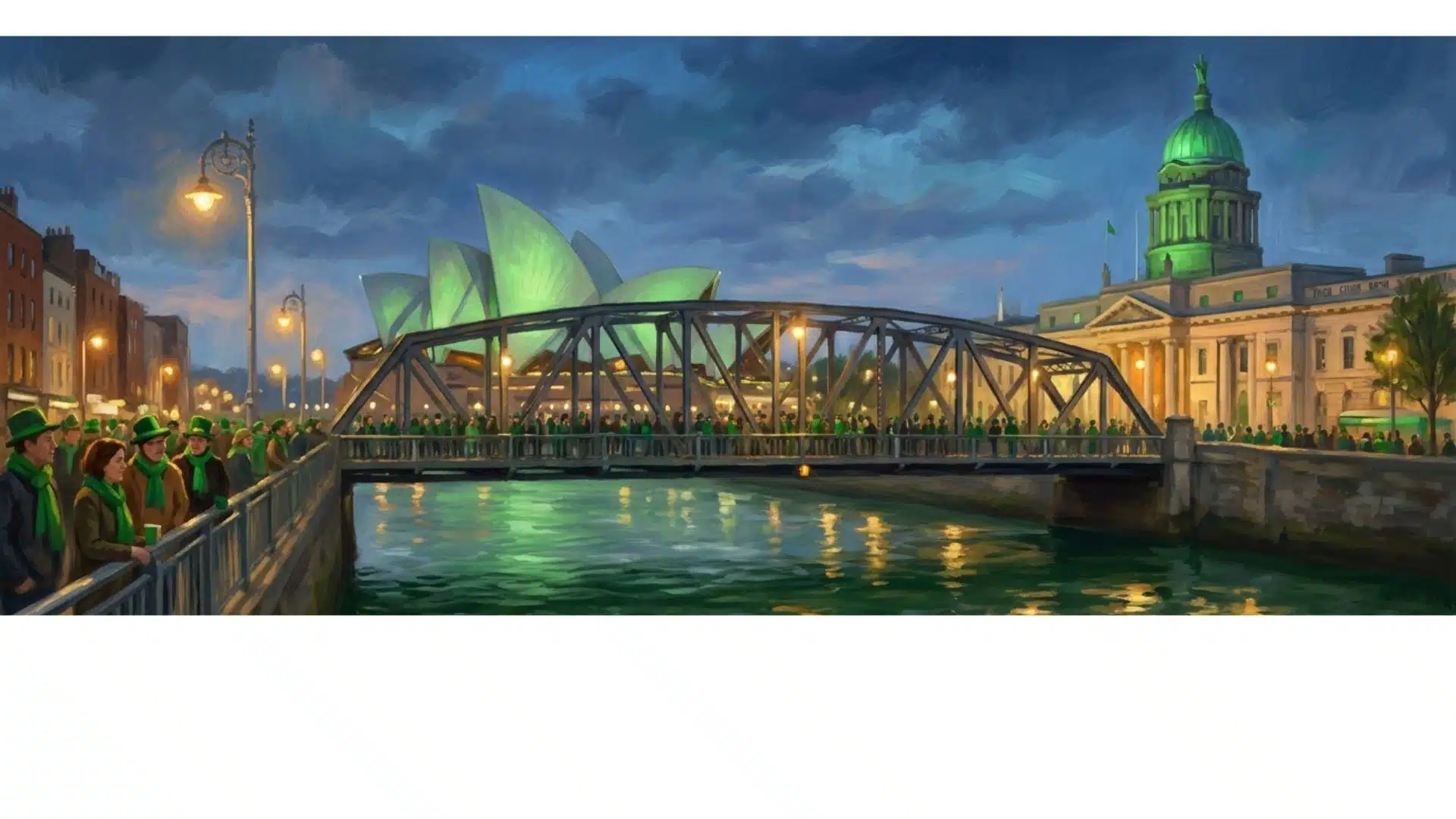
The Global Greening is Tourism Ireland’s campaign to light famous buildings and monuments green for St Patrick’s Day, and it started in Sydney in 2010. That year marked 200 years since Lachlan Macquarie, Governor of New South Wales, declared 17 March a day of celebration for Sydney’s largely Irish convict workers. Tourism Ireland asked for the Sydney Opera House to be lit green in honour of the bicentenary. Auckland’s Sky Tower joined it, and those two sites were the whole campaign in its first year.
The idea spread quickly because it cost little and photographed well. Within a few years, the Empire State Building, the London Eye, the Colosseum in Rome and Christ the Redeemer in Rio de Janeiro had all taken part. Local Irish communities and embassies did much of the work, asking site owners one by one.
The campaign has not run in a straight line. In 2023, Tourism Ireland chose not to promote the Global Greening because of the energy crisis. In January 2024, RTÉ reported that the Cabinet had been told the tourism body would stop promoting it, leaving individual embassies free to arrange greenings in their own countries. The Sydney Opera House stayed green regardless, with support from the New South Wales government and Sydney’s St Patrick’s Day organisers.
By March 2026, the campaign was running again at full scale. More than 400 sites lit up that year, including several new or returning names.
| Landmark | City and country | Why it matters |
|---|---|---|
| Sydney Opera House | Sydney, Australia | The first site to go green, on 17 March 2010 |
| Sky Tower | Auckland, New Zealand | Lit alongside Sydney in the first year |
| Empire State Building | New York, USA | Returned to the line-up in 2026 |
| Leaning Tower of Pisa | Pisa, Italy | Part of the 2026 Global Greening |
| Niagara Falls | Canada and USA border | Part of the 2026 Global Greening |
| CN Tower | Toronto, Canada | Part of the 2026 Global Greening |
| Grand Place | Brussels, Belgium | Part of the 2026 Global Greening |
| Gateshead Millennium Bridge | Gateshead, England | Part of the 2026 Global Greening |
| National Wallace Monument | Stirling, Scotland | Part of the 2026 Global Greening |
| Belfast City Hall | Belfast, Northern Ireland | Lit green by the city each St Patrick’s Day |
Belfast City Hall deserves a mention of its own. The building is lit in different colours to mark events through the year. It glows green for St Patrick’s Day, as ConnollyCove’s guide to Belfast City Hall’s history and lighting describes. If you only see one greening in person, this is one of the easiest to reach, since it sits right in the city centre.
How Do Ireland’s Own Cities Celebrate St Patrick’s Day?

Ireland celebrates St Patrick’s Day with a mix of big-city festival and older, quieter local custom. Dublin hosts the largest event on the island. Northern Ireland marks the day in Belfast and in the towns most closely tied to the saint. Across rural Ireland, parish parades and church services keep the feast day’s original character.
Dublin: The St Patrick’s Festival
Dublin’s St Patrick’s Festival is Ireland’s official national celebration, and it runs over several days around 17 March. The Irish government set the festival up in November 1995, and the first one took place on 17 March 1996. It grew to three days in 1997 and to five days by 2006. The official St Patrick’s Festival website lists the 2027 programme as running from Saturday 13 March to Wednesday 17 March.
The parade is the centrepiece. In 2024, around 500,000 people turned out to watch it. The route has traditionally passed along O’Connell Street, Dublin’s main boulevard, where the crowds are thickest. Dublin’s parade uses pageant companies, large puppets and themed performance, so it looks quite different from the marching format you’ll see in New York.
The festival also has a strong cultural programme beyond the parade. Walking tours, music, céilí dances and street performance fill the days before 17 March. The weeks around the feast day also bring Seachtain na Gaeilge, a festival of the Irish language, so you’ll hear more Irish spoken and see more of it on posters. For practical planning, ConnollyCove’s Dublin travel guide covers where to stay and how to get around.
Belfast and Northern Ireland
St Patrick’s Day is a bank holiday in Northern Ireland, and the celebrations there carry both festival energy and a strong sense of place. Belfast holds a city-centre parade and events, and City Hall is lit green in the evening. ConnollyCove’s guide to St Patrick’s Day in Northern Ireland covers the region’s parades and religious observances in detail.
Downpatrick in County Down is the place with the deepest claim on the day. The town’s name comes from the Irish Dún Pádraig, meaning Patrick’s fort, and tradition holds that the saint is buried in the grounds of Down Cathedral. Downpatrick marks 17 March with an annual cross-community parade through the town centre, and its celebrations have grown to fill a whole week. Our Downpatrick town guide covers the town, and the guide to Down Cathedral and St Patrick’s grave explains what you’ll find at the graveside.
“When friends visit for St Patrick’s Day, we send them to Downpatrick in the morning for the parade past the saint’s grave. Then it’s back to Belfast to see City Hall lit green that night. You get the old feast day and the modern festival in a single day, less than an hour apart.” , Ciaran Connolly, Founder of ConnollyCove
Rural Ireland and the Older Feast Day
Outside the cities, St Patrick’s Day still looks much as it did a century ago. Most towns and villages hold a small parade featuring the local school, sports clubs, farm machinery and whoever else wants to take part. Many families attend Mass in the morning. Older people still pin a bunch of real shamrock to a coat, and in Irish the day is Lá Fhéile Pádraig, the day of Patrick’s feast.
Visitors sometimes expect a mountain pilgrimage on 17 March, since Croagh Patrick in County Mayo is so closely tied to the saint. The mountain’s main pilgrimage, Reek Sunday, actually falls on the last Sunday of July. In March, the climb is quieter and the weather far less predictable, so check conditions before setting out.
How Is St Patrick’s Day Celebrated in North America?
North America is home to the oldest parade and the most famous single spectacle in the St Patrick’s Day calendar. Both grew out of large Irish communities that arrived in the eighteenth and nineteenth centuries. ConnollyCove’s account of the folklore and traditions carried by the Irish diaspora shows how much of Irish culture travelled in the same ships.
New York: The Oldest Parade in the World
New York’s parade is the oldest and largest St Patrick’s Day parade in the world, according to its organisers. It first marched on 17 March 1762, fourteen years before the Declaration of Independence, led by homesick Irish expatriates and Irish soldiers serving in the British Army. Around 150,000 people now march up Fifth Avenue from East 44th Street to East 79th Street, watched by roughly two million spectators.
Two rules give New York’s parade its character. It bans floats and cars, so everyone who takes part walks. It also passes St Patrick’s Cathedral, where the Archbishop of New York reviews the marchers from the steps. The 69th Infantry Regiment has led the parade since around 1851, followed by the county societies, Irish-language groups and schools. The parade steps off at 11am on 17 March, moving to the Saturday before when the date falls on a Sunday.
Chicago: The Green River
Chicago dyes its river green on the Saturday before St Patrick’s Day, a tradition that started in 1962. The story, as told by Chicago Plumbers Local 130, goes back to 1961. Business manager Stephen Bailey noticed a plumber’s white overalls stained a bright green by the dye the union used to trace leaks into the river. The union put 100 pounds of dye in the river the following year, and the water stayed green for about a week.
The modern version is shorter. Boats from Local 130 release a plant-based powder between Columbus Drive and State Street at around 10am. The powder looks orange on the surface before the water turns green within minutes, and the colour lasts a few hours. The city’s downtown parade follows at midday. The union keeps the exact formula a secret, and the river dyeing is free to watch, though the bridges fill up early.
Canada and the Rest of the Continent
Canada’s celebrations reflect a long Irish presence, especially in Atlantic Canada and Ontario. Toronto and Montreal both hold large parades, and the CN Tower and Niagara Falls have both gone green for the Global Greening. ConnollyCove’s guide to Irish-Canadian heritage covers the communities and organisations behind these events. Further south, Boston and Savannah hold large parades of their own, each shaped by the city’s particular Irish history.
How Does Britain Celebrate St Patrick’s Day?

Britain has one of the largest Irish-descended populations in the world, yet its celebrations get far less attention than America’s. London’s festival is the biggest. The Mayor of London’s office says the capital has the largest Irish community in the UK, and it organises a free parade and festival each year.
London: Trafalgar Square
London usually holds its St Patrick’s Day parade and festival on the Sunday nearest 17 March. In 2026 it took place on Sunday 15 March. The parade leaves from the Hyde Park Corner and Green Park area at midday, passes along Piccadilly, St James’s Street, Pall Mall and Whitehall, and ends in Trafalgar Square. The Mayor’s office expected more than 50,000 people to join the 2026 procession, which was led by Grand Marshal Emma Dabiri, the Irish writer and broadcaster.
Trafalgar Square hosts music, dance, comedy and food stalls through the afternoon. The Irish County Associations march with their banners, which makes London’s parade a good place to see the diaspora’s county loyalties on display.
Liverpool and Other UK Cities
Liverpool’s Irish connection runs deep. By the 1851 census, more than 20% of the city’s population was Irish, and the city also served as a staging post for emigrants heading to North America. ConnollyCove’s guide to Liverpool’s Irish heritage covers how that shaped the city, from its accent to its churches. Liverpool, Birmingham and Manchester all hold St Patrick’s Day events, and in Britain those events are often led by Irish community centres and county associations.
How Do Australia and the Southern Hemisphere Celebrate?
Australia’s St Patrick’s Day tradition is one of the oldest outside Ireland, and it began in a penal colony. Governor Macquarie’s 1810 declaration made 17 March a day of music and celebration for Irish convicts in Sydney. That history is why the Sydney Opera House became the first building to go green two centuries later. Sydney and Melbourne both hold parades and festivals, and the Opera House greening has become an annual fixture.
Some of the most interesting celebrations happen far from the big cities. On the Caribbean island of Montserrat, St Patrick’s Day is a public holiday that also commemorates an uprising by enslaved people. ConnollyCove’s guide to unusual St Patrick’s Day celebrations worldwide covers Montserrat, Nigeria and Japan in detail.
Comparing St Patrick’s Day Around the World
This table compares the signature tradition in each major city, so you can decide which suits the trip you have in mind.
| City | Signature tradition | Usual date | Best for |
|---|---|---|---|
| Dublin | Five-day St Patrick’s Festival with a pageant-style parade | Several days up to and including 17 March | Travellers who want the national celebration and a full cultural programme |
| Downpatrick | Cross-community parade near St Patrick’s grave | 17 March, with events across the week | Visitors interested in the saint’s history |
| Belfast | City parade and a green-lit City Hall | 17 March (bank holiday) | Combining a city break with Downpatrick |
| New York | The world’s oldest parade, marchers only, no floats | 17 March (Saturday before if the date is a Sunday) | Scale and history |
| Chicago | Green river followed by a downtown parade | Saturday before 17 March | The most photographed single spectacle |
| London | Mayor’s parade ending in Trafalgar Square | Usually the Sunday nearest 17 March | A free festival within easy reach of Ireland |
| Sydney | Opera House greening and a city festival | Around 17 March | Travellers already in Australia |
What Symbols Tie the Celebrations Together?
Green, the shamrock and Irish music appear in almost every city’s celebration, but each has a more interesting story than the costume shops suggest. Knowing a little of the background makes the day more rewarding to watch.
Why Is Everything Green and Not Blue?
Green became the colour of St Patrick’s Day through Irish nationalism, while the blue often called St Patrick’s blue came from an order of chivalry. King George III founded the Order of St Patrick in 1783, and its knights wore a sky-blue mantle and sash. Historians still debate how far blue was linked to Ireland or to Patrick before that date.
Green, by contrast, gathered its meaning from below. During the 1798 Rebellion, wearing a shamrock or green ribbon became a way of showing support for the Irish cause. The song “The Wearing of the Green” carried that meaning onwards. The shamrock itself is tied to the legend that Patrick used its three leaves to explain the Holy Trinity. The word comes from the Irish seamróg, meaning young clover.
Leprechauns, Music and Dance
The leprechaun is the figure most often seen in St Patrick’s Day parades abroad, yet it has nothing to do with the saint. It comes from Irish fairy lore, where the leprechaun is a solitary shoemaker with a talent for mischief. ConnollyCove’s guide to leprechauns and the little people of Irish folklore explains where the character came from before it became a cartoon.
Music and dance carry more of the real tradition. Emigrants took whole regional repertoires of tunes with them, and a feis or céilí in Chicago follows the same forms as one in Cork. Our guides to Irish folk music and live sessions and the different forms of Irish dance will help you recognise what you’re watching.
Planning a St Patrick’s Day City Trip
The single most useful planning step is to check the exact date of the celebration in your chosen city, because not every city celebrates on 17 March. London usually uses the nearest Sunday, Chicago dyes its river on the Saturday before, and Dublin spreads its festival over several days. Get the date right before you book anything.
Book early. Flights and hotels in Dublin, Belfast and New York fill quickly for mid-March, and prices rise as the date approaches. Travellers heading to Dublin should book accommodation several months ahead if possible.
Pack for changeable weather. Mid-March in Ireland and Britain is usually cool, often wet and occasionally bright. Bring layers, a waterproof jacket and comfortable shoes, since you’ll spend hours standing or walking.
Arrive early for the best spots. Parade routes fill up well before the start. In Chicago, the bridges and riverbanks near the dyeing are crowded by mid-morning. In New York, the area around St Patrick’s Cathedral is among the busiest points on the route.
Expect transport changes. Cities close roads for parades, and public transport runs on altered routes. Check the local transport operator’s updates on the morning itself.
Treat it as a feast day as well as a festival. Churches hold services on 17 March. In places like Downpatrick, the day has real religious meaning for local families. A little respect goes a long way.
Add a heritage stop. In Dublin, EPIC The Irish Emigration Museum tells the story of the people who took St Patrick’s Day overseas. In Belfast, ConnollyCove’s guide to the city of Belfast suggests where to spend the days around the parade.
If you want a phrase or two to carry with you, our collection of traditional Irish proverbs and their meanings is a good place to start. Beannachtaí na Féile Pádraig (Saint Patrick’s Day blessings) is the standard greeting in Irish.
Explore More Irish Heritage
St Patrick’s Day around the world reflects the reach of the Irish diaspora, and each city’s celebration carries its own piece of that history. Dublin offers the national festival, Downpatrick the saint’s own town, New York the oldest parade and Chicago the green river. Whichever you choose, check the local date first and give yourself time for the heritage sites around it.
ConnollyCove covers Irish traditions, language and cultural experiences to help travellers connect with Ireland beyond the postcard version. Explore our guides to Saint Patrick’s life, the Irish diaspora and Northern Ireland’s heritage towns, or watch our YouTube videos documenting Irish heritage firsthand.
FAQs
Which city has the biggest St Patrick’s Day parade in the world?
New York holds the largest and oldest St Patrick’s Day parade in the world, according to its organisers. Around 150,000 people march up Fifth Avenue in front of roughly two million spectators. Dublin’s parade is the largest in Ireland.
Why does Chicago dye its river green?
It began with an accident in 1961, when Chicago Plumbers Local 130 noticed that its leak-tracing dye turned the water bright green. The union has dyed the river every year since 1962, on the Saturday before St Patrick’s Day.
What is the Global Greening, and does it still happen?
The Global Greening is Tourism Ireland’s campaign to light famous landmarks green for St Patrick’s Day. It began in Sydney in 2010 and was paused in 2023. By March 2026, it was running again, with more than 400 sites taking part.
How do you say St Patrick’s Day in Irish?
St Patrick’s Day in Irish is Lá Fhéile Pádraig, roughly pronounced “law ay-leh paw-drig”. Pronunciation varies by dialect. The usual greeting is Beannachtaí na Féile Pádraig, meaning St Patrick’s Day blessings.