

Article Summary
What this article covers: The traditional Irish festivals that still run every year, organised by season and by county, with the ancient Gaelic roots behind them and practical guidance on when to book.
Who this is for: Travellers planning a trip to Ireland around a specific celebration, people with Irish heritage looking for the traditions their family came from, and anyone trying to work out which Irish festival is worth building a week around.
Key takeaway: Ireland’s festival calendar still follows the shape of the old Gaelic farming year, which is why the biggest traditional Irish festivals cluster around early February, May, August and the end of October rather than around the summer months most visitors book.
Expert insight: “I stood in the square at Killorglin one August watching a wild goat hoisted up onto a scaffold stand above the crowd, and what struck me was how ordinary everyone treated it. Nobody was performing for the visitors. That is the difference between an Irish festival that survived and one that was invented for tourism, and you can feel which is which about ten minutes after you arrive.” , Ciaran Connolly, Founder of ConnollyCove
Quick facts:
- Puck Fair in Killorglin, County Kerry, crowns a wild mountain goat as King Puck across three days every August, under the titles Gathering Day, Fair Day and Scattering Day.
- Fleadh Cheoil na hÉireann, run by Comhaltas Ceoltóirí Éireann, moves to a different host town each year and is the largest traditional Irish music gathering held anywhere.
- The Schools’ Collection at the National Folklore Collection, gathered by Irish primary school children between 1937 and 1939, records local festival and seasonal customs parish by parish and is free to search online.
Ask ten people to name an Irish festival and nine will say St Patrick’s Day. Fair enough. But the calendar runs to hundreds of entries in any given year. The ones that tell you most about the country are rarely the ones with the parade permits. A wild goat is crowned king of a Kerry town every August. A matchmaker in County Clare still works from a leather ledger his family has kept since the 1800s. Musicians take over an entire midlands town for a week and play in car parks because the pubs are full.
This guide covers the traditional Irish festivals that still run, when they happen, and which county to be in. It is organised the way you would actually plan a trip: by season first, then by place. Where a celebration grew out of something older, we say so and point you to the deeper piece. That starts with the four ancient Gaelic festivals, which still set the rhythm of the whole calendar.
ConnollyCove is an Ireland-based travel and culture platform, and festivals are where most of our Irish coverage begins. A festival is the one moment a community explains itself out loud to anyone who turns up.
Table of Contents
What Makes Irish Festivals Different
Irish festivals are organised around the agricultural year rather than around the church year or the tourist season, and that single fact explains most of the calendar. The four turning points of the old Gaelic year fall at the start of February, May, August and November, roughly halfway between each solstice and equinox. Christianity absorbed them rather than replaced them, so the dates stayed put while the names changed.
That is why so many of these dates land at moments that make no sense for a modern holiday. Puck Fair falls in the second week of August because that is when the harvest fair was. Lisdoonvarna’s matchmaking season runs through September because that is when the farm work eased off. The pattern holds across the country, and it holds in the folklore too. The origins of Celtic festivals are agricultural before they are religious.
The second difference is scale. Most of these celebrations are small on purpose. A town of two thousand people runs a four-day event with a committee of volunteers, and the whole thing works because everybody knows everybody. Ciaran Connolly, Founder of ConnollyCove, has covered dozens of them. The pattern he describes is consistent: the smaller the town, the more likely you are to end up in somebody’s kitchen by the second night.
The Four Gaelic Turning Points, Briefly
The four ancient festivals of the Gaelic year deserve more room than this article can give them, so here is the short version with a route to the detail. Each one marks a quarter day, and each one has a modern descendant you can still attend.
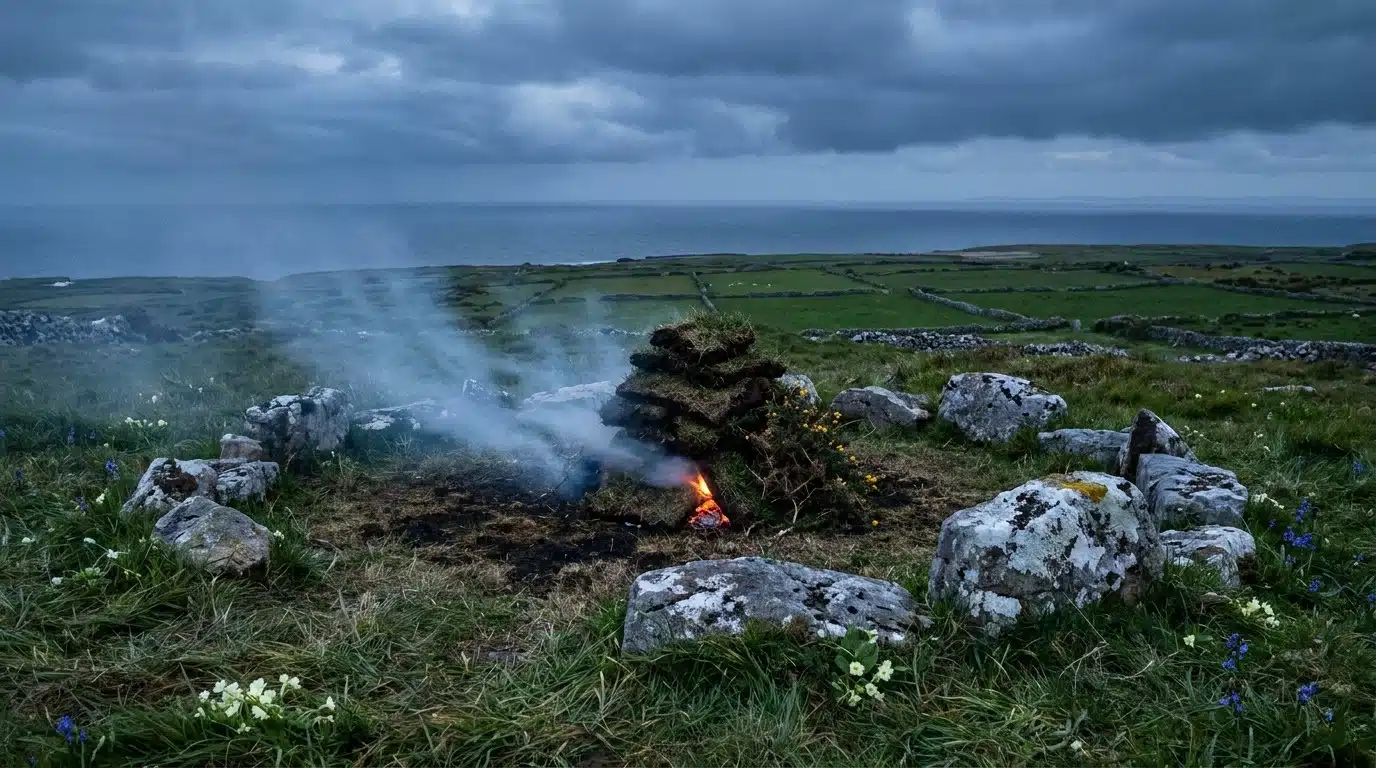
Imbolc falls on 1 February and marks the start of spring. It carries the goddess Brigid into St Brigid’s Day, which became a public holiday in the Republic in 2023. Bealtaine, pronounced BYOWL-tin-uh, falls on 1 May and is the fire festival that opened the grazing season. The Beltane fire traditions survive in bonfire customs across the midlands and in the ceremonial fire lit on the Hill of Uisneach in County Westmeath.
Lughnasadh, pronounced LOO-nuh-suh, opens the harvest on 1 August and is the direct ancestor of the August fair season, Puck Fair included. Read the fuller account of Lughnasadh celebrations in Ireland for the hilltop pilgrimages and the Lugh mythology behind it.
Samhain, pronounced SOW-in, falls on 31 October and closes the harvest. It is the origin of Halloween, and it is the reason Derry runs what is now one of Europe’s largest Halloween celebrations. The ancient Samhain rituals go into the ancestor customs and the fire practices in detail.
Traditional Irish Festivals That Still Run Every Year
Four traditional celebrations have run continuously long enough to be considered part of the national furniture: Puck Fair, the Lisdoonvarna Matchmaking Festival, Fleadh Cheoil na hÉireann and Bloomsday. Each one is genuinely old, each one still runs on community effort rather than corporate sponsorship, and each is worth planning a trip around.
They are very different from each other, which is the point. A goat fair, a marriage market, a music competition and a literary walking day tell you more about Ireland together than any single event could.
Puck Fair, Killorglin, County Kerry
Puck Fair crowns a wild mountain goat as King Puck over three days every August, and it is among the oldest fairs in Ireland. The days are named Gathering Day, Fair Day and Scattering Day. A goat is caught in the MacGillycuddy’s Reeks and brought into the town square. A local schoolgirl crowns him, he is raised onto a stand above the crowd, and he goes back to the mountains at the end.
The town of Killorglin does not scale itself up for visitors, which means accommodation across the Iveragh Peninsula tightens badly in early August. Book by spring. The surrounding folklore tales from County Kerry explain much of why the goat is there at all. Locals will give you three competing origin stories before lunch.
Lisdoonvarna Matchmaking Festival, County Clare
The Lisdoonvarna Matchmaking Festival runs across September in a small spa town in County Clare and is Europe’s longest-running event of its kind. It began when farmers came to the spa waters after the harvest and used the gathering to arrange marriages. A working matchmaker still operates from a pub in the town.
The festival now draws several tens of thousands of people across the month, with music from mid-morning until late. It sits close enough to the Burren and the Cliffs of Moher that a festival trip doubles as a coastal one. This is a tradition that is still practised rather than re-enacted, which is rarer than it sounds.
Fleadh Cheoil na hÉireann
Fleadh Cheoil na hÉireann, pronounced roughly flah KYOH-il, is the largest traditional Irish music festival held anywhere, and it moves to a new host town each August. Comhaltas Ceoltóirí Éireann runs it as a competition structure with county and provincial rounds feeding into the national final.
The competitions are only part of it. The street sessions and the informal playing are what most visitors remember, and they run more or less continuously for a week. Host towns are announced well in advance and their accommodation sells out roughly a year ahead, so the practical advice is to book the moment the host town is confirmed. If you want the year-round version rather than the festival week, live traditional music in Belfast covers the session pubs that run regardless of the calendar.
Bloomsday, Dublin
Bloomsday takes place on 16 June and follows the route of Leopold Bloom through Dublin as set out in Ulysses. It is a celebration rather than a solemn commemoration, which the original article got wrong; participants dress in Edwardian costume, eat gorgonzola sandwiches and read aloud in the street.
Readings and walking routes are scattered across the city centre and most are free. Anyone unfamiliar with the novel can still enjoy the day. The background on James Joyce helps a great deal with knowing why a group of adults is queuing outside a chemist on Lincoln Place.
Irish Festivals by Season and County
The best month for Irish festivals is August, followed by July and late September, and the worst is January. Ireland’s festival season is genuinely seasonal, and knowing the shape of it saves a wasted trip. The table below covers the traditional and cultural events with the longest track records.
| Season | Festival | County | Focus |
|---|---|---|---|
| February | St Brigid’s Day | Nationwide, Kildare | Heritage, crosses |
| March | St Patrick’s Festival | Nationwide, Dublin | Parades, culture |
| May | Bealtaine fires, Uisneach | Westmeath | Ancient, fire |
| June | Bloomsday | Dublin | Literature |
| June | Sea Sessions | Donegal | Music, surf |
| July | Willie Clancy Summer School | Clare | Traditional music |
| July | Galway International Arts Festival | Galway | Arts, theatre |
| July | West Cork Literary Festival | Cork | Literature |
| August | Puck Fair | Kerry | Heritage, fair |
| August | Fleadh Cheoil na hÉireann | Rotates | Traditional music |
| September | Lisdoonvarna Matchmaking | Clare | Heritage, music |
| September | Galway Oyster Festival | Galway | Food |
| September | Cape Clear Storytelling | Cork | Storytelling |
| October | Derry Halloween | Derry | Samhain, costume |
| October | Wexford Festival Opera | Wexford | Opera |
| October | Belfast International Arts Festival | Antrim | Arts |
Regional character matters as much as the calendar. What follows is the county-level view, because a festival in Ireland is inseparable from the place that runs it.
The West: Galway, Clare and the Islands
Galway city runs the densest festival programme in the Republic outside Dublin, with the arts festival in July and the oyster festival in late September as the two anchors. The city is compact enough that a festival takes the whole place over rather than occupying a venue.
County Clare is the traditional music county. Miltown Malbay hosts the Willie Clancy Summer School each July, which functions as a teaching week as much as a festival. The standard of playing in the pubs afterwards is the highest you will hear anywhere. If a session is running, sit down, buy a drink and do not talk over the tunes.
The Aran Islands run two smaller events that reward the ferry trip. Féile na gCloch on Inis Oírr is a dry-stone walling festival where builders come from several countries to work on the island’s walls. Tedfest on Inis Mór is an affectionate tribute to the television series Father Ted. Both are small, both sell out, and both are far easier to attend if you are already planning to visit Ireland’s islands.
Donegal, Sligo and the North West
Donegal’s festival season is short and concentrated into summer, because the weather makes anything else unwise. Sea Sessions in Bundoran in late June combines music with surfing competitions on the Atlantic coast, and it draws a much younger crowd than the traditional festivals further south.
Sligo trades on literature and scenery, with Yeats-centred programming through the summer. The county’s storytelling tradition remains strong, and the legends of County Donegal next door share most of the same material. Local guides recommend pairing a festival weekend here with a coastal drive, since the driving distances are longer than the map suggests.
Northern Ireland: Derry and Belfast
Derry runs the largest Halloween celebration in Ireland and one of the largest in Europe, built directly on the Samhain inheritance. The city centre becomes a costumed carnival across several days at the end of October, with a river fireworks display and a parade through the walled city. Full details on Derry’s Halloween celebrations and how the city organises the week are worth reading before you book, because hotels inside the walls go early.
Belfast’s calendar peaks twice, with the Festival of Fools street theatre event in May and the Belfast International Arts Festival in October. The Maritime Festival brings tall ships to the Titanic Quarter. For the wider seasonal picture across the six counties, Halloween events across Northern Ireland covers the smaller town celebrations that sit around the Derry programme.
Food, Drink and Craft Celebrations

Food festivals in Ireland have grown faster than any other category in the last fifteen years. The strongest of them are tied to a single product and a single place. The Galway International Oyster and Seafood Festival in late September is the oldest, and it pairs native oysters with an oyster-opening championship.
Smaller county events follow the same logic: a harvest, a catch or a craft, celebrated where it is produced. Several build in demonstrations of traditional Irish crafts such as basket weaving, thatching and dry-stone walling, and these are usually the least crowded part of any programme.
Markets sit alongside the festival calendar rather than inside it, and they are the reliable option if your dates do not line up with anything. The weekend craft markets in Ireland run year-round in most sizeable towns, and many of the same makers who trade at festivals trade there too.
Food is its own route into the culture. The regional dishes covered in traditional Irish food show up on festival stalls far more often than they show up on restaurant menus.
Planning a Trip Around a Festival in Ireland
Book accommodation six to nine months ahead for any named festival in Ireland, and a full year ahead for the Fleadh. This is the single piece of advice that most visitors ignore and most regret. Small towns have small bed stocks, and a festival that draws twenty thousand people into a town of two thousand does not magic up rooms.
Three further practicalities are worth knowing before you travel.
Staying in a neighbouring town is the standard local workaround. Prices in the host town can climb steeply during festival week, while a place fifteen kilometres away often stays close to normal. Rural bus services thin out in the evenings, so plan the return leg before you go.
Weather is the other constant. Festivals here run in the rain because otherwise they would not run, so waterproofs and boots matter more than anything else you pack. Layers work better than a single heavy coat, since venues run warm and streets run cold.
Etiquette at a traditional music session is simple and worth respecting. Musicians are playing for each other, not for the room. Do not clap over a tune, do not request songs, and do not film without asking. The same applies at storytelling events, where the tradition of the seanchaí carries genuine weight. The background in the craft of Irish storytelling explains why the form is treated so seriously.
For research into what a specific parish celebrated historically, go to the National Folklore Collection at University College Dublin. It has digitised the Schools’ Collection, gathered from primary school children across Ireland between 1937 and 1939. The archive is searchable by townland, and it is the closest thing to a public primary source on local Irish celebrations.
What Else to Build Into the Trip
Festivals are one entry point into Irish culture and they connect outward to several others. Matches and county rivalries run through the summer under the Gaelic Athletic Association. A championship weekend has much the same atmosphere if you cannot make the festival dates work.
The public holiday calendar is worth checking alongside the festival calendar, since several of the traditional dates now carry a day off. Irish public holidays and traditions sets out which is which.
Dance is the other thread running through almost every traditional event. Irish dance covers the competitive and social forms you will see at a fleadh.
Frequently Asked Questions
These are the questions readers ask most often about Irish festivals, taken from live search data and from the queries this page already appears for. Answers are kept short enough to be useful before you book.
What are the four main Irish festivals?
The four main ancient Irish festivals are Samhain, Imbolc, Bealtaine and Lughnasadh, the quarter days of the Gaelic year. Samhain falls on 31 October and marks the end of harvest. Imbolc on 1 February marks the start of spring. Bealtaine on 1 May opens the grazing season, and Lughnasadh on 1 August begins the harvest. Each sits roughly midway between a solstice and an equinox, which is why they do not line up with the modern seasons. They remain the framework the rest of the calendar is built on, and several modern celebrations sit directly on top of them.
What is the biggest festival in Ireland?
St Patrick’s Festival in Dublin is the largest festival in Ireland by attendance, running across several days around 17 March with a parade, street performance and city-wide programming. Fleadh Cheoil na hÉireann draws comparable numbers into a much smaller host town each August, which makes it feel considerably larger. Derry Halloween is the biggest event in Northern Ireland and among the largest Halloween celebrations in Europe. For sheer density of people relative to the size of the place, the Fleadh has no competition anywhere in the country.
How do you pronounce Fleadh Cheoil?
Fleadh Cheoil is pronounced roughly flah KYOH-il, and it means “festival of music” in Irish. Fleadh on its own means a feast or festival, and ceoil is the genitive form of ceol, music. The full name, Fleadh Cheoil na hÉireann, means the music festival of Ireland. Nobody will mind if you get it slightly wrong, and the vowel shifts between Donegal and Clare. The first syllable rhymes with “blah” rather than “flee”.
What festivals are on in Ireland in September?
September is one of the strongest months for Irish festivals, led by the Lisdoonvarna Matchmaking Festival in County Clare, which runs across most of the month. The Galway International Oyster and Seafood Festival falls in late September, and the Cape Clear International Storytelling Festival takes place on the island off West Cork in early September. The weather is often better than August and the crowds are lighter, which makes it a good month for a first festival trip. Accommodation still needs booking well ahead in Lisdoonvarna and on Cape Clear.
Are Irish festivals family friendly?
Most Irish festivals are family friendly during daytime hours, with separate evening programming that is aimed at adults. Puck Fair, Derry Halloween, the Galway arts festival and the Fleadh all run substantial daytime schedules for children, including street performance, workshops and parades. The exceptions are the music-and-camping festivals such as Sea Sessions, which are built around a younger crowd. As a rule, if a festival has heritage or arts in its name it will suit families, and if it has a campsite it will not.
Is Ireland expensive during festival season?
Accommodation prices in a host town commonly double or triple during a major festival, while everything else stays close to normal. Food, drink and transport do not move much; the bed is where the cost sits. Staying in a neighbouring town and driving or taking a bus in is the standard approach and can halve the total. Many of the traditional Irish festivals themselves are free to attend, including street sessions at the Fleadh, most Bloomsday readings and the bulk of the Puck Fair programme.
What is the oldest festival in Ireland?
Puck Fair in Killorglin, County Kerry, is generally described as the oldest surviving fair in Ireland. Its charter dates to the early seventeenth century, and folk tradition claims considerably older roots. The four Gaelic quarter days are older still as observances, though they were not continuous public events in the modern sense. Ballycastle’s Ould Lammas Fair in County Antrim, held each August, is another contender with a long documented history. Claims of antiquity in this area are worth treating with mild scepticism.
Where can I find records of local Irish festivals and customs?
The National Folklore Collection at University College Dublin is the best public source, and its Schools’ Collection is searchable free online by townland. Between 1937 and 1939, primary school children across Ireland recorded local customs, seasonal celebrations, games and beliefs from their families and neighbours. Searching your own family’s parish often turns up the specific festival practices that were alive there within living memory. County museums and local heritage centres hold further material and can usually point you to a local history society.
Do Irish festivals happen in winter?
Winter is the quietest season for Irish festivals, with activity concentrated around the winter solstice, Christmas and New Year rather than spread through the months. The solstice alignment at Newgrange in County Meath draws international attention each December, and the customs around the winter solstice in Ireland predate every other date on this calendar. Wren Day on 26 December survives in parts of Kerry, Clare and Dingle, where groups in straw costume go door to door with music. Beyond that, most of the country waits for St Brigid’s Day in February.
Where to Go From Here
Ireland’s festival calendar rewards planning more than spontaneity, and the celebrations covered here are the ones most worth building a trip around. Pick the season first, then the county, then book the bed before anything else. If a particular tradition has caught your interest, the deeper background is usually where the trip properly begins.
ConnollyCove covers Irish heritage, Celtic mythology and travel across Ireland and beyond. Ciaran Connolly founded it to give travellers the cultural context that guidebooks skip.
Start with the four ancient Gaelic festivals for the roots of the calendar.
For the customs and beliefs that grew up around them, go to Irish traditions.
Then subscribe to the ConnollyCove YouTube channel for video coverage from around the country.