
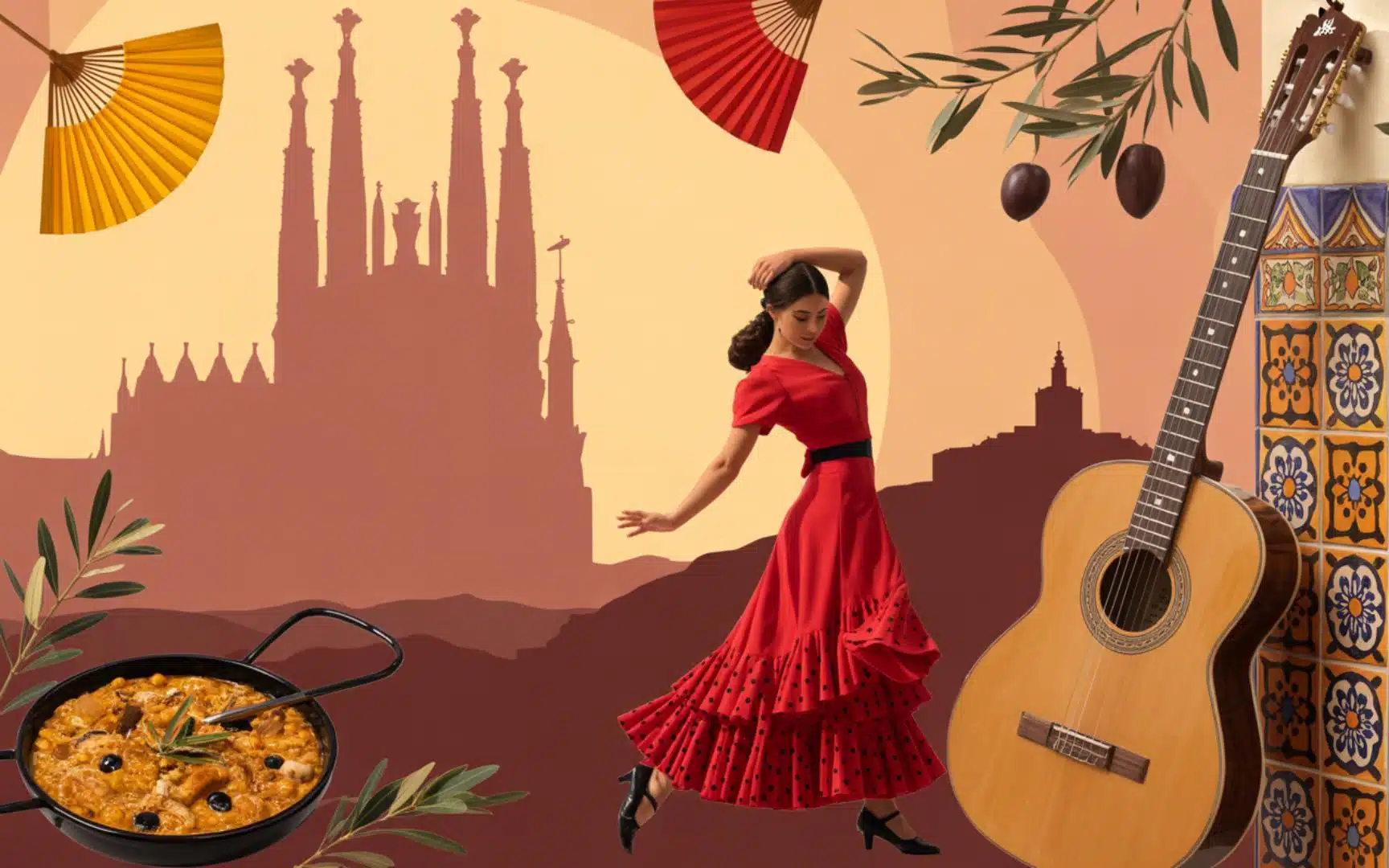

The flamenco guitar’s rhythmic strum fills the air. Garlic shrimp sizzle in olive oil. Laughter echoes through sun-drenched plazas. This is Spain—not the postcard version of endless siestas and sangria, but the real, complex nation that exists beyond the stereotypes.
Spain is a country of stark contrasts. The rainy, Celtic-influenced north feels worlds apart from the Moorish south. Barcelona’s Catalan identity differs fundamentally from Andalusia’s temperament. Understanding these regional nuances matters whether you’re planning a holiday or creating cultural content about this diverse nation.
At ConnollyCove, we’ve spent years documenting Spanish culture through video production and photography across Spain’s autonomous communities. This guide draws from that hands-on experience to help you understand the cultural codes that make Spain unique.
Table of Contents
Spain’s Regional Cultural Identity
Spain is not a cultural monolith. Locals often identify with their region first and the nation second. This impacts language, food, social temperament, and business practices.
The Cultural Divide: North, South, and Centre
The North (Galicia, Asturias, Basque Country) shares more with Ireland and Wales than the Mediterranean south. The Atlantic climate creates lush landscapes. Culture here is reserved and hardworking. In the Basque Country, gastronomy operates almost like religion, with social life revolving around txokos—private gastronomic societies. Galicia’s Celtic heritage manifests in bagpipe music and a language remarkably similar to Portuguese.
The South (Andalusia, Murcia) gave birth to the stereotypes—flamenco, whitewashed villages, gazpacho. Eight centuries of Moorish influence created architectural wonders like Granada’s Alhambra whilst shaping the region’s relaxed perception of time. Don’t expect London punctuality here. Social connections take priority over rigid schedules.
The Centre (Madrid, Castile) acts as Spain’s cultural melting pot. Madrileños are intensely social and famously nocturnal. The “lazy Spaniard” stereotype dies quickly during rush hour on the Gran Vía.
Language Diversity
Whilst Castellano (Spanish) is spoken everywhere, four co-official languages exist. Catalan dominates in Catalonia, Valencia, and the Balearic Islands. A simple “Bon dia” instead of “Buenos días” in Barcelona demonstrates cultural awareness. Galician sounds like Portuguese because they share origins. Basque (Euskera) stands apart with no relation to any other language family. Valencian and Aranese round out the official regional languages.
Spanish History’s Cultural Imprint
Spain’s vibrant culture stems from centuries of diverse influences. Roman conquest in 218 BC brought Latin, which evolved into Spanish and other Iberian languages. Roman engineering left aqueducts still standing today.
The Moors’ arrival in 711 AD began 800 years of Islamic presence. They brought advanced mathematics, medicine, and architecture—Granada’s Alhambra stands as testimony. Hundreds of Spanish words beginning with “al” derive from Arabic: almohada (pillow), aceite (oil), azúcar sugar).
The Reconquista climaxed in 1492 when Catholic Monarchs conquered Granada, expelled Spain’s Jews, and commissioned Columbus’s voyage. Catholic identity became inseparable from Spanish identity.
Spain’s empire stretched globally, bringing enormous wealth during the Spanish Golden Age. Yet by the 20th century, civil war and Franco’s dictatorship until 1975 left Spain isolated. Franco’s death opened democracy. The 1978 Constitution granted regional autonomy, explaining modern Spain’s “plurinational” character. Spain transformed from a conservative dictatorship to a progressive democracy remarkably quickly, legalising same-sex marriage in 2005 and advancing gender equality laws significantly.
The Rhythm of Spanish Life
Spanish daily rhythms confuse many UK visitors. Understanding Spain’s unique relationship with time prevents frustration.
The Siesta Myth
The universal afternoon nap is largely mythical in modern Spain. In Madrid and Barcelona, corporate employees work straight through with short lunch breaks. What foreigners interpret as siesta is Spain’s extended midday break. Shops close because lunch happens late (14:00-15:30) and lasts two hours. This allows time for proper meals and digestion, not necessarily sleep.
Spanish Meal Times
Spanish schedules run about three hours later than UK patterns. Breakfast runs light—café con leche with toast. Lunch (14:00-15:30) is the main meal with three courses. Merienda (17:00-18:00) bridges the afternoon gap. Dinner (21:00-23:00) arrives late by UK standards but remains lighter than lunch.
Sobremesa—the time spent lingering after eating—represents Spain’s most important cultural concept. This isn’t wasted time; it’s when relationships deepen. Rushing away immediately after finishing marks you as foreign and possibly rude.
Social Etiquette and Customs
Spanish social norms differ enough from UK customs that understanding the rules prevents awkward moments.
The Dos Besos Greeting
The “two kisses” greeting confuses newcomers but follows clear rules. Touch cheeks whilst making a kissing sound—right cheek first, then left. Use dos besos for social introductions between women or men and women, greeting friends, and meeting your partner’s friends. Shake hands for business introductions and formal situations.
Dress Codes
Spaniards pay attention to appearance. Wearing swimwear, flip-flops, or being shirtless outside beach areas marks you as a tourist. Cover up properly when leaving coastal areas. Evening social situations require more effort than UK pub casual.
Tipping Culture
Spain doesn’t have mandatory tipping. Service is included in prices. Leave 5-10% at restaurants for good service. Round up taxi fares to the nearest euro. €0.50 at bars after table service suffices. Spanish servers earn proper wages, unlike American tipping-dependent compensation.
Volume and Personal Space
Spain is loud. Conversations run louder than UK standards. What feels like shouting is often just an animated conversation. Orderly British queues don’t exist the same way—establish your presence and make eye contact. Spaniards stand closer during conversation than Brits. What feels uncomfortably close is normal.
Spanish Gastronomy as Cultural Expression
Spanish food culture extends far beyond paella. Gastronomy operates as a social glue and cultural identity.
Tapas and Pintxos Culture
Tapas originated in Andalusia as small portions covering drinks. True tapas culture means moving between bars, having one or two tapas and a drink at each, socialising whilst standing. This isn’t just eating; it’s the primary social activity.
Pintxos dominate in the Basque Country—elaborate small bites on bread held with toothpicks. San Sebastián holds the world’s highest concentration of Michelin stars per square metre.
Regional Specialities
Galicia: Seafood heaven with percebes (gooseneck barnacles), pulpo a feira (octopus with paprika), and Albariño wine.
Basque Country: Bacalao (salt cod) features heavily. Gastronomic societies (txokos) are men-only cooking clubs.
Catalonia: Pan con tomate (pa amb tomàquet) appears at every meal. Barcelona’s restaurant scene pushes culinary boundaries.
Andalusia: Gazpacho, salmorejo, fried fish, and jamón ibérico from acorn-fed pigs.
Valencia: Paella’s birthplace. Real Valencian paella contains rabbit and chicken—not seafood. Never order paella for dinner; it’s a lunchtime dish.
Coffee Ordering
Spanish coffee runs strong. Café solo is espresso. Café con leche is half coffee, half milk. Cortado is espresso with a small amount of warm milk.
Festivals and Artistic Expression
Spanish festivals reveal regional identity and Spanish passion for collective celebration.
Major Festivals
Las Fallas (Valencia, March) sees enormous satirical sculptures built across the city, then set ablaze during the Nit de Foc. Semana Santa (Easter week) brings Spain’s most solemn religious observance—penitents in pointed hoods carry religious statues through streets. Feria de Abril (Seville) explodes into a week-long celebration with flamenco attire, sevillanas dancing, and sherry. San Fermín (Pamplona, July) features the famous bull running. La Tomatina (Buñol, August) is the world’s largest food fight with 20,000 people pelting tomatoes.
Flamenco and Artistic Heritage
Flamenco is the artistic expression of Andalusian Roma culture, blended with Moorish and Jewish influences. Three components unite: cante (singing), toque (guitar), and baile (dance). Authentic flamenco happens in intimate peñas flamencas where performers connect with audiences, not tourist tablaos.
Spain’s architectural legacy stretches from Moorish palaces to Gaudí’s Sagrada Família. Spanish masters—Velázquez capturing royalty with realism, Goya documenting war’s horrors, Picasso revolutionising modern art, and Dalí bringing surrealism to global fame—shaped Western art history.
Capturing Spanish Culture: Content Creator Insights
Spain’s visual richness makes it exceptional for content creation. At ConnollyCove, we’ve learned valuable lessons producing cultural documentation across Spain.
Filming Permissions and Cultural Sensitivity
Public spaces generally allow photography and filming without permission. Historic sites vary—some permit photography, others prohibit it. Always check specific policies. Commercial filming typically requires advance permissions.
Cultural sensitivity matters. Avoid reducing Spain to stereotypes. Show regional diversity and modern reality alongside tradition. Acknowledge regional identity, particularly in Catalonia, the Basque Country, and Galicia. When covering flamenco, recognise its Roma origins respectfully.
Technical Considerations
Spanish light is extraordinary—intense and clear with deep shadows. Summer midday can be harsh; golden hour provides softer illumination. Spain’s ambient noise levels challenge audio recording. Research drone regulations before flying—Spain regulates usage strictly.
Spring (April-May) and autumn (September-October) offer ideal weather without summer’s heat and tourist crowds for filming.
Content Strategy
Spain’s cultural complexity demands more than surface-level destination guides. Explaining why Spaniards do things differently, how regional identities emerged, and what historical events shaped modern practices creates more engaging content.
Video production advantages include capturing flamenco’s movement, documenting market life, and showcasing Spain’s soundscape. Written content depth works best for complex cultural topics like regional politics and social etiquette nuances. The most effective strategy combines video documentation with written cultural analysis.
Practical Tips for UK and Irish Travellers
Cultural adjustments: Spanish cities run louder than UK equivalents. Adjust noise expectations. “On time” means something different—arriving 15-30 minutes late for social engagements is acceptable.
Cost comparisons: Restaurant meals cost significantly less. A three-course menú del día with wine costs €12-18 versus £20-30+ in the UK. Coffee runs €1.50-2 versus £3-4.
Language barriers: English proficiency varies. Major tourist areas have good English; rural areas and older generations speak little. Learn basic Spanish phrases—even minimal effort earns goodwill.
Experience Authentic Spanish Culture
Spanish culture reveals itself through layers—regional identities creating distinct zones, historical influences visible everywhere, social customs shaping interactions, and modern progressive values coexisting with ancient practices.
Spain rewards deeper exploration beyond stereotypes. Understanding the real siesta situation, knowing when to do besos, recognising Catalan identity in Barcelona, appreciating sobremesa’s importance, and respecting regional differences transforms tourism into genuine cultural understanding.
Frequently Asked Questions
Planning a trip to Spain or creating cultural content? These questions cover the practical details and cultural nuances that UK and Irish travellers ask most often.
Is the siesta really universal?
Not in modern urban Spain. Corporate employees work straight through. Extended midday breaks survive mainly in small towns and rural areas.
Why do Spaniards eat so late?
Spain’s timezone (one hour ahead of solar time), midday heat traditions, and cultural prioritisation of social eating create the late schedule.
How much should I tip?
Spain doesn’t have obligatory tipping. Leave 5-10% at restaurants for good service. Round up taxi fares. Service is included in prices.
Do most Spaniards speak English?
English proficiency varies significantly. Tourist areas and younger generations manage basic English. Outside tourist zones, English is limited.


