


Warwick Castle: The Intriguing Story of England’s Most Haunted Fort
Updated On: April 16, 2024 by  Noha Basiouny
The Middle Ages, stretching from the mid-5th century to the mid-15th century, is one of the most fascinating periods in European history. Although it was, for the most part, characterised by political instability and upheaval, it also witnessed tremendous development in learning and education, best represented by the establishment of universities. This indeed had a hand in the rise of the Renaissance, but more importantly, the development of medieval architecture.
Medieval architecture introduced different design and construction structures and features that were primarily used to build cathedrals, monasteries, churches and castles. This style was mainly introduced to England sometime in the 11th century when the Normans, coming from Normandy in northern France, invaded the country in 1066 during the chaos of finding a successor after King Edward died before appointing one.
One of the very first, very special, quite mysterious, yet historically rich castles ever built in England is Warwick Castle. Currently, it is one of the most splendid tourist attractions headed yearly by over 1.3 million visitors coming from every corner of Britain and the world not only to experience the history and innovation of the Middle Ages but also to enjoy short fantastic out-of-town breaks with great entertaining shows, events, adventures, and even weddings.
In today’s article, we are taking you on a tour to Warwick Castle to explore its precious history and learn what makes it so unique. So bring a cup of Earl Grey, and let’s hop into it.
Warwick Castle
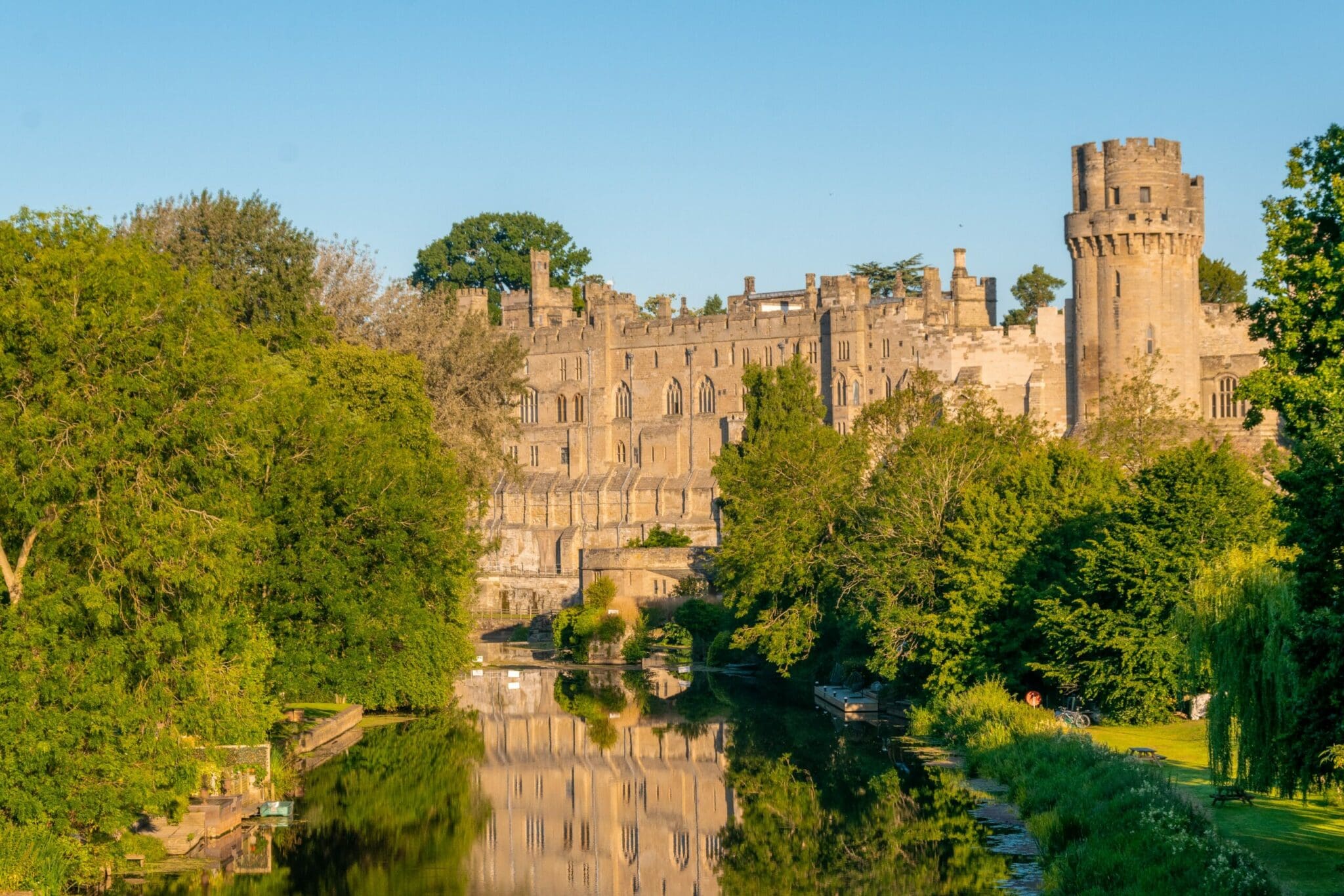
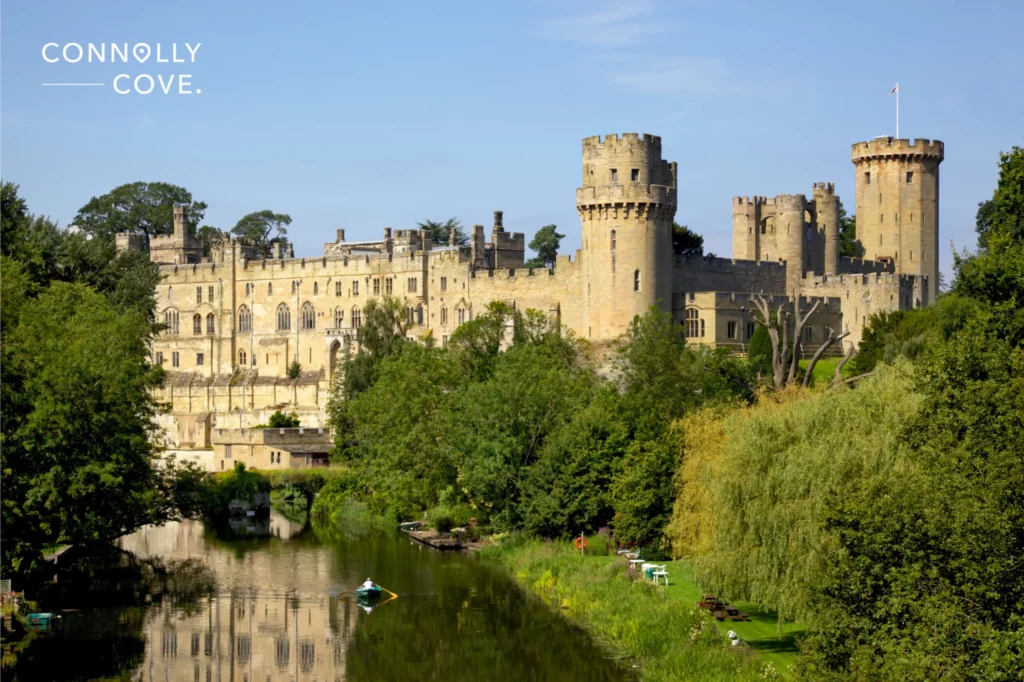
Warwick Castle is one of the most famous medieval castles in England and one of the earliest ones ever built. It is located on River Avon, Warwick town in the county of Warwickshire, Central England, around 132 kilometres northwest of London. It has a fantastic architectural style and a structure that has been under renovation since it first saw the light to date.
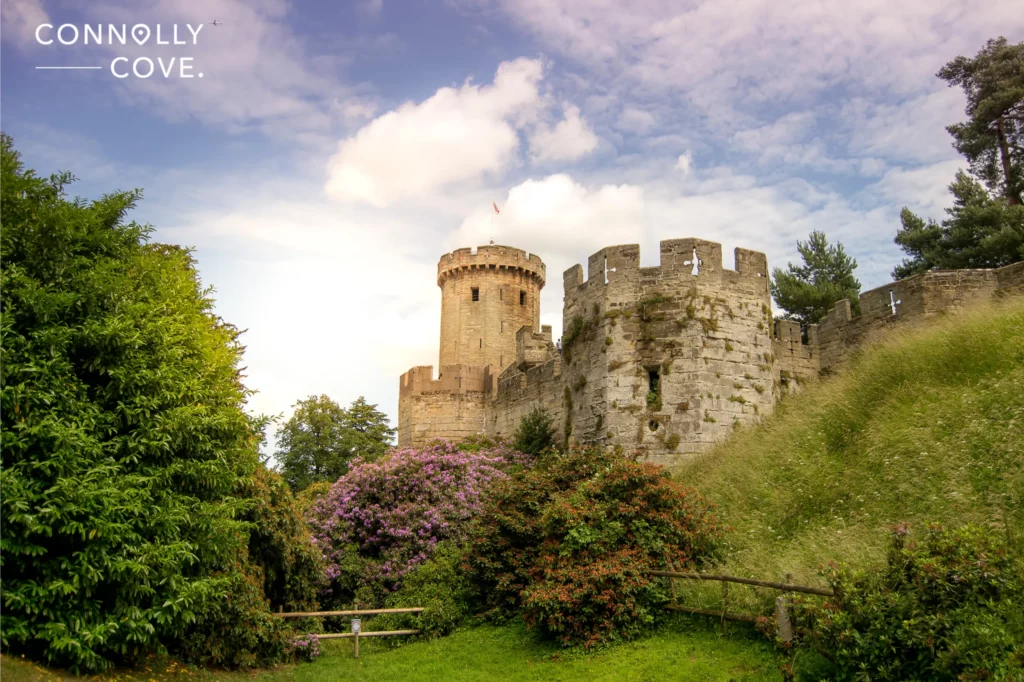
The original structure of the Castle was motte and bailey that was famous in Europe at the time but not in England until then. This architectural style features a tower typically built on a mound and surrounded by a bailey or a courtyard where the actual Castle is built. The tower, bailey and the existing castle building are enclosed with tall walls beyond which a moat, or a deep water-filled ditch, is dug to stop any potential attacks.
Warwick Castle was initially built in that structure from wood in the 11th century but was rebuilt in stone in the 12th century, and that is the one we have today.
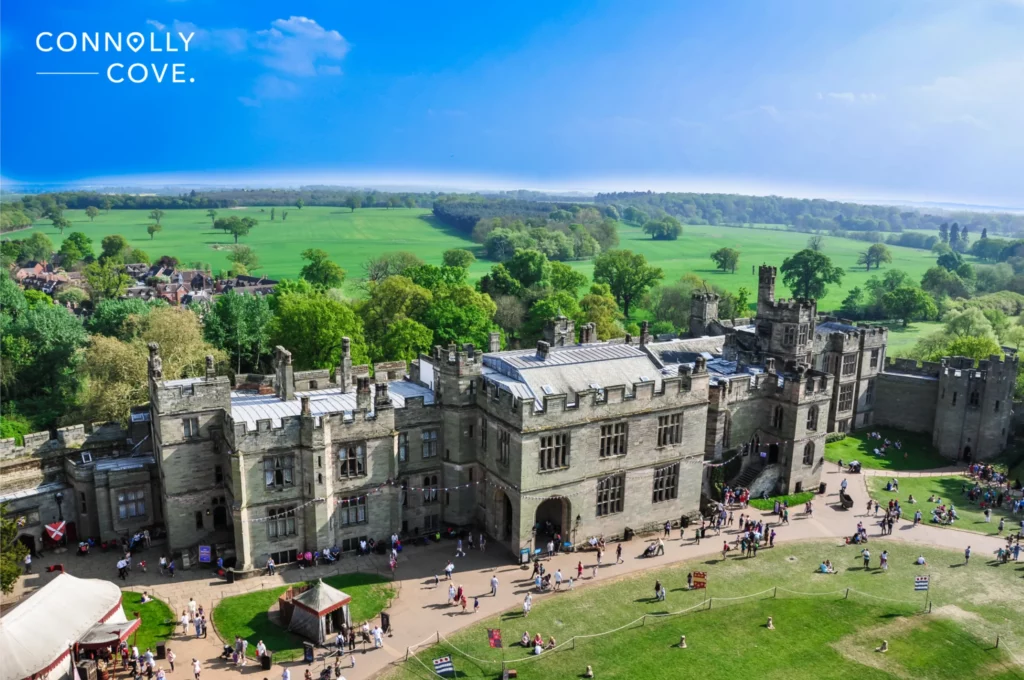
The current Castle is set on an area of 64 acres or 258,999 square metres on the banks of the Avon River. It has a total of six towers and is surrounded by a dry moat from the north. Warwick Castle has two entrances, one to the north and the other to the west, and because of that moat, the Castle is reachable through a drawbridge.
The residential buildings of the Castle face the northern entrance. This is where the Earls of Warwick and their families used to live. These buildings incorporate many different elegantly furnished and beautifully decorated rooms, most, if not all, of which are open to visitors. There is the Great Hall, Dining Room, Red Drawing Room and Green Drawing Room, Cedar Room, a chapel and a library.
These rooms make Warwick Castle feel more like a time machine that takes visitors centuries ago to see how the Castle’s previous owners lived. There are even many Madame Tussauds wax sculptures found in many of the Castle’s rooms as the Castle was sold to Merlin Entertainments in 1978. This is the same company that operates all the Madame Tussauds museums worldwide.
Enclosed within the walls of the Castle are stunning gardens featuring a diverse collection of flowers and trees. They pretty much make the perfect spot for leisure and recreation, especially when the weather is good.
Besides all of that, the history of Warwick Castle, from its early establishment up until today, is quite exciting and rich. In fact, it is somewhat what made it one of the most iconic castles in England and nicknamed it one of the most haunted ones.
Establishment
In the aftermath of the death of King Edward, there was a period of conflict in England. All of a sudden, the throne became ’empty’, and no one knew who would succeed the King, for he died before appointing an heir. Amidst this chaos, the Duke of Normandy in France, William the Conqueror, was waiting like a lion hiding in the bush to seize the chance and conquer England.
In 1066, already not too long after King Edward died, William, leading his army of Normans, could defeat the Anglo-Saxons in the Battle of Hastings and started the gradual domination of the entire country. To secure the territories he invaded and prevent any counterattacks, he started building castles. Warwick Castle was the first one he built, and it was constructed from wood, as we mentioned earlier.
Owners of Warwick Castle
When William the Conqueror died in 1087, his son William the Second succeeded him as King of England and appointed Henry de Beaumont, who descended from a powerful family in Normandy, as the first Earl of Warwick in 1088.
As he lived there with his family, de Beaumont made some minor renovations in the Castle, but he did build the Church Of All Saints inside of it in 1119. Yet, unfortunately, it was removed from there by the Bishop of Worcester only eight years later, as they thought Warwick Castle was an inappropriate spot for the sacred house to be located within.
After the death of Henry de Beaumont, his family took charge of the Castle. So they rebuilt it in stone in the 12th century and made the stunning structure we have now. The de Beaumont family continued to rule Warwick until 1449, and when there was no one of them left, the ownership of the Castle was moved to a new family of nobles with a hard-to-pronounce last name, too.
In total, Warwick Castle had 39 owners, all belonging to six different families, most of whom were the Earls of Warwick.
The last to own the Castle was the Greville family that turned it into a country house and a private residence and lived there from 1604 until the second half of the 20th century.
In 1928, Charles Greville, who was a British aristocrat, a Hollywood film star and one of the wealthiest men in all of Great Britain, became the new Earl of Warwick. Between the mid-1950s and the late 1960s, Charles sold most of his family properties, moved to Rome in 1969 and left Warwick Castle to his one and only son, David Greville. Eight years later, and for some reason, David sold the historic 900-year-old Castle to what was then the Tussauds Group.
The Tussauds Group, which was one day a limited company established by Madame Tussaud, the famous French sculptor, opened Warwick Castle to the public as a tourist attraction after it had been a private residence for almost a millennia. In 2007, the Blackstone Group bought the Tussauds Group and merged it with other companies to form Merlin Entertainments. So, Warwick Castle accordingly became a property of the latter.
Royal Property
For three times in its long history, Warwick Castle became a property of the British Crown.
This happened for the first time after the death of the Earl of Warwick Edward Plantagenet, whose successor was only two years old at the time. The Castle stayed in the custody of the Crown for 48 years from 1499 to 1547, a period during which the title Earl of Warwick disappeared. Still, the Castle received massive repairs mainly made by loads of stone.
Not too long after that, precisely in 1554, the Castle went back to the ownership of the Crown when John Dudley II, the second Earl of Warwick after initiating the title again, died with no heirs. In 1562, Ambrose Dudley became the third Earl of Warwick and regained ownership of the Castle. He stayed in his position until his death in 1590, and because he was childless, the property of the Castle once again returned to the British Crown until 1604.
Renovations
As we mentioned earlier, the first significant renovation Warwick Castle ever received was when it was rebuilt in stone instead of wood. But the terrific structure that exists now was developed over hundreds of years and by so many owners.
Some of the most remarkable renovations the Castle has received were made by Sir Fulke Greville, who ditched the title of Earl and embraced a more prestigiously sounding one when he appointed himself the Barron Brooke in 1621.
Fulke Greville was originally a poet and a statesman who represented Warwickshire in the parliament for over a decade and was at the service of the royals. In 1604, he was awarded Warwick Castle by King James. By that time, the Castle had already been in decay for so long that Greville warned it was marching steadily toward vanishing if it were left in such a disastrous condition.
However, he was not at all intending to leave this architectural landmark the way it was. So he started huge renovations that cost what is now equal to $5 million and converted it into a country house. He turned the land around Warwick Castle into beautiful gardens, constructed spiral trails to the mount tower and added facilities that made it easy to get into and out of the Castle.
Haunting Tales
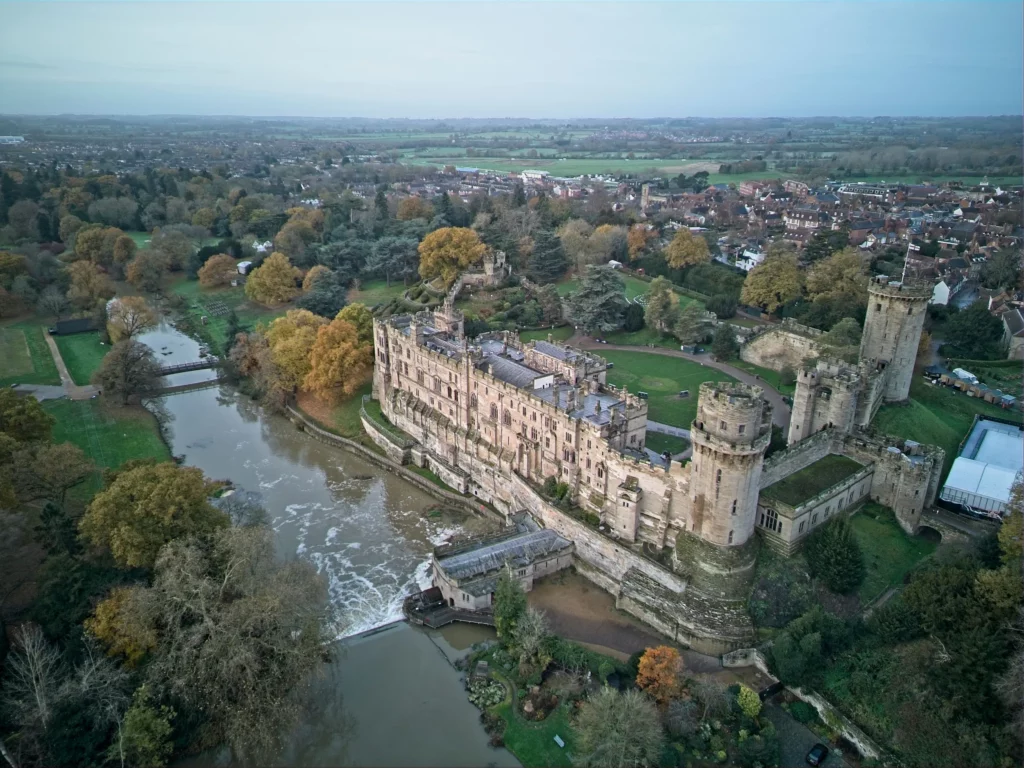
So far, the Castle does not sound more than a luxurious stay for all the Earls and their families who lived in it, and it definitely was.
But like many other Middle Ages castles in England and the rest of Europe, Warwick Castle is often associated with many haunting stories and legends that mainly stem from the dark part of its long history. Remember that Warwick Castle was originally built to defend the town against attacks, and over the years, it was subject to wars and battles that already destroyed parts of it before they were rebuilt or renovated.
How smooth the transition of power from one Earl to their successor must have also played a considerable role in establishing such a dark atmosphere around the Castle. The more conflicts there were over power, the more likely the Castle was to earn a bad reputation.
There is also the fact that many of the Castle’s owners were destined to violent events and even horrifying deaths, which made it, in the minds of the public at least, home to ghosts. Some people even reported unusual and somewhat paranormal events taking place in the Castle, although no one could prove any of them. Writers also manifested these stories by portraying Warwick Castle as a haunted one in their writings.
Some of Earls who met an unfortunate fate was Edward Plantagenet, the 17th Earl of Warwick. He was kept as a prisoner and was later beheaded for treason in 1499. John Dudley I, who created the title Earl of Warwick again in 1547, met the same fate as Edward Plantagenet, for he, too, was convicted with treason.
As it turned out, Dudley planned a conspiracy to make his daughter-in-law ascend to the English throne instead of the legitimate heiress Mary Tudor, or Mary I. But his plan failed, and he was arrested, tried, and then beheaded in 1553.
Yet, the most notable incident that helped create such a nasty reputation for the Castle is that related to the death of Sir Fulke Greville, the first Barron Brooke we mentioned earlier. In September 1628, Fulke Greville, aged 73, was stabbed multiple times in the Castle by his servant Ralph Heywood, who was outraged upon knowing that Greville excluded him from his will.
The death of Fulke Greville weeks later left a mysterious imprint on Warwick Castle and attached it more to horror. It is even said that Greville’s ghost has been wandering the Castle, especially the Ghost Tower, since then.
Finally, there is the story about the Lady in Grey, who some claim has seen wandering in the Castle; yet, not much is known about her story in terms of who she was or what made her ghost appear in the Castle. It might be some other tragic incident, of course, for those who die peacefully do not usually bother going back to where they lived in their earthly life to freak people out.
All these stories accumulated and created the haunting energy associated with the Castle and the culture that surrounds it. But it must be made clear that they were all probably made up by the people, for none of them were actually scientifically proven.
Activities
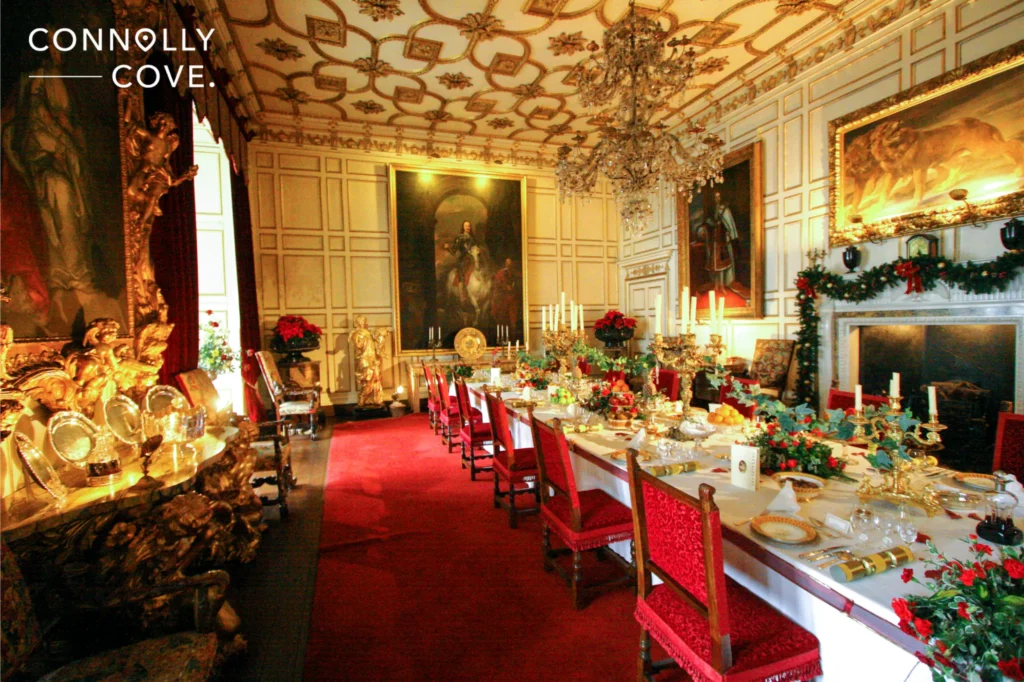
Despite these dark folklore tales, Warwick Castle, at least during daylight, is an excellent place for leisure and recreation that anyone ever making it to England must not miss visiting. Given that the Castle has been operated by Merlin Entertainments for over 15 years now, huge investments have been made to provide a great set of activities and facilities for visitors to do and enjoy there.
First of all, visitors can enjoy exploring the Castle either by themselves or as part of the guided tours offered there. They can take their time wandering the different rooms of the Castle, on top of which are definitely the Great Hall and the State Rooms, gaze at the stunning mediaeval architecture and take a glimpse of what Victorian society was like through the fantastic furniture and clothes.
Archery demonstrations are another thing visitors can enjoy at Warwick Castle, where they can see how these tools were used back then. There is also a chance to try shooting bows, indeed guided by an expert, for an extra fee.
Time Tower is also a great attraction, especially for visitors who like history, where they can go back in time by watching a show that demonstrates the development of the Castle over the centuries. The Horrible Histories® Maze is another go-back-in-time adventure where visitors can walk through a garden maze to explore the past history surrounding the Castle. This attraction is specially made for kids and is pretty comprehensive and educational.
In addition to all of that, there are multiple play areas for kids, such as the Zog Playland and Zog and the Quest for the Golden Star. Other attractions include the Pageant Field and the Peacock Garden, both perfect for walks and enjoying the beautiful scenery and weather. Plus, visitors can have a snack or a meal at one of the Castle’s restaurants and buy souvenirs and books from the gift shops.
To enjoy a day or a weekend at Warwick Castle, visitors must bear in mind that they will do a lot of walking in and around the Castle, and they need to be prepared for that. So wearing comfortable shoes is a must. And since the Castle is headed daily by hundreds of visitors, it is highly recommended to purchase tickets beforehand to avoid wasting time in long queues.
The Castle is open every day from 10:00 in the morning to 4:00 in the afternoon and can be reached from London either by car or train from Marylebone Station in a matter of only two hours.
Powered by precious history, fascinating haunting tales and various activities, Warwick Castle is one of the most stunning tourist attractions in England and a remarkable architectural masterpiece that reflects the brilliance of Middle Ages engineers. So anyone ever planning to spend their next vacation in the UK must have it on their list of activities to do in the country.

Discover The Mythical Valkyrie Horses: Steeds of Legend
Mythology and Folklore
28/04/2024

Exploring the Concept of Anam Cara: A Celtic Perspective on Soul Friendship
Culture Exploration
29/04/2024
Kensington Palace – London Attractions
England
29/04/2024
Harry Potter Shop at Platform 9 3/4 – London Attractions
England
29/04/2024
Exploring the Isle of Man’s Rich History and Culture
Ireland
29/04/2024