
Salzburg’s hills really do seem to hum with The Sound of Music, and that’s before you’ve found a single filming location. The 1965 film turned this Austrian city into one of Europe’s most recognisable movie-tourism destinations, built on real gardens, a real abbey and a real family whose story was considerably more complicated than Hollywood allowed. ConnollyCove, the Ireland-based travel and culture platform, covers musical heritage and stage traditions across Europe, and Salzburg sits at an unusual crossroads of the two: a city famous for Mozart long before Julie Andrews arrived, and one with an unexpected Irish thread running through its early history through Irish missionaries who reached Austria centuries before anyone had written a note of Do-Re-Me.
This guide separates the film from the facts, points you to the genuine locations you can visit today, and covers where the musical itself is currently being staged, including the 2026 productions reaching audiences in Leeds, Cork and Dublin.
Table of Contents
The Real Von Trapp Family: Separating Fact from Fiction

The true story behind The Sound of Music is less about romance and more about a citizenship issue that became a matter of life and death. Georg von Trapp was not fleeing Austria solely out of general anti-Nazi sentiment; after Austria’s annexation by Germany in March 1938, he was expected to accept a commission in the German navy, a role his conscience would not allow. The family’s exit was quiet and practical rather than the sweeping mountain trek the film shows.
The True Escape: A Train, Not a Mountain Climb
Contrary to the film’s famous closing image, the von Trapps did not hike over the Alps into Switzerland. Doing so would, in any case, have taken them further into Nazi-controlled territory rather than away from it. The family instead travelled by train to Italy, a country where Georg von Trapp still held citizenship rights from his birth in what had been Austria-Hungary’s Adriatic coastline before the First World War redrew the map. From Italy, they eventually made their way to the United States, where they built a singing career that became the basis for Maria von Trapp’s 1949 memoir.
Maria von Trapp: The Woman Behind the Story
Maria was a postulant at Nonnberg Abbey before she was sent to work as a governess, not a full nun as some retellings suggest, and her marriage to Georg von Trapp came several years before the family’s actual departure from Austria, not immediately beforehand as the film compresses events for pacing. She went on to write and perform with the family well into their years in America, shaping much of how the story was later told.
Truth vs Fiction: A Quick Comparison
| Film Event | Historical Reality |
|---|---|
| Escape on foot over the mountains to Switzerland | Departure by train to Italy, then onward travel to the United States |
| Maria arrives as governess shortly before the family flees | Maria married Georg years before the 1938 departure |
| Captain von Trapp is a stern widower softened by music | Georg von Trapp was a decorated former Austro-Hungarian naval officer with an established love of music in the family already |
Where to Find the Real Filming Locations in Salzburg
Salzburg’s Old Town, a UNESCO World Heritage Site since 1996, provides the backdrop for the film, even though almost none of the interior scenes were shot inside the buildings you can visit. What you’re seeing on a location tour is the exterior of the story, layered onto a city whose own history runs centuries deeper than the musical.
Schloss Leopoldskron and Mirabell Gardens
Schloss Leopoldskron, built in 1736 for Archbishop Leopold Firmian, provided the exterior of the Trapp family home, including the lakeside scenes and the boating sequence on Leopoldskron Pond. A short distance away, Mirabell Gardens hosted the Do-Re-Me sequence, and its Baroque flowerbeds and Pegasus Fountain remain freely open to visitors. Travellers exploring this region often pair the gardens with a walk through the Old Town, taking in the same Baroque architecture that earned Salzburg its UNESCO listing decades before the film existed.
Nonnberg Abbey and the Real Maria
Nonnberg Abbey, a working Benedictine monastery founded in the eighth century, is where the real Maria lived before beginning her work with the von Trapp family. It remains an active religious community rather than a tourist attraction in the conventional sense, so visitors should treat it with the same respect they would show any working place of worship.
Mondsee and Hellbrunn Castle
The wedding scene was filmed at Mondsee Abbey Church, a short trip from Salzburg in the town of Mondsee, and Hellbrunn Castle’s Glass Pavilion, relocated there for the production, still stands as one of the more visited stops on any filming-locations itinerary. Local guides recommend combining Mondsee with a wider look at the lakes region rather than treating it as a single-purpose day trip.
The Sound of Music on the Irish and UK Stage in 2026

The musical is not just a film relic; it is actively touring Irish and British stages this year, and the current wave of productions gives the story fresh local relevance well beyond Austria.
Opera North’s Leeds Production
Opera North brings The Sound of Music to Leeds Grand Theatre from 9 July to 1 August 2026, based on a production first staged by Leicester’s Curve theatre and directed by Nikolai Foster, whose credits include Kinky Boots and My Fair Lady. Katie Bird plays Maria opposite Edward Bennett as Captain von Trapp, with the Chorus and Orchestra of Opera North performing the score live. This is the kind of touring, orchestra-backed staging that has made Rodgers and Hammerstein’s work a recurring fixture on Britain’s regional theatre circuit, in much the same way that Europe’s grand opera houses have kept classical stage traditions alive for centuries.
Irish Stage History: Dublin, Cork and Belfast
Ireland has its own recent history with the show. Cork Opera House staged The Sound of Music in July 2026, its first production of the musical in fourteen years and part of a broader push toward Irish-produced stagings rather than solely touring West End versions. Dublin’s Bord Gáis Energy Theatre has also hosted touring productions of the musical in past years. Closer to home for ConnollyCove, Belfast Operatic Company staged an amateur production inside St Anne’s Cathedral in 2025 as part of the company’s 65th anniversary celebrations, a reminder that Belfast’s appetite for large-scale musical theatre extends well beyond its professional venues like the historic Grand Opera House, which has hosted musicals, pantomimes and operas since 1895. For visitors combining a Belfast trip with an interest in theatre, ConnollyCove’s Belfast travel guide covers the city’s wider cultural scene.
Is There a “Sound of Music 2”? Addressing the Rumours
No sequel to the 1965 film has been confirmed by any studio. Occasional AI-generated concept trailers and fan-made speculation circulate online, a pattern that has become increasingly common for beloved classic films, but nothing of this kind currently has any official backing. If a genuine sequel or remake is ever announced, it would represent a significant departure from how Rodgers and Hammerstein’s estate has historically managed the property, which has favoured stage revivals over screen sequels.
Planning Your Visit: Seasons, Access and Practical Tips
Best Time to Visit
Spring, from April to June, and early autumn, in September and October, offer the most comfortable walking weather for a filming-locations tour, and typically see fewer coach groups at the main sites. Winter brings a different draw entirely: Salzburg’s Christkindlmarkt and the illuminated displays at Hellbrunn Palace make it one of several Christmas city breaks across Europe worth considering if you’d rather see the city in festive mode than in peak summer crowds.
Getting There and Around
Salzburg is well served by rail from both Vienna and Munich, and the Old Town itself is compact enough to explore on foot once you arrive. Visitors travelling more broadly through the region often use Salzburg as one stop on a wider Europe travel guide route rather than a single-city trip, particularly given its proximity to Munich and the Austrian lakes.
Accessibility and Booking Notes
Most major filming locations, including Mirabell Gardens and the Old Town’s main squares, are step-free and can be navigated independently. Nonnberg Abbey and Mondsee Abbey Church, being active religious buildings, have more limited opening hours than secular attractions, so checking ahead before building an itinerary around them is worth the extra few minutes. For the most current opening times and any seasonal closures, Salzburg’s tourism office publishes up-to-date visitor information.
Beyond the Film: Salzburg’s Deeper History
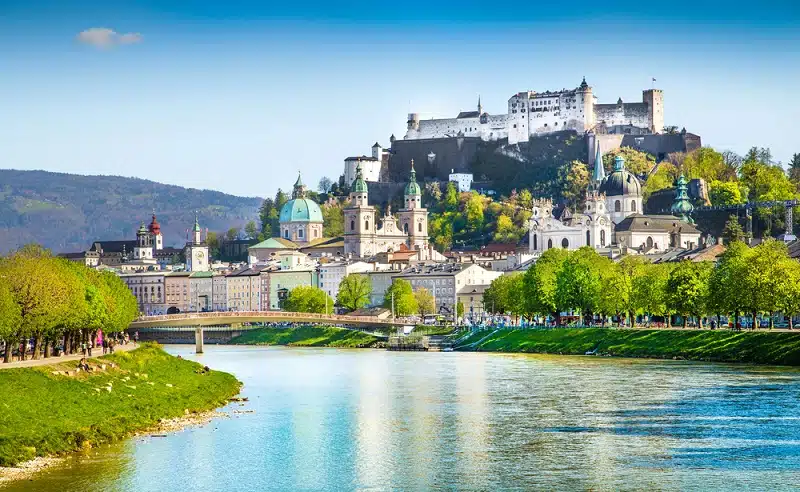
Long before Julie Andrews arrived, Salzburg’s Hohensalzburg Fortress, one of the largest surviving medieval castles in Europe, already dominated the skyline above the Old Town, built in 1077 by the Prince-Archbishops who ruled the city for centuries. Visitors interested in castle architecture more broadly can find Hohensalzburg discussed alongside the world’s other great fortresses in ConnollyCove’s guide to the largest castles on Earth. The city’s musical reputation also predates the film by roughly two centuries, resting first on Mozart, and its concert and festival tradition continues today in the same way that classical music heritage persists across Vienna, Salzburg and Prague as a connected European story rather than an isolated one.
There’s also a small, easily missed Irish connection buried in Salzburg’s early history. Long before any Austrian city became a byword for family drama and mountain scenery, Irish missionaries such as St Fergal, also known as Virgil of Salzburg, carried learning and faith across early medieval Europe, eventually becoming closely tied to the city itself. It’s a detail that has nothing to do with the film and everything to do with how far Irish influence travelled across the continent centuries before anyone set a story in these hills.
The Songs and the Screen Legacy
The score has outlasted the film in cultural reach, with songs like Do-Re-Mi and My Favourite Things recognisable to people who have never seen a single scene from the 1965 production. Richard Rodgers and Oscar Hammerstein II wrote the stage musical as their final collaboration before Hammerstein’s death in 1960, and the songs were built to work as standalone pieces rather than purely as scene-setters, which is part of why they’ve travelled so far beyond the story itself.
Julie Andrews and a Role That Defined a Career
Julie Andrews, already known for her stage work in My Fair Lady, became internationally recognised through her performance as Maria, and the role has followed her ever since in a way few film parts do. Her British background gave the production a particular crossover appeal in the UK and Ireland, where the film became a fixture of televised family viewing for decades. Christopher Plummer’s singing as Captain von Trapp was partly dubbed by Bill Lee for the film, a detail rarely mentioned in reviews but one that fans of musical theatre often ask about once they know to look for it.
Ranking the Songs: What Still Resonates
Do-Re-Me tends to top most fan rankings for sheer catchiness, while Edelweiss is frequently mistaken for a genuine Austrian folk song despite being written specifically for the production. So Long, Farewell has quietly become one of the most recognisable ways to say goodbye in English-language popular culture, in much the same way that Ireland has its own tradition of Irish farewell blessings that carry weight far beyond the words themselves. Sixteen Going on Seventeen and Climb Ev’ry Mountain round out the score’s best-known moments, each still performed regularly wherever the show tours, from Leeds to Cork.
Screen musicals rarely hold this kind of grip on public memory decades later, and it’s worth noting that Salzburg isn’t the only place where a single production has reshaped how travellers see a destination. ConnollyCove has traced similar effects elsewhere, from the enduring pull certain iconic screen performances still hold over audiences generations later, to filming locations that draw visitors long after a production wraps.
The Von Trapp Family Today
The real von Trapp family didn’t stop performing once they arrived in the United States, and their story continued well beyond the film’s ending. After arriving in America, the family toured as a singing group before eventually settling in Stowe, Vermont, a landscape whose mountains reminded them of home.
From Austria to Vermont
Maria and Georg von Trapp’s descendants still run the Trapp Family Lodge in Stowe, an alpine-style resort founded by the family in the 1950s that continues to operate today under their name. It stands as a quieter, less mythologised continuation of the family’s story than the film ever attempted to tell, built on the same instinct for reinvention that shaped so many families who left one home behind to build another, a pattern familiar to anyone who has read into the wider story of families rebuilding life far from home.
A Legacy Still Performing
Members of the extended von Trapp family have continued performing music professionally in various forms over the decades, keeping a direct link between the real family and the musical tradition their story helped popularise. It’s a detail easily lost next to the film’s fame, but it’s the reason the story still feels lived-in rather than purely cinematic, more than eighty years after the family first left Austria.
A Traveller’s Takeaway
Salzburg rewards visitors who look past the film to the city underneath it: a genuine UNESCO World Heritage site, a working abbey with its own quiet history, and a stage tradition still active in 2026 from Leeds to Cork. Whether you’re drawn here by Do-Re-Me or by the Old Town’s Baroque architecture, the real story of the von Trapp family, and the honest gaps between that story and the film, add far more to a visit than the soundtrack alone. If film-location travel interests you beyond Austria, ConnollyCove has covered locations from Andor’s Season Two filming stops to Northern Ireland’s own Dark Hedges trail, and for anyone drawn to stories of families leaving one home for another, ConnollyCove’s guide to the Irish diaspora’s literary legacy explores a different but related story of departure and belonging.
FAQs
Is The Sound of Music based on a true story?
Yes, it’s based on Maria von Trapp’s 1949 memoir about her marriage into the von Trapp family and their 1938 departure from Austria. The film compresses and dramatises several events, most notably the manner of their escape, but the core family and their flight from Nazi-controlled Austria are historical facts.
Where was The Sound of Music actually filmed?
The main exterior locations are in and around Salzburg, including Schloss Leopoldskron, Mirabell Gardens, Nonnberg Abbey, Mondsee Abbey Church and Hellbrunn Castle. Most interior scenes were filmed on studio sets rather than inside the real buildings.
How did the real von Trapp family escape Austria?
They left for Italy by train in 1938 rather than on foot over the mountains, as the film’s ending depicts. Georg von Trapp held Italian citizenship rights from before the First World War, which made this route possible, and the family later travelled onward to the United States.
Is there a Sound of Music 2 coming out?
No studio has confirmed a sequel. AI-generated concept trailers occasionally circulate online, but none currently carry any official backing from a production company or the Rodgers and Hammerstein estate.