
Article Summary
What this article covers: A ConnollyCove guide to the history, materials, traditional forms and modern revival of Irish basket weaving, from Bronze Age bog finds to the artisans keeping the craft alive today.
Who this is for: Travellers with an interest in Irish heritage crafts, culture enthusiasts and anyone planning a trip that includes Ireland’s living traditions.
Key takeaway: Irish basket weaving is one of the country’s oldest continuous crafts, and it survives today through a small network of artisans, museums and heritage bodies working to keep it from disappearing.
Expert insight: “Every willow creel we’ve seen on our travels across Connemara carries the shape of the hands that made it. That, more than anything, is why basket weaving deserves the same attention we give to Irish music or storytelling,” Ciaran Connolly, Founder of ConnollyCove
Quick Facts:
- Basketmaking is listed on Ireland’s National Inventory of Intangible Cultural Heritage, which tracks living traditions at risk of disappearing
- The craft’s two best-known forms are the creel (cliabh), used for carrying turf and produce, and the skib (sciob or ciseog), a flat basket used for straining potatoes
- Coppiced willow, known in Ireland as sally, remains the primary material, alongside hazel, straw and rush
Irish basket weaving is one of the country’s oldest crafts, older than written record and tied directly to the rhythms of rural life. Long before plastic containers, a family’s turf, potatoes and fish all passed through a woven willow basket at some point on their journey from field or bog to hearth.
As part of ConnollyCove’s wider coverage of Irish heritage and craft, this guide traces that story from archaeological bog finds through to the artisans keeping the craft alive today. It covers the materials, the traditional basket types, the regional differences across Ireland and the places where travellers can still see and try this craft first-hand.
Along the way, we’ll look at why a skill so ordinary became so easy to lose, and what is being done to make sure it survives the next generation.
Table of Contents
The Ancient Roots of Irish Basketry
Basket weaving in Ireland stretches back further than most crafts still practised today. Its story begins not in workshops but in bogs, where waterlogged conditions preserved woven fragments that would otherwise have rotted away centuries ago.
From Bronze Age Bogs to the Cottage Hearth
Archaeologists have recovered woven wicker trackways and fish traps from Irish raised bogs dating back to the Neolithic and Bronze Age periods. These finds show that basketry was already a refined skill thousands of years before Ireland had a written language.
The bogs themselves later became central to the craft’s everyday use. Families cutting turf for fuel relied on sturdy creels to carry sods back from the peat bogs that supplied most rural homes with heat well into the twentieth century.
Bog conditions are low in oxygen, which slows decay to a crawl. That accident of geology is the only reason anyone today can examine woven fragments thousands of years old rather than relying purely on guesswork about how early Irish basketry looked or worked.
Basketry in Early Gaelic Society
Woven containers appear throughout early Irish sources as ordinary household objects rather than anything remarkable, which tells its own story. If a basket was worth mentioning at all, it was because of what it carried, not because weaving one was unusual.
This everyday status placed basketry alongside spinning, dyeing and other domestic skills that formed part of a wider network of traditional Irish crafts passed down within families rather than taught formally.
Skills like these rarely appeared in written records because nobody thought to write down what everyone already knew. A weaver learned by watching a parent or neighbour, then by making mistakes with their own hands, a pattern of transmission that shaped most rural crafts long before formal apprenticeships existed.
From Rural Necessity to Endangered Craft
For most of Irish history, basketry was too useful to disappear. That changed quickly in the mid-twentieth century, when mass-produced plastic and metal containers replaced woven ones in kitchens, farms and fisheries within a generation.
Basket weaving is now one of several lost crafts being actively revived in Ireland, kept going by a small number of committed practitioners rather than widespread domestic use.
What makes this decline notable is its speed. A skill practised in nearly every rural household for centuries became a specialist trade within roughly two generations, which is part of why heritage bodies now treat basketry as genuinely at risk rather than simply old-fashioned.
The Raw Materials Behind Every Irish Basket
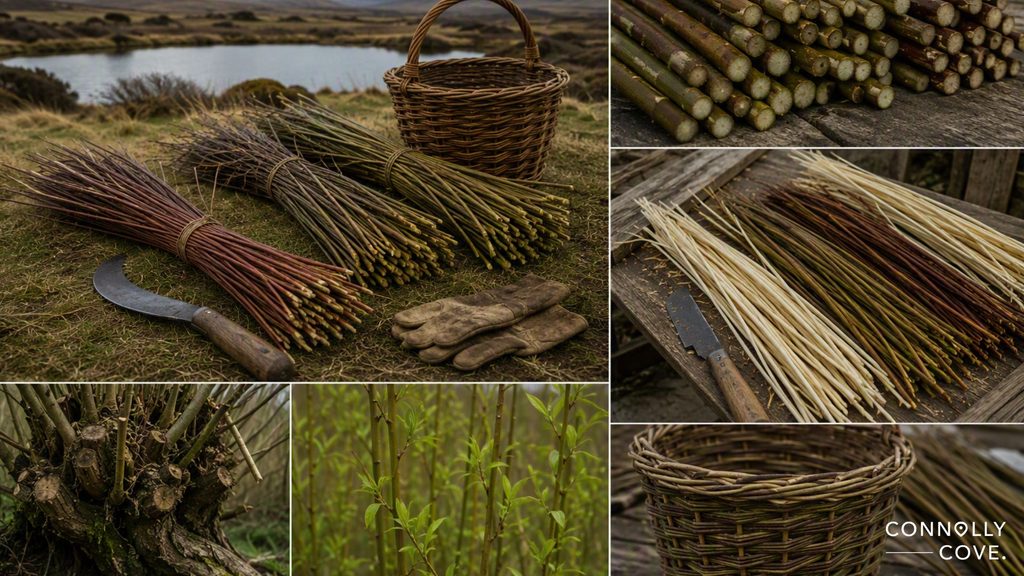
What a basket is made from shapes everything about how it looks, bends and lasts. Irish basketry draws almost entirely on materials that grow wild or are grown specifically for weaving close to home.
Willow and the Irish Sally Garden
Willow, known locally as sally (from the Irish saileach), is the backbone of Irish basketry. Traditional sally gardens, plots of coppiced willow grown specifically for weaving, once stood beside farmhouses across the country.
Different willow varieties suit different jobs. Thicker, unpeeled rods form the stakes and framework of a basket, while thinner, more pliable rods are used as weavers to fill in the shape. Willow also carries older meaning in Ireland, appearing among the sacred trees of Celtic belief long before it became a practical material.
Colour varies naturally too. Freshly cut willow is green, buff varieties turn a warm tan once dried, and rods boiled before stripping take on a deep brown tone. Weavers often mix these shades deliberately, giving traditional baskets a subtle pattern without dye of any kind.
Hazel, Straw and Hedgerow Materials
Willow rarely worked alone. Hazel rods, cut from hedgerows, gave extra strength to load-bearing frames such as turf creels and donkey panniers, while straw and rush were twisted into rope for lighter, softer baskets used indoors.
Hazel held its own symbolic weight in early Ireland, associated with wisdom in stories tied to the Druids and the wider Celtic tradition, which makes its practical use in basketry feel less like coincidence and more like continuity.
Straw rope, known as súgán, filled a different role again. Twisted rather than woven in the strict sense, it produced soft, lightweight baskets and mats better suited to indoor storage than the heavy outdoor work handled by willow and hazel.
The Winter Harvest and Preparation Process
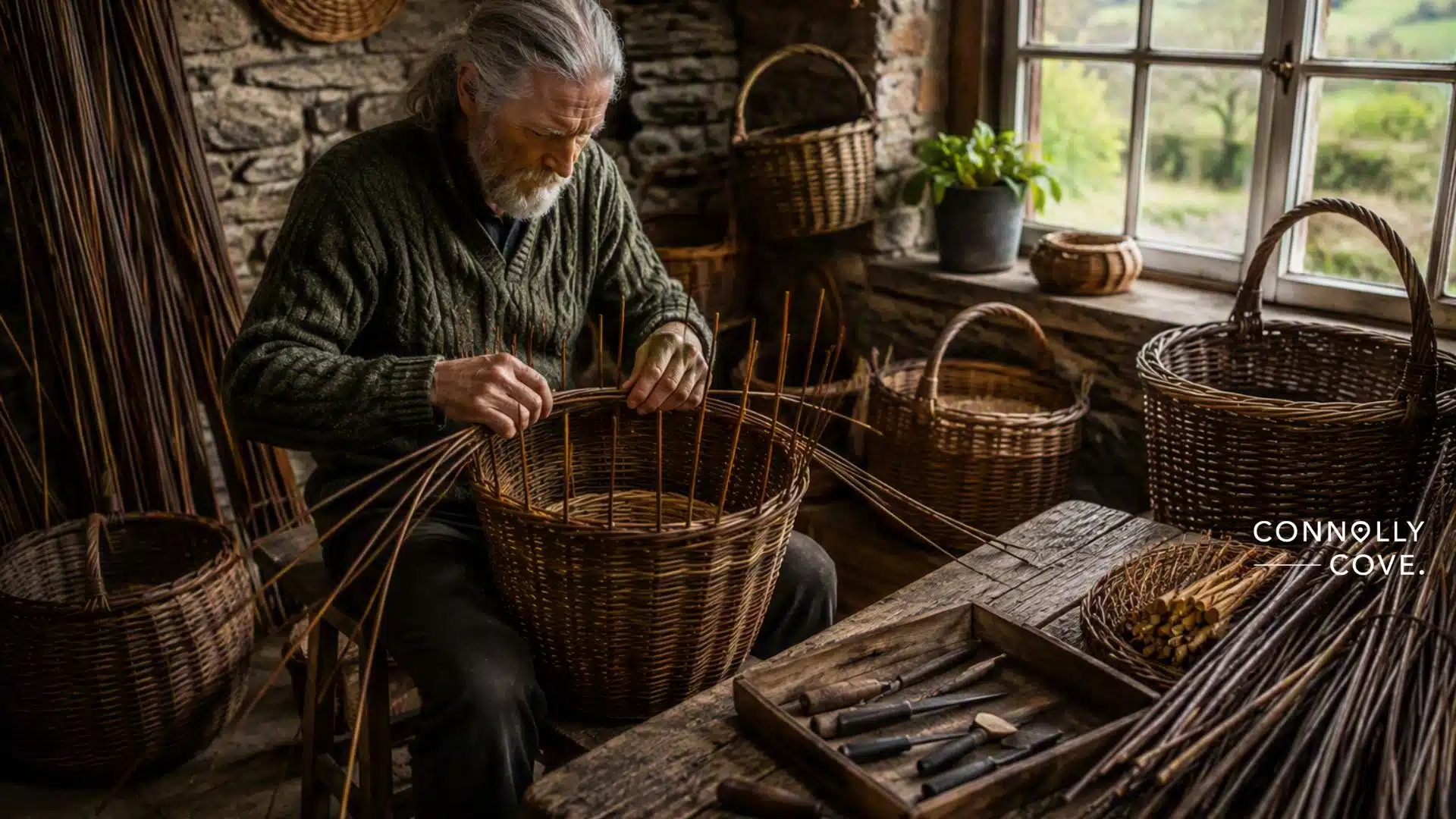
Willow is traditionally cut between November and March, once the sap has dropped and the rods have hardened for the season. Freshly cut rods are either woven green or soaked and stripped of bark to produce paler, cleaner material.
This seasonal rhythm shaped a weaver’s working year long before basketry became a specialist trade. Today, the same preparation methods are taught in the small number of workshops run by artisan craft practitioners across Ireland.
Soaking times matter more than most beginners expect. Rods that are under-soaked crack when bent, while over-soaked willow turns soft and loses the tension a basket needs to hold its shape once finished and dried out again.
A Guide to Traditional Irish Basket Types
Ireland never settled on a single basket design. Different jobs, materials and regions produced a genuinely wide family of forms, each built for a specific task rather than general use, a variety ConnollyCove finds just as interesting as the country’s mythology or language.
| Basket | Irish Name | Primary Material | Traditional Use |
|---|---|---|---|
| Creel | Cliabh | Willow and hazel | Carrying turf, seaweed and produce |
| Skib | Sciob / Ciseog | Willow | Straining and serving potatoes |
| Donkey pannier | Cliabh Asail | Willow | Transporting loads by donkey or pony |
| Fishing creel | Cliabh Iascaigh | Willow, hazel | Coastal fishing and eel trapping |
| Turf basket | Cise | Willow | Storing turf beside the hearth |
The Creel (Cliabh): Turf, Fish and Farm
The creel was Ireland’s working basket, built with a flat back so it could be carried on a person’s shoulders or strapped to a donkey. Its heavy, unpeeled willow frame was designed to survive years of rough handling on bog and farm.
Creel-making shares its basic logic with other forms of traditional Irish weaving, where structural strength and flexibility have to work together rather than against each other.
Smaller donkey and pony panniers, known as cliabh asail, followed the same basic structure at a reduced scale. Two matching creels were slung across an animal’s back, letting one trip carry twice the load a single person could manage alone.
The Skib (Sciob / Ciseog): The Potato Basket
The skib is a flat, open-weave basket built for one main job: straining boiled potatoes and serving them straight onto the table, or straight onto the flagstones in poorer households. Its wide, shallow shape let steam escape quickly.
Given how central the potato once was to traditional Irish food, the ciseog was arguably the single most-used object in many rural kitchens, refreshed or replaced far more often than furniture.
Its open weave was practical rather than decorative. Gaps between the rods let steam and water drain away almost immediately, something a solid bowl of the period simply could not do without extra tools.
Regional Variations Across Ireland
Basket styles shifted depending on what grew locally and what the terrain demanded. Heavier, unpeeled creels suited the windswept conditions of the west, while lighter, more refined weaves developed in sheltered river valleys further inland.
The willow beds and craft traditions of Connemara produced some of Ireland’s best documented creels, while heritage crafts in Northern Ireland developed their own hazel and willow framing techniques around Lough Neagh’s fishing communities.
Munster took a more commercial turn. Wicker workshops along the River Suir at Carrick-on-Suir once produced baskets at genuine scale, supplying markets well beyond the immediate area rather than serving a single household or farm.
Coastal and Farmyard Baskets
Away from turf and potatoes, coastal communities wove tighter, more compact traps and creels for eels, salmon and shellfish. These forms connect basketry directly to the maritime traditions and sea legends that grew up around Ireland’s fishing villages.
Farmyards produced their own smaller forms too, including straw lipwork nests for hens and light scollop baskets used in thatching, proof that the craft touched almost every part of rural life.
Scollops in particular deserve a mention, since they are woven rods rather than baskets in the strict sense, pinned across a roof to hold thatch in place. The same hand skill and material knowledge crossed easily between basketry and roofing work.
Cultural Significance and the Modern Revival

Basketry mattered in Ireland for reasons beyond the practical. It sat at the centre of shared meals, household routines and, eventually, a genuine effort, one ConnollyCove has followed closely across its coverage of Irish traditions, to stop the craft from disappearing altogether.
Basketry, Commensality and Rural Survival
Eating from a shared ciseog placed at the centre of the floor was, for many households without a proper table, the closest thing to a communal meal. The basket itself became part of the ritual, not just a container for it.
“Watching a family strain potatoes onto a ciseog placed straight on the flagstones connects you to a way of eating that predates the table itself. It is one of the simplest demonstrations of how ordinary objects held Irish rural life together,” Ciaran Connolly, Founder of ConnollyCove
These small domestic rituals were passed on through observation rather than instruction, in much the same way as the seanchaí storytelling tradition carried Irish history from one generation to the next around the same hearth.
The Irish Basketmakers Association and Master Weavers
The mid-twentieth-century decline in basketry did not go unanswered. The Irish Basketmakers Association, active since the late 1980s, now supports weavers through workshops, a quarterly newsletter and links to funding from the Crafts Council of Ireland.
Individual weavers have shaped the craft’s modern reputation too. Joe Hogan’s work in Connemara, in particular, has helped basketry move from a fading domestic skill toward genuine recognition, and his influence runs through much of the wider revival of ancient Celtic crafts across Ireland. Basketmaking itself now sits on Ireland’s National Inventory of Intangible Cultural Heritage, a formal acknowledgement of both its value and its fragility.
Contemporary Applications and Craft Innovation
Modern weavers have not simply repeated old patterns. Some are experimenting with recycled materials and mixed fibres, while others apply traditional techniques to sculptural or installation pieces rather than functional containers.
This broader move toward natural-material weaving as an art form, rather than a purely functional craft, is well documented in LearningMole’s guide to nature weaving, which looks at how artists worldwide are using branches, vines and willow to create sustainable, sculptural work. For visitors keen to bring something home, hand-woven pieces also feature among unique Irish crafts worth bringing home from a trip.
Experiencing Irish Basketry Today
For travellers, basket weaving is no longer something you only read about. Museums, working weavers and craft markets across Ireland make it possible to see, and sometimes try, the craft in person, which fits neatly alongside the kind of hands-on cultural travel ConnollyCove covers across Ireland more widely.
Museums and Heritage Collections
The National Museum of Ireland’s Country Life branch in Turlough Park, County Mayo, holds one of the country’s best collections of nineteenth-century wickerwork. In Northern Ireland, Cultra Manor and the Ulster Folk and Transport Museum displays baskets alongside the rural cottages and farm buildings they were originally made for.
Seeing a creel beside the turf shed or the potato patch it once served gives far more context than a basket viewed in isolation ever could.
Workshops and Learning the Craft
Several practitioners across Ireland now run short courses for complete beginners, usually covering one basket type over a single day or weekend. These sessions are a genuinely practical way to understand why certain rods are chosen for certain jobs.
Travellers planning ahead can find current course listings and where to learn Irish basket weaving, alongside more general weaving classes for anyone wanting to try willow work alongside other textile crafts during a visit.
Craft Markets and Where to Buy
Woven baskets, from small decorative pieces to full-size creels, turn up regularly at craft markets across Ireland, particularly in counties with an active weaving community such as Galway, Donegal and Clare.
Buying directly from a market stall or a weaver’s own workshop, rather than a generic souvenir shop, is usually the surest way to take home a basket made using the traditional methods described throughout this guide.
Conclusion
Irish basket weaving survived the bogs, the famine years and a century of industrial substitutes, only to nearly disappear once plastic arrived. What remains today is smaller but genuine: working weavers, heritage museums and a formal place on Ireland’s cultural inventory.
For anyone travelling through Ireland with an interest in craft and heritage, seeking out a working weaver or a folk museum collection is one of the most direct ways to connect with this history. Explore more of ConnollyCove’s guides to Irish traditions and heritage crafts to plan the rest of your visit.
FAQs
What is the traditional Irish basket called?
Ireland has several traditional baskets rather than one. The creel (cliabh) carried turf and produce, while the skib or ciseog was a flat basket used to strain and serve potatoes.
How do you pronounce ciseog and cliabh in Irish?
Ciseog is pronounced roughly “KISH-ogue” and cliabh is pronounced “KLEE-uv”. Both names come directly from the objects’ function within the Irish language.
What wood is used in traditional Irish basket weaving?
Coppiced willow, known locally as sally, is the main material. Hazel rods add strength to heavier frames, while straw and rush are used for softer, lighter baskets.
Can visitors take a basket weaving workshop in Ireland?
Yes. A small number of practitioners run beginner workshops, usually lasting a day or a weekend, in counties including Galway, Mayo and Wicklow. Booking ahead is recommended, as places are limited.
Is Irish basket weaving a dying craft?
It is considered endangered rather than extinct. Basketmaking is listed on Ireland’s National Inventory of Intangible Cultural Heritage, and organisations such as the Irish Basketmakers Association actively work to keep it going.