
Skip to content
Updated on: by Avatar image of authorDina Essawy Review By: Fatma Mohamed

Ghostly greetings, explorers! As October’s chill creeps closer, the familiar orange and black decorations begin to appear in shop windows, and the annual hunt for the perfect fancy dress begins. But for those seeking a truly spine-tingling Halloween experience, there’s far more to discover beyond the plastic pumpkins and factory-made costumes.

Halloween, in its commercial form, offers plenty of fun, but what if you could experience the holiday where it all began, amid the misty landscapes and ancient stones where the Celtic festival of Samhain was born? What if your Halloween could connect you to centuries of mystical tradition that still echoes across the hills and valleys of Ireland and the UK?

This is your invitation to discover the authentic roots of Halloween—where the veil between worlds truly thins, where bonfires have blazed for millennia, and where the whispers of ancient customs still linger in the autumn air.

Something Celtic About Halloween: The Ancient Origins of Samhain

You might be surprised to learn that almost every aspect of modern Halloween has Celtic origins, particularly in the harvest celebrations of ancient Ireland and Britain. While today’s Halloween focuses on sweets and fancy dress, its roots reach back over 2,000 years to a time when the changing seasons held profound spiritual significance.

The Celts celebrated Samhain (pronounced “sow-in”), a festival marking the end of the harvest season and the beginning of winter, the darker half of the year. This wasn’t merely a change in weather; it represented a momentous spiritual transition when the boundary between the living and the dead grew thin, allowing spirits to return to Earth and walk freely among the living.

The Celts believed that on the night of October 31, the deceased would revisit their homes. Some spirits were welcomed—ancestors returning to the family hearth—while others were feared. To ward off malevolent spirits, the Celts developed protective practices that evolved into our modern Halloween traditions:

  • Jack-o’-lanterns: Originally carved from turnips or other root vegetables (not pumpkins), these eerie faces with candles inside were designed to frighten away unwelcome spirits.
  • Fancy dress: The practice of wearing disguises began as a way to confuse or evade harmful spirits who might be wandering on Samhain night.
  • Trick-or-treating: The Celts would leave offerings of food outside their homes to appease wandering spirits and prevent mischief—the original “treat” to avoid a “trick.”

When the Veil Thins: Ghosts, Fairies, and the Aos Sí

Central to Samhain was the belief that the Aos Sí (pronounced “ees shee”)—the fairy folk of Celtic mythology—became particularly active during this liminal time. Neither fully good nor evil, these powerful beings could bestow blessings or bring misfortune, and humans took special care not to offend them during Samhain.

The Aos Sí were believed to reside in the ancient burial mounds and fairy forts that still dot the landscapes of Ireland and Scotland. On Samhain, these otherworldly beings could more easily cross into the human realm, sometimes taking humans back to their fairy mounds where time passed differently—a night in the fairy realm might equal years in the human world.

Many Irish and Scottish families still leave offerings at fairy trees or avoid disturbing ancient sites out of respect for these traditions. In County Meath, Ireland—the historical centre of Samhain celebrations—locals can point out fairy paths that should never be blocked by new construction, lest misfortune follow.

More Than a Costume: The Origins of Guising and Trick-or-Treating

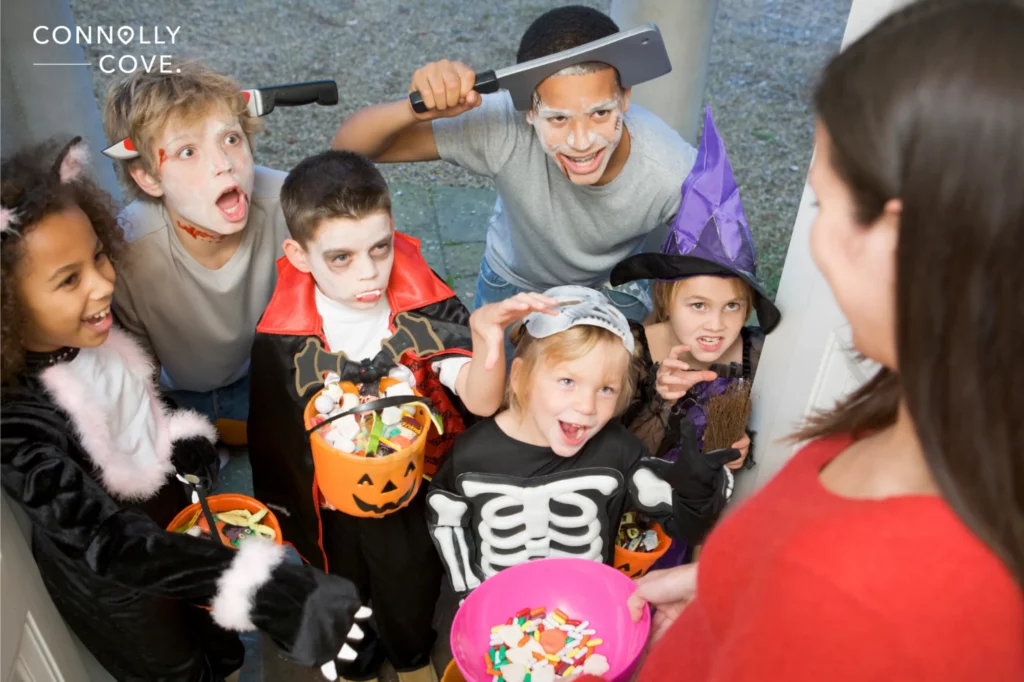
The modern practice of children dressing in fancy dress and going door-to-door has direct links to ancient Celtic traditions. “Guising”—the practice of disguising oneself on Samhain night—served two purposes: to blend in with the wandering spirits and avoid being noticed by them, and to receive offerings on their behalf.

Young people would go from house to house performing songs, poems, or tricks in exchange for food. This wasn’t mere entertainment but a symbolic exchange—the performers represented the spirits of the dead, and the food was an offering to ensure good fortune in the coming winter.

In Ireland’s rural communities, groups would carry a decorated horse skull (called a “hobby horse”) from house to house, with one person hidden under a white sheet. This figure—representing the dead—would remain silent while others sang. Householders would provide food and drink to honour both the performers and the spirits they represented.

Flames in the Dark: The Sacred Role of Bonfires and Divination

Perhaps the most striking feature of ancient Samhain was the lighting of great bonfires on hilltops across the Celtic lands. These weren’t merely for warmth or light—they held deep spiritual significance as symbols of purification and protection.

The word “bonfire” derives from “bone fire,” as the Celts would burn the bones of slaughtered livestock in these sacred flames. The community would extinguish all household fires and then relight them from the communal Samhain bonfire, symbolically connecting each home to the protective power of the sacred flame.

These fires served multiple purposes:

  • Warding off evil spirits
  • Purifying the community before winter
  • Honouring the sun god as days grew shorter
  • Providing a sacred space for divination rituals

Samhain was considered the ideal time for divination, peering into the future when the veil between worlds was at its thinnest. Young women would peel apples in one long strip, then toss the peel over their shoulders; the shape it formed on the ground was said to reveal their future husband’s initials. Others would place hazelnuts in the bonfire, naming each for a potential suitor—how they burned foretold the relationship’s future.

In Ireland, the Barmbrack cake (still enjoyed today) contained various objects baked inside, each foretelling the finder’s future: a ring meant marriage, a coin meant wealth, a rag meant poverty, and a thimble meant a person would never marry.

A Haunted Itinerary: The Ultimate Spooky Destinations in Ireland & the UK

For travellers seeking an authentically spooky Halloween experience, there’s no better place than the misty landscapes where Samhain originated. Here’s our guide to the most haunting locations where you can connect with the true spirit of Halloween.

Ireland: The Birthplace of Halloween

Walk the ancient soil where Halloween began over 2,000 years ago. Ireland isn’t just home to Halloween’s origins—it’s where the veil between worlds truly thins each October. Here, millennia-old traditions continue in rural communities, and Celtic history lives on in every stone circle and sacred well you’ll encounter.

These haunted castles and misty moors offer far more than tourist attractions; they’re portals to Halloween’s authentic essence. From communities still lighting Samhain bonfires to villages where turnips remain the traditional jack-o’-lantern, Ireland preserves the soul of this mystical celebration in ways impossible to find elsewhere.

The Hill of Ward (Tlachtga), County Meath

This unassuming grassy mound was once the centre of Ireland’s Samhain celebrations. Archaeological evidence confirms that massive fires were lit here over 2,000 years ago. Standing on this ancient ceremonial site as dusk falls during the Halloween season creates an atmosphere no commercial haunted house could match.

Visitor tip: The nearby town of Athboy holds the annual Púca Festival (28-31 October), reviving ancient Samhain traditions with storytelling, processions, and fire ceremonies.

Loftus Hall, County Wexford

Known as Ireland’s most haunted house, this 14th-century mansion sits on the isolated Hook Peninsula. Its most famous tale involves a mysterious visitor revealed to be the devil himself, leaving the daughter of the house in a state of madness from which she never recovered. Her ghost is said to still haunt the grand staircase.

Visitor tip: Night tours of Loftus Hall during Halloween week sell out months in advance. Book early for the full paranormal experience.

The Hellfire Club, Dublin Mountains

This ruined hunting lodge sits atop Montpelier Hill overlooking Dublin city. Built in 1725 on the site of an ancient passage tomb, it became notorious for debauched gatherings of aristocrats who allegedly practised black magic and devil worship. Numerous paranormal experiences have been reported here, from sudden temperature drops to sightings of a large black cat and a young woman in white.

Visitor tip: Halloween walking tours to the Hellfire Club combine history, folklore, and genuinely spine-tingling atmosphere.

Leap Castle, County Offaly

Often called the world’s most haunted castle, Leap’s bloody history includes fratricide in “The Bloody Chapel” and the discovery of an oubliette filled with human bones. Its most famous spectral resident is “The Elemental”—a primitive and malevolent entity that manifests as a decomposing corpse with a putrid stench.

Visitor tip: The current owner, musician Seán Ryan, offers personal tours by appointment, sharing both the history and his own paranormal experiences in the castle.

Scotland: Land of Myths and Mysteries

Scotland’s ancient Samhuinn celebrations rival Ireland’s in both age and mystique. Fire festivals, witch trials, and spectral encounters make Scottish Halloween traditions uniquely haunting, with a darker, more primal connection to Celtic spiritual practices.

From Edinburgh’s haunted underground streets to misty Highland battlefields, the boundary between worlds doesn’t just thin here—it shatters. Centuries-old folklore shapes modern celebrations in a land where the supernatural remains an everyday presence in both remote villages and bustling cities.

Edinburgh’s Mary King’s Close

Beneath Edinburgh’s Royal Mile lies a warren of 17th-century streets preserved when they were built over. The close was partially abandoned during the plague years, with some victims allegedly walled up alive to prevent the disease from spreading. Visitors report encounters with “Annie,” the ghost of a young girl abandoned during the plague.

Visitor tip: The “Haunted Halloween Tour” includes areas normally closed to the public and stories rarely shared on standard tours.

Culloden Battlefield, Inverness

Site of the last pitched battle on British soil, where over 1,500 men were killed in less than an hour in 1746. Visitors often report seeing spectral Highland warriors, hearing battle cries, and even feeling invisible touches. On the anniversary of the battle—and during Samhain when the veil thins—these experiences intensify.

Visitor tip: Sunset walks across the moor during Halloween week are particularly atmospheric, as mist often forms over the mass graves marked by clan stones.

Glamis Castle, Angus

The childhood home of the Queen Mother harbours numerous ghost stories, including “The Monster of Glamis” (a deformed heir supposedly hidden away in a secret chamber) and the ghost of a young serving girl who was murdered and bricked up in a wall. Shakespeare set “Macbeth” here, drawing on the castle’s already sinister reputation.

Visitor tip: The castle’s Halloween Extravaganza includes after-dark tours focusing on its darkest legends.

England: From Plagues to Poltergeists

England transforms Celtic Samhain traditions through centuries of haunted history, where plague pits, bloody Tower executions, and Victorian ghost stories create a uniquely English Halloween experience. While Ireland and Scotland preserve ancient rituals, England layers medieval witch trials and Gothic literature onto its Halloween celebrations, offering travellers a journey through the evolution of fear itself. Visit these locations to witness how England’s complex past created some of the world’s most enduring ghost stories and Halloween traditions.

The Tower of London

This iconic fortress has witnessed centuries of imprisonment, torture, and execution. The ghosts of Anne Boleyn, Lady Jane Grey, and the murdered princes in the Tower are among the many spirits said to haunt its ancient stones. Yeoman Warders (Beefeaters) regularly report unexplained footsteps, doors opening by themselves, and phantom touches.

Visitor tip: The special “Twilight Tours” during the Halloween season are led by Yeoman Warders who share their personal encounters with the Tower’s supernatural residents.

Pluckley Village, Kent

Listed in the Guinness Book of Records as Britain’s most haunted village, Pluckley boasts at least 12 distinct ghosts, including the Red Lady who searches the churchyard for the grave of her baby, the highwayman killed by villagers and pinned to a tree with a sword, and the miller who appears in the window of the old windmill.

Visitor tip: The village becomes a magnet for ghost hunters on Halloween night, so book accommodation well in advance if you plan to stay.

Pendle Hill, Lancashire

The site of England’s most famous witch trial in 1612, when ten people were hanged for witchcraft. The hill has a brooding presence that dominates the landscape, and the ghosts of the “Pendle Witches” are said to roam the area. Mysterious lights and sudden temperature drops are commonly reported by hikers.

Visitor tip: Guided Halloween hikes to the summit of Pendle Hill leave at sunset and return after dark—not for the faint-hearted!

Wales: Dragons, Druids, and Doleful Spirits

Wales guards some of Britain’s oldest and least diluted Halloween traditions, where ancient Druidic practices blend with tales of shapeshifting creatures and a distinctly Welsh celebration called ‘Nos Galan Gaeaf.’ In the land of dragons and bards, Halloween rituals focus on divination, spirit communication, and protection against the ‘Hwch Ddu Gwta’ (tailless black sow) that captures the souls of stragglers on Samhain night. Experience Wales’ mysterious Halloween heritage in these locations where Celtic language and traditions remain vibrantly alive.

St Fagans National Museum of History, Cardiff

This open-air museum showcases buildings from throughout Welsh history, many brought stone by stone from their original locations—along with their resident spirits. The Haunted Houses Trail features homes where staff regularly report paranormal activity, from the sound of children playing in empty rooms to furniture that moves overnight.

Visitor tip: During the annual “Nos Galan Gaeaf” (Welsh Halloween) celebrations, traditional divination games are demonstrated, and the origins of Welsh Halloween customs are explained.

Skirrid Mountain Inn, Abergavenny

Claiming to be Wales’ oldest pub (dating to the Norman Conquest), the Skirrid served as both inn and courthouse, with a hanging beam still visible in the ceiling. Over 180 people were executed here, and guests report seeing shadowy figures, hearing footsteps on empty staircases, and feeling invisible hands touching them.

Visitor tip: Halloween ghost hunts include a midnight séance in the former courtroom where so many were sentenced to death.

How to Host an Authentically Spooky Samhain-Inspired Gathering

Want to bring the authentic spirit of Samhain to your own Halloween celebrations? Here’s how to create an atmosphere that honours the ancient Celtic traditions while providing a genuinely spine-tingling experience for your guests.

Feasting with Ghosts: Traditional Foods like Barmbrack and Colcannon

Celtic Samhain celebrations centred around the final harvest, with special foods prepared both for the living and as offerings to the dead. Incorporate these traditional dishes into your Halloween gathering:

Barmbrack (Báirín Breac) – This Irish fruit bread contains various objects that foretell the finder’s future. Traditionally, items included:

  • A ring (marriage within the year)
  • A coin (wealth coming your way)
  • A piece of cloth (bad luck or poverty)
  • A thimble (you’ll never marry)
  • A small stick (an unhappy marriage)

Modern versions often include only the ring, but making an authentic barmbrack with all items creates a memorable divination activity for guests.

Colcannon – This hearty mixture of mashed potatoes, kale or cabbage, and onions was a Samhain staple. Coins would be hidden inside for children to find. Serve individual portions with a surprise token hidden in one for good luck.

Soul Cakes – These small spiced cakes were the original “treat” given to Samhain visitors. Marked with a cross, they were offered to those who would pray for the souls of the family’s dead relatives. Serving soul cakes connects your gathering directly to the origins of trick-or-treating.

Mulled Cider and Mead – Keep guests warm with traditional Celtic beverages. Spiced cider represents the apple harvest, while mead (honey wine) was considered a sacred drink that connected the human world with the divine.

Beyond Decorations: Crafting an Atmosphere with Firelight, Foliage, and Folklore

Commercial Halloween decorations have their place, but creating an authentic Samhain atmosphere requires a different approach:

Sacred Fire – The centrepiece of any Samhain celebration should be fire. If outdoor fires are permitted in your area, a bonfire is ideal. Otherwise, arrange candles throughout your space, preferably unscented beeswax or tallow candles for historical accuracy. Turn off electric lights entirely.

Natural Elements – Decorate with items from the autumn landscape:

  • Turnips carved into jack-o’-lanterns (the original Celtic version)
  • Bundles of wheat or corn to represent the harvest
  • Apples, nuts, and gourds
  • Fallen leaves and branches
  • Dried herbs like rosemary (remembrance) and mugwort (protection)

Ancestral Space – Create a small area dedicated to ancestors and loved ones who have passed. Traditional Celtic celebrations honoured the dead who returned on Samhain night. Invite guests to bring photos of departed loved ones to place on this memorial table, along with small offerings of food and drink.

Threshold Protection – The Celts believed boundaries between properties were particularly vulnerable on Samhain night. Place protective herbs like rowan berries or sprigs of holly at entrances, or draw Celtic knots with chalk at thresholds to ward off malevolent spirits.

The Lost Art of Spooky Storytelling: How to Share Local Legends

Perhaps the most powerful way to create an authentic Samhain atmosphere is through the ancient art of storytelling. Celtic cultures passed their legends orally for centuries before they were written down, and Halloween night is the perfect time to revive this tradition.

Setting the Scene:

  • Gather everyone in a circle around your fire or candles
  • Turn off all other lights and electronic devices
  • Provide comfortable seating with blankets (storytelling sessions can last hours!)
  • Serve warm drinks and traditional foods

Storytelling Techniques:

  • Start with a local legend from your area—every place has its ghost stories
  • Use a “storyteller’s candle” that only the current narrator may hold
  • Encourage guests to contribute their own tales or personal experiences
  • Vary your pacing and volume, using silence effectively to build tension
  • Make occasional eye contact with listeners, but also gaze into the darkness as if seeing something they cannot

Traditional Samhain Tales to Share:

  • The legend of Stingy Jack (the origin of jack-o’-lanterns)
  • Stories of the Aos Sí and their fairy mounds
  • Tales of ancestors who have visited after death
  • Local ghost stories and unexplained phenomena
  • Personal encounters with the supernatural

A Practical Planner for Your UK & Irish Spooky Season Trip

If you’re inspired to experience Halloween in its birthplace, here’s how to plan an unforgettable journey through the Celtic lands where Samhain originated.

When to Go & What to Book: A Seasonal Guide

Optimal Timing: The ideal period for a Halloween heritage trip is October 27-November 2. This allows you to:

  • Experience the pre-Halloween build-up and atmosphere
  • At the October 31 Night (October 31) celebrations
  • Participate in the November 1st Day (November 1) events
  • Visit key sites when they’re appropriately atmospheric but not overwhelmingly crowded

Priority Bookings: Certain experiences require advance planning:

  • Accommodation in key locations (Edinburgh, Dublin, haunted castles) often sells out 3-6 months in advance for Halloween week
  • Special Halloween tours (Loftus Hall, Tower of London Twilight Tours) open for bookings in early summer
  • Festival tickets for events like the Púca Festival in Ireland or the Samhuinn Fire Festival in Edinburgh should be purchased as soon as available
  • Restaurant reservations in tourist hotspots, October 31, for the October 31 dinner

Weather Considerations: Late October in Ireland and the UK typically features:

  • Temperatures of 5-12°C (40-55°F)
  • Frequent rain showers
  • Early sunsets (around 4:30-5:00 PM)
  • Atmospheric mist and fog, particularly in rural areas
  • Occasional windstorms

These conditions actually enhance the spooky atmosphere but require appropriate preparation.

Packing for the Paranormal: Essentials for Autumn in the British Isles

Clothing:

  • Waterproof jacket and trousers
  • Sturdy, waterproof walking boots
  • Warm layers (thermal base layers, fleece mid-layers)
  • Hat, gloves, and scarf
  • Wool socks (several pairs)

Equipment:

  • Small daypack with rain cover
  • Reusable water bottle
  • Thermos for hot drinks
  • Headlamp or torch (essential for evening ghost walks)
  • Portable phone charger (cold weather depletes batteries faster)
  • Small umbrella
  • Camera with low-light capabilities

Practical Items:

  • UK/Ireland power adaptors
  • Moisturiser and lip balm (windy conditions cause dryness)
  • Hand warmers for extended outdoor activities
  • Travel first aid kit
  • A rain cover for any electronics or cameras

Budgeting for Your Haunted Holiday (with costs in £GBP and €EUR)

Accommodation:

  • Budget options: Hostels (£25-35/€30-40 per night), B&Bs (£60-80/€70-95 per night)
  • Mid-range: 3-star hotels (£90-120/€105-140 per night)
  • Luxury: 4-5 star hotels (£150-300+/€175-350+ per night)
  • Haunted castle stays: £200-500/€235-585 per night

Transportation:

  • Car hire: £30-50/€35-60 per day plus fuel
  • Train travel: London to Edinburgh (£50-100/€60-120 one way), London to Dublin via ferry (£60-80/€70-95 one way)
  • Local buses: £2-5/€2.50-6 per journey
  • Guided tours: £40-80/€45-95 per day

Experiences:

  • Castle/Historic site entry: £10-20/€12-24 per site
  • Specialist ghost tours: £15-25/€18-30 per person
  • Halloween festival tickets: £20-40/€24-47
  • Samhain celebration events: £15-30/€18-35

Food and Drink:

  • Breakfast: £5-10/€6-12
  • Lunch: £8-15/€9-18
  • Dinner: £15-30/€18-35
  • Drinks in a pub: £4-6/€5-7 per pint

Total Budget Range (7 days):

  • Budget traveller: £700-900/€820-1050
  • Mid-range: £1,200-1,600/€1,400-1,870
  • Luxury experience: £2,000+/€2,340+

How the Word Halloween Was Coined: From Samhain to All Hallows’ Eve

The transformation from ancient Samhain to modern Halloween reveals how pagan and Christian traditions merged over centuries to create the holiday we know today.

As Christianity spread through Celtic lands, the Church sought to replace pagan festivals with Christian observances. In the 8th century, Pope GreNovember 1esignated November 1 as All Saints’ Day (also called All Hallows’ Day), a time to honour saints and martyrs. The evening before became known as All Hallows’ Eve.

The term “Halloween” evolved as a contraction of “All Hallows’ Eve.” In Old English, “hallow” meant holy or sanctified, so “All Hallows’ Eve” referred to the night before All Saints’ Day. This gradually shortened to “Hallowe’en” and finally to our modern “Halloween.”

Despite the name change, many of the ancient Samhain traditions persisted, absorbed into the new Christian framework. Bonfires, costumes, and food offerings continued, though their meaning shifted from pagan spirituality to Christian observance and eventually to secular celebration.

The Good Side of the Scary Night: Why Halloween Matters

Beyond the commercial aspects and spooky fun, Halloween serves valuable cultural and psychological purposes that connect us to our ancestors and to each other.

Halloween provides a safe way to confront our fears of death and the unknown. By playfully engaging with frightening concepts, we process anxieties that might otherwise remain unaddressed. The holiday’s focus on mortality—through skeletons, ghosts, and spirits—allows us to acknowledge death’s reality while celebrating life.

For children, Halloween offers valuable developmental benefits: exercising imagination, practising social skills during trick-or-treating, and experiencing managed risk through spooky (but safe) activities. For adults, it provides a rare opportunity to play, to step outside everyday roles, and to build community through shared celebration.

In our increasingly digital world, Halloween reconnects us with ancient rhythms and seasonal awareness. It marks the transition to the darker half of the year and acknowledges natural cycles of growth, harvest, decay, and rebirth that our ancestors understood intimately.

Most importantly, Halloween reminds us of our connection to the past. When we carve pumpkins, wear costumes, or tell ghost stories, we’re participating in traditions that stretch back thousands of years, linking us to countless generations who celebrated the thinning of the veil in similar ways.

Conclusion: Embracing the Authentic Spirit of Halloween

Whether you’re travelling to Celtic lands to experience Samhain where it began or bringing authentic traditions into your home celebration, connecting with Halloween’s ancient roots adds depth and meaning to the holiday.

Beyond plastic decorations and mass-produced costumes lies a rich cultural heritage that speaks to fundamental human experiences: our relationship with the changing seasons, our attempts to understand death and what might lie beyond, and our need to come together in community during the darkening days.

By understanding and honouring these roots, we transform Halloween from a superficial celebration into a meaningful connection with our ancestors, with nature’s cycles, and with the mysteries that have fascinated humanity since time immemorial.

Frequently Asked Questions About Halloween in Ireland & the UK

Curious about experiencing the authentic Celtic origins of Halloween? Here are the most common questions travellers ask about Samhain celebrations and spooky traditions in Ireland and the UK, with expert answers to help you plan your perfect Halloween adventure.

What is the original name for Halloween?

The original Celtic festival that became Halloween was called Samhain (pronounced “sow-in”), meaning “summer’s end” in ancient Gaelic. It marked the end of the harvest season and the beginning of winter.

Why is Ireland considered the birthplace of Halloween?

Ireland is where the Celtic festival of Samhain originated over 2,000 years ago. Samhain traditions—including bonfires, costumes to ward off spirits, and food offerings—directly evolved into modern Halloween practices.

When is the best time to visit Ireland for Halloween celebrations?

The optimal period is October 27-November 2, which allows you to experience both pre-Halloween activities and traditional Samhain celebrations on October 31, plus All Saints’ Day events on November 1.

What are the most authentic Halloween/Samhain events in Ireland?

The Púca Festival in County Meath (where Samhain originated) offers the most authentic experience with traditional fire ceremonies, storytelling, and music. Derry’s Halloween festival is larger but combines traditional and modern elements.

What is a traditional Irish Halloween food?

Barmbrack (Báirín Breac) is the traditional Irish Halloween bread containing various objects that foretell the finder’s fortune. Colcannon (mashed potatoes with kale or cabbage) is another traditional dish served at Samhain.

Where can I see traditional Celtic Samhain celebrations in the UK?

Edinburgh’s Samhuinn Fire Festival (October 31) presents one of the most authentic Celtic celebrations in the UK, with fire performances, drumming, and ancient Celtic characters. The festival recreates the ancient Celtic New Year celebration.

Are there any dangerous aspects to Halloween celebrations in Ireland?

Most events are family-friendly and safe. However, some rural areas still have unsupervised bonfires, which should be approached with caution. Always attend official events and follow local guidance.

What is the connection between Halloween and All Saints’ Day?

As Christianity spread, the Church established All Saints’ Day (November 1) to replace pagan Samhain celebrations. The night before became known as All Hallows’ Eve, which eventually evolved into “Halloween.”

Leave a comment

Your email address will not be published. Required fields are marked *