
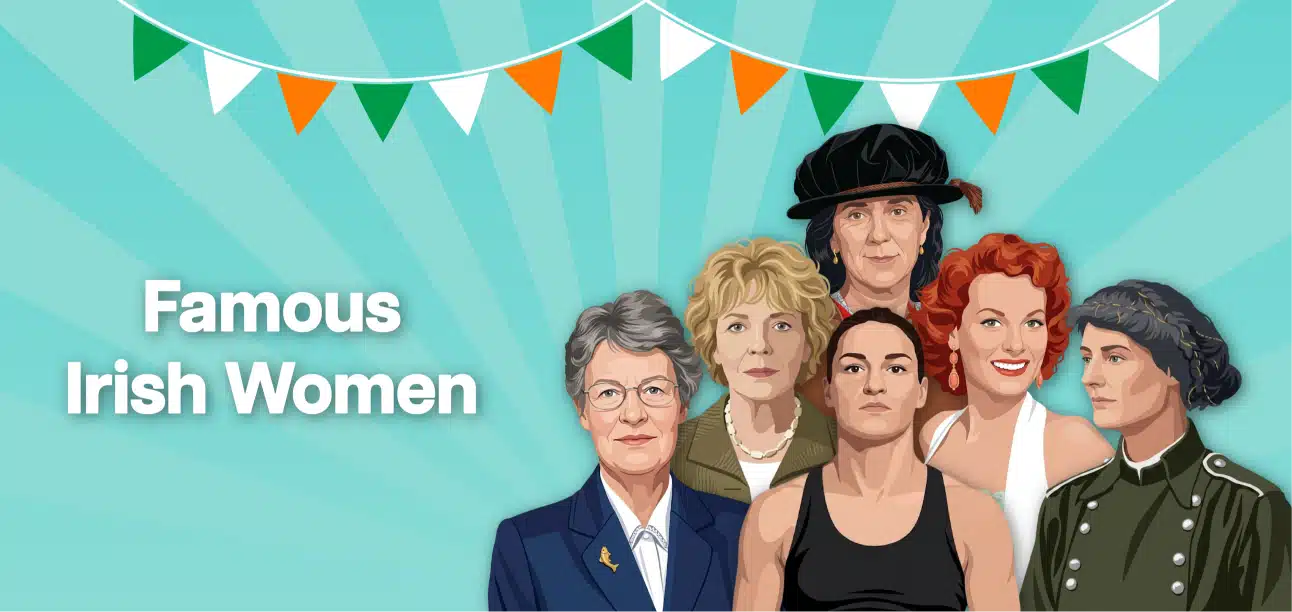


Article Summary
What this article covers: Irish women who changed things, grouped by what they did: rebellion and politics, science and invention, writing, art, screen, sport and comedy.
Who this is for: Readers looking for Irish women in a particular field, students and anyone who wants more than the same four names.
Key takeaway: Ireland produced the first woman elected to Westminster, one of the first computer programmers, and the astronomer who found pulsars. Several of them are better known abroad than at home.
Expert insight:
Standing in front of Lissadell House in Sligo, it is hard to square the place with what Constance Markievicz became. She grew up in a house with servants and a view of Benbulbin, and ended up in Kilmainham Gaol under sentence of death. Ireland has a lot of women like that, and most people can only name two of them.
Ciaran Connolly, Founder of ConnollyCove
Quick facts:
- Constance Markievicz was the first woman elected to the Westminster Parliament in 1918
- Kay McNulty from Donegal was one of the six original programmers of ENIAC
- Jocelyn Bell Burnell from Armagh discovered radio pulsars in 1967
Table of Contents
Ask most people to name a famous Irish woman, and you will get Countess Markievicz, possibly Mary Robinson, and then a pause.
That is a shame, because the list of famous Irish women runs much longer and much stranger than the usual two. A sixteenth-century sea captain who negotiated with Elizabeth I in Latin. One of the six women who programmed the first general-purpose electronic computer, without a manual, because none existed. The astronomer who found pulsars and watched someone else collect the Nobel Prize for it.
This is a guide to inspirational Irish women grouped by what they actually did, rather than by how well known they happen to be. ConnollyCove covers Irish heritage, and the people behind it, and this is one of those subjects where the further you get from the famous names, the better the stories become. Our guide to famous Irish people covers the wider set.
Rebels and Politicians
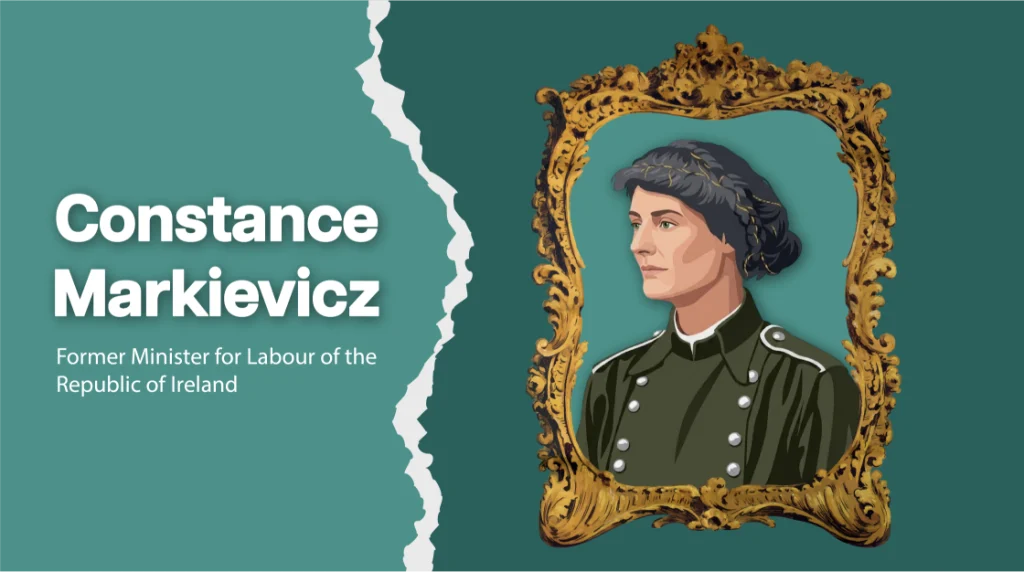
Ireland put a woman in a cabinet before almost anywhere else did, and has elected three women to the presidency since 1990. The pattern goes back further than the state itself: the five famous Irish women below span four centuries, from a sea captain who negotiated with Elizabeth I to the president sitting in Áras an Uachtaráin today.
Grace O’Malley
Gráinne Mhaol, born around 1530 in County Mayo, commanded a fleet from Clew Bay and controlled the waters off the west coast for decades. She raided shipping, held castles, and led men at sea at a time when almost no woman in Europe did any of those things.
In 1593, she sailed to London and met Elizabeth I at Greenwich. Neither spoke the other’s language, so they conducted the meeting in Latin. O’Malley refused to bow on the grounds that she did not recognise Elizabeth as Queen of Ireland.
Constance Markievicz
Born in London in 1868 and raised at Lissadell in County Sligo, Constance Gore-Booth grew up in the Anglo-Irish gentry and spent her adult life dismantling everything it stood for.
She trained as a painter in London and Paris, married a Polish count, and returned to Dublin, where she ran a soup kitchen during the 1913 Lockout and joined the Irish Citizen Army. She fought at St Stephen’s Green during the Easter Rising and was sentenced to death, commuted on account of her sex, which reportedly infuriated her.
In December 1918, she became the first woman elected to the Westminster Parliament, standing from a prison cell in Holloway. As a Sinn Féin member, she refused to take her seat. She served instead in the First Dáil as Minister for Labour from 1919 to 1922, making her one of the first women in the world to hold a cabinet post.
Mary Robinson
Elected in 1990 as the seventh President of Ireland and the first woman to hold the office. Before that, she was a barrister and, at 25, the youngest professor of law at Trinity College Dublin.
Her legal career was built on cases most people would not take: the right of women to sit on juries, access to contraception, and the decriminalisation of homosexuality. As president, she opened up an office that had been largely ceremonial. She left two months early to become the United Nations High Commissioner for Human Rights.
Mary McAleese
President from 1997 to 2011, and the first person from Northern Ireland to hold the office. A barrister and academic from Belfast, she campaigned on the theme of building bridges, which meant something specific coming from someone who had grown up through the Troubles.
Catherine Connolly
Inaugurated as the tenth President of Ireland in November 2025, and the third woman to hold the office. From Galway, she practised as a barrister and clinical psychologist, served as Mayor of Galway, and sat as an independent TD for Galway West from 2016.
Scientists and Inventors
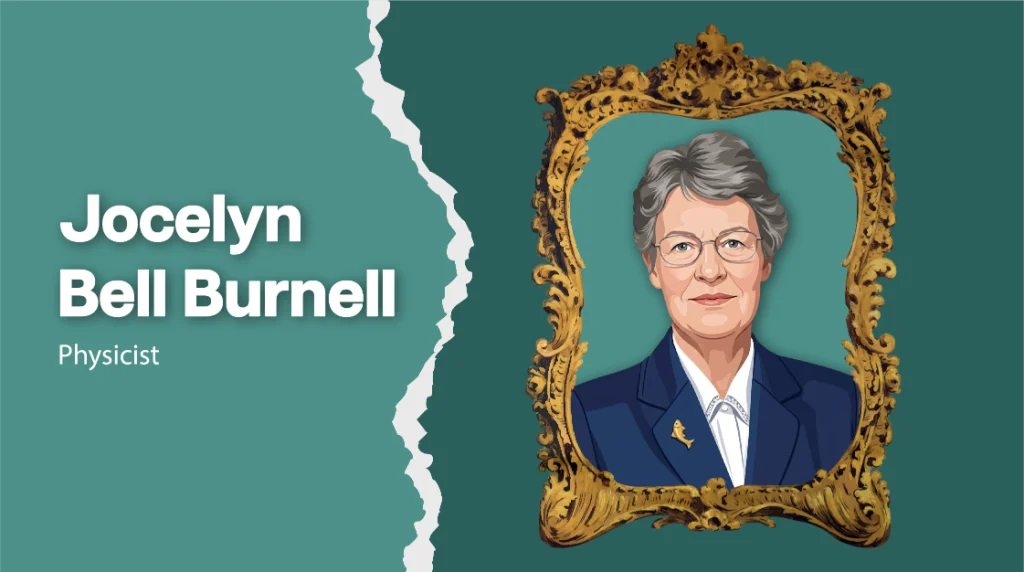
Irish women found pulsars, programmed the first electronic computer and settled the structure of benzene. This is the part of the list most people cannot fill in, and it is also where the recognition tends to have gone somewhere else. Two of the four below watched credit for their work land on someone else’s desk.
Jocelyn Bell Burnell
From Lurgan in County Armagh. In 1967, as a postgraduate student at Cambridge, she noticed a regular pulse in her radio telescope data that nobody could explain. It turned out to be a rotating neutron star, the first pulsar ever detected. The BBC has described it as one of the most significant scientific achievements of the twentieth century.
The 1974 Nobel Prize in Physics for the discovery went to her supervisor. She has consistently declined to be bitter about it in public.
In 2018, she was awarded the Special Breakthrough Prize in Fundamental Physics and gave the entire sum away, funding scholarships for women, ethnic minority students and refugees entering physics research.
Kay McNulty
Kathleen McNulty was born in Creeslough, County Donegal, in 1921, on the night her father was arrested during the War of Independence. The family emigrated to Pennsylvania when she was three.
She graduated in mathematics from Chestnut Hill College, one of only a handful of women in her year, and was recruited by the US Army as a human computer calculating artillery trajectories. She then became one of the six original programmers of ENIAC, the first general-purpose electronic digital computer.
There was no programming language and no manual. The six of them worked it out from the circuit diagrams. Their contribution went largely unrecognised for fifty years, until McNulty was inducted into the Women in Technology International Hall of Fame in 1997. Her papers and a detailed account of the ENIAC programmers are held by the Computer History Museum.
Kathleen Lonsdale
Born in Newbridge, County Kildare, in 1903. A crystallographer who proved that the benzene ring is flat, settling a question that had occupied chemists for decades.
In 1945, she became one of the first two women elected to the Royal Society. She was also a Quaker and a pacifist who served a month in Holloway Prison during the Second World War for refusing to register for civil defence duties.
Annie Maunder
An astronomer from Strabane, County Tyrone, born in 1868. She worked at the Royal Observatory in Greenwich, photographed solar eclipses, and co-authored the butterfly diagram showing how sunspots migrate across the sun’s surface over the solar cycle. She had to leave her paid post when she married, as the rules of the time required, and continued the work unpaid.
Writers
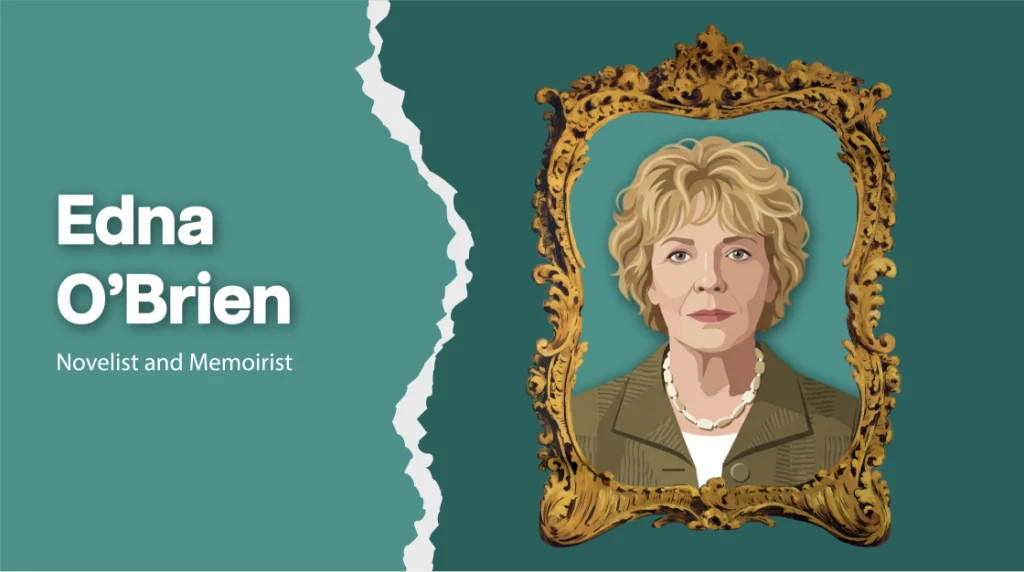
Irish writing is usually discussed through Joyce, Yeats, Beckett and Heaney, which leaves out roughly half of it. The four famous Irish women below wrote about Irish life from the inside, and the reception says a good deal about the country at the time. One of them had her debut novel banned within weeks of publication.
Edna O’Brien
Her first novel, The Country Girls, was published in 1960 and banned in Ireland almost immediately. Copies were reportedly burned in her home parish in County Clare. It is a book about two young women leaving the countryside for Dublin, and the offence taken says more about Ireland in 1960 than about the novel.
She went on to write more than twenty works of fiction, plus biographies of James Joyce and Lord Byron, and won the Frank O’Connor International Short Story Award for Saints and Sinners in 2011.
Maeve Binchy
The most commercially successful Irish novelist of her generation, and is frequently underrated because of it. She began as a journalist at the Irish Times and wrote seventeen novels, several of which have been filmed. Her subject was ordinary Irish life, written without condescension.
Elizabeth Bowen
Born in Dublin in 1899 into an Anglo-Irish family with a house in County Cork. She wrote ten novels and some of the best short stories in English about the Second World War in London, where she also worked for the Ministry of Information.
Nuala O’Faolain
A journalist and broadcaster whose memoir Are You Somebody? was published in 1996 as a collection of her columns with an autobiographical introduction. The introduction took over. It became a bestseller in Ireland and the United States and is one of the more honest accounts of an Irish woman’s life ever published.
Artists and Painters
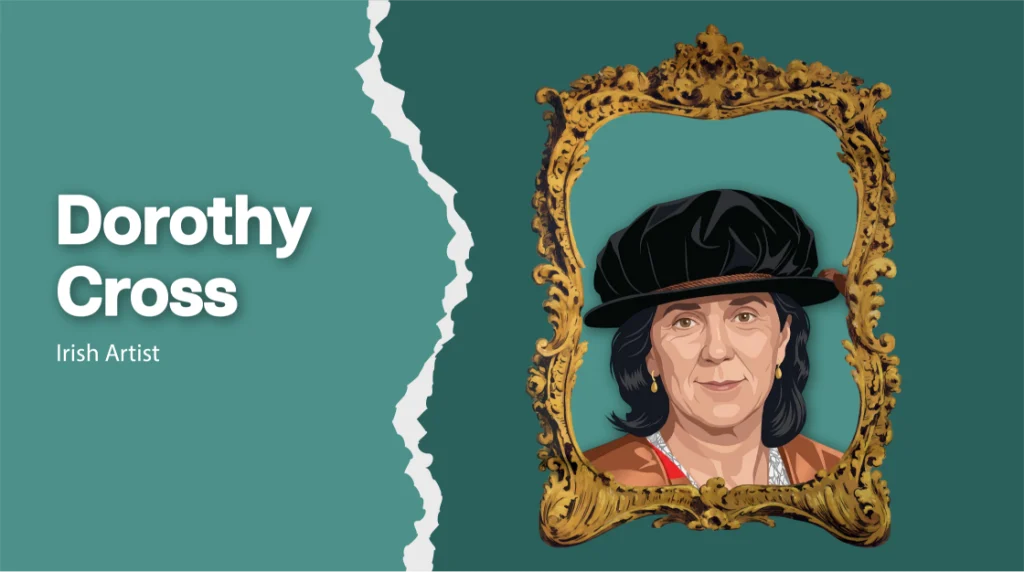
Modernism arrived in Ireland in the luggage of two Irish women coming back from Paris in the 1920s, and Dublin’s response was to laugh at them. Mainie Jellett and Evie Hone spent decades winning that argument, and the artists who followed had an easier time of it because they did.
Mainie Jellett and Evie Hone
The two women who brought modernism to Ireland. Both studied in Paris in the early 1920s under André Lhote and Albert Gleizes, and both returned with abstraction, which Dublin was not ready for. Jellett’s first abstract exhibition in 1923 was reviewed with open hostility.
She spent the rest of her life arguing the case in lectures and articles, and by the time she died in 1944, the argument was largely won. Hone moved into stained glass and produced windows that are still in churches across Ireland, including the east window at Eton College Chapel.
Norah McGuinness
A painter and illustrator from Derry who worked in Paris and New York before returning to Ireland. She illustrated editions of W.B. Yeats and became president of the Irish Exhibition of Living Art after Jellett’s death.
Dorothy Cross
Contemporary, born in Cork in 1956. Works in sculpture, film and installation, often with materials drawn from the sea. Her piece Ghost Ship, a lightship coated in luminous paint and moored in Dún Laoghaire harbour in 1999, is among the best-known pieces of Irish public art of recent decades.
Screen
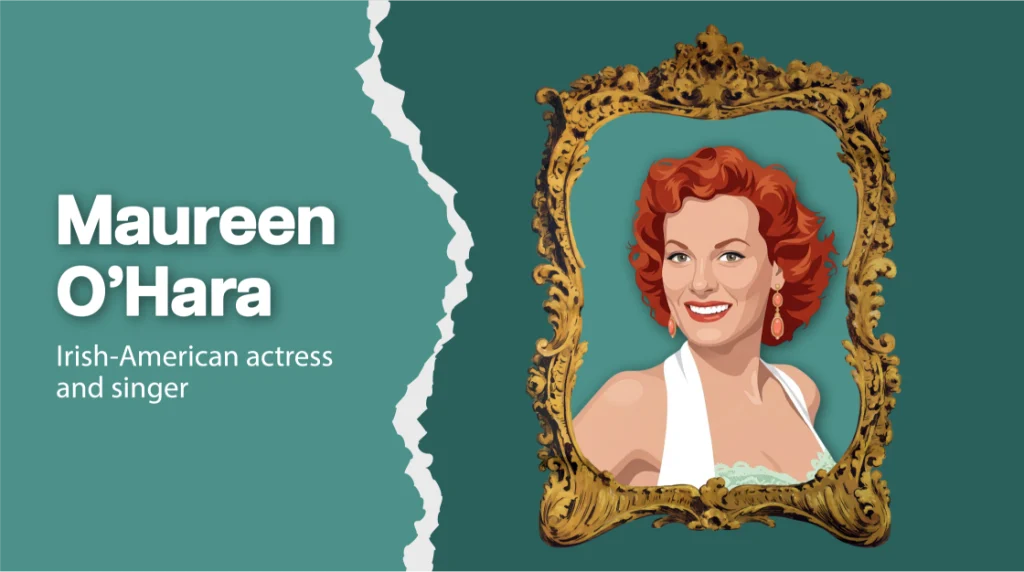
Two Irish actresses, seventy years apart, both of whom went to America young and both of whom kept coming back to Irish material. Between them, they cover the whole arc of Ireland on film, from Hollywood’s version of the country in the 1950s to Irish film-makers telling their own stories.
Maureen O’Hara
Born in Ranelagh, Dublin, in 1920, and trained at the Abbey Theatre. She moved to Hollywood in 1939 and appeared in The Hunchback of Notre Dame that same year.
She made more than fifty films across six decades and became known for playing women who fought back, most famously opposite John Wayne in The Quiet Man in 1952, shot in Cong, County Mayo. She was also a qualified pilot and, later in life, ran an airline in the Caribbean.
Saoirse Ronan
Born in New York in 1994 to Irish parents and raised in County Carlow. She was nominated for an Academy Award at thirteen for Atonement, and has been nominated three more times since, for Brooklyn, Lady Bird and Little Women.
Brooklyn is the one that matters here: a film about an Irish woman emigrating to New York in the 1950s, made by an Irish crew from a novel by Colm Tóibín.
Sport
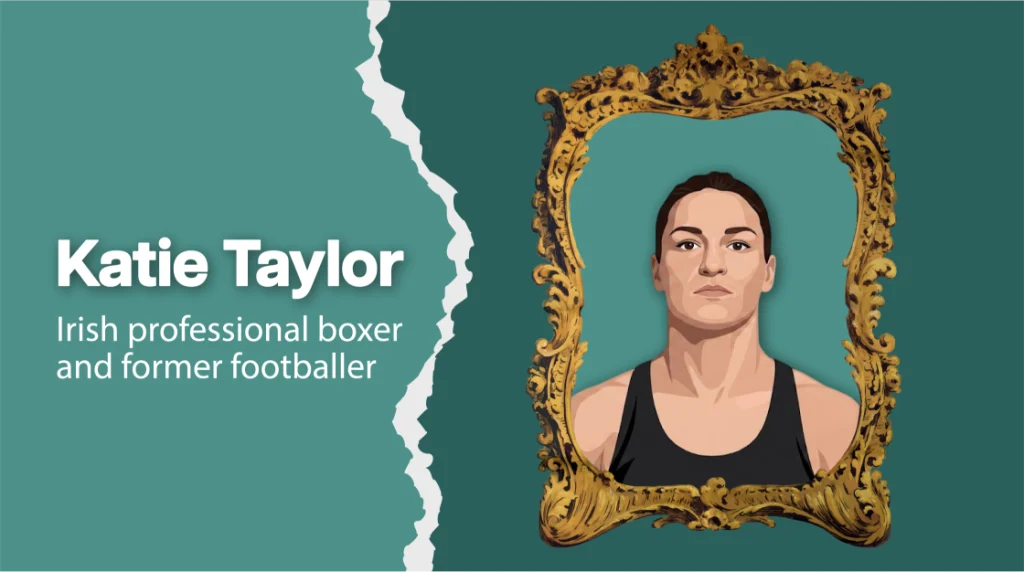
Two famous Irish women in sport whose wins changed what was available to the women who came after them. One of them competed in a sport that was not open to women at the Olympics until she was twenty-six years old.
Katie Taylor
From Bray, County Wicklow. She won five consecutive World Championships and six European titles as an amateur, then gold at the 2012 London Olympics in the first Games where women’s boxing was contested at all.
She turned professional in 2016 and became the undisputed lightweight world champion. Her 2022 fight against Amanda Serrano at Madison Square Garden was the first women’s bout to headline that venue.
Sonia O’Sullivan
The middle-distance runner who carried Irish athletics through the 1990s. World Champion over 5,000 metres in 1995, European Champion over 5,000 and 10,000 in 1998, and Olympic silver medallist over 5,000 metres in Sydney in 2000.
Comedy
Irish comedy is usually discussed as though it were entirely male, which has not been true for a long time.
Aisling Bea writes and performs, and created and starred in the Channel 4 series This Way Up. Maeve Higgins built a career in Ireland before moving to New York, where she writes as well as performs. Joanne McNally has filled arenas with a stand-up show that started in small rooms. Tara Flynn and Deirdre O’Kane were doing it before any of them.
Our guide to Irish comedians covers the wider scene.
Fashion and Publishing
One of the most powerful people in twentieth-century fashion publishing was a woman from Dublin who left Ireland as a child and never worked there again. Her name means very little in Ireland and a great deal in New York.
Carmel Snow
Born in Dublin in 1887, emigrated to New York as a child after her father’s death. She worked at Vogue under Condé Nast, then moved to Harper’s Bazaar as editor-in-chief, a defection that reportedly ended the friendship.
She ran Harper’s Bazaar for more than twenty years and hired Alexey Brodovitch, Richard Avedon and Diana Vreeland. She is credited with coining the phrase “the New Look” for Christian Dior’s 1947 collection.
Frequently Asked Questions
Who is the most famous Irish woman in history?
Of all the famous Irish women in history, Constance Markievicz is the most
widely recognised. She was the first woman elected to the Westminster Parliament, one of the first female cabinet ministers anywhere, and fought in the Easter Rising.
Which Irish woman was the first female President of Ireland?
Mary Robinson was inaugurated in December 1990. Mary McAleese followed in 1997, and Catherine Connolly became the third woman in the role in November 2025.
Are there famous Irish female scientists?
Several. Jocelyn Bell Burnell discovered radio pulsars in 1967. Kathleen Lonsdale proved the structure of the benzene ring and was among the first two women elected to the Royal Society. Annie Maunder co-authored the sunspot butterfly diagram.
Which Irish woman helped invent computer programming?
Kay McNulty from Creeslough, County Donegal, was one of the six original programmers of ENIAC, the first general-purpose electronic computer. They worked without a programming language, because none existed yet.
Who are the best-known Irish female writers?
Edna O’Brien, whose first novel was banned in Ireland; Maeve Binchy, the most widely read; Elizabeth Bowen, for her wartime short stories; and Nuala O’Faolain, whose memoir became a bestseller on both sides of the Atlantic.
Who are the important Irish women painters?
Mainie Jellett and Evie Hone brought modernism to Ireland in the 1920s and were mocked for it. Norah McGuinness led the Irish Exhibition of Living Art. Dorothy Cross is the best-known contemporary Irish artist working today.
Was Grace O’Malley a real person?
Yes. Gráinne Mhaol was a real sixteenth-century chieftain and sea captain from County Mayo who met Elizabeth I in 1593. The two are said to have spoken Latin, having no other language in common.
Which Irish women are famous in sport?
Katie Taylor, Olympic gold medallist and undisputed world champion in boxing, and Sonia O’Sullivan, world and European champion over 5,000 metres.
What connects most of these famous Irish women is that they were told no first. Bell Burnell watched the Nobel go elsewhere. Jellett was laughed at in print. Annie Maunder had to give up her salary to get married and kept working anyway.
For more, our guide to famous Irish people covers the wider list, and our guide to famous Irish female singers covers the musicians in proper detail.


