


Article Summary
What this article covers: Unusual sporting events around the world, from cheese rolling in Gloucestershire and wife carrying in Finland to the Poc Fada hurling contest in County Louth, with their rules, origins and practical advice for travellers who want to watch them.
Who this is for: Travellers planning a trip around a folk sporting event, readers curious about where unique competitions come from, and visitors to Ireland and Britain who want to see local traditions in person.
Key takeaway: Most unusual sporting events began as a local custom, a legend or a settlement of an old argument, and knowing that story is what turns a strange spectacle into a cultural experience worth travelling for.
Expert insight: “People ask why a hurling contest is held on a mountain in County Louth, and the answer is the Táin. The Poc Fada follows the route Sétanta is said to have taken across the Cooley Mountains, and almost every unusual sporting event we cover on ConnollyCove has a story like that underneath it, which is usually the reason the event has survived.”, Ciaran Connolly, Founder of ConnollyCove
Quick facts:
- The official wife carrying track in Sonkajärvi, Finland, is 253.5 metres long, and the person carried must weigh at least 49 kilograms.
- The first written evidence of cheese rolling at Cooper’s Hill is a message sent to the Gloucester town crier in 1826.
- The All-Ireland Poc Fada on Annaverna Mountain re-enacts the boyhood journey of Sétanta, later Cú Chulainn, from the Táin Bó Cúailnge.
Table of Contents
Unusual sporting events are some of the most rewarding reasons to plan a trip, because each one is tied to a particular hill, bog, road or mountain and to the people who have kept it going for generations. Some of these unique competitions are a few decades old and began as a pub wager, while others go back centuries and grew out of grazing rights, harvest gatherings or legend. In Ireland, the oldest of them connect directly to Celtic mythology, and the same pattern of local custom becoming a public contest appears in Finland, England, Wales and across Asia.
ConnollyCove is an Ireland-based travel and culture platform, and this guide covers the unusual competitions that travellers can actually go and watch. It explains how each event works, where it began and when it usually takes place, and it places Ireland’s own folk sports alongside the better-known British and Finnish examples. If you want the wider background first, our guide to traditional Irish games covers the sports most Irish children grow up with, and our history of ancient Irish sports from the Tailteann Games to Croke Park traces how they developed.
Unusual sporting events usually grow out of a local custom

Most unusual sporting events began as something other than sport: a fertility rite, a way to settle a land dispute, a feat from a legend or a joke between neighbouring villages. Over time the custom gained rules, a date in the calendar and a winner, and that is the point at which it became a competition.
Medieval football is the clearest early example. Matches between whole towns had few rules and little resemblance to the modern game, and the contest was closer to a mass brawl over a ball than to a sport with a pitch and a referee. Regulated versions eventually replaced it, but a handful of towns kept the older form alive. In Atherstone in Warwickshire, the Atherstone Ball Game is described as a tradition stretching back over 800 years, with residents competing in a rough contest to gain possession of a large ball.
Ireland has its own version of this history. The ancient Tailteann Games were associated with Lughnasadh and with the gathering held in honour of Tailtiu, the foster mother of Lugh, and our guide to the four Celtic festivals explains how athletic contests, storytelling and the arts were combined at that time of year. The same instinct to attach a contest to a season or a story runs through every event in this guide.
Britain’s folk sports are the best known unusual competitions
England and Wales host several of the most widely reported unusual sporting events in the world, and most of them take place in small rural communities on public holidays. Late May and late August are the busiest periods, so a trip to Britain at either time can take in more than one event. Our two-week UK itinerary passes through the Cotswolds and South Wales, which are the areas covered below.
Cooper’s Hill cheese rolling in Gloucestershire
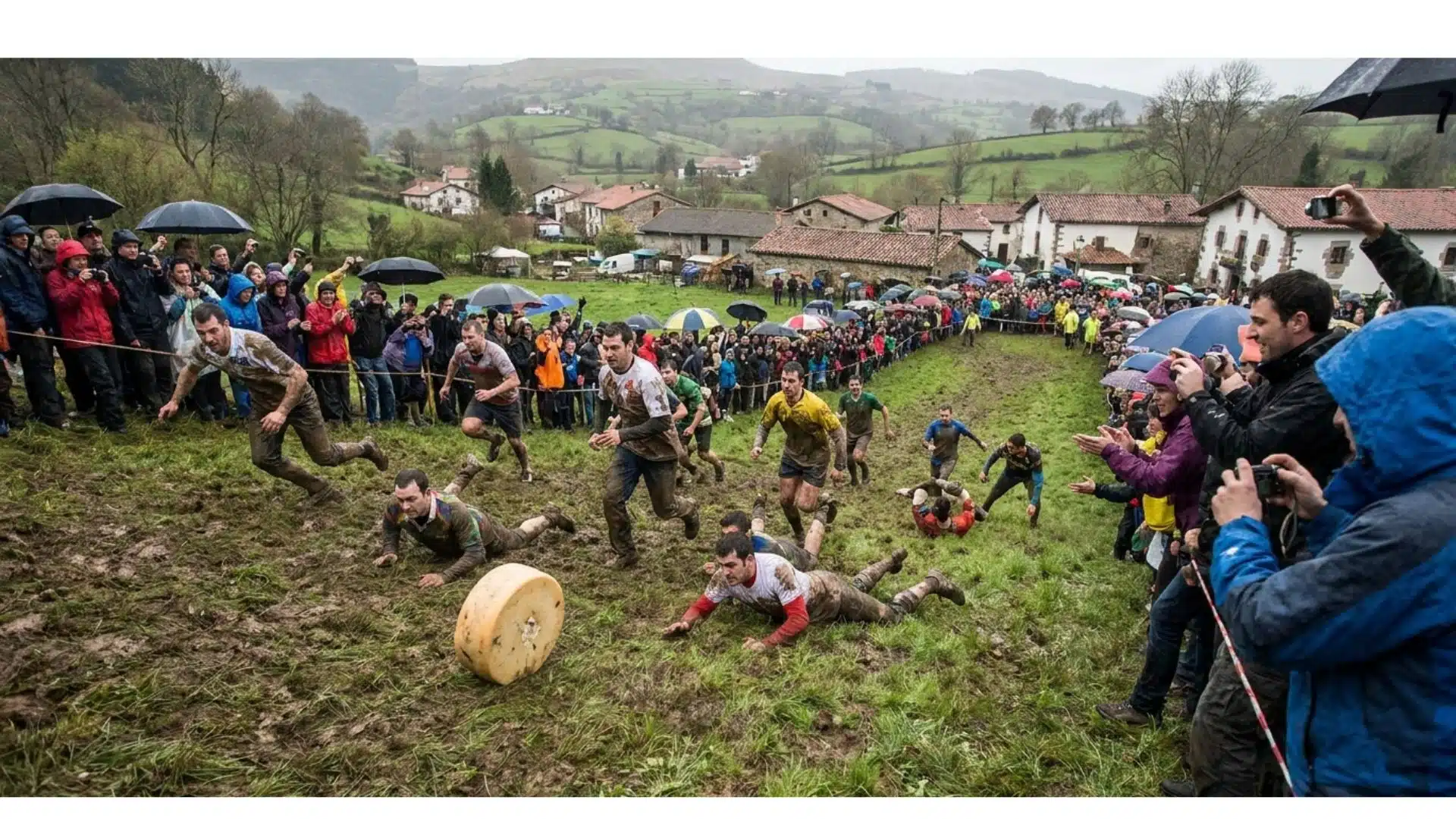
The Cooper’s Hill Cheese-Rolling and Wake takes place on the Spring Bank Holiday at Cooper’s Hill in Brockworth, Gloucestershire, where competitors chase a wheel of Double Gloucester cheese down a hill roughly 180 metres long. The cheese weighs between three and four kilograms and is protected by a wooden casing round its side. The first person across the finish line at the bottom wins the cheese, since catching it is close to impossible. There are no strict rules about how to get down the hill, and the descent is usually chaotic, with many runners falling most of the way.
The exact origins are unclear. The first written record is an 1826 message to the Gloucester town crier, and even then it was described as an old tradition. Two explanations are usually given: one links the event to keeping grazing rights on the common, and the other to a pagan custom of rolling burning brushwood down the hill to mark the end of winter. The race was originally held on Whit Monday and moved to the Spring Bank Holiday later.
Speeds of up to 70 miles per hour are often reported for the cheese, although no official measurement is published. The event was run officially until 2009, when it was called off over concerns about spectator safety, and it has continued each year since on an unofficial basis. That status matters for visitors, because the usual facilities of an organised event cannot be assumed.
Shin kicking at the Cotswold Olimpick Games
Shin kicking is the best-known contest at Robert Dover’s Cotswold Olimpick Games, held on Dover’s Hill above Chipping Campden on the evening of the last Friday in May. Robert Dover, a local lawyer, founded the games in 1612, and the British Olympic Association has described them as among the first signs of Britain’s Olympic beginnings.
Two competitors hold each other by the shoulders and try to bring the other to the ground by kicking at the shins. The rules have been softened over four centuries: steel toe caps are banned, soft shoes are required, and competitors may pad their shins with straw provided by the organisers. Kicks above or below the shin lead to disqualification, and the umpire, known as the Stickler, is often credited as the origin of the phrase “a stickler for the rules”. Competitors usually register on the hill on the day, which makes it one of the few unusual competitions a visitor can realistically enter.
Bog snorkelling in Llanwrtyd Wells
The World Bog Snorkelling Championships take place at the Waen Rhydd peat bog in Llanwrtyd Wells, Powys, usually over the August bank holiday weekend. Competitors complete two lengths of a 55-metre trench cut through the bog, wearing a snorkel, mask and flippers, and conventional swimming strokes are banned, so all the power has to come from the flippers. The event was first held in 1976, and the men’s world record of 1 minute 18.81 seconds was set by Neil Rutter in 2018.
The bog has an Irish connection that many visitors do not expect. Records listed for the championships include John Cantillon of Dublin in 2000 and Dineka Maguire from Northern Ireland in 2013, so competitors from both sides of the Irish border have held times at Llanwrtyd Wells. Mid Wales is quieter than the Cotswolds, and our guide to the best time to visit the United Kingdom covers the weather you can expect there in late summer.
Toe wrestling and other English contests
England has several smaller events that rarely travel beyond local news. The World Toe Wrestling Championship is held in Derbyshire in July, and two competitors lock toes and try to pin the opponent’s foot for three seconds. These contests are small, and visitors should check the organisers’ own pages each year, since dates and venues can change at short notice.
Finland’s wife carrying championships follow strict rules
Wife carrying is a race in which one competitor carries a partner through an obstacle course, and its home is Sonkajärvi in central Finland, where the world championships are held each July. The event has run annually in Sonkajärvi since 1992, and the prize for the winning couple is the carried partner’s weight in beer.
The sport is said to have been inspired by Herkko Rosvo-Ronkainen, a nineteenth-century outlaw whose gang was reputed to steal food and women from villages in the area and carry them away on their backs. This is a local legend and is best treated as one. Finnish broadcaster Yle has described the championships as beginning as a purely Finnish contest based on a regional tale that wife stealing was once common.
The international rules are precise for a contest built on a joke:
- The official track is 253.5 metres long, over sand, grass and gravel, with two dry obstacles and a water obstacle about a metre deep.
- The person carried can be your own wife, a neighbour’s or someone from further afield, but must be over 17 and weigh at least 49 kilograms; anyone lighter carries a rucksack to make up the difference.
- A carrier who drops his partner must lift her again and continue, and the only equipment allowed is a belt worn by the carrier.
- Couples race in pairs, each competitor is responsible for his or her own safety and insurance, and the rules state that all participants must have fun.
Several carrying styles are allowed, including the piggyback, the fireman’s lift and the Estonian carry, in which the partner hangs upside down with her legs over the carrier’s shoulders and holds his waist. Estonian couples dominated the championships for years, and Margo Uusorg and Sandra Kullas set a record of 56.9 seconds on the 253.5-metre course in 2006. Training for the event is mostly leg and core strength, balance and practice with the chosen carry, since a smooth hold matters as much as speed.
Some critics have raised concerns about the sport reinforcing traditional gender roles, while supporters describe it as a consensual and light-hearted test of strength and teamwork; the rules themselves allow either partner to be anyone over 17. For travellers, Sonkajärvi is a small municipality, and our guide to the top places to visit in Finland is a useful way to build a longer trip around the July weekend.
Ireland’s unusual sports carry the Celtic thread

Ireland’s most distinctive unusual sporting events are rooted in mythology and in rural parish life, and two of them, the Poc Fada and road bowling, can be watched by any visitor during the summer. They are less widely reported abroad than cheese rolling or wife carrying, which makes them worth seeking out.
The Poc Fada on Annaverna Mountain
The All-Ireland Poc Fada is a long-distance hurling contest held on Annaverna Mountain in the Cooley Mountains of County Louth. Poc Fada means “long puck” (approximately “puck FAH-da”), and competitors hit a sliotar (the hurling ball, approximately “SLIT-er”) with a hurley across the mountain in as few strokes as possible. The player who completes the course in the lowest number of pucks wins Corn Setanta.
The contest re-enacts a scene from the Táin Bó Cúailnge, in which the boy Sétanta travelled through the Cooley Mountains on his way to Emain Macha, striking his sliotar ahead of him and running to catch it. Sétanta later became Cú Chulainn, and our guide to Cú Chulainn and the heroes of myth tells the rest of his story, while our piece on Irish myth through literary texts explains where the Táin survives in the manuscripts.
The course is about five kilometres long and broken into stages, running up to Carn an Mhadaidh and back down, while senior camogie and under-16 competitors play a shorter two-stage course of about 2.5 kilometres. Visit Louth listed the 2026 All-Ireland final for Monday 3 August, though other sources describe the finals as taking place on the Saturday of the August holiday weekend, so check the date before you travel. The Cooley Peninsula lies between Dublin and Belfast, and our guides to visiting County Louth and things to do in Louth cover Carlingford and the walking routes nearby. If hurling itself is new to you, our introduction to hurling as a sport explains the game the Poc Fada is built on.
Road bowling in Cork and Armagh
Irish road bowling is played on public roads, and the aim is to cover a set course in the fewest throws using a solid iron bowl weighing 28 ounces, about 794 grams. The sport is concentrated in County Cork and County Armagh, especially south Armagh, and in Armagh the bowl is often called a bullet. The governing body, Ból Chumann na hÉireann, was formed in 1954 at a meeting in Enniskeane, County Cork.
The first All-Ireland senior final between Cork and Armagh took place in 1963 on the Moy Road in Armagh, and the rivalry between the two counties still defines the sport. Roads are usually closed for matches, and spectators line the verges along the route, so the best advice for a first visit is to stand well back from the line of throw and follow the crowd as the score moves along the road. Our guide to County Armagh covers Navan Fort, the site identified with Emain Macha, which links road bowling country back to the Sétanta story, and our Northern Ireland travel guide covers the routes from Belfast.
Puck Fair and the August festival season
Puck Fair in Killorglin, County Kerry, is a festival and not a sport, but it falls on 10, 11 and 12 August and fits naturally into an August trip built around the Poc Fada or road bowling. Each year a wild goat is brought down from the mountains and crowned King Puck, and our guide to the best Irish festivals explains the tradition and its long history. Following objections from animal welfare groups, King Puck is now displayed on the stand for a couple of hours instead of the full three days. For readers who want to understand how these customs fit into everyday Irish life, our guide to Irish traditions covers the wider calendar, and our guide to cultural experiences in Ireland covers the parish-level sport and pub culture that keeps events like these going.
Unique competitions elsewhere draw on local skills
Beyond Britain, Finland and Ireland, many unique competitions grow from a particular skill or place, and they range from team ball games to tests of nerve. The examples below appeared in the original version of this guide and are included as starting points for further research, since several are harder for visitors to attend.
Sepak takraw, played widely in Southeast Asia, is an acrobatic team game in which players keep a woven ball in the air using any part of the body except the arms and hands. Land diving on Pentecost Island in Vanuatu involves men jumping from tall wooden towers with vines tied to their ankles, and it is a ceremonial practice with deep local meaning before it is a spectacle. Extreme ironing, which is reported to have begun in Leicester, England, in 1997, involves pressing clothes in improbable places such as mountainsides.
In Alaska, the World Eskimo-Indian Olympics showcase traditional games based on hunting and survival skills, including the knuckle hop and the ear weight lift. Fireball football, in which players kick a burning ball, requires protective clothing against burns, and sheep shearing contests in New Zealand turn a farming skill into a timed competition. If tests of nerve appeal more than folk custom, our guide to extreme sports travel covers adventure sports you can try yourself.
A planning table for watching unusual sporting events
The table below gives the usual timing for each event in this guide. Dates move from year to year, especially for events tied to bank holidays, so confirm with the organisers before booking travel.
| Event | Place | Usual timing | Can visitors take part? | Best for |
|---|---|---|---|---|
| Cooper’s Hill cheese rolling | Brockworth, Gloucestershire | Spring Bank Holiday, late May | Yes, at your own risk | Spectators who are happy on a steep, crowded hillside |
| Cotswold Olimpick Games (shin kicking) | Dover’s Hill, Chipping Campden | Last Friday evening in May | Yes, registration on the night | Combining with a Cotswolds stay |
| World Bog Snorkelling Championships | Llanwrtyd Wells, Powys | August bank holiday weekend | Yes, check entry rules in advance | A quieter rural trip in mid Wales |
| Wife Carrying World Championships | Sonkajärvi, Finland | July | Yes, in couples | A summer trip to Finland |
| All-Ireland Poc Fada | Annaverna Mountain, County Louth | Early August | Finals are for qualifiers | Celtic mythology travellers based in Dublin or Belfast |
| Irish road bowling | Cork and Armagh | Summer season | Watch from the roadside | Seeing rural Irish sport up close |
| Puck Fair | Killorglin, County Kerry | 10 to 12 August | Festival only | Pairing with an August trip to the south west |
Spectators and safety need planning before you go
The main risk at most unusual sporting events falls on competitors, but spectators also need to plan, because many of these events take place on steep ground, open bog or public roads without the facilities of a stadium. At Cooper’s Hill, spectators should stay behind barriers and away from the line of the hill, and anyone thinking of running should accept that injuries are common. Wife carrying rules make each competitor responsible for their own safety and insurance, which is a useful reminder that standard travel insurance may not cover taking part in an organised contest.
For every event, arrive early, wear footwear suited to mud or steep grass, and check whether parking, toilets and food are provided on site. Small rural towns can fill quickly on event weekends, so book accommodation well in advance. Our guide to Ireland’s legendary creatures from Celtic mythology is good reading for the journey if you are heading to the Cooley Mountains, since several of the figures in the Táin appear there.
More Irish heritage and travel guides on ConnollyCove
ConnollyCove covers Irish heritage, Celtic mythology and travel destinations across Ireland and worldwide, and Ireland’s own unusual sporting events are some of the best ways to see how mythology and parish life still shape the country. To keep exploring, read our guide to successful Irish athletes for the country’s wider sporting record, or watch the ConnollyCove YouTube channel for video guides to Irish heritage and the places where these stories began.
FAQs
What are the weirdest competitions in the world?
Cooper’s Hill cheese rolling, wife carrying and bog snorkelling are among the most widely reported weird competitions in the world. Shin kicking in the Cotswolds, toe wrestling in Derbyshire and the Poc Fada hurling contest in County Louth are less famous but just as distinctive, and each is tied to a local custom or legend.
Where does cheese rolling take place?
Cheese rolling takes place at Cooper’s Hill in Brockworth, near Gloucester in England, on the Spring Bank Holiday at the end of May. Competitors chase a three to four kilogram wheel of Double Gloucester down a hill about 180 metres long, and the first person across the finish line wins the cheese.
What are the rules of the wife carrying competition?
Wife carrying requires a competitor to carry a partner over a 253.5-metre course with two dry obstacles and a water obstacle. The partner must be over 17 and weigh at least 49 kilograms, with a rucksack added to make up any shortfall, and a carrier who drops his partner must lift her again and continue.
What is bog snorkelling and how do you win?
Bog snorkelling is a race through two lengths of a 55-metre trench cut through a peat bog, held at Llanwrtyd Wells in Wales. Competitors wear a snorkel, mask and flippers, conventional swimming strokes are not allowed, and the fastest time wins.


