
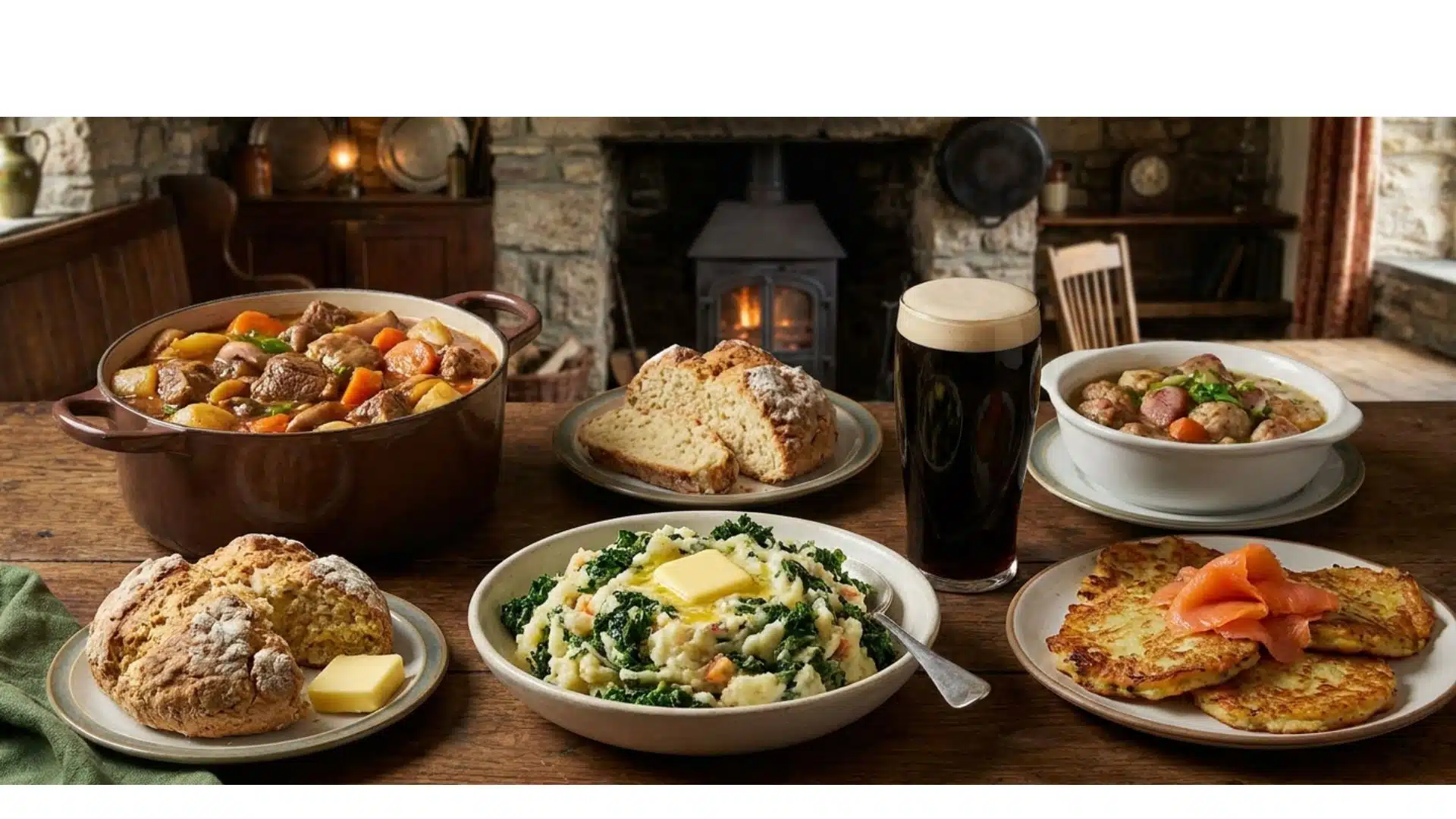


article summary
What this article covers: Irish food from its prehistoric roots to the modern food scene, including the traditional dishes worth ordering, the history behind them and where to eat them across Ireland and Northern Ireland.
Who this is for: Travellers planning a trip to Ireland, members of the Irish diaspora reconnecting with family recipes, and anyone curious about Irish cuisine and Irish food culture.
Key takeaway: Traditional Irish food is farmhouse cooking built on potatoes, oats, dairy, pork, lamb and Atlantic seafood, and the best versions are still found in local pubs, markets and coastal towns rather than in restaurants aimed at tourists.
Expert insight: “Ask three Dublin families how they make coddle, and you will get three answers, and every one of them will tell you the others are wrong. That argument is the best sign a dish is still alive, and it is why we write about Irish food the way we write about Irish folklore.”, Ciaran Connolly, Founder of ConnollyCove
Quick facts:
- Mount Sandel near Coleraine, one of the oldest known settlements in Ireland, has produced evidence of salmon, eel and hazelnuts eaten around 7000 BC.
- Ireland has no official national dish, although Irish stew is the dish most often given that title.
- The Galway International Oyster and Seafood Festival has run every September since 1954, at the start of the native oyster season.
Table of Contents
Irish food is built on a small number of ingredients that the island has always produced well, namely potatoes, oats, butter and milk, pork, lamb and seafood from the Atlantic and the Irish Sea. The traditional Irish dishes most visitors meet, from Irish stew and colcannon to soda bread and the full breakfast, grew out of farm kitchens where cooks had to feed large households cheaply, and that history still shapes what you will find on a menu in Ireland today. An old Irish proverb, “Is maith an t-anlann an t-ocras” (hunger is a good sauce), sums up the attitude, and ConnollyCove’s collection of traditional Irish proverbs has plenty more in the same spirit.
This guide comes from ConnollyCove, an Ireland-based travel and culture platform founded by Ciaran Connolly that covers Irish heritage, Celtic mythology and destinations worldwide. It follows Irish cuisine from the Mesolithic hunters of the River Bann to the spice bag in a Dublin takeaway, explains which dishes are part of everyday Irish eating and which belong mainly to St Patrick’s Day abroad, and finishes with practical advice on where to eat in Dublin, Cork, Galway and Belfast. If you are interested in how food fits alongside music, language and religious custom, our wider guide to Irish traditions and customs is a good companion read.
Irish cuisine began with salmon, shellfish and hazelnuts

The earliest Irish diet was a hunter-gatherer diet of fish, shellfish, wild birds, nuts and berries, and the archaeological record for it is unusually clear. At Mount Sandel, on the River Bann near Coleraine, excavations of a settlement dated to around 7000 BC found burnt hazelnut shells alongside bones of salmon, eel and wild pig. Along the coast, Mesolithic communities left shell middens, which are large heaps of discarded oyster, mussel and limpet shells that show how much of their food came from the shore. When people search for Celtic cuisine or Gaelic food, this early mix of fish, grain, dairy and wild plants is usually what they are looking for.
Farming arrived in the Neolithic period, roughly 6,000 years ago, when settlers brought cattle, sheep and goats and began growing wheat and barley. The Céide Fields in County Mayo preserve stone field walls from this period under the bog, and they give some sense of how organised early Irish agriculture became. Dairy then moved to the centre of Irish life for thousands of years. Early medieval Irish law texts treat cattle as the main measure of wealth, and summer milk products such as butter, curds and soft cheese were so important that scholars describe them as the “white foods” of the early Irish diet.
Fulacht fia and bog butter show how early cooks stored and cooked food
Across Ireland there are thousands of fulacht fia, horseshoe-shaped mounds of burnt stone dating mostly to the Bronze Age. Each one sits beside a trough that was filled with water and heated by dropping in stones from a fire, and the most common explanation is that they were used to boil meat, although archaeologists have also suggested bathing, brewing and textile work. Folklore later linked them with the Fianna, the warrior band of Irish legend, who were said to cook their hunted deer in this way.
Butter was sometimes buried in bogs, possibly to preserve it or as an offering, and large lumps of this “bog butter” are still turned up by turf cutters. The National Museum of Ireland holds several examples, some of them thousands of years old, and they are a reminder of how highly early Irish communities valued dairy.
Irish mythology is full of food
Early Irish literature uses food to carry meaning, and the best-known example is the story of Fionn mac Cumhaill and the Salmon of Knowledge. In the tale, the poet Finnegas spends years trying to catch a salmon that has eaten the hazelnuts of wisdom, and the young Fionn, told to cook it without tasting it, burns his thumb on the skin and gains the fish’s knowledge instead. ConnollyCove’s retelling of the legend of the Salmon of Knowledge covers the River Boyne setting in detail, and our profile of Fionn mac Cumhaill as a figure of myth and history traces the places in Ireland connected with him.
Mead, a fermented drink made from honey, is the other food that runs through early Irish stories and custom. It appears in accounts of royal feasts and became closely tied to weddings, where the couple were traditionally given mead to drink in the weeks after the ceremony. You can read more about the drink itself in our guide to how traditional Irish mead is brewed, and about the customs around it in our look at Irish wedding traditions and blessings.
The potato reshaped the Irish diet and then failed it
The potato arrived in Ireland in the late sixteenth century and, within two hundred years, had become the main food of most of the rural population. It grew well in poor and wet soil, a small plot could feed a family, and it combined with buttermilk to give a diet that was monotonous but nutritionally adequate. The wider political changes of the seventeenth century, when much Irish land passed to new landowners and Irish beef, butter and grain were increasingly produced for export, pushed the poorest families further towards the potato because it was the one crop they could grow for themselves.
That dependence made the Great Famine of 1845 to 1852 so devastating. Potato blight destroyed successive harvests, roughly one million people died, and around another million emigrated, and Irish food culture changed permanently. Many older dishes and regional habits faded in the decades that followed, while the diaspora carried simplified versions of Irish cooking to Britain, North America and Australia. The Irish Folklore Commission’s Schools’ Collection, gathered in the 1930s and now searchable through the Dúchas folklore archive, preserves thousands of children’s accounts of what their families ate, and it is one of the best sources for anyone researching Irish food history.
The corned beef question belongs to this period. Ireland did produce and export salted beef in large quantities in the seventeenth and eighteenth centuries, mainly through Cork, but most Irish people at home could not afford to eat it. Corned beef and cabbage became a St. Patrick’s Day meal in the United States, where Irish immigrants found beef cheaper than the bacon they knew from home. In Ireland, the everyday equivalent is still bacon and cabbage.
Traditional Irish dishes worth ordering when you visit

The traditional Irish dishes below are the ones you will see most often on menus across Ireland, and each has a story that explains why it took the shape it did. They are grouped roughly from main meals to breakfast, bread and sweet things, and the table at the end of this section gives a quick reference for ordering.
Irish stew
Irish stew (stobhach Gaelach in Irish) is the dish most often called the national dish of Ireland, even though no official national dish exists. The oldest versions used mutton, because older sheep were the animals a farm could spare, and were simply layered with potatoes and onions and cooked slowly in water. Lamb has largely replaced mutton, and carrots are now common, although some cooks still argue that carrots have no place in a real Irish stew. Versions made with beef and Guinness are popular in pubs, but they are a later development. Rosemary and thyme are frequent additions, and the dish is at its best in the colder months.
Full Irish breakfast and the Ulster fry
The full Irish breakfast is a fried plate of rashers, sausages, black and white pudding, eggs, grilled tomato and mushrooms, usually served with brown bread or toast and a pot of tea. North of the border, the Ulster fry adds two griddle breads, soda farls and potato bread, fried in the same pan as the meat. ConnollyCove’s Belfast food guide lists cafés that serve a proper Ulster fry all day, which is useful because hotel versions tend to be less generous with the breads. Baked beans and hash browns appear on some plates, but many Irish cooks regard them as later additions.
Colcannon and champ
Colcannon is mashed potato mixed with buttered kale or cabbage, and champ is mashed potato beaten with milk, butter and chopped scallions (spring onions). Champ is particularly associated with Ulster, and it was historically the cheaper of the two because it needed only potatoes, milk and onions. Colcannon has a strong link with Halloween, when families hid a ring, a coin or a thimble in the dish for someone to find, and our article on Irish Halloween traditions through the years explains what each object was supposed to predict.
Boxty
Boxty is a potato pancake made from a mixture of grated raw potato and mashed potato, bound with flour and buttermilk and cooked on a griddle or in a pan. It is most closely associated with the north Midlands and Connacht, especially Leitrim, Cavan, Fermanagh and Mayo. Modern restaurants use boxty as a wrap for fillings such as smoked bacon, chicken or cheese, while the older versions were eaten plain with butter.
Soda bread and wheaten bread
Irish soda bread uses bicarbonate of soda and buttermilk instead of yeast, which made it ideal for households cooking over an open fire with soft Irish flour. It became widespread in the nineteenth century, once bread soda was easy to buy, and recipes passed from parents to children with small family variations. White soda bread and brown soda bread are both common, and in Northern Ireland a wholemeal soda loaf is usually called wheaten bread. Folklore says the cross cut into the top of a round loaf lets the fairies out, although the practical reason is that it helps the bread rise and cook evenly.
Coddle
Coddle is a Dublin dish of sausages, rashers, onions and potatoes simmered in stock, and it is closely tied to the working-class history of the city. It was a way of using up what was left in the kitchen at the end of the week, and every Dublin family seems to have a firm view on the right way to make it. You are most likely to find it in older city pubs, and ConnollyCove’s guide to Dublin’s literary pubs includes several that still serve traditional food alongside their history.
Bacon and cabbage
Bacon and cabbage is the meal most Irish people would name as the everyday traditional dinner. A joint of salted bacon, usually from the collar or loin, is soaked overnight to draw out some of the salt, then boiled and served with cabbage cooked in the same water, boiled potatoes and a white parsley sauce. It is plain cooking, but the quality of the bacon makes all the difference.
Black and white pudding
Black pudding is a sausage of pork blood, pork fat and oatmeal or barley, and white pudding is a similar mixture made without the blood. Both are sliced and fried as part of the full Irish breakfast, and both now appear in restaurant starters, salads and even on pizza. Clonakilty in County Cork is particularly well known for its puddings, and many butchers in Ireland still make their own.
Barmbrack
Barmbrack, from the Irish bairín breac, meaning a speckled loaf, is a lightly sweetened yeast bread full of raisins and sultanas, usually sliced and buttered with a cup of tea. At Halloween, a ring, a pea, a coin and other small objects were baked into it as a fortune-telling game, and whoever found the ring was expected to marry within the year. ConnollyCove’s guide to Samhain and the Irish origins of Halloween explains how this custom grew out of the old festival marking the end of the harvest.
Shepherd’s pie, apple tart and Guinness cake
Shepherd’s pie, made with minced lamb or mutton under a mashed potato crust, is a standard Irish pub and home dish, although it is shared with British cooking and is often made with beef, which strictly makes it a cottage pie. Irish apple tart, baked on a plate with a shortcrust top and served with custard or cream, is the dessert most Irish families would name first. Guinness cake, a moist chocolate cake made with stout and finished with a cream cheese icing, is a more recent creation, but it has become a fixture in Irish cafés and bakeries.
Dulse and yellowman
Dulse and yellowman are the traditional treats of the Ould Lammas Fair in Ballycastle, County Antrim, held on the last Monday and Tuesday of August. Dulse is a dried red seaweed with a salty, chewy texture, and yellowman is a hard honeycomb toffee broken into chunks. The fair has records going back to the seventeenth century, and our article on street food scenes and market culture compares it with night markets in other parts of the world.
| Dish | Most associated with | Main ingredients | What to order or look for |
|---|---|---|---|
| Irish stew | Whole island | Lamb or mutton, potatoes, onions | Choose a version without Guinness to taste the older style |
| Ulster fry | Northern Ireland | Bacon, sausage, eggs, soda farl, potato bread | Order it in a Belfast café rather than a hotel |
| Colcannon | Whole island, especially at Halloween | Potato, kale or cabbage, butter | Try it as a side with bacon or sausages |
| Champ | Ulster | Potato, scallions, milk, butter | Look for it on Northern Irish pub menus |
| Boxty | Leitrim, Cavan, Fermanagh, Mayo | Raw and mashed potato, flour, buttermilk | Order it plain with butter first, then try a filled version |
| Coddle | Dublin | Sausages, rashers, onions, potatoes | Ask in older city pubs, as it is rarely on hotel menus |
| Bacon and cabbage | Whole island | Boiled bacon, cabbage, potatoes, parsley sauce | Order it for Sunday lunch or on St Patrick’s Day |
| Barmbrack | Whole island, especially in October | Yeast dough, dried fruit, tea | Buy one from a bakery in the weeks before Halloween |
| Dulse and yellowman | Ballycastle, County Antrim | Dried seaweed, honeycomb toffee | Visit the Ould Lammas Fair in late August |
Ireland’s coast supplies some of its best food
Seafood is the part of Irish food that most surprises visitors, because the famine story has given Irish cooking a reputation for being all about potatoes. Ireland has more than 3,000 kilometres of coastline, and the cold, clean water of the Atlantic produces oysters, mussels, crab, langoustine and salmon of a very high standard. Travellers driving the west coast will find seafood chowder, a creamy soup of smoked and fresh fish thickened with potato, on almost every pub menu, and it is often the best value meal on the menu.
Galway Bay is known for its native flat oyster, a different species from the Pacific oyster farmed in most of the world. Native oysters are in season from September to April, and the Galway International Oyster and Seafood Festival, first held in September 1954, marks the start of the season on the last weekend of that month with oyster-opening competitions, live music and a seafood trail through the city’s restaurants. Oysters with a pint of stout is the classic Galway combination.
Elsewhere on the coast, Dublin Bay prawns (langoustine) are a speciality of Howth and the fishing villages north of Dublin, and cockles and mussels are part of the city’s identity through the song “Molly Malone”. Smoked salmon from Irish smokehouses, served on brown soda bread with butter and lemon, is a simple lunch that shows off three of the country’s best products together. ConnollyCove’s guide to planning a trip along the Wild Atlantic Way includes the coastal towns where this kind of food is easiest to find.
Modern Irish food mixes farmhouse cheese, gastropubs and takeaway culture
The biggest change in Irish food over the last 40 years has been the growth of small producers and chefs who cook with Irish ingredients in a modern way. Farmhouse cheese is the clearest example. Cashel Blue, a soft blue cheese made in County Tipperary, and St Tola goat’s cheese from County Clare are now sold well beyond Ireland, and most good delis and markets stock a range of Irish cheeses that did not exist two generations ago. The Michelin Guide now lists starred restaurants in cities and rural areas across the island, and many of them build their menus around Irish beef, lamb, seafood and foraged seaweed.
“The most interesting Irish cooking right now is happening in places that would have been ordinary pubs 20 years ago. When a chef in a small town serves a bowl of chowder made with fish landed that morning and bread baked in the kitchen, that is the old Irish diet done properly, and it is what we point readers towards first.”, Ciaran Connolly, Founder of ConnollyCove
Everyday modern Irish food has its own classics as well. The spice bag, a takeaway bag of chips, crispy chicken, peppers and onions tossed in a spice mix, took off in Dublin’s Chinese takeaways in the 2010s and has since spread across the country. The chicken fillet roll, a breaded chicken fillet in a crusty roll from a shop deli counter, is the standard lunch for students and workers across the Republic. Neither appears in older food guides, but both say more about how Irish people eat now than a plate of coddle does.
Travellers who want good pub food should look for places that make their own pies, soups and brown bread, and should be wary of long laminated menus in the busiest tourist streets. ConnollyCove’s list of favourite pubs in Ireland covers pubs from Athlone to Cork, and our guide to some of Ireland’s oldest pubs is useful if you want food with a few centuries of history around it. Vegetarian, vegan and gluten-free visitors will find that most Irish restaurants now offer alternatives, including plant-based breakfasts and gluten-free soda bread, although choice is narrower in small rural pubs.
Regional Irish food in Dublin, Cork, Galway and Belfast
Each of the four main cities has its own food character, and planning meals around them is one of the easiest ways to understand Irish food culture on a short trip. Dublin is the place for coddle, historic pubs and modern restaurants, and Cork has the English Market, a covered food market trading since the late eighteenth century, as well as local specialities such as spiced beef at Christmas and drisheen, a blood sausage that few other places still make. Galway combines seafood with a lively restaurant scene in the Latin Quarter, while Belfast offers the Ulster fry, St George’s Market and a strong group of modern restaurants.
Belfast also hosts food events through the year, and our guide to BelFeast, the Belfast food festival, explains how the city celebrates Northern Irish produce. If you are visiting as a couple, ConnollyCove’s ideas for affordable dates in Belfast include several food stops that cost very little.
| City | Local specialities | Where to look | What to do first |
|---|---|---|---|
| Dublin | Coddle, Dublin Bay prawns, pub food | Older city pubs, Howth harbour | Eat coddle in a historic pub, then take the DART to Howth for seafood |
| Cork | Spiced beef, drisheen, farmhouse cheese | The English Market | Spend a morning tasting at the English Market |
| Galway | Native oysters, chowder, smoked salmon | Quay Street and the Latin Quarter | Plan a visit for the oyster festival in late September |
| Belfast | Ulster fry, wheaten bread, champ | St George’s Market, city cafés | Go to St George’s Market on a Saturday morning |
Irish food follows the festival calendar
Many traditional Irish dishes belong to particular times of year, and the old Celtic festivals still shape what Irish families cook. ConnollyCove’s guide to seasonal foods in Irish folklore follows the four quarter days of Imbolc, Bealtaine, Lughnasadh and Samhain, from butter left at the door at Imbolc to colcannon and barmbrack at the end of October.
St Patrick’s Day on 17 March is the date most visitors connect with Irish food. In Ireland, a family meal on the day is more likely to be bacon and cabbage, Irish stew or a Sunday-style roast than anything coloured green. The green food tradition belongs mostly to St Patrick’s Day celebrations abroad, and our article on St Patrick’s Day as a global celebration explains how the day spread around the world.
Green St Patrick’s Day desserts are still fun to make at home, and they were a popular part of the original version of this page. Mint milkshakes made with vanilla ice cream and mint extract, green velvet cupcakes decorated as shamrocks, green-coated shamrock pretzels and no-bake mint chocolate layer cakes are all easy to prepare with a little food colouring. Leprechaun hat s’mores borrow their shape from the hat of the leprechaun, a figure covered in ConnollyCove’s guide to legendary creatures of Celtic mythology, although traditional Irish folklore often described leprechauns in red rather than green.
Christmas brings its own dishes, including turkey and ham, Christmas pudding and, in Cork, spiced beef. Summer is the season for fairs such as the Ould Lammas Fair, and autumn is the best time for oysters, apples and the first barmbracks of the year.
Plan your own Irish food trail with ConnollyCove
The simplest way to start is to pick one city and one dish from this guide and build a day around it, whether that is coddle in an old Dublin pub, oysters in Galway in September or an Ulster fry before a morning at St George’s Market. ConnollyCove covers Irish traditions, folklore and destinations across the island, and our guides to Irish heritage and the ConnollyCove YouTube channel show many of these places and customs in more detail. When you have chosen your route, our Wild Atlantic Way, Belfast and Dublin pub guides linked above will help you plan where to stop and what to order.
FAQs
What is the national dish of Ireland?
Ireland has no official national dish, but Irish stew of lamb or mutton, potatoes and onions is the dish most often given the title. Bacon and cabbage has an equally strong claim as the everyday traditional dinner.
What food is Ireland famous for?
Ireland is best known for its dairy, especially butter and farmhouse cheese, along with lamb, pork, potatoes and Atlantic seafood such as oysters and salmon. Irish stew, soda bread and the full Irish breakfast are the dishes most visitors recognise.
What is a typical Irish dinner?
A typical traditional Irish dinner is meat with potatoes and a vegetable, such as bacon and cabbage, a roast with gravy or a bowl of stew. Modern Irish households eat a much wider mix, including pasta, curries and takeaways.
Is corned beef and cabbage an Irish dish?
Corned beef and cabbage is mainly an Irish-American St. Patrick’s Day meal. In Ireland, the traditional equivalent is boiled bacon and cabbage with potatoes and parsley sauce.


