

Madame Tussauds London: A Tour with the World’s Most Eminent Figures
Updated On: April 29, 2024 by  Noha Basiouny
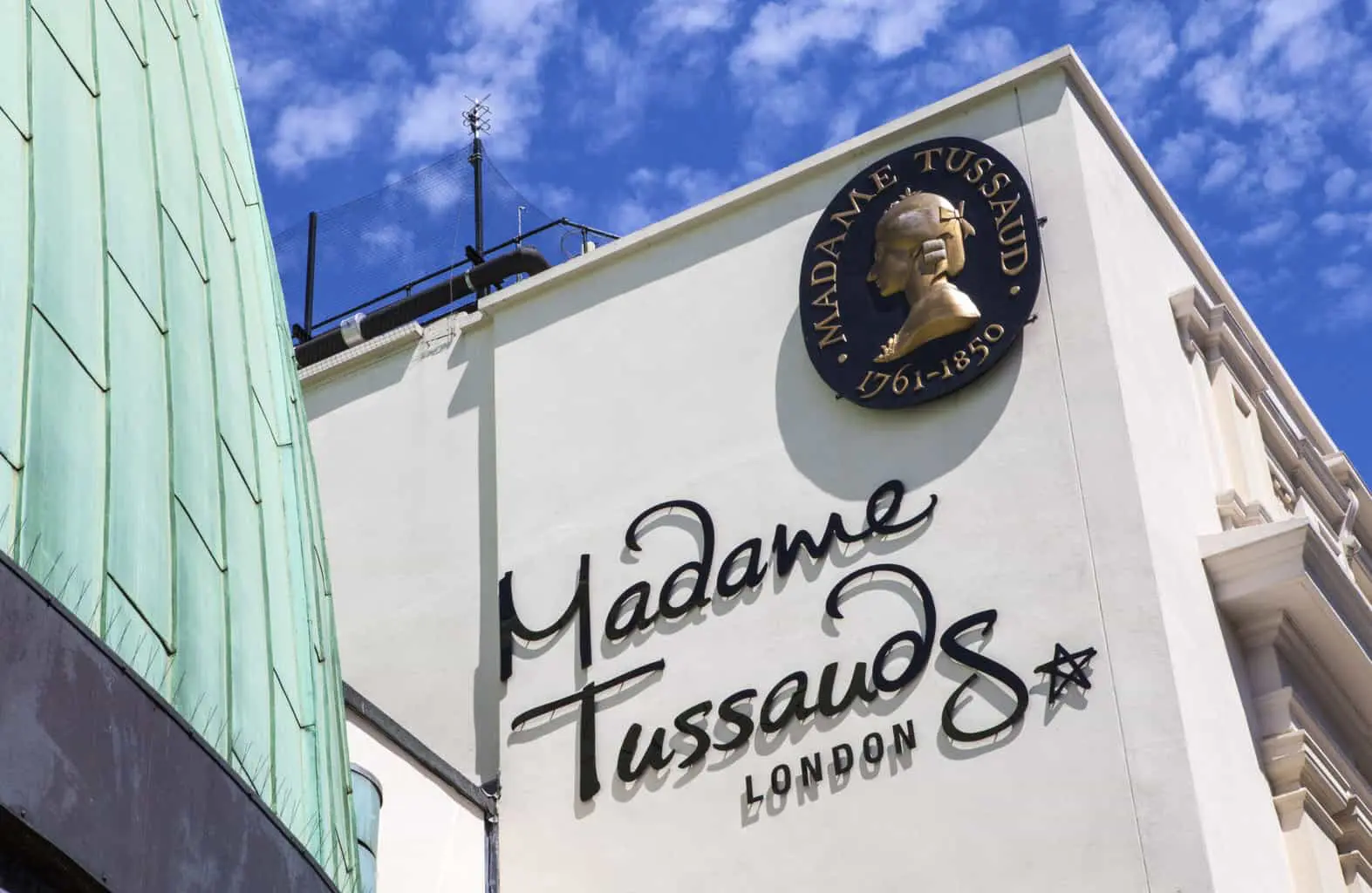
Among the many attractions one can enjoy visiting while in London is the iconic Madame Tussauds London. This place, whose construction goes as far back as 1835, is probably the world’s first wax museum and currently the most well-known one. It is also one that started a huge chain of similar museums, all under the same name and authorisation and all of which came into existence because of the brilliant French wax modeller Marie Tussaud.
Originally spelt Madame Tussaud’s, with an apostrophe removed later, Madame Tussauds London provides the fantastic opportunity of meeting and taking pictures with the world’s most prominent figures and celebrities, something that most of us long for but rarely get to experience.
The museum is also the perfect place to mesmerise at the incredible human talent that can depict even the slightest features and use them to create excellent and highly realistic life-size wax sculptures that are extremely hard to tell apart from the real human models!
Madame Tussauds London was created by Marie Tussaud and is located on Marylebone Road, London. It used to be on Baker Street for so long before some financial difficulties required relocation. In 1970, the first overseas Madame Tussauds was opened in Amsterdam, whose success encouraged the creation of 21 other branches in the world’s most global cities.
But to understand the significance of Madame Tussauds London and why it is a must-visit attraction, we need to explore the life of the main reason why it came into and still is in existence.
Marie Tussaud
So Marie Tussaud was originally Marie Grosholtz, and Tussaud was her husband’s last name which she acquired as a result of their marriage. Ironically, the marriage itself was quite a disappointment for both parties. It was just the name that was meant to live eternally, not their love, and become one of the most famous names in the world of art..
Early childhood
Marie was born in 1761 in Strasbourg, France, yet, she spent most of her early childhood years in Bern, Switzerland as her mother, who became Marie’s only parent after her father died, was working as a housekeeper for a famous Swiss wax modeller called Philippe Curtius.
Curtius was originally a physician but had an obsession with wax modelling. His amazing talent enabled him to create highly accurate anatomical wax sculptures that he used in his anatomy lessons.
As he was not married, Curtius treated Marie like his daughter and she, too, was very close to him. From a very young age, six years old, Marie started learning everything about wax modelling. When Curtius saw her interest and potential, he began to teach her the basic anatomy required to make wax sculptures. Then Marie started experimenting with wax herself.
Marie’s life changed again when Curtius decided to give up on medicine altogether and dedicate the rest of his life to wax modelling. To do that, he had to relocate to Paris, and where else could embrace and contain his huge artistic ambitions? As a result, all three of them, Curtius, Marie, and the mother travelled to the City of Art.
Teenage years
Once in Paris, Curtius immersed himself in wax modelling and started promoting his work. He made his debut by creating his first exhibition in 1770, which was moved to the Royal Palace in 1776. This was followed by another more distinct exhibition a few years later. Curtius’ work inspired Marie and taught her so much about this art that she could make her very first sculpture, one of Voltaire, only at the age of 16.
Then came what would later start a series of changes that, in pretty much a butterfly effect manner, would eventually make Marie the Madame Tussaud the world knows today. That was when she got a job to teach art to the sister of King Louis XVI of France. Marie enjoyed this job for a few years, during which she became close to the French royal family.
Death masks
While this is such a great honour and all, the royal job did take its toll on Marie afterwards. When the French Revolution broke out, resulting in chaos nationwide and the execution of the King and the Queen of France themselves. Among those who were arrested due to being close to the Royal Family was, you guessed it, Marie. She was sent to prison only to wait for execution. However, a twist in destiny made a friend of hers interfere to release her from prison.
This period was quite insanely transforming in Marie’s life. Her obsession with wax modelling seemed to have reached super high levels, that she made tens of death masks of those who were executed, basically beheaded, or killed in crimes. Once she heard a crime took place somewhere, she would rush to the crime scene and get the first impression of the dead face without feeling even a bit of fear. Or maybe she did feel afraid but it was her stamina that allowed her to take that all in.
Anyways.
The result of this horrific activity was actually a vast number of death masks that made up Marie’s very first collection which she put on display for the first time in London. This came in as an invitation to present her work in a joint show with a German magic lantern artist. That was in 1802.
Tours
Around that time, Marie was unable to go back to France thanks to Monsieur Napoleon attacking every country that was against the revolution and creating even more chaos in the country. So she decided to go on tours in Britain and Ireland to show her work, which she did for the next 30 years.
It was also during that period that Marie’s sculpting skills levelled up so much that she created sculptures of Europe’s elite and other well-known personalities in Britain. In her collection, there were sculptures of Queen Victoria and King Henry VIII.
In 1835, Marie felt it was time to settle down. So she went back to London, found a place on Baker Street and opened her permanent exhibition, Marie Tussaud’s, to display her fantastic work.
Marie Tussaud’s
Marie was a genuinely passionate artist as she used to put her heart and soul into her art. So when she opened the museum on Baker Street, which crowned her long journey, she gave all she could to produce it in the best way possible.
So she took much care of how the exhibits were organised, welcomed the visitors herself and provided chairs so they could take their time and mesmerise at the beauty of her creations. This contributed to the museum’s success, and more and more visitors flocked to it to meet her in person and enjoy her work.
In the museum, Marie created the famous Chamber of Horror, where she displayed the death masks that she made during the chaotic period of the French Revolution as well as many other wax sculptures of criminals. Marie might have been inspired by Curtius to do this idea who also had an exhibition of some of London’s criminals of the time.
Relocation
The museum opened in 1835 and proved a massive success over the following 15 years. When Marie died in 1850, the museum’s administration was moved to her sons, who took much care of it and well-preserved their mother’s artistic legacy. They continued to work hard to attract visitors.
Yet, in the mid-1880s, the family was not able to afford the rent of the museum on Baker Street anymore after it was raised to some unexpected and unattainable levels. So they decided to move the museum to another building on Marylebone Road that they constructed from scratch specifically for this purpose. The new location was only a four-minute walk from the former one.
Ownership
In 1884, the new Madame Tussaud’s was opened and proved just as successful. Yet, things were meant to get complicated again when a financial hardship forced Marie’s family to sell it in 1889 to some businessmen who took the responsibility of operating it.
Thanks to those businessmen, the museum started to expand. They hired other talented wax modellers to create new sculptures of celebrities and displayed them in the museum alongside Marie’s.
Such an expansion created room for the idea of establishing new branches under the same name to present the waxwork of professional artists. In 1970, Madame Tussauds Amsterdam, the first branch ever, was opened. Then other branches were opened in Hong Kong and the United States.
In 2005, the London museum and all other branches were sold once again to Dubai International Capital Company and then to Blackstone, Inc, which merged it into Merlin Entertainment. This is an entertainment company in England specialised in operating museums. It did a pretty good job opening more and more overseas branches as well as developing and renovating the original Marie Tussauds London.
Madame Tussauds London
Respelled without an apostrophe, Madame Tussauds London has grown into a fantastic tourist attraction and one of the city’s most iconic places that provide entertaining experiences no one wants to miss.
The museum as it is now is three floors and hosts over 150 life-size figures of celebrities and famous personalities from England as well as the rest of the world. These 150 sculptures are divided into eight zones and five experiences.
Zones
As we just mentioned, there are eight different zones in the museum. You can think of them as categories that help organise the sculptures in the best way possible.
The most iconic zone in the museum is the Royals featuring statues of members of the royal family. There you can find sculptures of King Charles and Queen Camilla as well as others of Queen Elizabeth I, Elizabeth II, Prince Phillip, Prince William, and Princess Catherine. There is also a sculpture of Princess Diana. Prince Harry and Meghan Markle’s statues are found in a different zone.
Inside the Royals zone, one can also find not one but three sculptures of British actress Helen Mirren since she was given the honorary title Dame Commander of the Order of the British Empire for her services in film and drama. In addition, there are other figures of celebrities who were honoured by the Royals.
There is also the Music zone that hosts figures of some of the world’s most famous singers, including Miley Cyrus, Taylor Swift, Rihanna and definitely Freddie Mercury and red-haired Ed Sheeran.
The Awards Party zone is by far the newest zone in Madame Tussauds London where sculptures of famous A-List celebrities are found, many of whom received either an Academy Award, a Golden Globe, a BAFTA or any other well-regarded award. There, visitors can meet Angelina Jolie, Eddie Redmayne, Brad Pitt, Tom Hardy, Dwayne Johnson, Benedict Cumberbatch and Leonardo DiCaprio.
It is also the Awards Party where one can find statues of David and Victoria Beckham, Duke and Duchess of Sussex Prince Harry and Meghan Markle and popular Bollywood actors, including Shah Rukh Khan and Deepika Padukone.
Another interesting zone in the museum is that one dedicated to iconic film characters, called Film. For instance, there are six sculptures of the actors who played James Bond as well as The Terminator, Katniss Everdeen from The Hunger Games and film director Steven Spielberg.
Other zones include Sports, Culture where a figure of Winston Churchill was added, Star Wars, and Marvel Hall of Heroes featuring Captain Marvel, Spider-Man, the Incredible Hulk, Iron Man, and Black Panther, Captain America, and Nick Fury.
Experiences
The other section of Madame Tussauds London basically offers, yes, different experiences to visitors. The first one is the Marvel Universe 4D. This is a 4D film made with the wax figures of the Marvel superheroes found in the Marvel Hall of Heroes zone.
The most fantastic experience in the museum, however, could be the Chamber of Horror, which was created by Marie Tussaud herself. This is where sculptures of some of the most notorious criminals and serial killers in London are found. There are also many artefacts related to criminals or found in the crime scenes.
The sculptures are organised in a way that creates an atmosphere of suspense using dim light in some places, flashlights in others, smoke and music. That is why this experience is not recommended for those who suffer from high blood pressure, cannot stand loud noises or flashing lights, pregnant women and children under the age of 16.
Alien Escape, Kong: Skull Island and the Spirit of London are three other experiences available at the museum.
Tickets
Since it is a private museum, admission to Madame Tussauds London is paid. The museum provides a wide variety of tickets and prices that hopefully match all preferences. For instance, the Standard ticket includes seeing all 150 sculptures at the museum and offers three experiences. The Fast Track ticket is more expensive but provides faster entry to the museum. The Ultimate VIP gives unlimited permission to take pictures and provides visitors with a guidebook to learn about the history of the museum.
There are also Family tickets, but those are available only on Mondays and Thursdays.
While they can still show up at the museum with no prior planning, visitors are always recommended they buy their tickets online and choose a specified time slot for their visits. It is also cheaper than buying tickets at the museum.
What is even more interesting is the availability of tickets to different other London attractions besides museum admission at reasonable prices. Some of these attractions certainly include the London Eye, the Sea Life London Aquarium, Big Bus Standard, London Dungeon, and Shrek’s Adventure.
There are also discounts when multiple tickets are bought together online.
Merlin Entertainment, the company that runs Madame Tussauds London, offers annual passes with access to more than 30 of London’s top attractions as well as many other features. There is the Discovery Pass, the Silver Pass, the Gold Pass and the Platinum Pass.
The museum is open every day from 10:00 in the morning to 3:00 in the afternoon. This is the standard timing, but on other days, admission can be allowed until 4:00 pm. Any changes to the opening times can be seen on the museum’s website.
Madame Tussauds London is the most famous and largest wax museum that provides the amazing experience of meeting the world’s most prominent figures, from royals, actors and singers to sports personalities, politicians and film characters, and taking pictures with them while marvelling at the incredible talent of some of the world’s most professional wax modellers.
If you are already in London or planning to spend your next vacation there, make sure you check out our other story on the best nine places you must visit while in the city to have the most authentic, beautiful and diverse London experience.
One comment on “Madame Tussauds London: A Tour with the World’s Most Eminent Figures”
Natural History Museum – London Attractions
Europe
29/04/2024

Cinderella Mocktails at Killyhevlin Hotel, Enniskillen
Northern Ireland
29/04/2024
Aunt Sandra’s Delicious Candy Factory, Belfast
Northern Ireland
29/04/2024
A Guide to the Best Belfast Hotels
Travel & Hospitality Careers
29/04/2024
The Dying Gaul: Unraveling the Meaning and History of an Ancient Roman Masterpiece
History and Heritage
29/04/2024
Wow, Madame Tussauds London looks like such a blast! I can’t believe how realistic those wax figures are. Definitely adding this to my must-visit list for my next trip to London. Thanks for sharing this awesome article!