
Article Summary
What this article covers: Where County Kildare is, what its Irish name means, the saints and legends in its history, and why it is called the Thoroughbred County.
Who this is for: Travellers planning a route through Ireland’s Ancient East and visitors based in Dublin who want a day out.
Key takeaway: Kildare is an inland Leinster county in the Republic of Ireland, within an hour of Dublin. Its character comes from St Brigid’s early monastery and from centuries of horse racing on the Curragh.
Expert insight: “Most people meet Kildare from the M7 on their way somewhere else. From the top of the round tower beside St Brigid’s Cathedral you see the saint’s town below you, with the open grass of the Curragh to the east.” , Ciaran Connolly, Founder of ConnollyCove
Quick facts:
- County Kildare had 247,774 residents at the 2022 census, the fifth largest local authority population in the State.
- The name comes from the Irish Cill Dara, meaning “church of the oak”, after the church St Brigid founded in the fifth century.
- The round tower at St Brigid’s Cathedral is about 33 metres tall, the second tallest in Ireland, and can be climbed in summer.
Kildare is a county in the province of Leinster, in the east of the Republic of Ireland, lying just west and south-west of Dublin. It is the county of St Brigid, the Curragh and the Irish National Stud. Many visitors cross it on the M7 without stopping, and miss a county of bogs, canals, monastic ruins and stud farms with a long history.
At ConnollyCove, the Ireland-based travel and culture platform founded by Ciaran Connolly, we write about each Irish county by first explaining what makes it distinctive. This guide answers the questions people most often ask about Kildare, from whether it is in Northern Ireland to what the name means. It then turns to the county’s history and landmarks. If you have already decided to go, our guide to things to do in Kildare lists the activities one by one.
Table of Contents
Where County Kildare Sits in Ireland
County Kildare is in the east of Ireland, in the province of Leinster, and it belongs to the Republic of Ireland rather than Northern Ireland. It has no coastline. Its neighbours are Dublin to the east, Meath to the north, Offaly to the west, Laois to the south-west, Carlow to the south and Wicklow to the south-east. The county lies well south of the border and uses the euro.
The county covers roughly 1,700 square kilometres of farmland, bog and grassland, drained by the River Liffey in the north and the River Barrow in the south. The 2022 census results for Kildare recorded 247,774 residents, and Kildare County Council’s demographic profile of the county notes that the population doubled between 1991 and 2022. That growth explains why towns such as Naas, Newbridge and Maynooth feel larger than older guidebooks suggest.
Naas, Kildare Town and the Other Main Towns
Naas is the county town and the seat of Kildare County Council, which surprises visitors who expect Kildare Town to hold that role. Kildare Town, about 20 kilometres south-west, is the historic and religious centre built around St Brigid’s Cathedral.
The north of the county, around Maynooth, Leixlip and Celbridge, has the great country houses and the university. Mid Kildare holds the racecourses, the stud farms and the shopping, while the south, around Athy and Moone, is quieter farming country along the Barrow.
Getting to Kildare From Dublin
Kildare Town is roughly 55 kilometres from Dublin city centre, and the drive on the M7 usually takes 45 minutes to an hour. Maynooth and Leixlip are quicker to reach on the M4. Trains from Dublin Heuston stop at Sallins, Newbridge and Kildare, and commuter trains from Connolly serve Leixlip and Maynooth, so most sights are reachable without a car.
The Meaning Behind the Name Cill Dara
The name Kildare is an anglicised form of the Irish Cill Dara, which translates as “church of the oak”. The county’s full Irish name is Contae Chill Dara. Tradition holds that St Brigid founded her church beside a great oak, which may already have been a sacred place before Christianity reached Ireland. Our article on the meanings behind Ireland’s county names explains how other counties were named in similar ways.
The Nicknames You Will Hear for Kildare
Kildare carries three common nicknames, and each points to a different part of its identity. The table below explains where each comes from.
| Nickname | Where it comes from | Where you are likely to hear it |
|---|---|---|
| The Short Grass County | The close-cropped grass of the Curragh, kept short by grazing sheep | Local conversation and older writing |
| The Thoroughbred County | The stud farms and racecourses centred on the Curragh | Tourism campaigns and racing coverage |
| The Lilywhites | The all-white jerseys of the county’s GAA teams | Gaelic football and hurling matches |
St Brigid and the Monastic Heart of Kildare
St Brigid is the reason Kildare Town exists, and her story is still visible in its cathedral, wells and streets. She founded a monastery here in the late fifth century, by tradition around 480. Brigid is one of Ireland’s three patron saints, alongside Patrick and Colmcille. Her feast day on 1 February became the basis for a new Irish public holiday in 2023, and our guide to Saint Brigid’s Day describes the customs connected with it.
Brigid also shares her name with a goddess of the Tuatha Dé Danann, linked in Irish tradition with fire, poetry and healing. Many historians think the saint and the older goddess merged over time in local belief. That may explain why fire is so central to her story here.
St Brigid’s Cathedral and the Round Tower
St Brigid’s Cathedral stands on the site traditionally linked to her monastery. The present building was begun in 1223 under the Norman bishop Ralph of Bristol. It fell into ruin after the wars of the 1640s and was restored in the 19th century, reopening in 1896. Inside is the tomb of Walter Wellesley, Bishop of Kildare, which disappeared after his death in 1539 and was found again in 1971.
The round tower in the churchyard rises to around 33 metres, the second tallest in Ireland. It is one of very few round towers that visitors can climb, using internal ladders to reach the roof in summer. Stepped battlements long ago replaced its conical cap. Our article on the purpose of Ireland’s round towers explains why their doors sit so far above the ground. Beside the tower is a wishing stone; local custom says a wish is granted if you reach through its hole and touch your shoulder.
Brigid’s Flame and the Fire Temple
North of the cathedral are the restored foundations of the fire temple. Medieval writers recorded that the nuns of Kildare kept a fire burning there in Brigid’s honour, and by most accounts it was put out around the Reformation. The Brigidine Sisters relit the flame in 1993, and it now burns at Solas Bhríde, their centre on the edge of the town.
St Brigid’s Well lies south of the town at Tully, close to the Irish National Stud, and people still visit it on 1 February. In 2024 the county marked Brigid 1500, the 1,500th anniversary of her death. The walk between the cathedral, Solas Bhríde and the well makes a quiet half-day route.
Myths, Kings and Rebels in Kildare’s Past
The county’s history reaches well beyond Brigid, with sites linked to mythology, early kingship, Norman lords and the 1798 Rebellion. Its flat land between Dublin and the Midlands made it a crossroads for armies and a power base for whoever held it.
The Hill of Allen and Fionn mac Cumhaill
The Hill of Allen, north-west of Newbridge, rises above the Bog of Allen. In the Fenian Cycle it is Almu, home of Fionn mac Cumhaill and his warriors, the Fianna. The hill also gave its name to the Battle of Allen in 722, fought between the Leinstermen and the Uí Néill. Sir Gerald Aylmer built the stone tower on the summit in 1859, and quarrying has since cut deeply into one side. Our article on Fionn mac Cumhaill between myth and history tells the stories connected with the hill. The wider cast of Irish otherworld beings appears in our guide to legendary creatures in Celtic mythology.
Dún Ailinne and the Kings of Leinster
Dún Ailinne, a large hilltop enclosure near Kilcullen, was a royal ceremonial site of the kings of Leinster in the Iron Age. In 2010 the Irish government placed it on Ireland’s tentative list for UNESCO World Heritage status, as one of the Royal Sites of Ireland alongside Tara and Cashel.
The FitzGeralds and Maynooth Castle
From the 13th to the 16th century, the FitzGerald Earls of Kildare ruled from Maynooth and became the most powerful Anglo-Norman family in Ireland. Gearóid Mór FitzGerald, the 8th Earl, governed Ireland for the English Crown for much of the late 15th century. The family’s power ended with the rebellion of Silken Thomas in 1534, and Crown forces took Maynooth Castle the following year. The castle ruins are now managed by the Office of Public Works.
Wolfe Tone’s Grave at Bodenstown
The old churchyard at Bodenstown, near Sallins and just outside Clane, is the burial place of Theobald Wolfe Tone. Tone was one of the leaders of the 1798 Rebellion and is generally regarded as the founder of Irish republicanism. He was captured after a French expedition to Ireland failed in 1798 and died in custody in Dublin on 19 November that year. His grave is marked by stones carrying quotations from Tone and Pádraig Pearse.
Interesting Facts About Kildare
Some of the county’s connections surprise even people who live nearby. The facts below are the ones readers most often look up.
The Birthplace of Arthur Guinness
Arthur Guinness was born in County Kildare in 1725, generally said to be at Celbridge. His godfather, Arthur Price, the Church of Ireland Archbishop of Cashel, died in 1752 and left him £100. Guinness used the legacy to open his first brewery at Leixlip in 1755, then took the lease on St James’s Gate in Dublin in 1759. He and his wife, Olivia Whitmore, had 21 children, ten of whom survived to adulthood. He died in Dublin in 1803 but was buried in his mother’s family plot at Oughterard, County Kildare. Our article on the life of Arthur Guinness follows the full story.
Castletown House and the Wonderful Barn
Castletown House, near Celbridge, was built from 1722 for William Conolly, Speaker of the Irish House of Commons, and is regarded as Ireland’s first great Palladian house. After Conolly died in 1729, his widow Katherine stayed on and commissioned two unusual buildings around the famine of 1740 and 1741. The Conolly Folly, an obelisk raised on arches, gave work to local people. The Wonderful Barn near Leixlip, a conical grain store with an external spiral stairway, followed in 1743 to hold grain against future shortages.
Castletown is now in state care. Its parkland is free to walk, and the house is seen on a paid guided tour.
Why Kildare Is Known as the Thoroughbred County
Kildare is the centre of Irish horse racing and breeding, helped by limestone soils that produce grassland breeders have long valued. The open plain of the Curragh has been used for racing for centuries. The county has three racecourses, at the Curragh, Punchestown and Naas, along with dozens of stud farms. If you would rather ride than watch, our guide to horseback riding in Ireland covers stables across the country.
The Curragh Racecourse and Plains
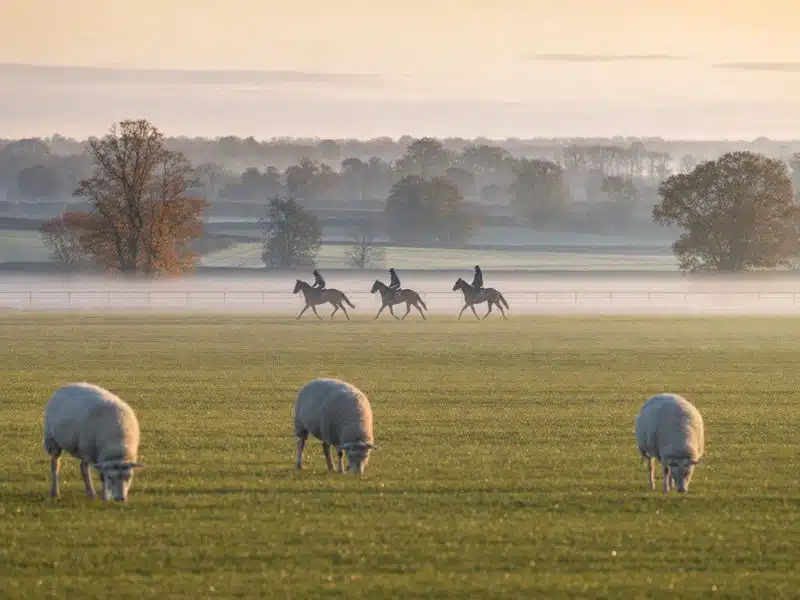
The Curragh Racecourse is the home of Irish flat racing and hosts all five Irish Classics, including the Irish Derby, usually run in late June or early July. Around it lie the Curragh plains, a large expanse of open grassland where sheep still graze the commonage and racehorses work on the gallops early in the morning. Punchestown, near Naas, is the main jump racing venue, with a festival each spring.
The Irish National Stud and Japanese Gardens
The Irish National Stud at Tully, about a kilometre and a half south of Kildare Town, is a working thoroughbred farm open to visitors. Colonel William Hall Walker, a wealthy Scot from a well-known brewing family, bought the estate in 1900 and began breeding horses there. He gave the stud to the British Crown in 1915, and it became the Irish National Stud under Irish state ownership in 1946. The horse museum on site holds the skeleton of Arkle, the celebrated steeplechaser.
Walker also commissioned the Japanese Gardens, laid out between 1906 and 1910 by the horticulturist Tassa Eida and his son Minoru. They trace the Life of Man along a winding path. St Fiachra’s Garden, added later, draws on Ireland’s early monastic tradition, and one ticket covers the stud and both gardens.
Landmarks Worth Seeing Across Kildare
Beyond the cathedral and the stud, the county has landmarks for very different kinds of traveller. Our full list of Kildare attractions adds cafés, galleries and family days out.
Moone High Cross
Moone High Cross is a granite cross about 5.3 metres tall, standing inside the ruined church of Moone Abbey. The abbey was an early monastic site associated with St Colmcille. Scholars date it to between the 8th and 10th centuries. Its carvings of the Twelve Apostles and the Flight into Egypt are unusually simple and flat. Sections were found buried in the graveyard in 1835, the shaft was recovered in 1893, and a glass roof now protects the cross from the weather.
The Bog of Allen and Lullymore
The Bog of Allen covers much of the west of the county. The Bog of Allen Nature Centre at Lullymore, run by the Irish Peatland Conservation Council, explains how peatlands form and why they matter for wildlife. Its gardens include a large collection of carnivorous plants. Lullymore Heritage and Discovery Park, nearby, is aimed at families.
Canals, Greenways and the Barrow Blueway
Two of Ireland’s great canals cross the county. The Royal Canal Greenway runs west from Maynooth into the Midlands, and the Grand Canal passes Sallins and Robertstown before its Barrow Line turns south towards Athy. Waterways Ireland and the Kildare and Laois councils have been developing a 46 kilometre Barrow Blueway from Lowtown to Athy for walking, cycling and paddling. Some sections opened before others, so check its current status before planning the full route.
Kildare Village and Newbridge Silverware
Kildare Village, on the edge of the town, is an outlet shopping village that opened in July 2006. It is operated by Value Retail as part of The Bicester Collection and runs coach services from Dublin. Newbridge Silverware, founded in the 1930s, has a visitor centre and the Museum of Style Icons. The museum displays costumes and personal items from film and music.
Planning a Visit to Kildare
The county rewards a full day, or two if you want to add the canals or the north. Late spring and summer bring the longest days, the racing festivals and the chance to climb the round tower. Early February is the time to see Kildare Town at its most traditional, when Féile Bríde celebrates St Brigid around her feast day.
“We usually suggest giving Kildare a full day rather than an hour at the outlet village. The Japanese Gardens, the cathedral and the high cross at Moone are within half an hour’s drive of each other. Between them they cover around fifteen centuries of Irish history.” , Ciaran Connolly, Founder of ConnollyCove
The county sits on the route through Ireland’s Ancient East and combines well with a wider tour. Heading further west, our guides to County Laois and things to do in Offaly pick up where this one ends. ConnollyCove covers Irish heritage in every county, and our YouTube channel films many of these places.
FAQs
Is Kildare in Northern Ireland?
Kildare is not in Northern Ireland. It is a county in the Republic of Ireland, in the province of Leinster, just west of Dublin.
What Is the County Town of Kildare?
Naas is the county town and the base of Kildare County Council. Kildare Town is the historic religious centre.
What Is Kildare Famous For?
The county is best known for horse racing and breeding and for St Brigid. Kildare Village outlet shopping also draws many visitors.
What Does Kildare Mean in Irish?
The name comes from Cill Dara, meaning “church of the oak”. It refers to the church St Brigid founded beside an oak tree.
How Far Is Kildare From Dublin?
Kildare Town is about 55 kilometres from Dublin city centre. The drive takes 45 minutes to an hour, and the train from Heuston takes roughly 30 to 45 minutes.
Can You Climb the Round Tower in Kildare?
The round tower at St Brigid’s Cathedral can be climbed in summer for a small charge. Opening hours vary, so check before you visit.
Is Kildare Village in Kildare Town?
Kildare Village is on the edge of Kildare Town, within walking distance of the centre. It is a separate outlet shopping development.