


Armagh Planetarium and Observatory – County Armagh
Updated On: April 15, 2024 by  Ciaran Connolly
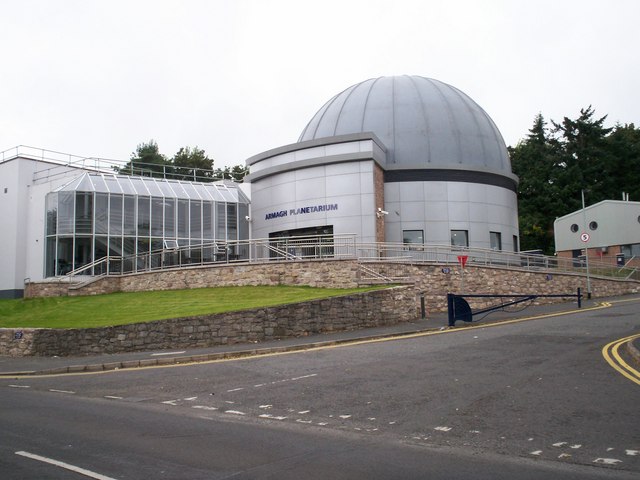
Armagh Planetarium offers a unique magical experience. At the Planetarium’s amazing Digital Theatre, you can embark on a journey into our mesmerising space.
Learn about the wonders of the Universe. You can take a trip into the Planetarium’s Mars room or touch the largest meteorite in Ireland, which is 4.6 billion years old. You will explore scale models of probes, such as Viking and Satellites, such as the International Space Station and the Hubble Space Telescope.
The History of Armagh Planetarium
Armagh Planetarium was founded by Dr Eric Mervyn Lindsay, the 7th director of Armagh Observatory, in 1965. He spent 25 years trying to secure funding from local councils and the Ministry of Commerce of Northern Ireland and eventually managed to do so. In the same year, in 1965, Patrick Moore was appointed as Director of the Planetarium. His role was to supervise the planetarium’s construction until its official opening on 1 May 1968.
It was open to the public for some months before the official opening. The construction of the Planetarium cost £70,000, including £12,000 dedicated to the planetarium’s first projector, a Goto Mars model made in Japan.
However, that was not the final layout of the Planetarium. Several alterations have been carried out since then. In 1974, the main building was extended to include the Lindsay Hall of Astronomy, named after Dr Eric Lindsay in honour of him. In addition, a dome was built, in which a 16″ (400 mm) reflecting telescope was placed for public use which is now considered the largest public telescope in Ireland.
Further Developments
In 1994, the interest in Earth Science has been incredibly increasing, which led to the incorporation of a new exhibition hall. Known as the Eartharium. In 1994 the Armagh Astropark was also opened. This is a scale model of the solar system and the Universe. It is contained in the grounds of the Armagh Observatory, with size-scaled stainless steel models of the Sun and planets.
Technical Innovation—A World First
In the 1970s, many new technologies were introduced to the Armagh Planetarium by Terence Murtagh. Terence the Director of the Planetarium at the time. Videotape recorders were rare high-end technology at the time, and Murtagh believed that the new technology of video projectors could be tapped to provide special effects to the show. Which would result in dispensing with dozens of slide projectors.
Thus, he saw the possibility of modifying the off-the-shelf video projectors optically and electronically in order to present natural-looking images of celestial bodies on the dome. Until the introduction of computer-controlled laserdisc players technology, the Planetarium kept using videotape players until in the 1980s. The incorporation of this newest high-tech, at the time, put the Armagh Planetarium in the lead compared to the other planetaria in the world since it was the first to project video on its dome.
More New Innovation
Not only this, Armagh Planetarium was the first to introduce an electronic audience participation system that allowed the audience to control the shows displayed and select from a simple menu interface any 500,000 images and video clips with explanatory text stored on laserdiscs.
It worked this way: each seat was fitted with a device, a small keypad, which the audience could use to answer some multiple-choice quizzes in the show, answer a survey regarding their preferences, and even select the topics of the show. This system was truly impressive to the public and it received wide press and television coverage worldwide.
A Recognised Exhibition
The Encyclopaedia Galactica, an exhibition at the Armagh Planetarium, was featured in the BBC’s Tomorrow’s World. It also received full-page coverage in the prestigious New Scientist magazine. The world’s first completely interactive planetarium show displayed at the Armagh Planetarium was the Space Odyssey in the 1980s, scripted by Ian Ridpath. ِ
Influence on Other Planetariums
Armagh Planetarium set an example for other planetaria around the world. Spreading these new innovations to planetaria worldwide. Other interactive computer systems were also added to demonstrate the fundamentals of astronomy. Enabling visitors, for example, to design their own telescope on screen. Then see a simulated view of the Planetarium through it.
Take a Tour Through Armagh Planetarium via our 360-degree video.
Redevelopment of the Planetarium
A major renovation was made at the Armagh Planetarium before its reopening on 31 July 2006 to make the establishment more comfortable and environmentally friendly. This major renovation included improvements, such as the reconstruction of the Digital Theatre to accommodate 94 visitors in air-conditioned comfort.
A new Bose Corporation stereo sound system was installed. As well as an advanced LED lighting suite and a Digistar 3 full-dome video projection system. In an effort to enhance the audience experience. On 7 December 2006, a ceremony was organized and led by Archbishop Robin Eames, in which the Armagh Planetarium building was dedicated to the memory of Eric Lindsay. The Armagh Planetarium is systematically enhanced with the latest technology.
The Man Behind the Construction of Armagh Planetarium
Dr Eric Mervyn Lindsay a prominent figure with a distinguished career as a full-time astronomer in Ireland, South Africa and the US. He believed in the necessity of having a planetarium that would serve as a complementary to Armagh Observatory. Dr Mervyn first proposed the idea of building the Armagh Planetarium in 1943.
He started fundraising for the project as Director of Armagh Observatory and spent 25 years trying to secure this funding throughout the 1950s from local councils and the Ministry of Commerce of Northern Ireland. In 1964, after presenting the Planetarium project as a centre for education and tourism, he finally managed to persuade these institutions to fund the establishment of the Planetarium.
The Armagh Astropark
The Armagh Astropark is a scale model of the Universe, opened in 1994. Astropark is located on the grounds of Armagh Observatory and Armagh Planetarium. Along with a Nature Trail and a Weather Station.
In this beautiful natural setting, you will discover some of the amazing phenomena in the Solar System, the Milky Way, and beyond. You can also take a virtual tour around it or pay a visit to its unique features. The Solar System, the Hyper-Cube, the Hill of Infinity and the Stone Calendar. The Astropark grounds are landscaped and dotted with stainless steel scale models of the planets.
Different Features
- The Solar System: you will be able to compare the relative distances and sizes of the rocky inner planets and the gaseous outer planets and reach planets that are invisible to the naked eye.
- The Hyper-Cube: you will see a series of cubes, each ten times bigger than the one inside. The first cube is the size of a floppy disk, only 11 are needed to engulf the orbit of the moon, and 28 to fill the entire Universe.
- The Hill of Infinity: discover the most distant objects in space. The more you look further away, the more you go back in time, so at the edge of the Universe, we approach the Big Bang itself.
- The Stone Calendar: since prehistoric times, stone circle formations have existed all over Europe. They may have been temples, meeting places or observatories. However, the Stone Calendar functions as a simple calendar. You can watch the sunrise on the solstice.
Armagh Planetarium in the New Millennium
Starting from the year 2000, Armagh Planetarium started developing its focus. It saw the necessity of starting an outreach program to the public. Armagh Planetarium can come to you. It maintains an outreach program where the Planetarium staff travel to schools and science festivals. Having a thirty-seat inflatable planetarium on most of their visits to deliver presentations on astronomy and other sciences.
Armagh science communicators travelled throughout Ireland and other destinations as far as Nigeria. To present StarDome shows and conduct workshops. StarDome shows were not the only shows displayed. The shows extended to cover other topics, such as magnetism, dinosaurs, electricity and rockets and proved very popular among audiences. Over 100,000 people enjoyed the shows presented by the Armagh Planetarium education team.
The Digistar 3 Projection System—A Technical Triumph
Instead of having a giant projector in the centre of the Digital Theatre at Armagh Planetarium, the Digistar 3 uses a bank of six video projectors which display the images on the Theatre’s hemispherical ceiling, presenting a night sky with outstanding accuracy. With Digistar 3, visitors can travel anywhere in the entire Universe. Planets, stars, galaxies and asteroids can be viewed in full detail as though they are just over your head. Unparalleled scenes are displayed in the Digital Theatre via the Digistar 3 Projection System.
Armagh Planetarium and Nasa
Armagh Planetarium has always enjoyed a prominent international status. Accordingly, Nasa loaned the Planetarium invaluable items from its archives. Such as an Apollo spacesuit and some astronaut’s clothes worn on the Skylab space station.
The most valuable item of them all is a fragment of moon rock. This rock was collected by astronaut Eugene Cernan from the Taurus-Littrow Valley. Here’s the fun part, visitors can try on the spacesuit’s helmet and gloves.
Amazing Armagh Planetarium Facts
According to www.armaghplanet.com, here are some facts about Armagh Planetarium:
- Armagh Planetarium is the longest-serving planetarium in the United Kingdom.
- Armagh Planetarium was the first planetarium in the world to show moving images by projecting video on the dome. This innovation has been shared with other planetaria around the world.
- The Space Odyssey show, created in Armagh, was the world’s first-ever completely interactive planetarium show. The audience could decide what they wanted to see by pressing buttons on keypads built into their seats. Again, this technology, invented in Armagh, has spread to Planetaria worldwide.
- The first seats installed in the Star Theatre were airliner seats donated by Belfast aircraft company Shorts.
- Throughout the 1970s and 80s, one of the Planetarium’s popular exhibits was a full-scale mock-up of a Gemini spacecraft, originally used in the filming of the James Bond film You Only Live Twice.
- Among the non-astronomical events presented at Armagh Planetarium was live coverage of Princess Anne’s wedding in 1973 on the dome.
- When Halley’s Comet flew through the sky in 1986, Armagh Planetarium offered free admission to anyone who had seen the comet in its previous appearance in 1910!
- Armagh Planetarium hosted many astronomers and astronauts, including Jim Irwin and Al Worden (both Apollo 15), Dr Edgar Mitchell (Apollo 14), Helen Sharman (first UK astronaut) and Thomas Bopp (co-discoverer of Comet Hale-Bopp)
- The Planetarium has its own BBC radio studio.
- Armagh Planetarium was the first in the world to display the nucleus of Halley’s Comet in close-up. When the Giotto spacecraft made its historic fly-by on 13 March 1986, the images were projected live on the dome of the Star Theatre!
Opening Times
- Monday-Saturday 10:00 – 17:00.
Prices to Entry Armagh Planetarium
- Adults: £6 per show.
- Children (under 16): £5 per show.
- Senior Citizens: £5 per show.
- Free Show: Little Yellow Star (Pre-school Show) 11:00 on Saturdays (Admission is free for the show, but remember to pre-book!).
- Group Rates (Minimum 20 people):
- Adults: £5 per show.
- Senior Citizens: £5 per person.
- Summer Schemes: £5 per child.
- 20% discount on booking two or more shows.
- School Booking Prices:
- Pupils: £5 per child.
- Teachers: Free.
Facilities
- Baby Changing facilities
- Parking Available
- Credit/ Debit Cards Accepted Euro Accepted
- Picnic Area
- Toilets
- Gift Shop
- Accept Groups/ Coach Parties
For more information on shows and showtimes, go to www.armaghplanet.com
For a list of events, go to www.armaghplanet.com/events
Pre-booking is essential for all Digital Theatre shows at (028) 3752 3689.
Have you ever visited the Armagh Planetarium? Let us know your experience in the comments below.
Don’t forget to check out other places and attractions in Northern Ireland that might interest you: Armagh County Museum | Armagh – The Ecclesiastical Capital | Armagh’s Cathedral | Rostrevor County Down | Exploring Carrickfergus Museum | Navan Centre and Fort
Must-See Casablanca
Africa
27/04/2024
The Ultimate Guide for London One Day Tours!
England
27/04/2024

Key Insights: Global Medical Tourism Statistics and Market Growth Analysis
Travel Statistics
26/04/2024

The Irish Mafia: A Closer Look at Organised Crime Syndicates
History and Heritage
26/04/2024

The Ultimate Guide to Eating Out in Ireland: Tips and Recommendations
Food and Cuisine
26/04/2024