


Where was Titanic Built? Titanic Quarter Belfast-Harland & Wolff
Updated On: March 05, 2024 by  Ciaran Connolly
“Icebergs loomed up and fell astern and we never slackened. It was an anxious time with the Titanic’s fateful experience very close in our minds”.
Captain Arthur H Rostron, Commander of the Carpathia (recounting the Carpathia’s desperate journey to the site of the sinking)
To see the Titanic Quarter, visit Northern Ireland and explore the ship with one of the most interesting histories ever. At the Harland and Wolff Cranes, Titanic’s Dock and Pump-House, and Titanic Museum, you will get introduced to the Titanic, the dreadful story that moved us all.
- Titanic’s Dock and Pump-House
Walk about 20 minutes from Belfast City Centre to Titanic Quarter to reach the Dock and the Pump-house.
- Harland and Wolff Cranes
Samson and Goliath cranes are located on Queen’s Road at Titanic Quarter.
- Titanic Museum
The fantastic Titanic Belfast is at 1 Olympic Way on Queen’s Road. It is at Titanic Quarter too.
Titanic’s Dock and Pump-House
It would be a memorable experience to step foot where the Titanic rose. Titanic’s Dock’s and Pump-House is where the construction of the Titanic took place.
History & Construction
By the hands of thousands of builders and three beautiful minds, the passenger liner Titanic was launched to the world. William James Pirrie, Viscount Pirrie, was the director of the White Star, which owned Titanic. He was the president of the company responsible for building the ship in the 1910s and the leader of the Titanic project.
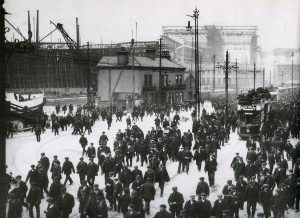
Thomas Andrews, the leader of the design department and the construction manager at Harland and Wolf Company, was the marine architect in charge of designing the inner steel structure. When the ship’s collision occurred, he was the first to be consulted by the Titanic’s captain.
More on the Titanic’s Ship History and Construction
Alexander M. Carlisle sought to supply the ship with about 64 lifeboats to be filled to a capacity of 3600 passengers. What happened was that the ship carried 16 lifeboats, and the other 4 were in terrible condition.
He was also the managing director of the shipyard, the supervisor of the construction process, the one responsible for providing the material and tools needed for the building project and the designer of the interior décor of the ship.
“It hardly bears thinking about that if there had been sufficient boats that night … every soul aboard could have been saved, since it was two-and-a-half hours after she struck that she tilted her massive stern into the heavens and sank by the head, taking with her all that were unprovided for”.
Arthur Rostron, Captain of the rescue vessel Carpathia (‘Home From The Sea’ 1931)
The Titanic Ship Launch
Titanic’s Dock and Pump-House witnessed the launch of the Titanic, a deluxe ship at the time. Engineering excelled to new levels in building the Titanic. Titanic’s Dock had to be so significant to contain such a massive ship, so it was the largest one ever built, and it followed the Edwardian engineering.
Now, it is still in a very good state and holds within the origins of the Titanic since it came to life with the hands of thousands of builders and the historic engineering work that constructed such a dock. The original machines by which the dry-dock worked are still there at the Pump House, displayed to visitors. The real equipment used by the workers is displayed, too.
Guided Tours
Well-trained experts present the visitors with Titanic’s construction spirit through the following tours:
- Public self-guided tours:
A unique tour through Titanic’s history, including:
- 44 feet down below sea level to the dry-dock floor.
- The real equipment that the workers used in the dock.
- Rare audio-visual footage of the ship in the dock.
- A presentation of the engineering ideas of the pumps used to empty the dock in 100 minutes is displayed audio-visually.
- Private guided tours:
Travel 100 years back in time and explore the story of Titanic. Get to see what used to be the most busy-working shipyard, Harland and Wolff. Only you or your group will be led on a previously booked tour.
- The Wee Tram Tour:
This is also a pre-booked tour is scheduled every 30 minutes. Information, unique stories, videos and photographs are displayed on screens. Such tours are available from 12 pm to 5 pm.
What about grabbing a bite at Titanic’s Dock and Pump House? Visit Café 1404, located there, and enjoy the delicious options offered. It is a venue for occasions, weddings, musical events, and birthday parties.
Harland and Wolff Cranes
They are named Samson and Goliath after specific biblical figures and are considered one of the famous landmarks in Belfast.
History of the Cranes
They were constructed in Harland & Wolff’s shipyard. Krupp, a German company, was in charge of the construction. Goliath is 96 meters, and its building process finished in 1969, while 1974 witnessed the end of Samson’s building with an area of 106 m2.
Although these cranes were built after the year of the launch of Titanic, some people believe that Titanic sued such cranes in the building project.
Construction
Together, both cranes can lift one of the most significant loads in the world, 1600 tons. In addition, there is a dry dock under the cranes, which is the largest of its kind, and its area is 556m X 93m. A newspaper seller, Edward Salmon, was the one who bolted the H&W logo onto the cranes.
Changes at Harland & Wolff
Several years passed after the construction of the famous cranes, and then news spread that the H&W Company had declined. The number of employees declined after reaching 35,000. Moreover, the Roll-on/roll-off ferry was the last ship to launch at the site in 2003.
That year, the place started to narrow down its activity on shipbuilding, focusing more on design and structural engineering, metal engineering, offshore construction, heavy lifting, and ship repair.
Although there was great interest in demolishing numerous cranes, they were considered historic monuments under Article 3 of the Historic Monuments and Archaeological Objects Order. They are also considered structures of ‘architectural or historic interest’ by the Northern Ireland Environment Agency.
Recent History of H&W
Since Samson and Goliath had gained fame in Belfast, anything related to them grabbed attention. In 2007, news spread of Samson crashing into the jib of the tower crane Henson, 95 tons and of 25 m. high, when a video of the incident spread on YouTube.
In the same year, Goliath started to return to the business world and was declared by the company’s spokesman, stressing how the work is growing.
Titanic Belfast Museum
Titanic Museum, or Titanic Belfast, is also the perfect place to learn about Belfast’s marine history of the Titanic ship, which was built at Titanic Quarter at the shipyard of Harland & Wolff Company. You will closely explore Titanic’s crisis story, starting with when it hit an iceberg and caused its sinking in 1912. There is also great information about other ships, like HMHS Britannic and RMS Olympic. Stunning galleries and other display rooms await your visit to the Museum.
History of the Titanic Museum
It is situated at Queen’s Island, at the entrance of Belfast Lough. There were profound effects on the buildings because of what happened to the shipbuilding business, causing the demolition of such structures.
The best part about these sad incidents is that some buildings were given listed status, such as the slipways and the graving docks of the Titanic, Samson and Goliath cranes, and the Olympics. That part of the land on which those buildings stood was named “Titanic Quarter” or “TQ” in 2001, and it was decided to be set for development. A property construction and management company, Harcourt Development, got development rights over a significant area of TQ.
It exceeded 185 acres, and it cost more than £45 million. Other 23 acres were specified for a science park.
The Titanic Museum Plans
Hotels, houses, science centres and museums display the marine heritage. Leisure and recreation were part of the redeveloping plan in TQ. Accordingly, a museum presenting Titanic’s history, especially its only voyage, to the whole world was considered to be established by 2012 after several plans were declared in 2005 regarding the construction of a museum at Titanic Quarter. Several ideas received serious attention, seeking tourism attraction.
For example, one entailed rebuilding the considerable steel gantry where Olympic and Titanic ships were built. Another entailed constructing a sparkling wireframe outline of the Titanic and that to be at the dock. “Titanic Signature Project” was a project that publically declared its significant funding in detail.
50% of the funding was revealed to be from the Northern Ireland Executive through the Northern Ireland Tourist Board, and the other 50% came from the private sector. Other funding was provided by the Belfast City Council, all thanks to the Titanic Foundation. It is a charity foundation that cares more about using Titanic’s story to raise the people’s awareness of Belfast’s heritage, historically, socially and industrially.
“Titanic, name and thing, will stand as a monument and warning to human presumption”.
The Bishop of Winchester, preaching in Southampton, 1912.
More Information About the Titanic Museum
“Titanic Belfast” is the current name of the Museum. It was expected to welcome about 165,000 visitors from outside Northern Ireland out of a whole 425,000 visitors every year. There is a plan for the Museum to serve a transformational function of, for example, Guggenheim Museum Bilbao.
Frank Gehry designed it as a revival and renewal of the city. Impressive statistics came on visitors in the first year, which exceeded expectations. In general, there were 807,340 visitors, 471,702 of them from outside Northern Ireland. Numerous conferences were held at Titanic Belfast, exceeding 350 conferences.
Design and Construction of the Museum
Eric Kuhne and Associates and Todd Architects were responsible for the project and were the lead consultants. Titanic Museum was planned to reflect Titanic’s spirit through the design to manifest the history of ship-making in Belfast.
Unique Shape of the Museum
The Museum is characterised by its angular-shaped design. It is angled down the middle of the slipways of the Olympics, and Titanic is in the direction of the Lagan River. What also makes this building stand out is the wonderfully placed 3,000 aluminium shards coated with silver for the facade of Titanic Belfast.
The building is 126 ft. high, the same as the Titanic. Recently, there has been a suggestion to change the design to resemble an iceberg, and “The Iceberg” has been the name given to such construction by some people from Belfast.
The building is 12,000 m2 in space. Outstanding galleries are at the centre of the building, rich with everything about Titanic—the building project, deluxe design, and even the sinking incident of the ship. The Titanic suite is located on the highest floor and is suitable for holding huge conferences.
It is a perfect place for holding a banquet of up to 750 people. A replica of the famous staircase from Titanic the movie is displayed in the conference centre, as well as another staircase, which looks exactly like the real one.
Cost of the Building
The construction of Titanic Belfast cost a whopping £77 million, and £24 million was spent on general refurbishments. Harcourt Construction Ltd, a subsidiary company run by the property development company Harcourt Developments Ltd in Dublin, was responsible for the project’s design and construction.
Titanica Sculpture
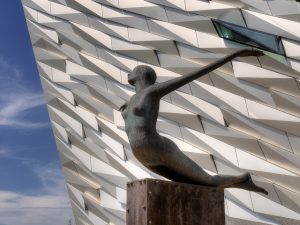
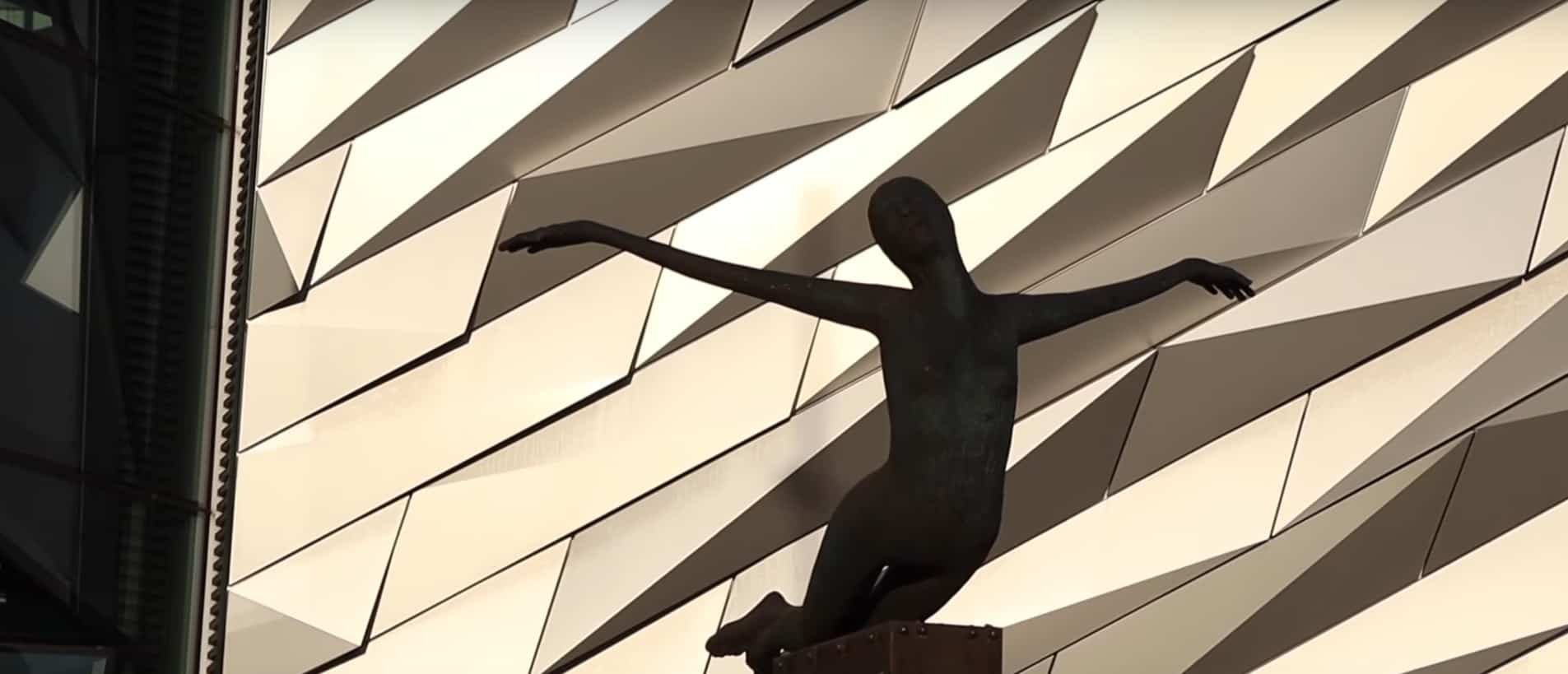
In front of Titanic Belfast, a remarkable bronze sculpture called Titanica by Rowan Gillespie, an Irish sculptor, is placed on a base made of brass, depicting a female figurine that would have been mounted to ships, bowing to represent hope and positivity. Such a design recalls Titanic’s carving on its prows, showing hope. Before the opening day of the Museum, the sculpture was dedicated by four churches—the Catholic, Methodist, Anglican, and Presbyterian.
Galleries of Titanic Belfast
There has never been a better time for movie fans to visit Titanic Belfast’s nine interactive galleries. They are open to the public to tell the story of the Titanic, from her conception in Belfast in the early 1900s to her construction and launch to her famous maiden voyage and tragic end.
- Boomtown Belfast
The gallery reveals Belfast’s primary industries by presenting the shipyard of H&W, the construction plans of the Titanic, the original drawings and some scale models.
- The Shipyard
Enjoy a fantastic ride with a mini-car around and up the rudder of the Titanic. A steel scaffold of 66 ft. displays Arrol Gantry, which was constructed especially for the building process of Olympic and Titanic ships. You can also reach the top of the Arrol Gantry and enjoy the audio materials and amazing pictures about shipbuilding. There is also an exact model of Titanic’s rudder, which can be spotted from a car of six people.
- The Launch
The gallery here displays the launching day of Titanic to the Belfast Lough and how 100,000 people witnessed such an event. You can see the slipway where the ship started launching, and there will be a window for a view over the docks and the slipways in their current state.
- The Fit-Out
This one introduces a large model of Titanic. It also holds the cabins of the three classes during that time. All ship levels are presented: the dining salons, the bridge, and the engine room.
- The Maiden Voyage
A wooden deck and some photographs are displayed here in this fifth gallery. This place pictures Titanic’s boat deck; visitors can walk across it and enjoy sitting there looking at the view of the harbour and the docks. Some photos of the ship Father Francis Browne took are also presented. He was on board the ship on its trip from Southampton to Cobh.
- The Sinking
April 1912 was when the Titanic sank, and this gallery displays the incident. The sound of Morse code SOS messages can be heard clearly. Other materials about sinking are introduced, too. For example, photographs of the sinking, audio recordings for survivors, and press coverage of the incident. The famous iceberg is brought to life by a wall of 400 life jackets and a picture of the Titanic sinking.
- The Aftermath
The aftermath of the Titanic is documented here in this gallery. A replica of one of the ship’s lifeboats used to save passengers is displayed. On both sides of the lifeboat, visitors can get to know all the British and American inquiries concerning the end of the Titanic. There are also interactive screens displaying the crew and passengers’ names.
- Myths & Legends
Many films, books, poems, and plays presented legends or myths related to Titanic. At this gallery, enjoy listening to Celine Dion’s most famous romantic song, “My Heart Will Go On”, while getting close to how the popular culture there is affected by such a ship.
- Titanic Beneath
Want to know how Titanic looks now in the North Atlantic? This gallery gets you closer to the shipwreck, now lying at a depth of 12,000 ft. Thanks to excavators, we now know more about Titanic through surviving footage, pictures, and audio displayed in this gallery.
An amazing fish-eye view is also available under the glass floor. One can also learn more about maritime biology, findings from the waters of NI, and the Ocean Exploration Centre below the glass floor.
The Titanic Hotel
Created in 2018, another addition to the Titanic Quarter the world’s most authentic hotel. It was once the location of the famous headquarters of Harland and Wolff, and now it has been transformed into a beautiful Hotel.
28 million pounds were spent on creating this hotel, which is a fitting tribute to the area and helps highlight history. The hotel offers 119 unique bedrooms with their personality and style, making it the perfect place to stay in Northern Ireland.
Not to be missed: SS Nomadic
One of the most beautiful things that can’t be missed when visiting the place where the Titanic was built. The SS Nomadic is the only restored White Star line ship, taking you over 100 years back.
“I cannot imagine any condition which would cause a ship to founder. I cannot conceive of any vital disaster happening to this vessel. Modern shipbuilding has gone beyond that”.
Captain Edward Smith, referring to Adriatic
Facilities
- Visitor Centre Facilities
You can enjoy the following at the Café and the Visitor Centre:
- Your lunch, breakfast or even snacks can be homemade at the café.
- Leaf teas can be served loose.
- The coffee served is locally roasted.
- A private room can be provided if you are in a group and want to have a meal together.
- Toilets prepared for disabled males and females are available.
- You can do baby changing.
- The disabled are allowed to visit Pump-House easily.
- Souvenirs to remind you of Titanic are available at the gift shop.
- Titanic Belfast
There are several facilities available at the museum, including:
- An ATM Cash Machine
- A free Wi-Fi
- Lockers
- Car, coach, and bicycle parking
- Restaurants: Bistro 401 and Galley Café
- Titanic store for souvenirs
- Charging points for electric cars
Opening Hours
- Titanic Dock & Pump House:
From January to March: 10:30 am – 5:00 pm
April & May: 10:00 am – 5:00 pm
From June to August: 10:00 am – 5:00 pm
September & October: 10:00 am – 5:00 pm
November & December: 10:30 am – 4:00 pm
- Titanic Belfast:
From January to March: 10:00 am – 5:00 pm
April & May: 9:00 am – 6:00 pm
June & July: 9:00 am – 7:00 pm
August: 9:00 am – 8:00 pm
September: 9:00 am – 6:00 pm
From October to December: 10:00 am – 5:00 pm
Prices
- Titanic Belfast Museum
The following prices allow visitors to enter SS Nomadic, too:
- Adults: £18 per each one
- Children from 5 to 16 years: £8 per each one
- Children under 5 years: for free
- Each family pack that consists of 2adults and 2 children: £44
- Essential Carers: for free
- For students or unemployed: £14.50 per one
- For seniors who are over 60s: £14.50 per each one
Note that:
- Adults must accompany children who are 16 or under this age.
- SS Nomadic Tickets have validity for a whole day, 24 hours, starting when they are bought.
- A timed ticketing system controls Titanic Belfast’s Tickets and can be used every 15 minutes.
Contact Information
- Titanic Dock and Pump House
Tel.: +44(0)28 9073 7813
Email: [email protected]
Website: titanicsdock.com
- Titanic Belfast
Tel.: +44 (0) 28 9076 6386
Email: [email protected]
Website: titanicbelfast.com
Facebook: https://www.facebook.com/TitanicBelfast/
- Harland and Wolff Cranes
Website: http://www.harland-wolff.com/
Email: [email protected]
Tel.: (028) 9024 6609
The Titanic story lives on in hearts and minds worldwide, but nowhere more so than in Belfast—the birthplace of the world’s most famous ship and home to the world’s most immense Titanic visitor experience.
“The big icebergs that drift into warmer water melt much more rapidly under water than on the surface, and sometimes a sharp, low reef extending two or three hundred feet beneath the sea is formed. If a vessel should run on one of these reefs half her bottom might be torn away”.
Captain Edward John Smith, Commander of Titanic
Other Attractions Near Titanic Quarter
The Titanic Museum isn’t the only great attraction in the Titanic Quarter, but there are many other things to explore. Visit the Titanic’s Dock and Pump House to view the site where the Titanic last sat on dry land. It offers you a piece of history into the famous monument.
The Titanic Boat tour is also not to be missed, where you’ll learn about Belfast’s rich maritime heritage and how the port has changed. Check out the famous HMS Caroline, one of the world’s last WW1 floating battleships. You can explore inside the ship and learn all about its exciting history.
You can go on various walking tours around the Titanic Quarter that tell you all about the area and more. We recommend two main tours, the Susie Millar and the Colin Cobb Tour, both offering great insights into the Titanic and more.
Other attractions that you also shouldn’t miss are the W5 Interactive Centre, Segway Guided Tours, the Titanic Hotel and the Odyssey Pavilion.
The Titanic Quarter offers so much for people to do and experience. You could spend a few days exploring the different tours and attractions. Make sure you check all these great attractions out on your visit to Belfast.
Have you ever visited Belfast’s Titanic Quarter or Queens Road? Let us know your thoughts in the comments below.
Don’t forget to check out other related blogs that might interest you: Titanic Dock and Pump House | SS Nomadic: The Titanic’s Sister Ship | Stories of Bravery on the RMS Titanic | Belfast Peace Walls
The Ultimate Guide for London One Day Tours!
England
27/04/2024

Key Insights: Global Medical Tourism Statistics and Market Growth Analysis
Travel Statistics
26/04/2024
The Irish Mafia: A Closer Look at Organised Crime Syndicates
History and Heritage
26/04/2024

The Ultimate Guide to Eating Out in Ireland: Tips and Recommendations
Food and Cuisine
26/04/2024

Plan Your Perfect Trips to Northern Ireland: A Guide to the Best Tours and Vacation Packages!
Northern Ireland
26/04/2024