
Article Summary
What this article covers: Guinness Storehouse Dublin explained in full, covering what the building actually is, how it differs from the working Guinness factory next door, which ticket to choose, what each floor holds, and how the attraction connects to the history of The Liberties.
Who this is for: First-time visitors to Dublin, diaspora travellers tracing Irish roots, UK weekend city-breakers, and anyone deciding whether St James’s Gate deserves a slot in a short itinerary.
Key takeaway: The Guinness Storehouse is a heritage museum inside a 1904 fermentation building, not a production line tour, and knowing that before you arrive is the difference between a great visit and a disappointed one.
Expert insight: “The thing nobody tells you is that the building itself is the exhibit. You’re standing inside the first multi-storey steel-framed structure ever raised in Ireland, and once you understand that, the whole visit changes shape.” Ciaran Connolly, Founder of ConnollyCove
Quick facts:
- The Storehouse opened to the public on 2 December 2000, inside a building constructed between 1902 and 1904 as the brewery’s fermentation plant.
- The glass atrium is shaped like a pint glass and would hold 14.3 million pints if filled.
- The Gravity Bar stands 46 metres above ground level, the highest bar in Dublin.
Table of Contents
Arthur Guinness signed a 9,000-year lease at St James’s Gate in 1759, and more than two and a half centuries later that address remains the reason most visitors put Dublin 8 on their map. The Guinness Storehouse now occupies seven floors of a converted industrial building at the heart of the brewery site, and it has drawn well over twenty million people through its doors since opening. If you are building a wider itinerary, our guide to things to do in Dublin covers how St James’s Gate fits alongside the rest of the city.
This guide answers the questions travellers actually arrive with. Is the Guinness Storehouse the same thing as the Guinness factory? Which ticket is worth the money and which is a novelty? What is on each floor, and how long does the whole thing take? ConnollyCove is an Ireland-based travel and culture platform, and our Dublin coverage is built around giving you the practical detail before you spend the money, plus the cultural background that turns a ticket into an afternoon you remember.
Guinness Storehouse Fast Facts Before You Book
Here is the short version for anyone booking today. The Guinness Storehouse is at St James’s Gate, Dublin 8, postcode D08 VF8H, a twenty-minute walk west of College Green. Doors typically open mid-morning, with last entry in the late afternoon and closing times that shift by season. Most visitors need 90 minutes to two hours for the self-guided route, longer if you add the Academy or eat on the fifth floor.
Tickets use dynamic pricing, so the same slot costs different amounts depending on the day and hour you pick. Adult admission generally falls between €28 and €35, children aged five to seventeen pay around €10, and under-fives enter free. Book online several days ahead in summer. The nearest tram is the Luas Red Line at James’s stop, and Dublin Bus routes including the 123 and 40 run close by. Check the official Guinness Storehouse website for live pricing and seasonal hours before you travel, since both change through the year.
Travellers planning several attractions in one trip may find our Dublin travel guide useful for sequencing, and our practical guide to planning a holiday in Dublin covers accommodation districts and airport transfers.
Is the Guinness Storehouse a Working Guinness Factory?
No. The Guinness Storehouse is a heritage museum and visitor centre, and the working Guinness factory operates separately on the same 50-acre site, closed to general visitors. This single point causes more disappointment than anything else at St James’s Gate, and most guides skip past it.
Here is what happened. The building you tour was raised between 1902 and 1904 as the brewery’s fermentation plant, designed in the style of the Chicago School of Architecture and engineered as the first multi-storey steel-framed building in Ireland. It performed that job continuously until 1988, when a new fermentation plant opened nearer the River Liffey and the old structure fell idle. In 1997 the decision was taken to convert it into a visitor experience, replacing the older Hop Store centre, and the Guinness Storehouse opened to the public on 2 December 2000. A further wing was added in 2006, carrying a live installation of the modern brewing process, which is where a lot of the confusion about opening dates comes from.
So when people search for the Guinness factory in Dublin, the Guinness brewery in Dublin, or Guinness beer headquarters, they are usually describing this building without realising it holds exhibitions instead of mash tuns. You will see the working brewery’s chimneys, tanks, and delivery yards from the windows as you climb. You will not walk through them. The St James’s Gate site remains the largest Guinness brewery in the world and still produces millions of pints, but production areas are industrial workplaces and stay closed to the public.
“People arrive expecting steam and copper and a man in a hard hat,” says Ciaran Connolly. “What they get instead is an archive, an advertising gallery and a view. Once you stop wishing it were a factory tour, it becomes one of the best-designed museums in the country.”, Ciaran Connolly, Founder of ConnollyCove
If a genuine working brewhouse matters to you, the Guinness Open Gate Brewery stands about four minutes’ walk away at 53 James Street. It is the brewery’s experimental brewhouse, over-18s only, ticketed, and open on selected evenings and weekend afternoons. Check ahead before walking down.
Guinness Brewery Dublin History: From a Disused Site to a Global Brand
Guinness brewery history in Dublin begins with a 34-year-old brewer taking on a derelict four-acre property nobody else wanted. In 1759, Arthur Guinness signed the now-famous lease at St James’s Gate, reportedly running for 9,000 years at £45 a year, and began brewing ale before the porter style that made the name came later.
The brewery expanded across Dublin 8 through the nineteenth century until it became one of the largest in the world, with its own internal railway, cooperage workshops turning out wooden casks by the thousand, and a fleet of barges carrying barrels down the Liffey. That industrial machinery is what the Storehouse documents. The archive holds thousands of linear metres of paper records, and the genealogy pods on site carry employment records for roughly 20,000 former brewery workers going back to the 1880s. For visitors with Dublin ancestry, that is often the most affecting part of the building.
The Storehouse also preserves the advertising story, which is where most people linger. The John Gilroy animal posters, the toucan, the sea lion, and the slogans of the 1920s and 1930s occupy a full floor. Dublin’s older attractions each tell a different chapter of the same city, and readers interested in that broader picture can explore our round-up of famous Irish landmarks or our guide to Dublin’s historic buildings.
Which Guinness Storehouse Ticket Should You Choose?
Standard admission suits most visitors, and the upgrades are worth paying for only if the specific activity appeals. Everything below includes the self-guided route through all public floors and a drink at the top, with a non-alcoholic option available and soft drinks for under-18s.
| Ticket | Typical price | What it adds | Time needed | Best for |
|---|---|---|---|---|
| Storehouse Experience (standard) | €28 to €35 adult | Self-guided route, drink at the Gravity Bar | 90 to 120 mins | First-time visitors, families, anyone on a tight schedule |
| The STOUTie | Standard plus roughly €10 to €15 | A second drink with your photograph printed on the head | Add 20 mins | Groups, novelty photographs, social media |
| Guinness Academy | Standard plus roughly €10 to €15 | Guided instruction in pouring, with a certificate | Add 30 to 45 mins | Visitors who want to do something, not just look |
| Connoisseur Experience | €60 to €75 | Guided tasting of several variants in a private bar, over-18s only | Add 45 mins | Returning visitors, anyone interested in the brewing detail |
Prices shift by day and time slot, so treat the table as a guide and confirm at the point of booking. Our honest read: the Academy is the upgrade that most consistently justifies itself, because it gives you a skill and a guided human interaction in a building that is otherwise entirely self-directed. The STOUTie is fun and completely disposable. The Connoisseur Experience rewards people who already care about brewing and underwhelms those who do not.
Travellers comparing Dublin attractions on cost will find our Dublin or Belfast comparison useful, and Kilmainham Gaol remains the best-value historic site in the city by some distance.
Floor by Floor Inside the Giant’s Pint
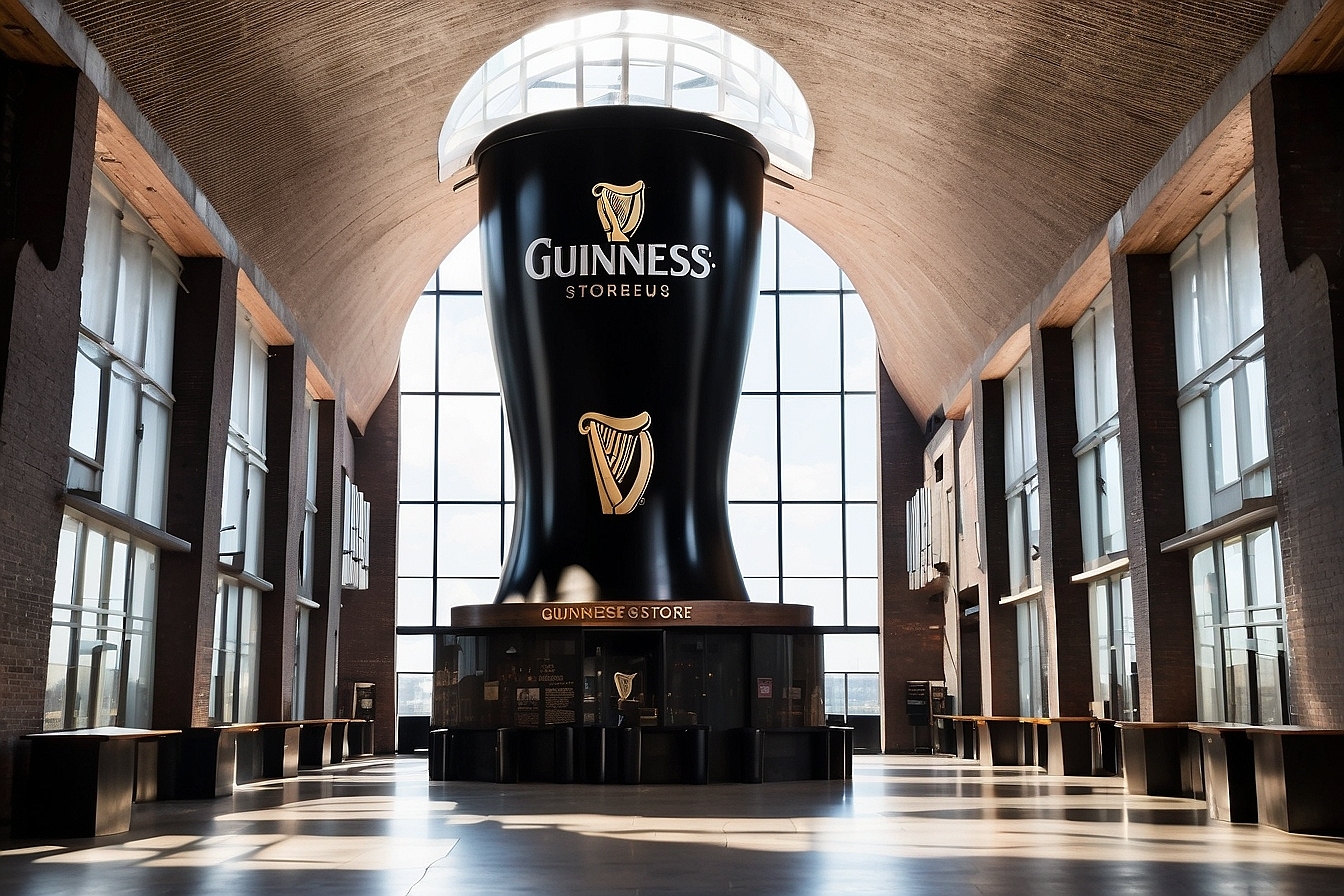
The route runs upward around a central glass atrium shaped like a pint glass, which would hold 14.3 million pints if you ever filled it. The building is roughly 125 feet high, and the climb is the structure of the visit.
| Floor | What you find |
|---|---|
| Ground | The brewing story and the four ingredients: Wicklow water, barley, hops and yeast, plus the flagship retail store |
| First | Arthur Guinness, the cooperage, and the transport story including the brewery railway and barges |
| Second | The tasting rooms and multi-sensory experience |
| Third | The advertising archive and the STOUTie |
| Fourth | The Guinness Academy and the Connoisseur bar |
| Fifth | Restaurants and bars, including beef and Guinness stew |
| Seventh | The Gravity Bar, 46 metres up, with 360-degree views across Dublin |
Floor six is administrative and closed to visitors, which surprises people counting windows from the street. Floor allocations do shift as exhibitions are refreshed, so treat this as the shape of the visit rather than a fixed map.
The Gravity Bar deserves an honest word. On a Saturday afternoon in July it is loud, standing-room only, and the windows are three deep in people holding phones. On a Tuesday at half nine in the morning you can stand at the glass with the Dublin Mountains to the south and Howth to the north-east and have the place almost to yourself. The view has not changed. The experience has entirely.
Why Guinness Tastes Different in Dublin
The difference is mostly freshness and mechanics, not magic. Kegs turn over faster in high-volume Dublin pubs, supply lines are short, and cellar temperature and line cleaning are taken seriously in houses that pour hundreds of pints a day. A drink that has spent three days in transit behaves differently from one that has spent three weeks.
The texture comes from a mathematician. Guinness hired Michael Ash in 1951, the first non-brewer to join the company, and set him the problem of reproducing the old two-part pour from a single keg. Working with keg designer Eric Lewis, Ash developed a two-chamber system charged with a nitrogen and carbon dioxide blend, commonly cited as roughly 75% nitrogen to 25% carbon dioxide. It launched in 1959, the brewery’s bicentenary year, and created the surge and settle effect that people now cross continents to watch. Nitrogen forms much smaller, less soluble bubbles than carbon dioxide, which is why the head is dense, and the drink reads as creamy.
The water comes from the Poulaphouca reservoir in County Wicklow, not the River Liffey, despite one of Dublin’s most durable pieces of misinformation. Soft mountain water suits a dark roasted grain bill, which is part of why the style took hold here at all. County Wicklow features across our Irish travel coverage, and our guide to the 32 Irish counties sets out what each region offers travellers.
The Liberties: The Neighbourhood That Built the Brewery
The brewery and its neighbourhood cannot be separated, and most visitor guides treat St James’s Gate as if it floated free of Dublin 8. It did not. The Liberties supplied the labour, the coopers, the draymen and the loading crews, and Guinness money reshaped the district in return.
Edward Cecil Guinness, the first Earl of Iveagh, funded the Iveagh Trust housing blocks, public baths and hostels across the area, part of a wider pattern of company welfare that included pensions and medical care for brewery families decades before the Irish state offered anything comparable. Historians have debated the balance of genuine philanthropy against paternalism and the family’s unionist politics ever since, and any honest account of the brewery has to hold both things at once.
Today the district around the Storehouse rewards a walk. Weaver Park, the antique shops on Francis Street, St Patrick’s Tower and the old distillery buildings all lie within fifteen minutes on foot, and Kilmainham Gaol sits fifteen minutes west for anyone building a Dublin 8 day around Irish political history. Local guides recommend walking rather than taxiing between them, because the neighbourhood is the point.
Irish and Celtic Connections: The Harp That Faces the Wrong Way
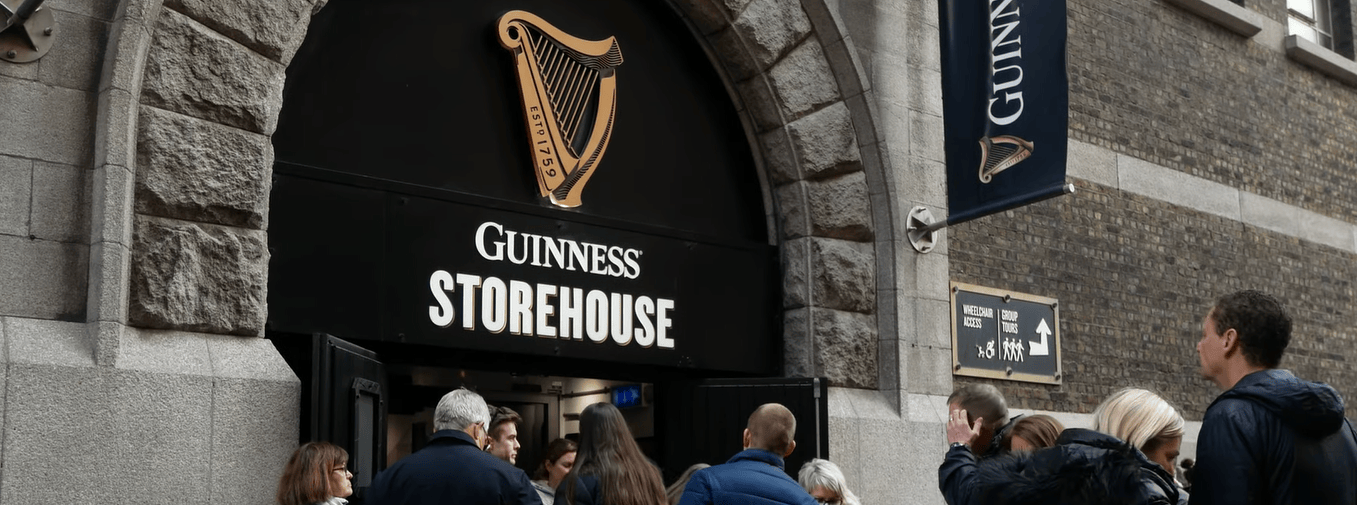
One detail in the exhibition connects the brewery directly to Ireland’s national symbol, and most visitors walk past it. Benjamin Lee Guinness adopted a harp motif for the brand’s label in 1862, modelled on the medieval Trinity College harp, also known as the Brian Boru harp, and the right-facing design was registered as a trademark in 1876.
When the Irish Free State was established in 1922 and chose the same harp as the emblem of the new state, the trademark was already taken. The state’s harp therefore faces the opposite direction to the Guinness one, which is why the harp on an Irish passport and the harp on a bottle label are mirror images of each other. A brewery got there first, and the country worked around it.
The instrument itself carries far older weight. Brian Boru, High King of Ireland, belongs to a tradition of kingship and music that runs back through Irish legend to the Tuatha Dé Danann and the mythological cycles that shaped Irish identity long before any brewery existed. ConnollyCove covers that older material in depth through our guide to Celtic mythology creatures, and the oral tradition that carried those stories survives today in the Irish proverbs still quoted around the country. Travellers who come to Dublin for the Storehouse and leave curious about the harp usually find that is where the deeper trip starts.
Current Conditions and Seasonal Information
Book ahead between June and August and on any weekend in March, because those are the periods when slots sell out, and walk-ups get turned away. The pattern at St James’s Gate is consistent year to year.
Crowd rhythm through the day. The first slot of the morning and anything after about half four are markedly quieter. The middle of the day, roughly half eleven to three, is when coach groups arrive, and the Gravity Bar becomes standing room only. If photographs matter to you, take the earliest slot available.
Season by season. Spring brings the St Patrick’s Day surge, with the week around 17 March the single busiest stretch of the year in Dublin. Summer runs consistently full and warm inside the upper floors. Autumn is the sweet spot for quiet visits with reasonable daylight. Winter is quietest of all, though Dublin daylight fades by half four in December, which removes most of the point of the Gravity Bar view. Our guide to Ireland in March covers what to expect from that peak period.
Weather. Dublin weather changes quickly, and the walk from the city centre is exposed in places. Bring a light waterproof regardless of forecast.
Getting there. The Luas Red Line James’s stop is the closest tram. Dublin Bus routes 123 and 40 serve James’s Street. Walking from College Green takes about twenty minutes through Christ Church and Thomas Street. Limited complimentary parking is available on Crane Street on a first-come basis, and driving into Dublin 8 is not recommended. The city sightseeing bus routes stop at the Storehouse if you prefer to cover several attractions in one ticket, and our Dublin bus tour guide explains how the routes compare.
Building a day around it. St Stephen’s Green, Grafton Street and the Little Museum of Dublin cluster together on the south side, while O’Connell Street and Phoenix Park anchor the north and west. Most visitors pair St James’s Gate with the Temple Bar district in the evening, though the quieter heritage pubs of The Liberties give you a truer sense of the neighbourhood.
Planning Your Visit to Dublin
The Guinness Storehouse works best when you know what it is before you walk in: a heritage museum in a remarkable industrial building, with an archive, an advertising collection and the highest view in the city. Book an early slot, give the Academy serious thought, and leave time to walk The Liberties afterwards.
ConnollyCove produces in-depth guides to Irish heritage, Celtic mythology and destinations worldwide, and our Dublin coverage keeps expanding. Explore the best cities to visit in Ireland for trip planning beyond the capital, or our Ireland travel guide for a route across the island. You can also watch our destination films on the ConnollyCove YouTube channel.
FAQs
Can you visit the Gravity Bar without buying a ticket?
No. The Gravity Bar is on the seventh floor of the paid attraction and has no separate street entrance or public lift. Admission to the Storehouse is the only route in. If you want a drink and a view without paying museum admission, the Guinness Open Gate Brewery on James Street is the nearby alternative for over-18s.
How long do you need at the Guinness Storehouse?
Allow 90 minutes to two hours for the self-guided route, including time at the Gravity Bar. Add 30 to 45 minutes if you book the Guinness Academy, and longer again if you plan to eat on the fifth floor. Families with young children often move faster, since the advertising and archive floors hold less appeal for under-tens.
What is the best time of day to visit?
Take the first slot of the morning or anything after half four in the afternoon. The middle of the day, from around half eleven to three, coincides with coach arrivals and makes the upper floors and the Gravity Bar noticeably crowded. Weekday visits outside July and August are quieter than weekends in any season.
Is the Guinness Storehouse a working brewery?
No. The Storehouse is a visitor centre inside the brewery’s former fermentation building, which stopped production in 1988. The working Guinness factory operates on the same St James’s Gate site and remains closed to general visitors for safety and operational reasons. You will see the production buildings from the windows without entering them.