
Article Summary
What this article covers: The myths, historical events and folklore that surround Rathlin Island, Northern Ireland’s only permanently inhabited offshore island, alongside practical guidance for travellers who want to see the places behind the stories.
Who this is for: Travellers with an interest in Irish and Scottish Gaelic folklore, heritage seekers planning a trip to the Causeway Coast, and anyone curious about the legends attached to Northern Ireland’s remote islands.
Key takeaway: Rathlin’s isolation is exactly why its legends survived largely intact; a small, close-knit population kept oral traditions alive long after similar stories faded elsewhere on the Irish and Scottish coasts.
Expert insight: “Standing on the cliffs above Bruce’s Cave with the Sea of Moyle running white beneath you, it’s easy to understand why this island produced so many stories about persistence and exile. The weather does half the storytelling before you’ve said a word.”
Ciaran Connolly, Founder of ConnollyCove
Quick facts:
- Rathlin recorded a usual resident population of 141 in the 2021 Census, making it Northern Ireland’s only permanently inhabited offshore island
- The island’s Irish name, Reachlainn, sits within the historic Gaelic sea kingdom of Dál Riata, which once linked Antrim to western Scotland.
- Rathlin’s reverse L-shape runs roughly six miles along its northern side and four miles along the other, separated from Ballycastle by the Sea of Moyle
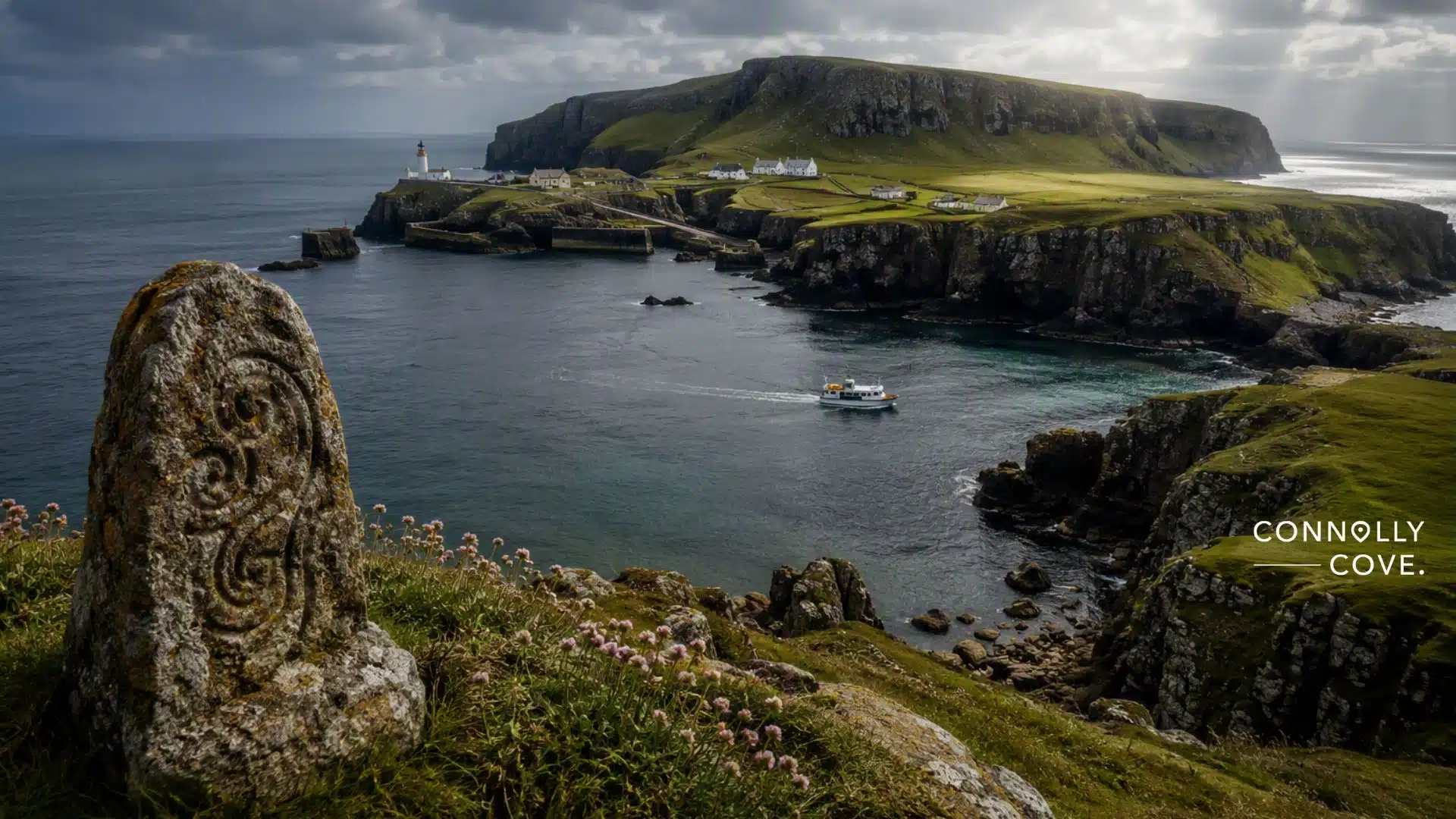
Nine kilometres off the Antrim coast, Rathlin Island carries more legend per square mile than almost anywhere else in Ireland. A Scottish king took refuge in one of its sea caves. A stepmother’s curse is said to have condemned four swan children to three hundred years on the water separating the island from the mainland.
ConnollyCove has covered Irish and Celtic mythology extensively, and Rathlin sits at an unusual crossing point between Irish and Scottish Gaelic tradition, a detail that gets lost when the island is treated purely as a day trip.
This guide works through Rathlin’s best-known legends, the real history sitting alongside them, the wildlife that draws visitors each summer, and what to expect if you plan to see the sites for yourself.
Table of Contents
Rathlin Island: Ireland’s Enchanted Isle in the Sea of Moyle

Rathlin’s geography and its folklore are difficult to separate; the island’s isolation shaped both its history and the stories that explain it. Before looking at individual legends, it helps to understand where Rathlin sits and what its Gaelic name actually means.
Where the Sea of Moyle Meets the Antrim Coast
Rathlin lies around six miles north of Ballycastle, across a stretch of water known as the Sea of Moyle. The crossing is short but notoriously changeable, and sailors have treated it with caution for centuries. On a clear day, the island offers views back towards the Antrim coast and, further east, towards the Mull of Kintyre in Scotland.
Travellers exploring this stretch of coastline often pair Rathlin with a stop at the Antrim mainland’s other great legend, the story of Finn McCool and the Giant’s Causeway, since both sit within the same short drive from Ballycastle and both explain dramatic coastal geology through myth rather than geology textbooks.
Reachlainn and the Legend of the Vanishing Isle
The island’s Irish name, Reachlainn, predates its English form by centuries. Local tradition also attaches Rathlin to one of Ireland’s more unusual folk beliefs: the idea that certain enchanted islands rise from the sea only once every seven years, and can only be fixed permanently in this world if someone throws iron or a stone onto the shore before it sinks again.
This belief is not unique to Rathlin. It appears in wider Irish fairy mythology tied to the Tuatha Dé Danann and the Otherworld, where islands, mounds and lakes act as thresholds between the visible world and something older underneath it.
A Crossroads Between Irish and Scottish Gaelic Tradition
Rathlin’s position in the Sea of Moyle placed it inside Dál Riata, the early medieval Gaelic sea kingdom that spanned both sides of the North Channel. This is why Rathlin’s folklore often reads as neither wholly Irish nor wholly Scottish; the same figures and motifs turn up on both coasts.
The wider mythological backdrop to this shared tradition includes the Tuatha Dé Danann, the god-like race credited across Irish and Scottish Gaelic sources with shaping the landscape long before recorded history began.
Robert the Bruce and the Cave of the Spider
No Rathlin legend travels further than the story of Robert the Bruce, and it is worth separating what the historical record actually supports from what later storytellers added.
Exile, Defeat and a Cave on Altacarry Head
In 1306, Robert the Bruce suffered a serious defeat at the hands of English forces and fled Scotland. Historical accounts place him in hiding for a period during this exile, and local tradition on Rathlin holds that he sheltered in a sea cave near Altacarry Head, close to the island’s east lighthouse, under the protection of the MacDonnell family.
Rathlin’s turbulent history includes other visitors who arrived less peacefully, a theme covered in ConnollyCove’s wider look at haunted places across Northern Ireland, several of which share Rathlin’s pattern of conflict layered beneath a calmer modern surface.
Bruce’s Cave: Historical Fact Behind the Folklore
The version most people know, in which Bruce watches a spider fail six times before succeeding on a seventh attempt and draws inspiration to return to Scotland, comes largely from Sir Walter Scott’s nineteenth-century writing rather than a contemporary medieval source. Local oral tradition on Rathlin appears to predate Scott’s printed account, though the two versions have since blended into one another.
This pattern, where a popular retelling reshapes an older local story, appears elsewhere along the coast too, including in the Finn McCool legend at the Giant’s Causeway, where geology, folklore and later literary embellishment have similarly become difficult to untangle.
Why the Spider Story Still Captures Visitors’ Imagination
Stories about persistence rewarded after repeated failure appear across many cultures, but Rathlin’s version has an advantage most competing tales lack: a specific, visitable cave on a specific cliff face. That physical anchor is part of what keeps the story circulating among visitors rather than fading into general folklore.
The same pattern, a myth kept alive because it is tied to a real place rather than a vague setting, runs through much of Ireland’s storytelling tradition, something ConnollyCove explores further in its wider guide to Irish mythological creatures and the landscapes they are attached to.
The Children of Lir and Rathlin’s Marine Otherworld

Robert the Bruce is Rathlin’s best-known legend outside Ireland, but locally the island’s folklore runs considerably deeper, particularly where the sea itself is concerned.
The Swan Children and Three Hundred Years on the Sea of Moyle
In the tale of the Children of Lir, four royal children are transformed into swans by a jealous stepmother and condemned to spend nine hundred years split across three bodies of water. Tradition places the second and longest stretch, three hundred years, on the Sea of Moyle between Rathlin and the Antrim coast, one of the coldest and most exposed crossings in Irish or Scottish waters.
ConnollyCove’s full retelling of the Children of Lir covers the story’s other locations and its various endings, several of which differ depending on which regional source is followed.
Selkies, Merrows and the Superstitions of Seal-Folk
Seals are a constant presence around Rathlin, and with them comes a strand of folklore common to both Irish and Scottish coastal communities: the selkie, a seal that sheds its skin to walk on land as a human. Fishing communities around the North Channel traditionally treated harming a seal as bad luck, a superstition that outlasted most others tied to the sea.
Our guide to the legend of the selkies sets out the regional variations in more detail, including the version of the tale in which a human hides a selkie’s skin to keep her ashore against her will.
The Kebble Banshee and the Ghosts of the Western Cliffs
Local tradition also attaches a ghost story to Kebble, on Rathlin’s western headland, where a wailing spirit is said to haunt the cliffs and the abandoned cottages nearby. Whether this figure is a genuine local banshee or a more general ghost story shaped by isolation and weather is difficult to establish from written sources.
The banshee tradition itself, properly bean sídhe, or woman of the fairy mound, is set out in ConnollyCove’s dedicated guide to the Irish banshee, which explains why she is traditionally seen as a mourner rather than a threat.
Where These Tales Sit Within Wider Celtic Mythology
Selkies, banshees and enchanted islands all belong to a much larger body of Celtic storytelling that spans Ireland, Scotland and beyond. Rathlin’s version of each tale is shaped by its particular geography, but the underlying figures are shared across the wider tradition.
Readers wanting the fuller picture can turn to ConnollyCove’s field guide to legendary creatures in Celtic mythology, which groups these figures by type rather than by location.
History, Wildlife and Community on an Island Shaped by Legend
Rathlin’s myths did not develop in isolation from its history. Viking raids, a documented massacre and a small, resilient population all sit behind the folklore, and the island’s wildlife has become just as central to its modern reputation.
Viking Raids and the Rathlin Island Massacre of 1575
Rathlin’s position in Dál Riata made it a target for Norse raiders from the eighth century onwards, and Viking influence blended gradually into the island’s Gaelic culture rather than replacing it outright, a pattern that also shaped folklore elsewhere in the wider Celtic mythology shared between Ireland and Scotland. Centuries later, in 1575, English forces killed a large number of the island’s inhabitants after taking Rathlin’s castle, one of the darkest events in the island’s recorded history and one still referenced in local memory today.
Puffins, Seals and the RSPB West Light Seabird Centre
Rathlin’s cliffs host one of Northern Ireland’s largest seabird colonies, and puffins are the main draw between roughly late April and early August, when they nest at the RSPB’s West Light Seabird Centre on the island’s west coast. Guillemots, razorbills, kittiwakes and fulmars share the same cliffs, and grey and common seals are a regular sight in the water below.
For travellers planning a trip around the breeding season, ConnollyCove’s guide to where to see puffins in Ireland covers Rathlin alongside the country’s other main colonies. For current opening times and access details, the RSPB’s own Rathlin reserve page is the most reliable source, since entry charges and seasonal closures change from year to year.
Marconi’s Wireless Message and an Unlikely Footnote
Rathlin holds an unusual place in the history of communication technology. In 1898, Guglielmo Marconi’s assistant George Kemp successfully sent a wireless signal from the island across to Ballycastle, one of the earliest demonstrations of commercial wireless telegraphy anywhere in the world. It sits oddly alongside the island’s older stories, though islanders have long been comfortable holding both a scientific milestone and a set of ghost stories in the same small stretch of coastline, much as Irish communities elsewhere have absorbed new ideas without discarding older ones.
A Small Community Shaped by Isolation and Story
The 2021 Census recorded 141 usual residents on Rathlin, a figure that makes it Northern Ireland’s only permanently inhabited offshore island. That small population has long depended on the ferry link to Ballycastle for supplies, healthcare access and, in past centuries, escape from raids and conflict recorded in the island’s history.
Isolation of this kind tends to preserve oral tradition rather than erode it, which is part of why sites connected to Northern Ireland’s ghost stories and haunted locations so often turn out to be small, tightly knit communities rather than large towns.
Planning a Visit: Ferries, Trails and Where the Legends Come Alive
Reading about Rathlin’s legends is one thing; standing at the actual sites is another. This section covers what to expect if you plan the crossing yourself.
“There’s a specific kind of quiet that settles over Rathlin once the last ferry of the day has gone. That’s usually when the stories make the most sense,” notes Ciaran Connolly, Founder of ConnollyCove.
Getting There by Ferry from Ballycastle
Rathlin is reached by ferry from Ballycastle Harbour, with services running throughout the year and more frequent sailings during the summer months. Crossing times vary depending on the vessel, and it is worth booking ahead, particularly in July and August. Travellers combining the trip with a look at Ireland’s wider mythology may also enjoy the background covered in the Tuatha Dé Danann guide before setting out, since several of the figures mentioned there recur in Rathlin’s own tradition.
Walking from Church Bay to the West Light Clifftop
Most visitors arrive at Church Bay and head west towards the Seabird Centre, a walk of a little over four miles each way that passes close to Kebble, the headland associated with the island’s local banshee legend. The terrain is manageable on foot, though a private bus service also runs for those who prefer not to walk the full distance.
When to Go: Seasons, Puffins and Practicalities
Late spring through midsummer offers the calmest crossings and the best chance of seeing puffins nesting on the cliffs, roughly April to early August. Outside this window, the Seabird Centre typically closes, and the island settles into a quieter, more weather-dependent rhythm, which some travellers prefer for exactly that reason.
Taking the Stories Further
Rathlin rewards a full day rather than a rushed few hours, and the island’s legends make more sense once you have seen the caves, cliffs and headlands they are attached to. Readers wanting to go deeper into the underlying mythology before or after a visit can return to ConnollyCove’s guide to the Children of Lir, which sets Rathlin’s chapter of the story within its full nine-hundred-year arc.
Conclusion
Rathlin Island packs an unusual amount of history and legend into a small stretch of the Sea of Moyle, from Robert the Bruce’s cave to the swan children of Lir and a resident seabird colony. Whether the draw is folklore, history or puffins, the island rewards a proper visit rather than a passing glance. Explore more of ConnollyCove’s Irish fairy mythology guide before you go, or check the ferry timetable and plan your own crossing to Rathlin.
FAQs
What is the legend of Robert the Bruce on Rathlin Island?
Local tradition holds that Robert the Bruce sheltered in a sea cave near Altacarry Head during his exile in 1306, sheltered by the MacDonnell family. The well-known detail of a persistent spider inspiring his return to Scotland comes mainly from Sir Walter Scott’s nineteenth-century writing, though a version of the story appears to have existed on Rathlin before Scott’s account was published.
How do you pronounce Reachlainn, Rathlin’s Irish name?
Reachlainn is generally pronounced roughly as “RAKH-lin”, with a soft, breathy sound at the start similar to the “ch” in “loch”. Regional Irish dialects vary slightly in how the middle syllable is stressed.
What happened to the Children of Lir on the Sea of Moyle?
In the legend, four royal children are turned into swans by their stepmother’s curse and spend nine hundred years split across three stretches of water. Tradition places the middle three-hundred-year period on the Sea of Moyle, the cold, exposed crossing between Rathlin and the Antrim coast.
Can visitors reach Bruce’s Cave on foot?
No. The cave sits beneath sheer cliffs at Altacarry Head and opens directly onto the sea, so it is only accessible by boat in calm conditions. Walkers can view the general area from clifftop paths near the east lighthouse, though the cave entrance itself is not visible from land at every angle.
How do you get the ferry to Rathlin Island?
Ferries run from Ballycastle Harbour year-round, with more frequent sailings in summer. Crossing times and fares vary between the passenger and vehicle services, so it is worth checking the ferry operator’s website directly for current timetables and prices before travelling, particularly if you plan to visit during peak puffin season.