


Palais Garnier, France’s Extravagant Opera House
Updated On: November 08, 2023 by  Aya Radwan
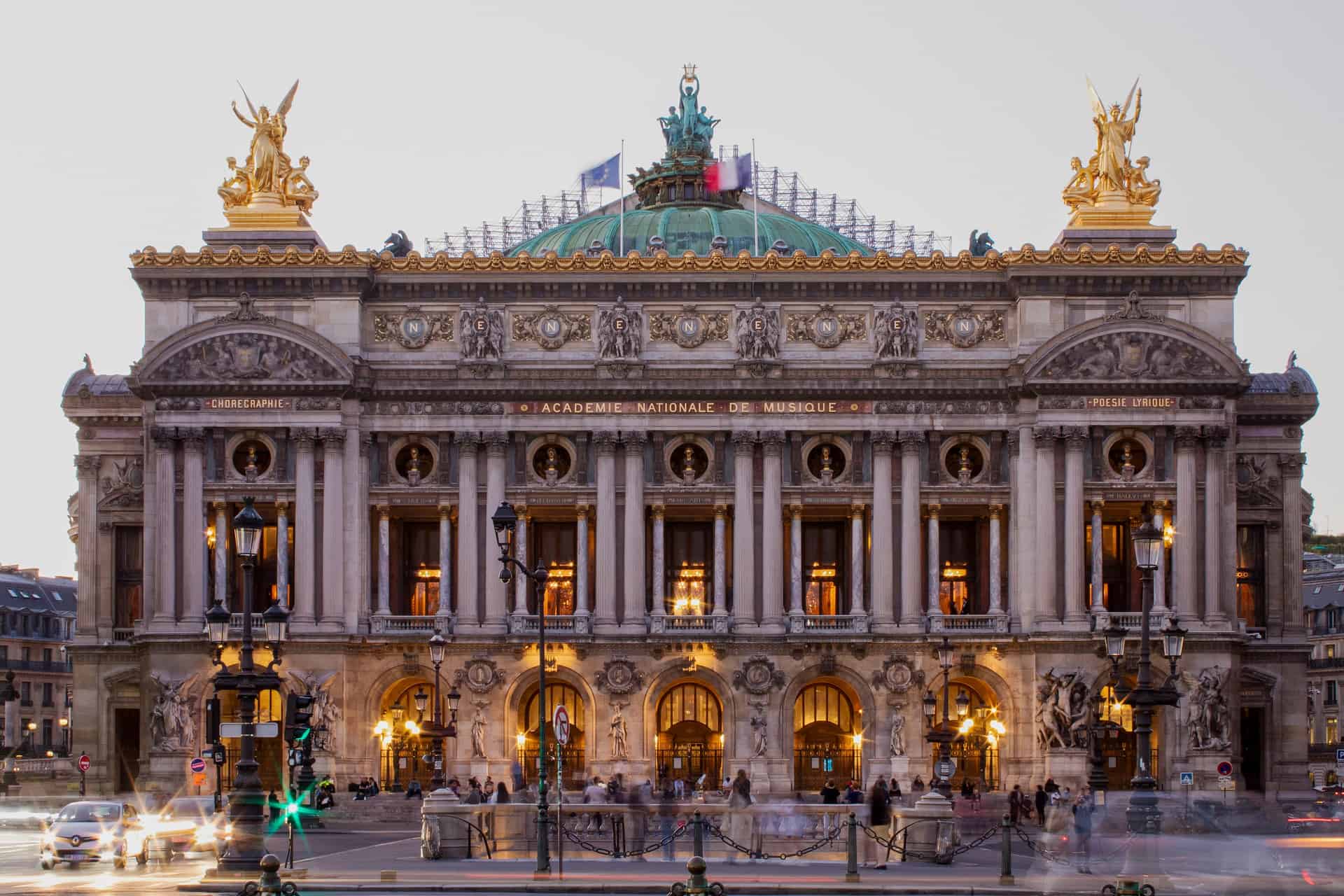
France’s most extravagant opera house, the Palais Garnier is considered a symbol of the country along famous landmarks such as the Eiffel Tower, the Louvre and the Notre-Dame du Paris. This world renowned opera house dominates Place de l’Opera in Paris’ 9th arrondissement. Palais Garnier was dubbed a monument historique in 1923.
History Snippet of Palais Garnier
Since the movement of the Opera de Paris in a temporary building in 1821, the need for the construction of a new building to house the majestic institution arose. However, it wasn’t until the end of 1860 that a design competition for the new building was announced.
Charles Garnier was one of the 170 applicants in the design competition, of which 7 only made it to the second phase of the competition. A month after the beginning of the second round, Garnier’s design was chosen as the winner due to its uniqueness of the design of the exterior and interiors and the interesting usage of sculptures in the work.
Following with his opulent architectural design which he described as representative of Napoleon III, the first foundations were set in 1862 under Garnier’s supervision. What inspired Gaston Leroux’s famous novel Phantom of the Opera was the existence of what people liked to call a subterranean lake beneath the opera house, when it was actually water wells that refused to dry out. A problem Garnier suggested building a double foundation to deal with, successfully so.
Construction works went up and down with the changes in the political scene in France. It wasn’t until a fire ravaged the entire Salle Le Peletier; the temporary home of the Paris Opera in 1873, that Garnier was instructed to finished construction works on the new building as soon as he could.
Garnier and his team worked tirelessly throughout 1874 to finish the construction. During the same year, the first acoustic test took place, the following test was attended by state officials, the Paris Opera Ballet presented the first show and the famous chandelier was lit in the opera house on December 18th.
Palais Garnier Opera House was officially inaugurated in 1875. Since then, the opera house saw the installment of electric lighting, the addition of elevators to help with moving sceneries for new works, and the latest restoration works on the building began in 1994 to strengthen the structure and preserve its opulence, only finishing in 2007.
Architecture of the Palais Garnier
The word often used to describe Palais Garnier is “opulence” which means extreme extravagance. Even though, the majority of architectural opinions about this landmark have agreed it’s a masterpiece, other architects described the Garnier style of architecture as a décor for the grave.
Either way, the Palais Garnier was designed in what its mastering architect called Napoleon III style, which basically means no space, inside or out, is left without decoration. This style resulted in an architectural masterpiece, both inside and out.
Outside Opera Palais Garnier
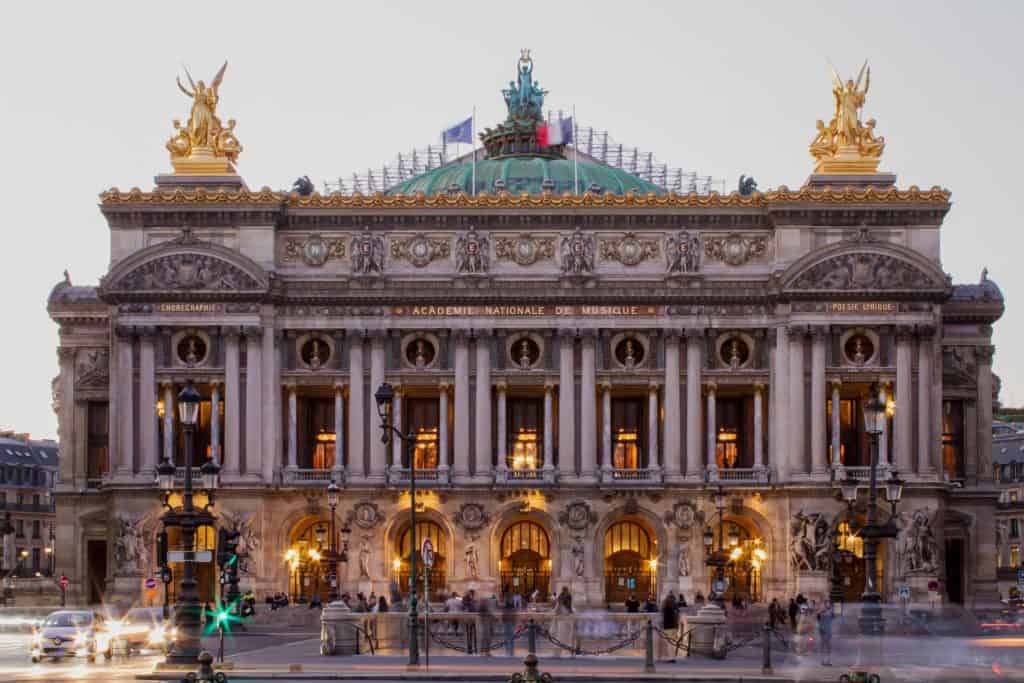
The opera’s main façade is the south one, where a total number of 87 sculptors, painters and mosaicists worked on it, dominates Place de l’Opera. This façade is decorated by two sculptural groups representing Harmony and Poetry at each far side. Beneath these two main groups, the entire façade is decorated with sculptural works by many prominent artists, such as Jouffroy’s Poetry, Chapu’s The Cantata and Jean-Baptiste Carpeaux’s infamous The Dance.
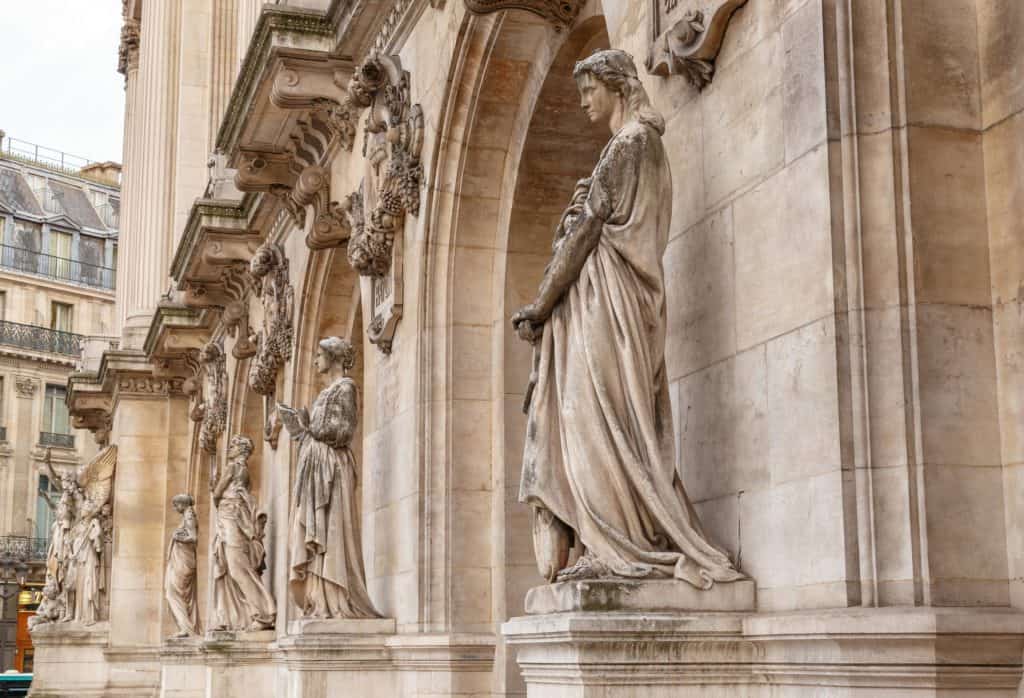
To finish off the decoration of the main façade, busts of some of the all-time great composers, such as Beethoven, Mozart, Auber and Meyerbeer, were lined all along this part of the building. Atop this southern façade is the sculptural group representing the Greek god Apollo accompanied by two statues representing Poetry and Music.
The unfinished rooms of Pavillon de l’Empereur on the west façade, designed initially to allow the emperor’s safe access to the opera, were later converted into the Paris Opera Library-Museum, now houses about 600,000 documents, books, records, photographs and more.
On the east façade, mirroring the Pavillon de l’Empereur, is the Pavillon des Abonnés. It was designed to allow visitors to get off their carriages and enter directly to the building. This pavillon has two matching obelisks at each side of its entrance.
Inside Opera Palais Garnier
The most prominent feature of the interior of this majestic opera house is the Grand Staircase. A fabulous staircase was weaved using white marble and infused with green and red marble, then the main staircase is divided into two staircases leading up to the Grand Foyer. Four grand works of painting decorate the ceiling above the grand staircase, finished just the day before the opera’s grand opening.
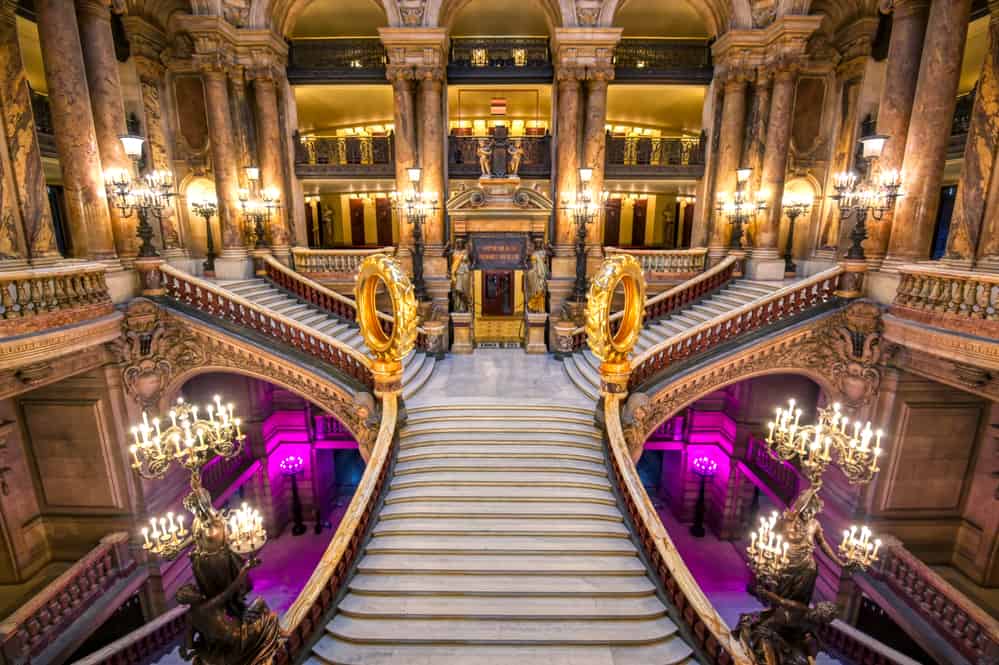
Important moments in the history of music are represented in the paintings by Paul-Jacques-Aimé Baudry on the ceiling of the Grand Foyer. The 54 meters foyer at the end branches out to two salons with equally beautiful painted ceilings. Each of these salons opens into another one, Salon de la Lune to the west, and Salon du Soleil to the east.
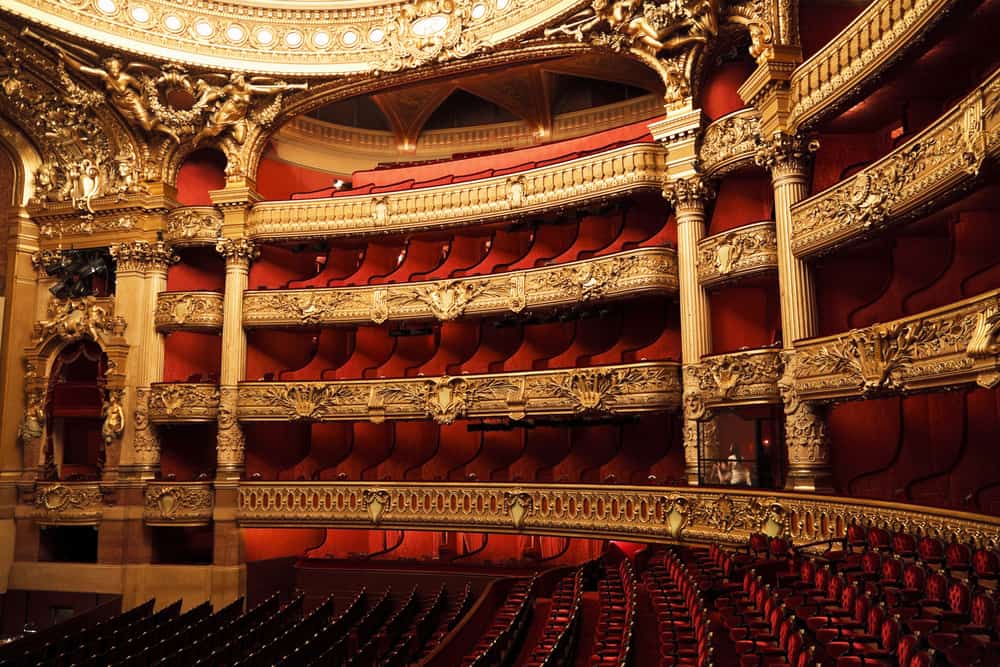
The auditorium is big enough to sit 1,979 people and overlooks the largest stage in Europe. The famous chandelier, which inspired Leroux’s The Phantom of the Opera, was also designed by Garnier himself. At a weight of seven tons, it was made from bronze and crystal and gave an even more majestic aura to the painted ceiling, if that was even possible.
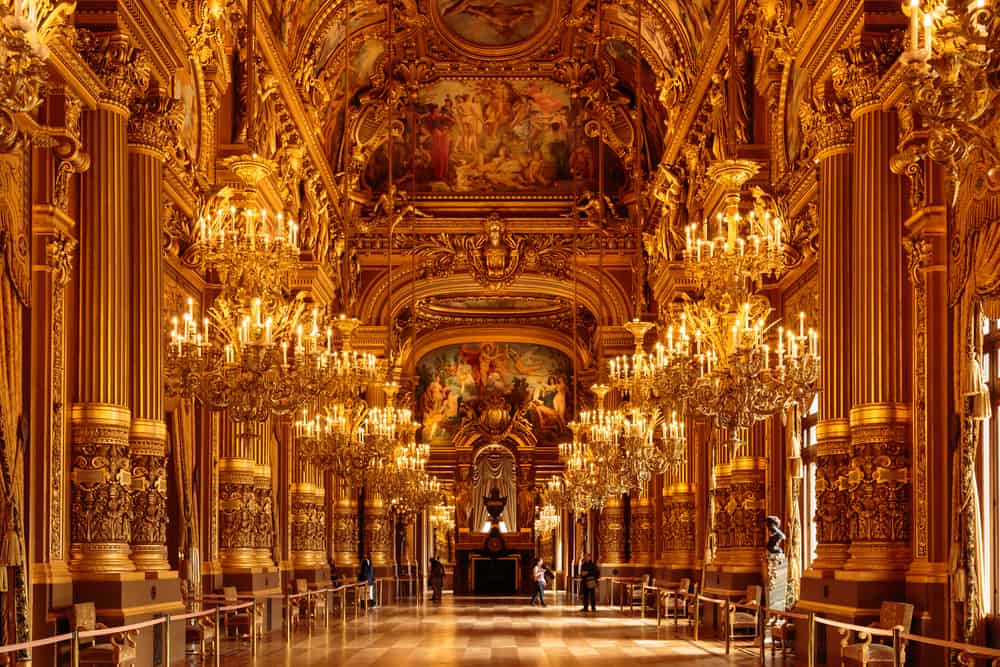
Palais Garnier remained home to the Paris Opera and the Paris Opera Ballet, until the construction and opening of the modern Opera Bastille. Since then, Opera Bastille became home to the Paris National Opera, while Palais Garnier mainly focused on Ballet with a bit of Opera now and then.
Where is Palais Garnier?
This opulent opera house is located at no. 8 Rue de Scribe, Place de l’Opera, 9th arrondissement, Paris.
How to get to Palais Garnier?
Many public transportations can take you to the famous opera house. These being:
- Metro Opera Station: Lines 3, 7 and 8 of the metro will take you to the closest metro station to the opera.
- Bus Stop: Many bus lines stop near the Palais Garnier, such as lines 20, 21, 27, 29, 32, 45, 52, 66, 68 and 95.
- RER: There’s an Auber Station Line A, near the opera.
Opera de Paris Palais Garnier Opening Hours
Palais Garnier welcomes visitors from 10:00 am to 5:00 pm every day and the last entry takes place 45 minutes before closing.
The Palais Garnier closes its doors three times a year. These being on January 1st, May 1st and December 25th.
Palais Garnier Opera Dress-Code
There’s no particular dress-code set for attending shows at Palais Ganier. Many attendances actually head there after finishing their work day, which means they’re usually dressed in semi-formal attire.
However, if the performance you booked takes place at night, formal clothing is a must. Meaning, it’s required that men wear a dark suit and women wear a dress as well.
Opera de Paris Palais Garnier Individuals’ Guided Tour
Through the Palais Garnier official website, you can take a look at and book tickets for guided tours. These guided tours can be divided into two main tours.
- Tour of the Palais Garnier itself, during daytime where you will get to learn all about the history and architecture of this fascinating building.
- Mysteries of the Palais Garnier, this tour takes place after the regular visiting hours, usually starting after 5:00 pm. Through this mysterious tour you will get to discover more of the secrets hidden between the walls of the opera.
Individual Guided Tours Entry Fee
The entry fee for guided tours are as follows, after you choose the date of your visit and the availability of either of the two previous tours to book.
- Full Fee: €18.50.
- Reduced Fee: €13.
- Visitors benefiting from the reduced fee are: students, visitors with disabilities, job seekers, pensioners over 65 years of age and people between the ages of 10 and 24 and
- Children under 4 years old: Free entry.
- Children between 4 and 9 years old: €10.
Important Tips Regarding the Guided Tours:
- You must exchange your online reservation pass, booked through the website, for entrance tickets at the desk designated for guided tours in the building.
- This tour lasts for an hour and a half.
- Not all the time access is granted to the performance hall. Could be due to technical reasons.
- A BTS or Behind the Scenes tour is not included in this guided tour.
- This guided tour ticket once booked cannot be cancelled or modified except in the case of emergency.
Opera de Paris Palais Garnier Individuals’ Self-Guided Tour
If you’d like to wander around the Palais Garnier Opera House on your own, with the company of an audio guide, you can actually book a self-guided tour through the Opera House’s official website and there’s no need to book one through travel websites. Through the official website as well, you can see all the dates of afternoon performances, during which the auditorium will be closed and base the time of your tour accordingly.
Individual Self-Guided Tour Entry Fee
There are three entry fee rates of the Palais Garnier Self-Guided Tour. These are as follows:
- Full Rate: 14€ and becomes 12€ when there are no exhibitions.
- Adults over the age of 26 are charged at the full rate.
- Reduced Rate: 10€ and 8€ outside exhibition periods.
- Visitors between the ages of 12 and 25.
- Visitors who already have a visiting ticket to the Bastille Opera.
- Visitors who have an Opera subscriber card or those who have a card of Pass’ Academie.
- Visitors who have a ticket to either Musee d’Orsay or Musee Gustave Moreau, as long as the ticket is 8 days old maximum.
- Free Admission (upon presentation of valid identification or certificate):
- Children under age 12.
- Visitors with disabilities and their helper, with the limit of one helper per visitor.
- Visitors who are unemployed or receive social assistance, on the presentation of a verified document during the last three months before the visit.
- Visitors who have a Pass Jeunes Opera.
- Visitors with AROP Particulier Card.
- The Carte Culture Pass is valid for two visitors.
- Visitors with the French Professional tour-guide card.
- Students of Architecture and students of Ecole du Louvre.
- Visitors who have the reader’s card from the Bibliotheque nationale de France, they get access to the reading room at the Opera’s library-museum.
Opera de Paris Palais Garnier Group Self-Guided Tours
Guided tours for groups are available for booking as well on the official website. These tours allow access to the public areas in the Palais Garnier as well as any exhibitions taking place at the time. It’s important to know that access to the auditorium can sometimes be restricted due to rehearsals or technical reasons.
You can book a group self-guided tour whether you already have a guide with you who will help explain the wonders of the Palais Garnier or if you’re a group and would just like to freely explore the beauty of the building. A multimedia guide is offered when you book the tour either ways.
Group Self-Guided Tours Entry Fee
Just like the Individual Self-Guided, these are the entry fee rates:
- Full fee: €8, for visitors more than 25 years of age.
- Reduced fee: €7, for visitors between 12 and 25 years old.
- Free Admission: These are the groups enjoying free admission:
- Children under the age of 12, and the adult accompanying up to five children while the remaining adults pay according to the reduced price.
- People with disabilities and their helper.
- The unemployed, recipients of social welfare or other social benefits, with the presentation of a document issued during the past 3 months.
- Student groups from applied arts schools, upon the presentation of their in-progress project.
- Student groups from Ecole du Louvre or architecture schools.
- A group of more than 30 adults and 35 school students and their accompanying teachers and guide, must pay an extra booking fee in addition to the ticket prices.
- These Booking Fees are as follows:
- Full fee: €45 for a group of more than 7 adults over the age of 25.
- Reduced fee: €20 for groups of 7 visitors or less visiting along with a lecturer, school groups or extra-curricular groups when their ages are less than 25. As well as groups enjoying free admission into the opera house.
It’s important to know that only groups with pre-booked tickets are allowed to enter the Palais Garnier. Tickets must be booked at least 21 days before the visit date.
Palais Garnier Group Backstage Private Tour
For an hour and a half, you are taken through where all the magic happens behind the scenes of the opera house. This backstage tour is available for groups with a maximum number of 30 visitors. This makes the entry fee as follows:
- A group of maximum 5 visitors: €700.
- A group between 6 and 30 visitors: €1,500.
- The Private Tour and the Costume Shop Tour: €2000.
It’s worth nothing that the tour of the Costume Shop is only available as a part of the Backstage Private Tour and cannot be booked any other way.
Palais Garnier Phantom of the Opera Tour
Cabin number 5 in the auditorium has a plaque on it that says “Box for the Phantom of the Opera” or “Loge du Fantome de L’Opera”. Some have claimed to have heard scary whispers from this iconic box, even when there was no one inside. The box remains vacant, until today, reserved for the Phantom until this very day.
The fact that Gaston Leroux’s main character was a phantom spooked a lot of people back in time. Some even thought the ghost lived by the lake beneath the building, a belief that was fed through the fact there was actual water wells beneath the opera. Although Leroux defended this belief of the “ghost” even on his deathbed, many said it was all fiction.
Was Phantom of the Opera filmed at Palais Garnier?
I remember watching Gerard Butler and Emmy Rossum in a dark themed movie by the name The Phantom of the Opera many years ago. Back at the time I was so engrossed in the story that I barely focused on the building inside which the movie was supposed to be set.
Years later, I realized the film was supposed to be set in the great Palais Garnier Opera house and the movie was actually based on the renowned renowned novel Le Fantôme de l’Opéra by Gaston Leroux. The novel actually had several adaptations in film, cinema, radio and television.
Even though the plot of the original novel is based on historical events that took place back during the 19th century at the Paris Opera. The setting chosen by Gaston for his novel is the Palais Garnier Opera House.
So, was Phantom of the Opera filmed at Palais Garnier?
The 1990 TV mini series with Charles Dance and Teri Polo was the first ever adaptation of the novel to be filmed inside the Palais Garnier. However, not all scenes of the series were filmed in the famous opera house, only those taking place backstage, the dressing rooms, the cellars and the opera’s grand staircase. Other scenes such as those taking place in the auditorium were filmed at another opera house and the ones at the lagoon were done on a built film set.
Many similarities between the true history of the building and the events of the novel exist. The accident of the fall of a massive chandelier injuring many and killing one, the existence of a lake beneath the Opera building and even rumours about a ghost roaming the folds of the building are all true. Except may be for the Opera ghost, some don’t believe that.
Leroux believed the ghost of the Opera truly existed and he even defended its existence on his death bed. In a way, Gaston Leroux made sure the ghost of the Opera will never be forgotten no matter how much time passes, he made the ghost eternal through his embodiment in his famous novel.
Palais Garnier Opera House Facts and Tips
- The Opera House offers ease of access to visitors with wheelchairs, reduced mobility or visual disabilities.
- In accordance with the regulations set to combat the Covid-19 pandemic, a valid vaccination pass for those over 16 should be presented before entry. A health pass for children from the age of 12 to 16 should be presented.
- The wearing of a face mask is mandatory inside the building, starting from age 6. You must come with your own mask, as these are not provided.
- Temperatures are checked before entering the Palais Garnier and if a temperature higher than 38 degrees will not be allowed to enter.
- A phone-line is designated for any questions or phone-bookings you’d like to make. You can call from inside France at 08 92 89 90 90 with the rate of 0,35€ per minute, or call at +33 1 71 25 24 23 from outside France.
- You can book your tickets from the Paris Opera Application.
- The Palais Garnier ticket desk is open everyday from 10:00 am to 4:15 pm to book your tickets.
- Temporary exhibitions taking place at the Palais Garnier are not accessible to visitors with reduced mobility.
- Don’t worry if the show you’re attending is not in English, there are subtitles provided.
- No worries if you can’t visit the City of Love and admire this extravagant building in person, you can actually take a virtual tour through their official website and still get to enjoy it.
Opera Bastille vs. Palais Garnier
Opera Bastille has become the main venue for the Paris National Opera after its construction and inauguration in 1989. Since its construction, it has become the main theater for opera and ballet performances while Palais Garnier focused on ballet with some opera shows every now and then.
There’s a massive difference between the two opera buildings. While Palais Gariner takes you back to the time it was built it, Opera Bastille gives the feel of an airport lounge, as if you were waiting for your flight to take you a bit further into the future.
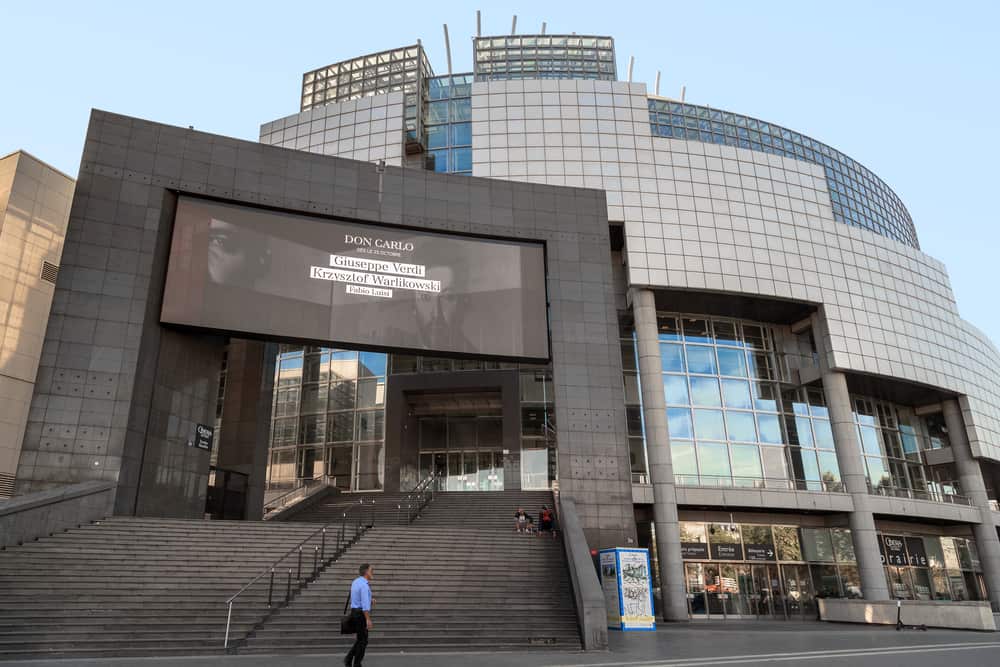
The lavish and warm-toned paintings of the Palais Garnier undoubtedly make you feel at home. The modern style of Opera Bastille has succeeded in warding off many visitors, who preferred the more decorated and warm Palais Garnier.
There’s no right or wrong answer to the question of which opera house to visit, each of them has and gives off a different vibe. It mainly depends on the show you’ll be attending and that will determine which place to check out first.
Places of Interest near Palais Garnier
1. Musée du Parfum -Fragonard:
Established in 1983 by the Fragonard Parfumeur, this privately-owned museum is dedicated to everything about perfumes. Otherwise known as Fragonard Musee du Parfum, the items on display in here include antique perfume bottles and toiletry sets. The museum gives a recount of the history of perfume-making and the components used by the Fragonard company in perfume-making. You can also buy whichever product you like from the items they have on sale.
2. Quartier de l’Opéra:
This is basically the quarter of the Opera Garnier, which dominates the square. The area is studded with architectural gems, department stores dominated by Galleries Lafayette, restaurants, hotels and designer and haute couture shops.
Time at Place de l’Opera is best spent walking around, enjoying the architecture, grabbing a bite or having a chilly drink and topping it with a good shopping spree.
3. Sculpture Groupe d’Apollon:
This group of sculptures atop the Palais Garnier was designed by French sculptor Aimé Millet. The group is made of Apollo and two sculptures depicting Poetry and Music. The bronze sculptures might be harder to see clearly in comparison to other sculptural works on the building of the opera house, due to their location. However, they’re definitely worth a try and get a glimpse of admiration for their fine work.
4. Le Buste de Charles Garnier:
A couple of minutes away from the opera house, this sculptural work is dedicated to the man who designed the prestigious building. The monument at Rue Scribe Ramp, at the back of the opera house, displays a layout of the opera house and is topped by a bust of the famous architect. Garnier’s name is forever inscribed in history books after his fine work on the design of the Palais Garnier.
Where to stay near Palais Garnier
1. Ibis Paris Opera La Fayette (19 Rue Buffault, 9th arr., 75009 Paris, France):
A few minutes away from the Palais Garnier, this hotel offers you modern lightly decorated rooms with optimistic furnishing. The nearby Auber RER station is also 10 minutes away and it leads directly to the loveable Disneyland Paris. The Rendez Vous bar in the hotel offers different drinks and snacks along with a relaxing atmosphere. Not to mention that your furry friend is always welcome here.
A Standard Double Room with one double bed, for two nights, will be €285 in addition to taxes and charges. This price doesn’t include breakfast, an additional €10.50 must be paid for that. The same room with the option of free cancelation and payment at the property will be €308 with taxes and charges, still with the additional €10.50 for breakfast.
2. Hôtel Clauzel Paris (33 Rue Des Martyrs, 9th arr., 75009 Paris, France):
Praised for the quiet atmosphere filling its rooms, this hotel is dubbed perfect for sleeping by one of the reviewers on Booking.com. The place is also highly rated for getting great service for the money you pay and the friendliness of its staff. Opera Garnier is less than a kilometer away.
A Twin Room with two single beds for example, for a two-night stay, will be €205 in addition to taxes and charges. If you’d like to enjoy their continental breakfast, a mere €7 extra charge will be added. This price includes free cancelation and payment at the property. However, if you’d like to pay in advance, the room will be available for €186.
3. Atlantic Hotel (44 rue de Londres, 8th arr., 75008 Paris, France):
Less than a kilometer away from the Garnier Opera House, Atlantic Hotel is also a couple of minutes away from a variety of restaurants. The modern, light and airy furnishing of the hotel gives a fresh and welcoming feel. The place is highly praised for its cleanliness, staff friendliness and its location near Paris’ attractions.
A Standard Queen Room with a double bed, for two nights, will be a total of €223 plus taxes and charges. This prices includes free cancelation and payment at the property. An extra €16 can be added if you’d like to enjoy their delicious breakfast.
4. ibis Paris Grands Boulevards Opéra 9e (38 rue du Faubourg Montmartre, 9th arr., 75009 Paris, France):
Warm shades of blue and beige couldn’t have looked better than they do in the furnishing of this lovely hotel. Not only that, the ibis Paris Grands Boulevards Opera 9e hotel is less than 900 meters away from Palais Garnier and they offer a great variety of sweet and savory dishes for breakfast. Their snack bar is open 24 hours a day!
A Standard Double Room, for two nights, with one double bed, will be a total of €285 without the addition of breakfast. Their colorful breakfast can be enjoyed by adding an extra €10.50. With the inclusion of free cancelation and payment at the property, the total price of the same room will be €308, and the additional €10.50 for breakfast.
5. Sofitel Le Scribe Paris Opera (1 Rue Scribe, 9th arr., 75009 Paris, France):
While we’re mostly look for budget-friendly options while traveling, other times we’d like to splurge and this branch of the Sofitel brand is just the right place. With a mere 200 meters away from the Palais Garnier, this five-star hotel offers its guests free access to a spa, fitness center and even a hammam with a hot tub.
If you’re in for this luxurious treat, you can get the Superior Queen Room for €775, for a two-night stay and you can enjoy their fresh and delicious breakfast for an additional €35. Free cancelation and payment at the property raise the price to €855 without the additional €35 for breakfast.
Where to eat near Palais Garnier
1. Palais Garnier Opera Restaurant (1 place Jacques Rouché, Paris 9th ):
Otherwise known as L’Opéra Restaurant or CoCo Restaurant, this is the restaurant that shares the same view and location of the Palais Garnier. This majestic restaurant was only opened in 2011, despite the original plan of the opera house including a restaurant, it wasn’t until recently the vision came true.
CoCo is open all week and they have specific time limits set for each meal. Lunch is from 12:00 pm to 3:00 pm, dinner is from 7:00 pm to 11:00 pm while brunch is only served on weekends from 12:00 pm to 6:00 pm. The restaurant has an outdoor garden, Le Jardin de Coco, where Yoga classes take place sometimes and is open from 7:00 pm to 11:00 pm.
The lunch menu has a price range from €8 to €59, while the brunch menu ranges from €12 to €49 without the inclusion of drinks. Prior reservation is recommended, either by phone or through the internet.
2. Restaurant Akrame (7 rue Tronchet, 75008 Paris France):
This Michelin Star awarded restaurant for its high quality cooking is named after its chef. Akrame focuses on French and European cuisines and their Instinct Menu can change every day depending on the produce of the day and the creative mood of the Chef, Akrame.
They offer two menus on their official website. The Friends of the South Menu is €75 and is served at noon only every day. The other menu is the Instinct Menu which is made with fresh ingredients from the every day products and is offered at €200.
3. Pascade (14 rue Daunou, 75002 Paris France):
With French and European specialties, Pascade also offers vegetarian friendly options. Their price range is also great; from €8 to €32 only. Many of the reviewers loved having their meals out on the sidewalk but many loved in-house dining as well. The serving portions were enough to fill you up and leave just enough space for a drink.
4. Ao Izakaya (12 rue de Caumartin, 75009 Paris France):
A taste of Asia with a focus on Japan and an infusion of vegetarian and vegan options. Ao Izakaya offers you great dishes at price range between €18 and €73. Seen as a bit pricey by a few reviewers on TripAdvisor, however, they all said the food was definitely worth it and they’d be coming back sure.
Some of the most recommended items on the menu to try include the Warm Grilled Tuna, the Bento Box, the Chef Menu and not to forget the Tempura and Sushi. This is the place to go if you’d like a complete change of palette.
Palais Garnier is the perfect place to feel like you’re walking through a different era. A time of music, great performance and extravagance await you!
If you’ve ever been there, we’d love to hear about your experience and do tell us if we’ve missed any tips.
Unveiling the Most Terrifying Haunted Tours in Scotland
Scotland
25/04/2024

7 Top Amusement Parks in England for an Unforgettable Adventure
England
25/04/2024

Miami Tourism Statistics: A Comprehensive Overview of Visitor Numbers and Revenue
Travel Statistics
25/04/2024

The Enchanting Charm of Scotland Wedding Castles!
Scotland
25/04/2024

London in June: An Ultimate Guide to 13 Unmissable Events and Festivals
United Kingdom
25/04/2024