

Bari, Have fun on the Other Side of the Adriatic
Updated On: November 08, 2023 by  Aya Radwan
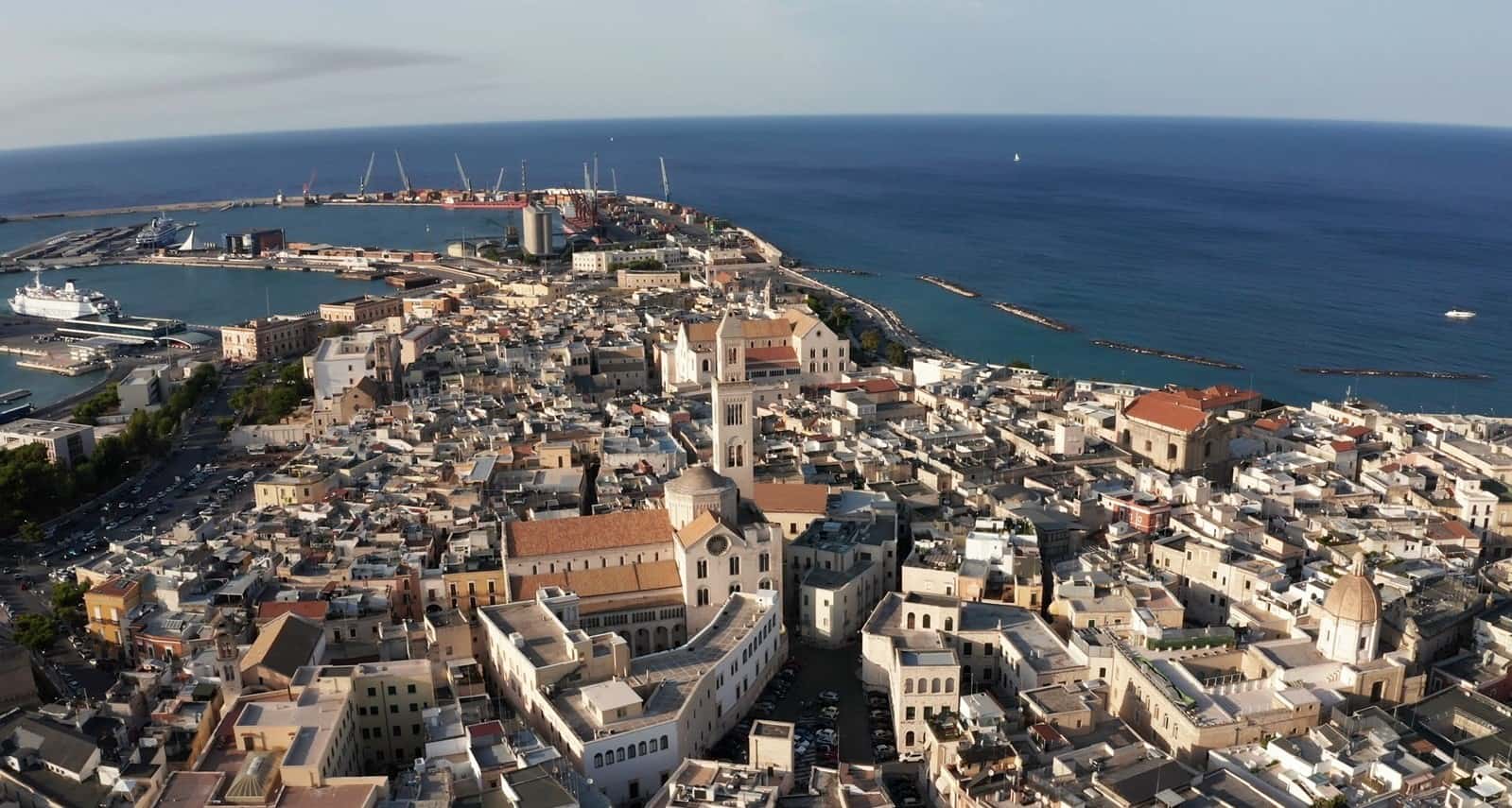
If I told you that you can have a great time on the shores of the Adriatic Sea, in a city other than Venice, would you believe that? The second largest city in the south of Italy promises to give you just that and then some more.
Bari, a coastal beauty that’s buzzing with beautiful city life, historical monuments, beaches and the friendliest of people invites you over for a visit.
With fascinating Mediterranean summers during which you can enjoy walking through the city or get in more enjoyment by cycling through, Bari’s diversity will surely captivate you. The summer season in Bari is the busiest of the year; especially in August, with Italians themselves making up the majority of the tourists as they enjoy their summer vacation.
If milder weather is more appealing to you, you might want to start your trip by September when the crowds have lessened and the heat has winded down.
Bari is the largest urban and metro area overlooking the Adriatic. An old commercial center and busy trading port, Bari keeps up this role by being the busiest passenger port in the Adriatic, with regular ferry links to the Balkans and Greece. Thought to have been established by the Greeks, Bari’s history isn’t void of colors.
Falling into the hands of the Romans, Lombards, Byzantines and Normans over and over, the city proved it could survive destruction and rebuild. The city’s port, mentioned in history as early as 181 BC, suffered two horrendous explosions both in 1943 and 1945 after which the harbor was closed. Yet, the city of Bari showed resilience and strength through rebuilding after such incidents. The city’s harbor continues to hold great importance to this present day.
A main dish of history with an appetizing seaside, a side of entrancing festivals and night-life and local Italian cuisine for a dessert. The city of Bari, Italy is one delicious meal you must not skip.
How to get to Bari?
- Fly in: Bari Karol Wojtyła Airport is Bari’s international airport. It’s located about 8 kilometers northwest from the town center. It receives flights from all around the world, some of which are carriers such as Alitalia, Lufthansa and Ryanair. For a cost of about 30 Euros, a taxi can take you from the airport to the city center. You can also use the train, one leaves every half an hour, as the railway line directly links the airport with the main train station; Bari Centrale where a ticket would cost you just 5 Euros.
- By train: Bari Centrale is Bari’s main railway station, located in Piazza Aldo Moro. There’s a direct link from Bari Centrale to most Italian cities such as Rome, Naples, Milan and Taranto. Inside the station, there are information desks for tourists, ticket machines, bars and waiting rooms. To check train schedules and ticket prices, you can check the site of Trenitalia which handles all train tickets around Italy.
- By bus: If you’re a group traveling together, you can travel to Bari by bus. Bus fares and schedules can be found on the website BusCenter. The site lets you pick departure and destination stops, suitable departure times and prices as well. When booking a bus ticket, it’s more advised if you book in advance to avoid high price rates.
- By ferry-boats: Ferry rates can change depending on the working season, a ticket during low season can cost 16 Euros while during the mid-season it can rise up to over 30 Euros. It’s always good to check the rates before deciding on taking this route during your travel. Check the length of the ride and price rates on the site Ferries.gr which is an online ferry booking site.
- By car: Fancy a road trip? Well, you can get to Bari by renting a car from your start point. If you start at Rome, for example, a car drive will take about 4 hours and a half for the entire 457 kilometers using the A1/E45 and A16/E842. Or you can take the Autostrada A14/Autostrada Adriatica/A14 which will get you there in almost 5 hours for the entire 504 kilometers.
If you start from Naples, however, which is closer to Bari than Rome, the longest route is 284.5 kilometers long with a trip of 3 and a half hours. The fastest route is 260.8 kilometers through the A16/E842 and Autostrada A14/Autostrada Adriatica/A14 with the trip done in less than 3 hours.
Always make sure to check airline, railway and bus websites before planning your trip in order to get the best deals for tickets. The further you book your ticket from the desired date, the better the deals you’ll find. To get around the city of Bari you can use public transportation buses there that cost just 1 Euros or 1.50 Euros if you buy it on board.
You can rent a car online from a website called Expedia; which allows you to compare car rental companies’ prices and choose the best for you. For going about the city center if you prefer, you can always cycle around to soak in the local atmosphere. Whichever means of transportation you use to reach Bari, the city promises you it is worth your effort.
Experiencing the best of Bari
This city on the south side of the Adriatic Sea has its share of monuments that charm visitors, both Italians and foreigners. You can walk in the old town of Bari, exploring and marveling at old buildings and neighborhoods which the government invested in renovating in the last years. These streets are full of so much architectural heritage, it can be overwhelming.
Churches, castles, theaters, art galleries and local restaurants are some of the stops you’d want to make during your trip to this beauty of a city. Here we’ll explore the best things to see in Bari and the relaxing and romantic things to do.
- Barivecchia (Old Bari): The intertwining streets and passageways comprising the section of the city to the north of the modern Murat area. You can lose yourself in the heritage of this Adriatic city and immerse yourself in its history.
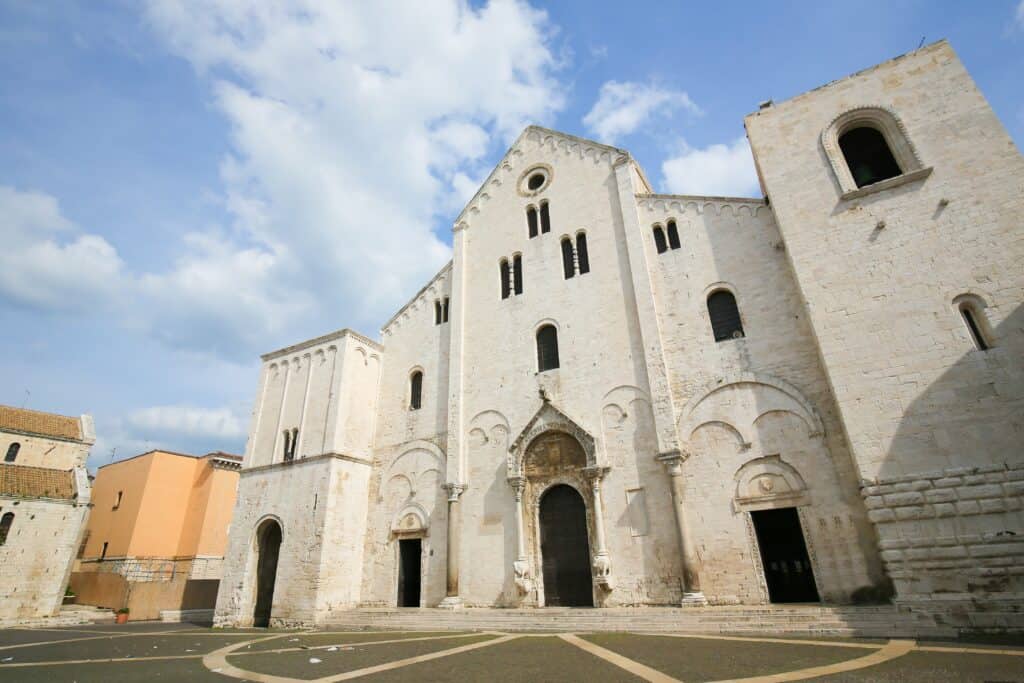
- Basilica di San Nicola (The Pontifical Basilica of Saint Nicholas): This important pilgrimage destination has wide religious importance all throughout Europe and the Christian world. Built between 1087 and 1197, this church is the most important monument in Bari. It is alleged it’s the final resting place of the relics of Saint Nicholas, who passed by the city of Bari on his way to Rome and chose it as his burial place.
This venerable church radiates the vibe of a castle, mainly because it was used as one several times before but also due to the two low massive towers framing its façade. During its life-time so far, the church has been through several restoration works. In the late 13th century, in 1456 and in the 17th century some restorations were carried out, however in the 20th century restoration works, most of the Baroque style additions were removed.
The Basilica has a museum which houses valuable works of art such as a collection of 12th century candelabras donated by King Charles I of Anjou. One of the most Romanesque sculptural works in southern Italy is in the church; a bishop’s throne (a cathedra) that was finished in the late 11th century for Elias. Consisting of 26 columns, the crypt, which houses Saint Nicholas’ relics, shows capitals of Byzantine and Romanesque style. Queen Bona Sforza’s tomb, Queen of Poland from the 16th century, is one of the treasures housed inside the basilica.
- Bari Cathedral (Cathedral of Saint Sabinus): This cathedral that house the relics of Saint Sabinus, which were brought in the 9th century, stands on the remains of several older churches. The existence of a cathedral in the area is mentioned since the 6th century but was most likely destroyed in the 9th or 10th Another church was built in 1034 only to be destroyed by William the Wicked (William I of Sicily) in 1156.
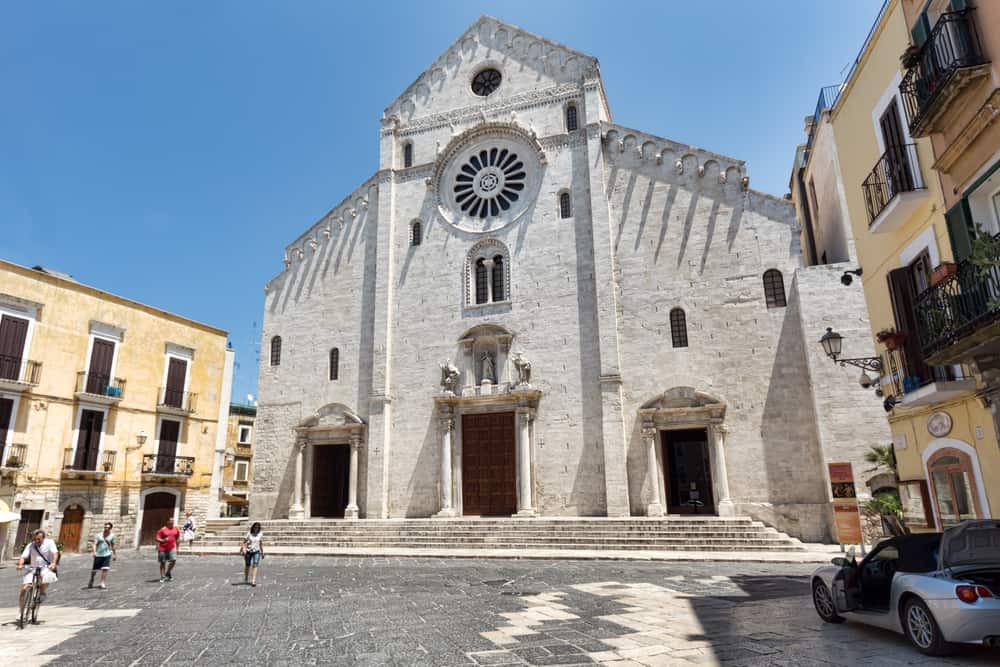
Finally, at the end of the 12th century, building the current cathedral started using materials from the previous churches and neighboring destroyed buildings, the new cathedral was consecrated in 1292. During the 18th century parts of the church were refurbished in Baroque style, another works of extensions and refurbishments took place to restore the Romanesque appearance of the interior in the 1950s.
Adjacent to the cathedral, there’s the Diocesan Museum where a precious document of Byzantine origin is put on display; the Exultet. In this manuscript, the images are upside down from the point of view of the priest reading the manuscript. This way, during celebrating Easter Vigil, the faithful would be able to look at the sacred drawings and the ones who don’t understand Latin could get an idea of what’s going on.
4. Russian Orthodox Church of Saint Nicholas: It is the main destination for Russian pilgrims every year. The Imperial Orthodox Palestine Society headed by the Grand Duchess Elizabeth decided to build a church and pilgrim house for Russian visitors. Foundation began in 1913 in the rare Pskov-Novgorod style. In 1937, the church was sold to the municipality of Bari. The formal donation of the church from Bari to Russia took place in 2009.
5. Cathedral of Acquaviva delle Fonti (Co-cathedral of Saint Eustace): It is the main cathedral of Acquaviva delle Fonti which is on the lower Murgia of Bari. The community’s patron saint is Saint Eustace. This church was built in 1158 on the ruins of a small temple that has Messapian origins and has a Romanesque style. The church was later rebuilt in 1529 and was finished in 1594 and consecrated in 1623. Saint Eustace is celebrated every year on May 20th.
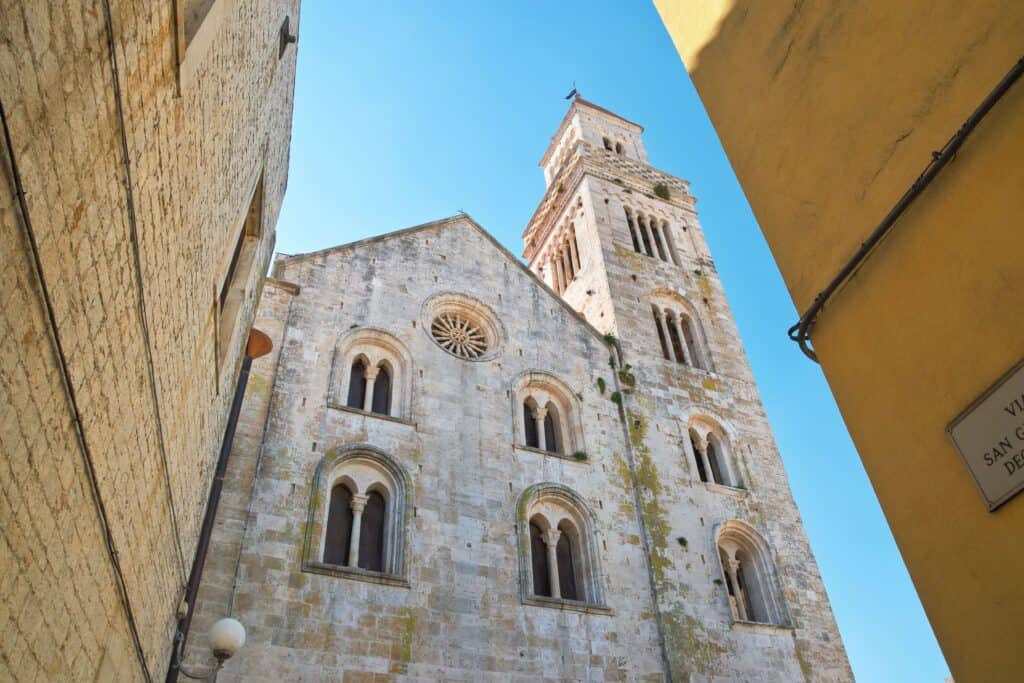
6. Cathedral of Altamura: This is the main attraction site of the community of Altamura, of the metropolitan city of Bari. It is a Romanesque cathedral with strong Gothic influences which probably took place in the 14th restoration of the cathedral. The construction of this church began in 1232 with restorations taking place in 1330, 1521 and 1547.
One of the most beautiful features of the cathedral is the rose window with 15 small columns that are radially intermingling. On the arch of portals are sculpted 22 panels with scenes from Jesus’ life.
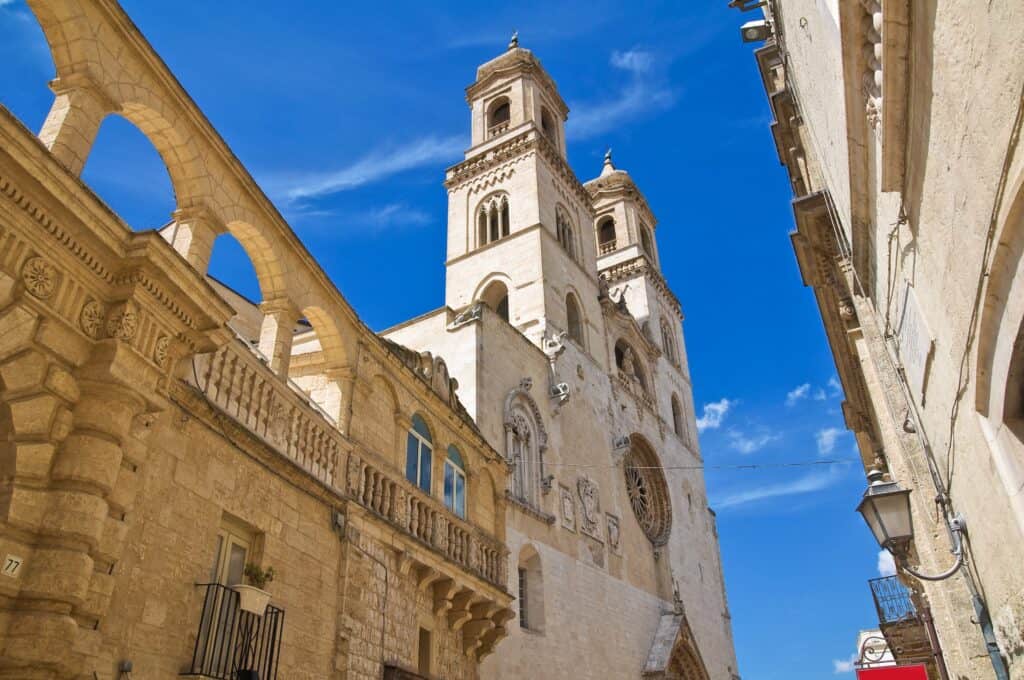
7. Chiesa di Sant’Anna (Catholic Church of Saint Anna): Dating back to the 11th century, it was initially built as a synagogue, known as “Scola Grande” to accommodate the growing Jewish community in the city. It was later converted into a Christian church and finally a museum in 2009.The Church is located in the local Giudecca and is also close to the city harbor and the Cathedral. The white surface of the façade has several marble tiles showing real or fantastic animals drawn from oriental culture.
8. Santa Chiara (church of Santa Chiara di Bari): It is located in the old town in Bari, it was once the church of Santa Maria degli Alemanni or Santa Maria. In 1492 the name was changed to Santa Chiara. The church underwent restoration works in 1539 and 1730. In 1975, the church was definitively closed to worship and now it only opens on Sundays at 11 am.
9. The medieval church of San Marco dei Veneziani: This Romanesque medieval church is presumed to have been founded by the Venetians in 1002. Traces of the medieval building are still visible in the façade with a decoration of rosary beads and a winged lion; the symbol of Venice and the Evangelist Mark.
10. San Giorgio degli Armeni (The Church of San Giorgio dei Martiri): This medieval church is located on the street of the same name in the industrial area of Bari. It is proposed the church was built in the 11th century. A plaque placed inside the church informs of some alterations made in 1920.
11. Santa Teresa dei Maschi (The Church of Santa Teresa dei Maschi): This baroque style church is located in the old town of the city of Bari. The construction of a monastery began in 1671 by the Discalced Carmelites while the church was built between 1690 and 1696. In the present day, the church is home to the “de Gemmis” Provincial Library for Culture and Arts which were donated by Baron Gennaro de Gemmis in 1952.
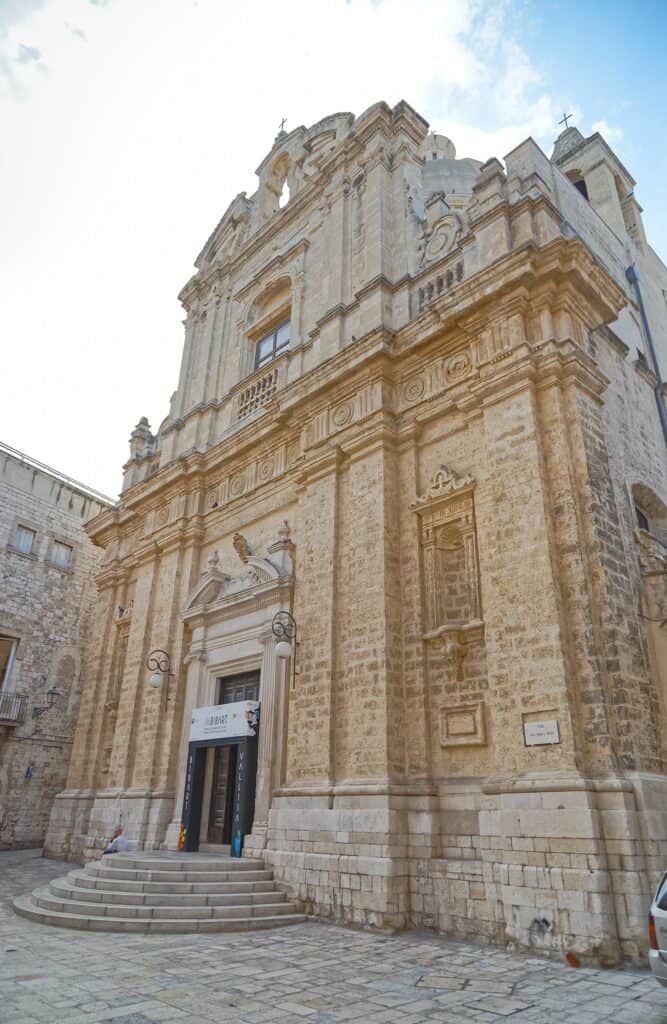
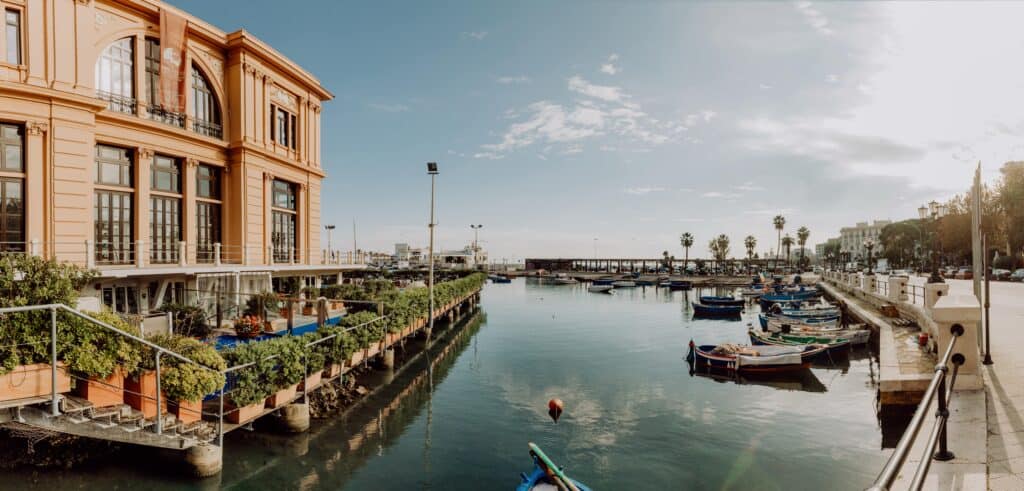
12. Teatro Margherita (Margherita Theater): This Theater is currently a museum. The last time the building was used as a theater and cinema was back in 1979. On the 1st of September, 2021, the first Architectural Festival in the city of Bari was inaugurated. The event took place until the 20th of September this year, manifesting in more than 60 exhibitions, conferences and workshops all around the city.
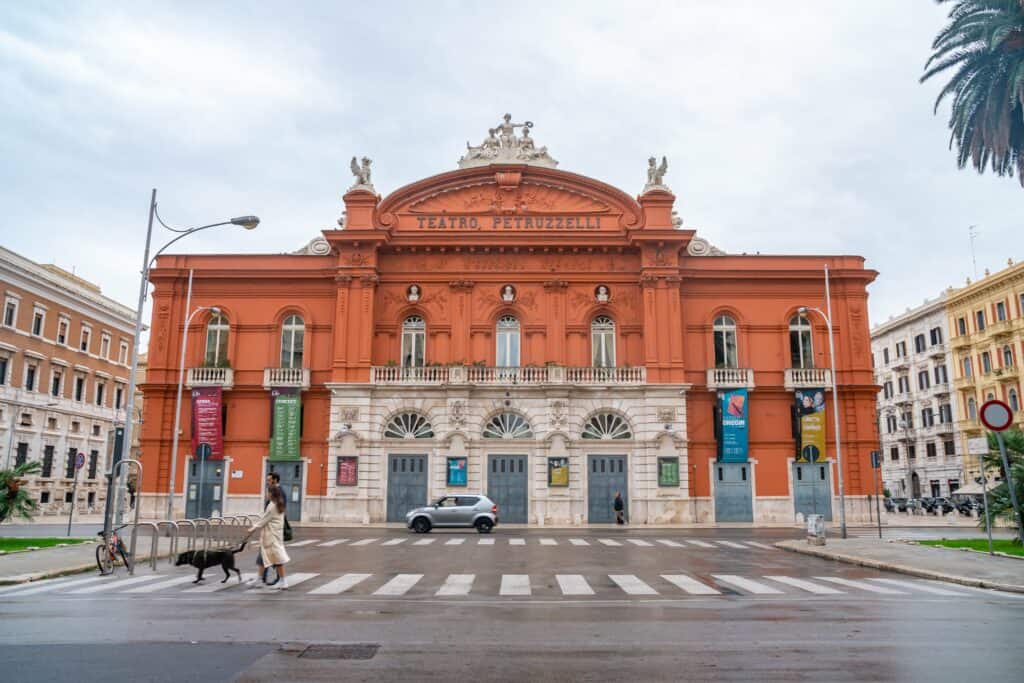
13. Petruzzelli Theatre: This is the largest theater in the city of Bari. The plans for building this theater were presented to and accepted by the city of Bari in 1896. Works began in 1898 and finished 1903.
In addition to operas, the theater hosted ballets and big concerts. Many great Italian artists have performed there such as Carla Fracci and Lucian Pavarotti. Many international artists such as Frank Sinatra and Ray Charles have performed there as well.
Completely destroyed because of arson back in 1991, the theater closed. Plans to rebuild it were begun and stopped several times until the theater was reconstructed completely from public money in 2008. Almost 18 years after the fire, the theater was reopened in October 2009 with Giacomo Puccini’s Turandot.
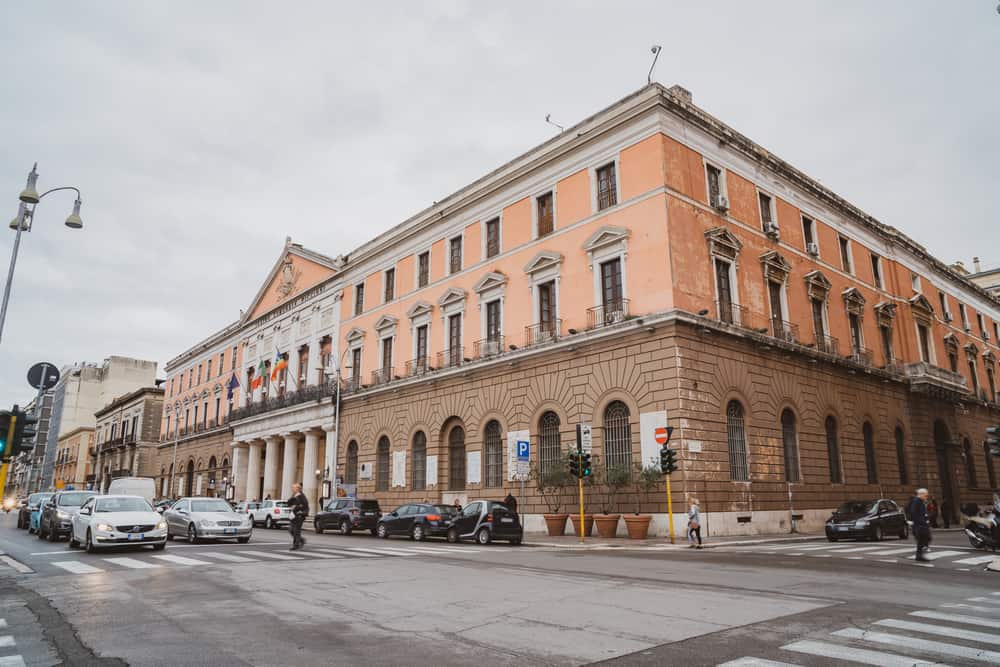
14. Teatro Piccinni: Named after the famous 18th century Italian composer, Niccolò Piccinni who was born in Bari. This theater was founded and opened in 1854 making it the oldest theater in Bari. Teatro Piccinni is the fourth Italian style theater in the region in terms of size.
While restorations and bureaucratic problems kept the theater closed for shows for some time, it was reopened on December 5th, 2019. A marathon of symphonic, jazz and comedy concerts taking place. The following day, as the city celebrated its patron saint; Saint Nicholas, this marathon was gifted from the municipality of Bari to its citizens who got to enjoy the shows for free.
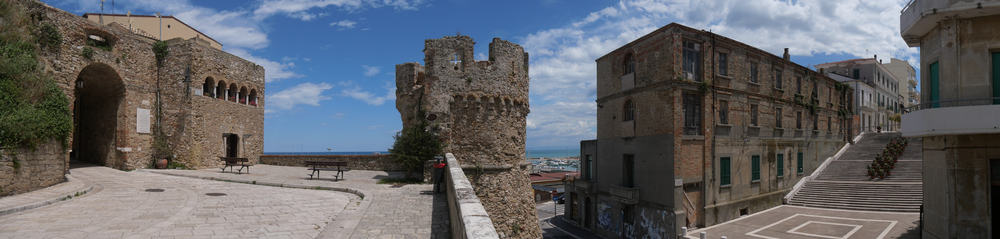
15. Swabian Castle (Castello Svevo): This castle that’s currently used for exhibitions was built by the Norman King Roger II around 1132. After the destruction of the city of Bari by William the Wicked, the castle was rebuilt and reinforced in 1233.
The castle is encircled by walls on all sides except its northern section which faces the sea and can be accessed from the bridge and the gate on the southern side. The castle is mainly composed of the Aragon walls and the main Hohenstaufen tower, and has spaces that are open to the public for art exhibitions and special events.
16. Niccolò Piccinni Conservatory (The Conservatory of Bari): Once an esteemed music school, this conservatory was founded by the violinist and music critic Giovanni Capaldi in 1925 making it the 14th music school in Italy. This music education high school was converted into a conservatory in 1937 and named after the 18th century composer Niccolò Piccinni.
17. Orto Botanico dell’Università di Bari: This botanical garden is known by many names such as Orto Botanico di APS Parco Domingo Comunità Empatica e Sostenibile and Orto Domingo. The garden was established in 1955 and opened in 1960 and later doubled in size in 1964. The garden is open from Monday to Friday morning.
The garden includes a greenhouse and an herbarium that houses a whopping 40,000 specimens. There are several collections in the garden including ornamental and useful plants, regional plants and Orchidaceae.
18. Pinacoteca Provinciale di Bari (Provincial Picture Gallery of Bari): This art gallery and museum is the most important art gallery in Bari, was established in 1928. It is home to many 15th century paintings up to the days of contemporary arts. The museum displays a wide range of artistic works relating to the region of Puglia.
Initially located at the local government center, in 1936 it was moved to its current location; the province’s palace by the sea in Bari. The art collections include some works by artists like Paris Bordon and Palma il Giovane.
Relaxing and Romantic things to do in Bari
Having spent some time getting yourself acquainted with Bari’s monuments and historical sites, some relaxation time on a sandy beach is just what you need. Bari offers you many beach gateways that will set your mood straight and help you relax.
- Pane e Pomodoro Beach: Only a 20 minute walk from the city center, this beach gives you the choice between a sandy beach and a rocky one. With a cafe and vendors at a hands reach, you can enjoy some gelato while you fill your lungs with that iodine filled air. The waters at this beach are shallow so it’s safe for children to play in the water as well.
- Torre Quetta: By train, bus, metro or light rail, you can get from the city center to this much-loved beach by both locals and tourists. A stroll along the beach reflecting the last rays of sunlight for the day will purify your soul. Many services are available at your disposal such as fish restaurants, pizzerias, canoes and games for children to name a few.
- Lido San Francesco: This popular seaside site enables you to rent a lounger and a parasol to enjoy sunbathing by the beach. If you fancy a bite, a fish restaurant is available at your service with the freshest and most delicious seafood dishes.
Food, fun things to do and shopping in Bari.
As you might’ve noticed by far that Bari has everything to offer you, including several yearly festivals such as the Festival of Saint Nicholas. You can try local dishes such as homemade orecchiette; the famous ear-shaped pasta and you can enjoy gelato with flavors depending on the season of your visit.
- Festa di San Nicola Patrono di Bari (6th December): On the day of the Festival of Saint Nicholas – the Patron Saint of Bari, masses start early in the morning, as early as 4 am. Many fast food stands fill the old town. The city’s main celebration of Saint Nicholas takes place in the period from May 6th to the 8th with historical reconstructions, popular music and a two-day fireworks contest. Pilgrims from all over the world flock to Bari to venerate the city’s patron saint.
- Bari International Film Festival (25th of September – 2nd of October): Held annually since 2009, the festival’s 12th edition has just taken place this past September. Over the years, the festival has attracted over 75,000 spectators from around the world, making it one of the leading cinematic events in Italy.
- Fiera del Levante (September): This is one of the exhibitions where you’ll find stands from all over world. This conference hall that hosts musical events should be on your list of fun things to do. The center closes every day at 10 pm.
- Orecchiette: One of the local things to do is try the city’s renowned ear-shaped pasta, has been made by the grandmas of the city for centuries. This famous pasta is made without the use of eggs and are dried in mesh screens of wooden trays outside their doorways. The ladies sell their pasta to the locals and tourists by the kilo.
- Tiella: If you prefer a change from pasta dishes, you can try this local dish that’s made of rice and mussels.
- Burrata: This creamy ball of mozzarella-like cheese is nothing short of decadent, and there’s no better place to try it.
- On your shopping spree in Bari, you can buy bags, shoes and pottery. On Via Sparano da Bari, you will find high class labels such as Louis Vuitton and other shops you will find on Via Argiro.
As you sit thinking about the destination of your next trip, come to Bari, we promise you wouldn’t want to leave.
Benvenuti a Bari!
Unveiling the Most Terrifying Haunted Tours in Scotland
Scotland
25/04/2024

7 Top Amusement Parks in England for an Unforgettable Adventure
England
25/04/2024
Miami Tourism Statistics: A Comprehensive Overview of Visitor Numbers and Revenue
Travel Statistics
25/04/2024

The Enchanting Charm of Scotland Wedding Castles!
Scotland
25/04/2024
London in June: An Ultimate Guide to 13 Unmissable Events and Festivals
United Kingdom
25/04/2024