

Article Summary
What this article covers: The history, architecture and folklore of Ballintubber Abbey in County Mayo, with practical advice on visiting and on walking the Tóchar Phádraig pilgrim path.
Who this is for: Travellers planning a trip to the west of Ireland, pilgrims and walkers, and anyone interested in Irish heritage.
Key takeaway: Ballintubber Abbey is the only church in Ireland founded by an Irish king that is still in daily use. Mass has been celebrated there without a break since 1216, even when the nave had no roof.
Expert insight: “What struck me at Ballintubber was how ordinary the extraordinary feels. You can stand beside a grave split in two by an ash tree and pass the crypt of Grace O’Malley’s son. A few minutes later, local families arrive for morning Mass in a church a king built over eight hundred years ago.” , Ciaran Connolly, Founder of ConnollyCove
Quick facts:
- King Cathal Crobhdearg Ua Conchobair of Connacht founded the abbey in 1216 for the Canons Regular of St Augustine.
- Cromwellian forces burned the church in 1653, yet Mass continued inside the roofless walls.
- The 35km Tóchar Phádraig pilgrim path to Croagh Patrick begins in the abbey grounds.
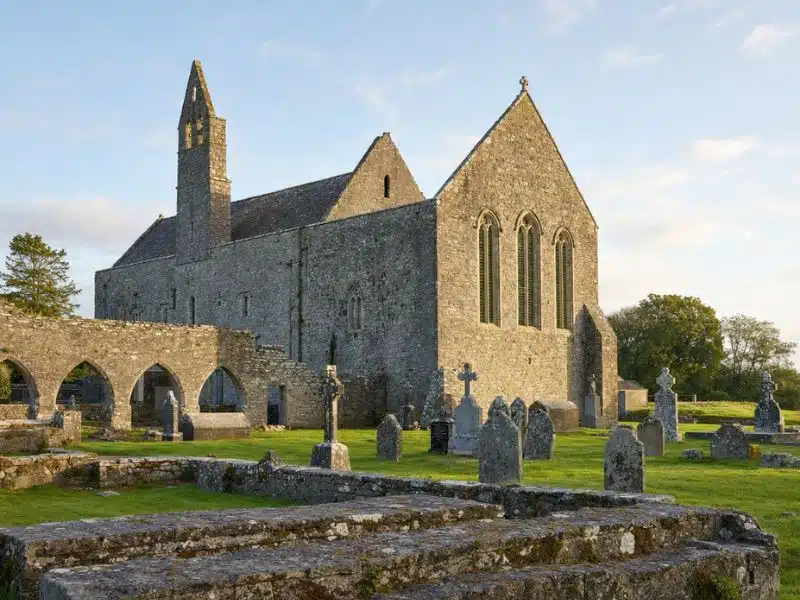
Ballintubber Abbey stands in the Carra district of County Mayo, about 13km south of Castlebar, and it holds a record no other church in Ireland can match. A king of Connacht founded it in 1216, and Cromwellian soldiers set it alight in 1653. For more than two centuries afterwards the nave had no roof, yet the local community kept celebrating Mass inside its walls. That unbroken run of worship is why the building is known as “the abbey that refused to die”. The poet Cecil Day-Lewis used the phrase for a poem he wrote in 1967 to raise restoration funds.
ConnollyCove, the Ireland-based travel and culture platform founded by Ciaran Connolly, covers places where Irish history is still part of daily life. Ballintubber Abbey is one of the clearest examples in the west of Ireland. This guide covers the royal foundation, the abbey’s survival, its tombs and folklore, and the practical details of a visit. For a wider trip, our guide to things to do in Mayo and our page on the holy mountain of Croagh Patrick cover the surrounding county.
The video below introduces Ballintubber Abbey and its founder, King Cathal Crobhdearg Ua Conchobair. It gives a good sense of the setting, the cloister remains and the restored church before you visit.
Table of Contents
The Royal Foundation of Ballintubber Abbey
Ballintubber Abbey owes its existence to a promise made by a young prince in exile, according to local tradition. The Annals of the Four Masters date it to 1216. Built for the Canons Regular of St Augustine and dedicated to the Holy Trinity, it stands on ground that tradition links to St Patrick more than seven centuries earlier.
King Cathal Crobhdearg and the Legend of Sheridan
Cathal Crobhdearg Ua Conchobair, known as Cathal of the wine-red hand, was a son of King Toirdhealbhach Ua Conchobair, for whom the Cross of Cong was made. Before he came to the throne, Cathal spent a period in hiding. Local folklore says he found work and shelter in Ballintubber with a man named Sheridan, who treated him with great kindness.
Years later, as King of Connacht, Cathal returned and asked how he could repay the favour. Sheridan asked only that the old local church, which was falling down, be repaired. Cathal promised a new church instead, but on a later visit Sheridan reproached him for breaking his word. The king then vowed to build a church in Ballintubber seven times more magnificent, and the abbey is said to be the result. The story is legend rather than record, but the Ballintubber Abbey Trust tells it as the founding story of the site.
St Patrick, the Holy Well and the Name Ballintubber
The name Ballintubber comes from the Irish Baile an Tobair, meaning the town of the well. Tradition holds that St Patrick baptised local people at a well here around 441 and founded a small church nearby. The Annals of the Four Masters record the abbey as Tobar Pádraig, or Patrick’s Well, and the well still lies in the grounds. Our article on Irish holy wells and sacred trees explains the place of these wells in Irish belief.
How Ballintubber Abbey Survived Eight Centuries
The history of Ballintubber Abbey is a sequence of destruction and recovery, held together by a community that never stopped worshipping there. The table below sets out the main dates, drawn from the National Inventory of Architectural Heritage and History Ireland.
| Year | Event at Ballintubber Abbey |
|---|---|
| 1216 | Foundation by King Cathal Crobhdearg Ua Conchobair |
| 1265 | Fire damages the church and the nave is rebuilt |
| 1542 | The abbey is surrendered to the Crown during the Reformation |
| 1635 | Augustinian friars settle in the abbey precinct |
| 1653 | Cromwellian forces burn the church and demolish the domestic buildings |
| 1846 to 1848 | First restoration attempt, halted by the Great Famine |
| 1889 to 1890 | Second restoration, by George Coppinger Ashlin, covering the eastern end |
| 1963 to 1966 | Full restoration under Percy le Clerc of the Office of Public Works |
| 1997 | Chapter house and dormitory restored and re-roofed |
Suppression, Fire and the Cromwellian Attack of 1653
Laws passed in the 1530s to dissolve the monasteries began the abbey’s slow decline, and it was surrendered to the Crown in 1542. Augustinian friars returned to the precinct in 1635 after a petition to Rome. Their stay ended in May 1653, when Cromwellian forces set the church alight and pulled down the cloister, dormitories and domestic quarters. The stone church survived as a shell, but the timber roof was lost.
Mass Through the Penal Times
Through the 18th century, the Penal Laws restricted Catholic worship and put a price on the heads of priests. Mass continued to be said at Ballintubber Abbey all the same, often in secret and under the open sky. Heritage Ireland, the Office of Public Works site for state heritage, notes that Mass has been said there without fail since 1216. That record gives Ballintubber its standing, because many medieval abbeys of the same age survive only as ruins.
Three Restorations and the Abbey That Refused to Die
Two 19th century restorations made partial progress, but the church only regained its full roof in the 1960s. Fr Thomas Egan led the campaign, and Percy le Clerc of the Office of Public Works supervised the work between 1963 and 1966. It was finished in time for the 750th anniversary on 8 September 1966. During the campaign, Cecil Day-Lewis visited the church and was asked to write a poem that could be sold to raise funds. He called it The Abbey That Refused to Die, and the name has stayed with the building. In 2016, Ballintubber Abbey marked 800 years of continuous worship.
The Architecture and Sacred Art of Ballintubber Abbey
Ballintubber Abbey pairs some of the finest medieval carving in Connacht with a restored interior shaped by the Second Vatican Council. The original church was a cruciform building without aisles, with a low tower over the crossing. Chapels opened off the east side of each transept, a layout borrowed from Cistercian practice.
The School of the West and the Ballintubber Master
The carved details of the chancel are the reason architectural historians rate Ballintubber Abbey so highly. The east end has three windows with chevron mouldings and capitals carved with foliage, in the late Romanesque style that was giving way to early Gothic around 1200. The carvings are attributed to the School of the West, a group of masons working in Connacht at the turn of the 13th century. The finest work is credited to an unnamed craftsman whom historians call the Ballintubber Master. When you visit, look closely at the capitals around the chancel windows, where the leaf patterns are cut with real precision.
Modern Art Inside the Restored Church
The 1960s restoration kept the interior plain so that the medieval stonework could be seen clearly, and the modern art added afterwards is worth as much of your time. Imogen Stuart created the Stations of the Cross in 1972, and Gabriel Loire of Chartres designed the stained glass showing Saints Patrick, Brigid and Colmcille. Oisín Kelly carved the wooden statue of the Virgin and Child. The 15th century west doorway, once taken to Hollymount, was returned by the Church of Ireland and reset in the west wall in 1964.
Tombs and Folklore at Ballintubber Abbey
Two graves at Ballintubber Abbey show opposite sides of life in 17th and 18th century Mayo. One belongs to a powerful Gaelic lord, the other to a man the local community despised, and guides tell both stories on tours.
Tibóid na Long, Son of Grace O’Malley
Theobald Bourke was known in Irish as Tibóid na Long, or Tibbot of the Ships, because he was born at sea. He was the son of the pirate queen Grace O’Malley (Gráinne Mhaol) and her second husband, Richard Bourke. He grew up nearby with the MacEvilly family at Kinturk Castle and was created first Viscount Mayo in 1627. When he died in June 1629, he was said to be the wealthiest man in Connacht. He lies in a crypt beneath the sacristy, built as a mortuary chapel for the Bourkes of Mayo, with his wife and four later Viscounts Mayo. Our profile of Grace O’Malley tells the story of his mother.
Seán na Sagart and the Split Grave
Seán na Sagart, meaning John of the Priests, was the name given to John Malowney, a priest hunter who tracked down Catholic clergy in Mayo during the Penal Times. The abbey’s own account says he died in 1726 while pursuing Fr David Burke near Partry. A pedlar who came to the priest’s aid killed him with his own dagger. Soldiers buried him in the abbey grounds, and tradition says an ash sapling grew from the grave and split it in two. Seán na Sagart’s Tree still stands in the grounds, and the abbey marked the 300th anniversary of his death on 20 September 2026.
Walking Tóchar Phádraig from Ballintubber Abbey to Croagh Patrick
Tóchar Phádraig, or St Patrick’s Causeway, links Ballintubber Abbey with Croagh Patrick. It is one of the oldest walking routes in Ireland still in use, and it began as a chariot road running from Rathcroghan, seat of the kings of Connacht, to Aghagower and the mountain then called Cruachán Aigle. Christian pilgrims later took the same road, and the abbey built a hostel for them in 1216, the remains of which survive in the grounds.
The Route and What to Expect
The full Tóchar runs for about 35km from the abbey to Murrisk, at the foot of Croagh Patrick. The abbey describes it as a strenuous linear trail that takes eight to 10 hours. Yellow pilgrim symbols mark the way, and the route crosses more than 100 stiles, with fields and bog in the first half and mostly tarmac roads in the second. Aghagower, roughly halfway, has a round tower and a holy well, and many walkers split the route there. The path was abandoned during the Penal Times and was cleared and restored by local people in 1987. Our article on Irish pilgrimage routes and their stories places the Tóchar alongside other historic Irish paths.
Registration, Passports and Guided Walks
All walkers register at Ballintubber Abbey before setting out, and maps and leaflets are provided at registration. Self-guided groups can walk the Tóchar year-round, and the abbey also runs guided walks on set dates with a bus back at the end. Tóchar Phádraig is one of the five passported trails of the Pilgrim Paths of Ireland. You can buy a passport at registration and have it stamped at Murrisk after completing the full route. Fees differ for the half and full routes and have changed in recent years, so check the Ballintubber Abbey website before booking.
Planning Your Visit to Ballintubber Abbey
Ballintubber Abbey is an active parish church cared for by the Ballintubber Abbey Trust and the local community. A visit combines heritage sightseeing with the rhythm of parish life, so a little planning helps.
Getting There and Parking
The abbey lies just off the N84 between Castlebar and Ballinrobe, about 17km from Westport, and brown tourist signs mark the turn. From Galway, the N84 north through Headford and Ballinrobe takes a little over an hour. There is a car park at the abbey. Castlebar and Westport have the nearest rail stations, so a car or taxi is the practical way to arrive. If you are staying in Westport, our Westport travel guide covers places to stay and eat.
Mass, Tours and Visitor Etiquette
Mass is celebrated daily at Ballintubber Abbey, and the church is regularly used for weddings, funerals and retreats. Check service times on the abbey website before you travel. If you have come for the architecture rather than worship, arrive outside service times. Guided tours cover St Patrick, the Cromwellian burning, the Bourke family and the restoration, and they are the best way to see the sacristy. Tour times and prices vary through the year, so confirm them in advance. The abbey is also a popular wedding venue, and the actor Pierce Brosnan married Keely Shaye Smith there in 2001.
The New Cultural and Heritage Visitor Centre
The derelict east wing of Ballintubber Abbey is being turned into a three-storey Cultural and Heritage Visitor Centre, a project the Ballintubber Abbey Trust began planning in 2008. In May 2026, Minister Dara Calleary approved the project to proceed to construction, with final funding of over €6.4 million from the Rural Regeneration and Development Fund. The Connaught Telegraph reported that the works also include conservation of the chapter house and cloister. Parts of the grounds may be affected during construction, so check access before you visit.
Attractions Near Ballintubber Abbey
Ballintubber Abbey sits in a part of Mayo with plenty to see within an hour’s drive. The places below work well as half-day or full-day additions to a visit.
Croagh Patrick and Westport
Croagh Patrick, known locally as the Reek, rises above Clew Bay about 35 minutes’ drive west of Ballintubber Abbey. Tradition says St Patrick fasted on the summit for 40 days in 441. On Reek Sunday, the last Sunday in July, thousands of pilgrims climb the mountain, some of them barefoot. Westport, the nearest large town, has Westport House, an 18th century house in parkland near Clew Bay. The Clew Bay Archaeological Trail links monuments around the bay from prehistoric to medieval times.
Lough Carra and Moore Hall
Lough Carra lies a few kilometres east of the abbey and is known for its clear water over a pale marl bed. Church Island, in the north west of the lake, has the remains of an early church. The shell of Moore Hall stands on the eastern shore, in woodland with walking trails. Our pages on the beautiful Lough Carra and the ruins of Moore Hall cover both.
National Museum of Ireland, Country Life
The Country Life branch of the National Museum of Ireland is at Turlough Park, just outside Castlebar. Its galleries cover rural Irish life from the 1850s to the 1950s, from farming and fishing to crafts and home life. It pairs well with an abbey visit, because it shows how the families who kept Ballintubber’s faith alive actually lived. Admission is free, but check opening days before you go.
Connemara and Kylemore Abbey
For a longer day out, Connemara National Park and Kylemore Abbey are both around one hour and 15 minutes’ drive away. Kylemore is a Victorian castle on a lakeshore with a restored walled garden, and it has been home to a Benedictine community since 1920. Our guide to Kylemore Abbey and its Victorian walled garden has the details.
Explore More Irish Heritage
ConnollyCove covers Irish traditions, sacred sites and the stories behind them, so that travellers understand what they are looking at when they visit. Our article on St Patrick, Ireland’s patron saint gives the background to many traditions linked to Ballintubber Abbey. For official information, the Heritage Ireland page on the abbey and the National Inventory of Architectural Heritage entry are reliable starting points. The ConnollyCove YouTube channel also documents heritage sites across Ireland on video.
Frequently Asked Questions About Ballintubber Abbey
Who Founded Ballintubber Abbey?
King Cathal Crobhdearg Ua Conchobair of Connacht founded the abbey in 1216. It was built for the Canons Regular of St Augustine.
Why Is Ballintubber Abbey Called the Abbey That Refused to Die?
Mass has been celebrated there without a break since 1216. Worship continued even after Cromwellian forces burned the church in 1653.
Is Ballintubber Abbey Still Used for Mass?
Ballintubber Abbey is an active parish church with daily Mass. It is also a popular venue for weddings.
Who Is Buried at Ballintubber Abbey?
Tibóid na Long Bourke, son of Grace O’Malley, is buried in the crypt beneath the sacristy. The priest hunter Seán na Sagart lies in the grounds.
How Long Is the Walk from Ballintubber Abbey to Croagh Patrick?
The Tóchar Phádraig is about 35km and takes eight to 10 hours. All walkers register at the abbey before they start.
How Far Is Ballintubber Abbey from Westport?
The abbey is about 17km from Westport, roughly 25 minutes by car. It is about 13km south of Castlebar.
Do You Need to Book a Tour of Ballintubber Abbey?
You can visit the grounds and church without booking. Guided tours and group visits should be arranged in advance.


