


70+ Most Fascinating Roman Names for Baby Boys and Girls

Updated On: November 08, 2023 by  Ciaran Connolly
Ancient Rome is regarded as the pinnacle of literature and art, influencing all aspects of life, including Roman names. Parents today are rediscovering names from the Roman era due to the popularity of TV dramas based on the ancient lifestyle. Roman names have a grace and elegance that parents find appealing for both boys and girls.
Each Roman name was carefully considered, inspired, and given a rhythmic flow. Every little detail in these lovely Roman names is intricately stitched together, giving a magical feel. Such names may provide your child’s name with a bit of drama and joy. They might be easier to remember than other names, and they will definitely give your child a sense of uniqueness.
If you want to give your children names that are one-of-a-kind and have a deep meaning, then this article will help you! You will also notice that Latin is the origin of most of the following names.
Without further ado, here are some of the most famous Roman names for baby boys and girls!
Roman Names for Boys
Parents typically like ancient Roman baby names because they often have rich connotations, particularly when they are connected to historical figures from Rome. These names are easy to pronounce and have lovely meanings and musicality. Let’s examine the following Roman baby names for boys.
Albus
- Meaning: “white” or “bright.”
- Origin: Latin
- Note: It is given to the beloved Harry Potter character, Albus Dumbledore, in the book and movie series.
Augustus
- Meaning: “magnificent,” “majestic,” or “great.”
- Origin: Latin
- Note: It is the name of the first Roman Emperor, Octavian.
Aeneas
- Meaning: “praised”
- Origin: Latin
- Note: It is the name of Aphrodite’s and Anchises’s son, who is believed to have broken Queen Dido of Carthage’s heart. Aeneas is also a character in Troilus and Cressida, one of Shakespeare’s problem plays.
Consus
- Meaning: “to plant” or “to sow.”
- Origin: Latin
- Note: It is simple to pronounce and write. Consus is the god of grain in Roman mythology.
Cupid
- Meaning: “desire”
- Origin: Latin
- Note: Cupid is the Roman deity of love. This lovely name may attract the attention of everyone.
Apollo
- Meaning: “prophecy,” “healing,” and “destroyer.”
- Origin: Latin
- Note: It is derived from Greek and Roman mythology. Apollo was the Roman god of spring, music, dance, and prophecy.
Faunus
- Meaning: “the protector of flocks,” “animals,” and “pastures.”
- Origin: Latin
- Note: According to Roman mythology, Faunus was a half-human–half-goat creature and the god of forests.
Liber
- Meaning: “liberty” and “freedom.”
- Origin: Latin
- Note: In Roman mythology, Liber was the god of fertility, freedom, and wine.
Felix
- Meaning: “happy,” “fortunate,” “successful,” and “lucky.”
- Origin: Latin
- Note: The ancient Roman general Sulla adopted it as a nickname believing that Roman gods blessed him with luck.
Julius
- Meaning: “youthful” and “downy-bearded.”
- Origin: Latin and Greek
- Note: During Roman times, Julius was a general and statesman. The name is best known in Shakespeare’s The Tragedy of Julius Caesar.
Cicero
- Meaning: “chickpea”
- Origin: Latin and Greek
- Note: It is the family name for the first-century BC statesman, philosopher, and orator Marcus Tullius Cicero.
Marcellus
- Meaning: “young warrior” or “hammer.”
- Origin: Latin
- Note: It comes from the Roman god of war, Mars. It’s such an inspiring name for a baby boy!
Marcus
- Meaning: “dedicated to Mars” or “warlike.”
- Origin: Latin
- Note: Besides being related to Mars, the Roman deity of war, it was also the name of a famous Roman gladiator at the Roman times.
Maximus
- Meaning: “greatness”
- Origin: Latin
- Note: It was a Roman title given to the victorious commanders. In the movie Gladiator, Maximus is the protagonist’s name.
Octavius
- Meaning: “eighth”
- Origin: Latin
- Note: It refers to the eighth kid in the family. It is the name of the first Roman emperor, Caesar Augustus (a.k.a. Octavian). In addition, Shakespeare adopted the name Octavius in his renowned The Tragedy of Julius Caesar.
Orlando
- Meaning: “brave,” “from glorious land,” or “famous.”
- Origin: Latin
- Note: Orlando is the protagonist in the famous Shakesperean play As You Like it.
Prospero
- Meaning: “prosperous”
- Origin: Latin
- Note: Shakespeare adopted the name in his famous play The Tempest.
Petran
- Meaning: “solid as a rock” or a “rock-solid person.”
- Origin: Roman and Germanic
Priscus
- Meaning: “the first”, “ancient,” “original,” or “venerable.”
- Origin: Latin
- Note: It was also the name of a famous Roman gladiator.
Regulus
- Meaning: “princess,” “little king.”
- Origin: Latin
- Note: It is a star name in the constellation Leo. It is also a famous name in ancient Rome.
Remus
- Meaning: “oar”
- Origin: Latin
- Note: According to the legend, Remus is the twin brother of Romulus, who formed the city of Rome
Roberto
- Meaning: “bright fame” or “shining glory.”
- Origin: Latin and Germanic
Stefano
- Meaning: “crown”
- Origin: Greek and Italian
- Note: It is in the list of the most popular baby boy names. Despite being long, this name is easy to pronounce.
Sylvester
- Meaning: “wooden” or “overgrown with trees.”
- Origin: Latin and Roman
- Note: It is derived from the word “silva”, which denotes “woodland.” It was a typical surname during Roman times.
Dominic
- Meaning: “of the lord” or ” belongs to the lord.”
- Origin: Latin
- Note: Boys born on Sundays have previously received this name.
Emilius
- Meaning: “eager ” or “rival.”
- Origin: Latin
- Note: It came from “Aemilia”, a Latin family name.
Vulcan
- Meaning: “to flash.”
- Origin: Latin
- Note: According to the legend, Vulcan is the Roman deity of fire who possessed great energy. This name is now more well-known because Mr Spock played one of the pointy-eared humanoids on “Star Trek.”
Antony
- Meaning: “highly praiseworthy” or “priceless.”
- Origin: Latin
- Note: It stems from “Antonii”, a Roman family name. Shakespeare adopted the name in his famous play, Antony and Cleopatra. Marcus Antonius, commonly known as Mark Antony, was a well-known Roman statesman.
Giorgio
- Meaning: “farmer ” or “earth-worker.”
- Origin: Latin
- Note: It is derived from the Greek Geogios, or “georgos”. Some of the most well-known Giorgios include Italian artists Giorgio Morandi and renowned fashion designer Giorgio Arni.
Titus
- Meaning: “title of honour.”
- Origin: The Latin word “titulus”.
- Note: It is related to an ancient Roman empire. Titus Tatis served as a king of the Sabines.
Vitus
- Meaning: “life-giving,” “lively,” or “life.”
- Origin: The Latin word “vita.”.
- Note: It was the name of a famous Christian saint, Saint Vitus. It is easy to pronounce with an inspiring meaning.
Albanus
- Meaning: “white,” “sunrise,” “bright,” or “shining.”
- Origin: The Latin word “alba.”
- Note: Boys with this name are strong, very smart and not greedy. They are independent and friendly at the same time.
Avitus
- Meaning: “ancestral”
- Origin: Latin
- Note: It denotes a creative, passionate person with a magnetic presence.
Brutus
- Meaning: “heavy”
- Origin: Latin
- Note: It is related to the Roman Republic founder, Lucius Junius Brutus.
Gallus
- Meaning: “rooster,” or “heavy.”
- Origin: Latin
- Note: It expresses the baby’s rebellious side. It refers to lucky and supportive people.
Hilarius
- Meaning: “hilaris,” “happy,” or “cheerful.”
- Origin: Latin
- Note: The name is identical to highly motivated people with a friendly presence.
Junius
- Meaning: “young,” or “youthful.”
- Origin: Latin
- Note: It is the name of Lucius Junius Brutus, the Roman Republic founder. It suits people who are imaginative and full of potential.
Edoardo
- Meaning: “rich guardian,” “guardian of their property,” or “wealthy guardian.”
- Origin: Old English
- Note: People with this name are confident and hardworking. This name reflects the strength and morality required of the traditional man of the house.
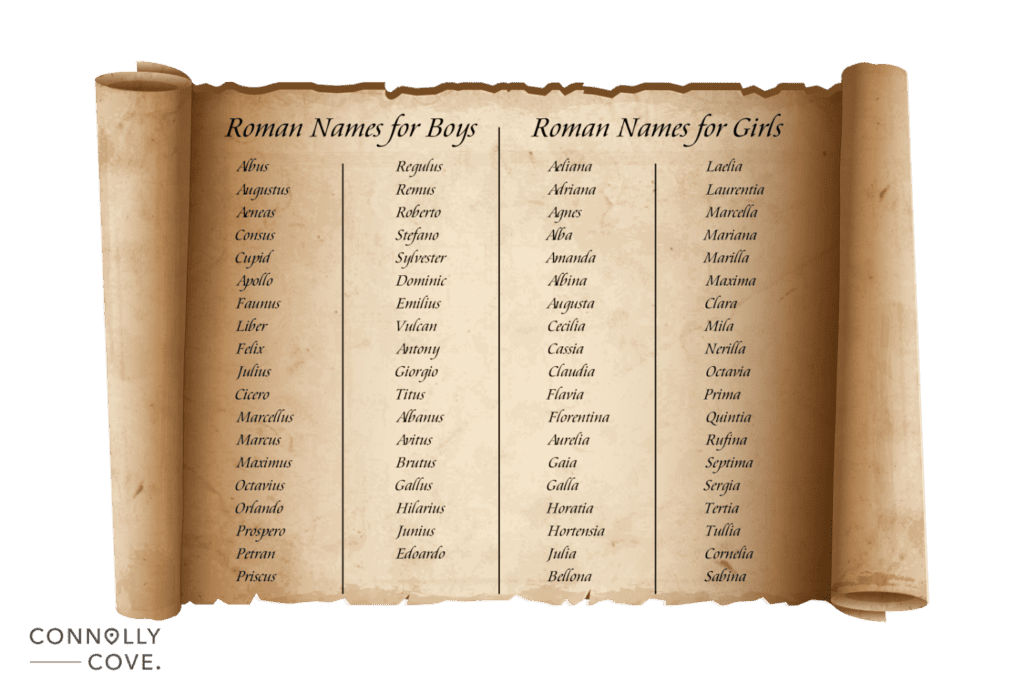
Roman Names for Girls
The Romans were quite proud of their names since they served as a means of identification and influence. The lovely female names express beauty, charm, and affection. Their names can be found inscribed in stone. Let’s have to check some of the most famous female Roman names.
Aeliana
- Meaning: “sun”
- Origin: Latin
- Note: It sounds musical to the ears. The first sound is pronounced “ee.”
Adriana
- Meaning: “From Hadria”
- Origin: Latin
- Note: Adriana is E. Antipholus’s wife in Shakespeare’s “The Comedy of Errors.”. The name reflects a robust and enthusiastic, cheerful and happy character. It also sounds appealing.
Agnes
- Meaning: “purity” and “chaste.”
- Origin: Greek
- Note: Girls with this name have a leadership personality and enthusiastic spirit. “Aggie” is a popular nickname for Agnes.
Alba
- Meaning: “bright” or “white.”
- Origin: Latin and Germanic
- Note: It is an adorable name that is easy to pronounce. Albi can be used as a nickname.
Amanda
- Meaning: “Loveable,” “worthy of love,” or “the one that must be loved.”
- Origin: Latin origin from the verb “amare.”
- Note: It is a popular and lovely name among girls. They have wise and philosophical characters.
Cecilia
- Meaning: “blind by love.”
- Origin: Latin
- Note: It refers to a family-oriented and loving girl. Cila is a common nickname that is easy to pronounce.
Cassia
- Meaning: “Cassia tree” or “cinnamon.”
- Origin: Roman
- Note: It is related to the Roman name Keziah. It inspires joy and harmony in mind.
Claudia
- Meaning: “Of the patrician Claudii,” “enclosure,” or “lame.”
- Origin: Latin
- Note: It is derived from the name Claudius. Girls with this appealing name possess mature and dedicated characters.
Flavia
- Meaning: “golden-haired” or “yellow or blond.”
- Origin: Latin
- Note: It stems from the Latin name Flavius. It is a sensitive character with an artistic flair.
Aurelia
- Meaning: “The golden one” or “gold.”
- Origin: Latin
- Note: It stems from the Roman family name Aurelius and the Latin word “aureus.” It derives from the male name Aurelius.
Julia
- Meaning: “youth,” “youthful,” and “downy” or “sky father.”
- Origin: Latin
- Note: It stems from Julius, which is a Roman family name. Also, it sounds musical to the ears. Girls with such an appealing name have self-confidence and determination.
Bellona
- Meaning: “fight” or “fighter.”
- Origin: Latin
- Note: It is related to the Roman deity of war. Lona can be used as a nickname for this compassionate name. They possess intellectual traits.
Marcella
- Meaning: “warlike” or “dedicated to Mars.”
- Origin: Latin
- Note: It refers to a name of a strong and intellectual matron during the Roman time. They have spiritual and intuitive characters. The common nicknames are Mary and Cella.
Mariana
- Meaning: “a wished-for child” or “of the sea.”
- Origin: Latin
- Note: It is derived from the Roman name Marius. These personalities are communicative, creative and popular. Mari, Anna and Mai can be used as nicknames.
Marilla
- Meaning: “shining sea.”
- Origin: Latin
- Note: It refers to a type of flower, Amaryllis. Merry and Lilla are appealing nicknames.
Clara
- Meaning: “bright,” “famous,” or “clear.”
- Origin: Latin
- Note: It is derived from the name Clarus. Also, It is a lovely and classy name. They have problem-solving traits that aid their success.
Mila
- Meaning: “dear” or “gracious.”
- Origin: Latin
- Note: It is a nice name for girls and is easy to pronounce. They possess problem-solving and powerful traits.
Prima
- Meaning: “the first one.”
- Origin: Latin and Roman
- Note: It fits any baby girl, especially if it is the first daughter, and it sounds musical to the ears.
Rufina
- Meaning: “Red hair” or “ruddy.”
- Origin: Latin and Roman
- Note: It is derived from the Roman name Rufinus. They are sensible characters with an artistic flair.
Tertia
- Meaning: “third”
- Origin: Latin
- Note: It is derived from the Roman male name Tertius. It is a charming name. Tia is a sweet nickname.
Tullia
- Meaning: “peaceful,” “calm,” or “bound for glory.”
- Origin: Latin and Spanish
- Note: It is derived from Tullius, a Roman family name. Also, it is a lovely and unique name for baby girls. What do you think of Lily and Tulip as nicknames for this sweet name?
Cornelia
- Meaning: “horn”
- Origin: Roman
- Note: It stems from the Latin word cornu. Aso, it is related to the Roman family name Cornelli. Lia and Nell are appealing nicknames.
Sabina
- Meaning: “woman of the Sabine people.”
- Origin: Roman
- Note: It is a pretty and unique name for girls. They are independent and willing to take action. They are ambitious and successful. Beanie and Sabi are nice nicknames.
Valentina
- Meaning: “strength,” “strong,” or “health.”
- Origin: Roman
- Note: It is derived from the Roman name Valentinus. It is a romantic name for baby girls. The girl with this name will be powerful and wealthy. Valley, Valya and Lena can be nicknames for Valentina.
Valeria
- Meaning: “Strength,” “vigour,” “bravery,” “power,” and “capable.”
- Origin: Latin
- Note: It is derived from the Roman name Valerius. It denotes a freedom-loving, easygoing but intellectual character. In Shakespeare’s tragedy “Coriolanus,” Valeria plays a minor role.
So, we have covered various Roman names for boys and girls, their origins, and their meaning. If you’re looking for a unique name that has an everlasting effect on the ears, this list might inspire you. While considering these names, why not visit Rome for the complete experience? Check our reasons to embark on a journey to Rome right now.

A Walk in Ireland Guide: Best Trails, Routes, and Tips
Ireland
26/04/2024

An Ultimate Guide to 6 of the Finest Castle Tours in England
England
26/04/2024

Unveiling the Most Terrifying Haunted Tours in Scotland
Scotland
25/04/2024

7 Top Amusement Parks in England for an Unforgettable Adventure
England
25/04/2024

Miami Tourism Statistics: A Comprehensive Overview of Visitor Numbers and Revenue
Travel Statistics
25/04/2024