

Article Summary
What this article covers: A self-guided walking tour of SS Nomadic in Belfast, from the riverside route out of the city centre to each deck on board, with the ship’s history and the practical details you need before visiting.
Who this is for: Visitors planning a day in Belfast’s Titanic Quarter and Titanic enthusiasts who would rather reach the ship on foot than by car or taxi.
Key takeaway: SS Nomadic is the last surviving White Star Line vessel, and she now rests in the same Belfast dock where she was fitted out in 1911, so the walk to her leads back to where her story began.
Expert insight: “When we filmed along the Maritime Mile for ConnollyCove, the detail that stayed with me was that Nomadic sits in the very dock where Harland and Wolff fitted her out in 1911. She spent decades in France and came close to the scrapyard, and walking up to her on Queen’s Road feels like meeting someone who has finally made it home.” , Ciaran Connolly, Founder of ConnollyCove
Quick facts:
- SS Nomadic was launched at Harland and Wolff’s Queen’s Island yard on 25 April 1911 as yard number 422.
- On 10 April 1912, she carried Titanic’s first and second-class passengers out to the liner at Cherbourg.
- Entry to SS Nomadic is included in the standard Titanic Experience ticket at Titanic Belfast.
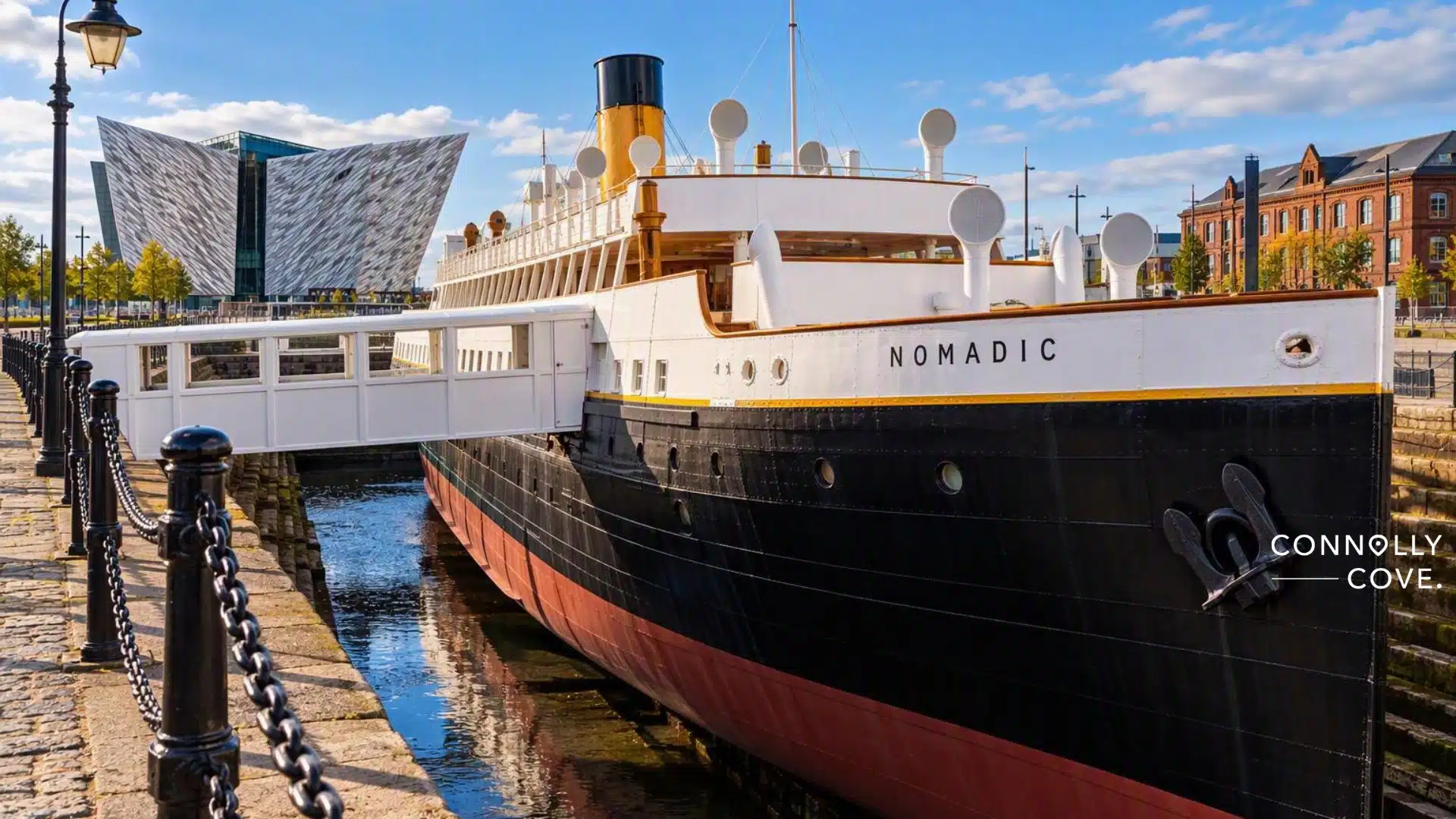
A walking tour of SS Nomadic in Belfast takes you aboard the last surviving White Star Line vessel, a small tender that ferried passengers out to RMS Titanic at Cherbourg in April 1912. She sits in Hamilton Dock in the Titanic Quarter, around half an hour on foot from City Hall.
ConnollyCove, the Ireland-based travel and culture platform founded by Ciaran Connolly, has walked and filmed this stretch of the Belfast waterfront many times. Arriving on foot shows you the shipyard setting long before you reach the gangway.
This guide covers the ship’s history, a step-by-step route from the city centre, a deck-by-deck tour on board, her years in Paris and the practical details for your visit. Five common visitor questions are answered at the end.
Table of Contents
The Story Behind SS Nomadic
SS Nomadic was built in Belfast in 1911 to carry passengers between the quay at Cherbourg and the large White Star liners anchored offshore. Her history explains much of what you see on board, so a little background makes the walk far more rewarding.
Built on Queen’s Island in 1911
Harland and Wolff laid down SS Nomadic’s keel in 1910 and launched her from slip number one at Queen’s Island on 25 April 1911, according to the National Historic Ships UK register. Olympic was built on the neighbouring slip, with Titanic on the third, so the tender and the liners she would serve took shape side by side.
After her launch, Nomadic was fitted out in the Hamilton Graving Dock and handed over to the White Star Line on 27 May 1911. Shipbuilding defined east Belfast for generations, and ConnollyCove’s account of the fascinating history of Belfast traces how Queen’s Island shaped the wider city.
Carrying Titanic’s Passengers at Cherbourg
The harbour at Cherbourg was too small for the new Olympic class liners, so White Star stationed two tenders there. Nomadic carried first and second-class passengers, while her running mate, SS Traffic, took third-class passengers and mail.
SS Nomadic arrived at Cherbourg on 3 June 1911 and worked alongside Olympic for almost a year before Titanic’s maiden voyage. On the evening of 10 April 1912, she carried Titanic’s Cherbourg first and second-class passengers out to the liner, among them Margaret “Molly” Brown and Benjamin Guggenheim.
Several of those travellers became part of the most retold stories of the disaster. ConnollyCove’s profile of the heroes of the Titanic follows what happened to passengers and crew after they left the tender behind.
A Tender Rather Than a Sister Ship
SS Nomadic is often called Titanic’s little sister, and the nickname appears on signs and souvenirs across the Titanic Quarter. Strictly speaking, the sister ships were Olympic, Titanic and Britannic, the three liners of the same class, while Nomadic was a tender built to serve them.
The confusion is understandable, because Harland and Wolff gave her interiors that echoed the liners in style and finish. Seafaring stories tend to grow in the retelling, as ConnollyCove’s guide to the mythology of the sea shows, and the “little sister” label is a gentle example of that habit.
You may also hear the well-worn Belfast quip about Titanic, “she was alright when she left here”, which locals use with a mix of pride and dark humour. SS Nomadic gives that pride something solid to stand on, as she is a Belfast-built White Star ship that came through more than a century intact.
Walking from the City Centre to Hamilton Dock
The walk from Belfast City Hall to SS Nomadic covers roughly 2.5 kilometres (about 1.5 miles) on flat, paved paths, and most people complete it in 30 to 40 minutes. The route follows the River Lagan past several waterfront landmarks, so allow extra time if you like to stop for photographs. The table below gives approximate walking times for each stage of the route.
| Stage | Approximate time from previous stop | What to look for |
|---|---|---|
| City Hall or St George’s Market | Starting point | Donegall Square, or the Victorian market hall on Oxford Street |
| Custom House Square and Donegall Quay | 10 to 15 minutes | Charles Lanyon’s Custom House and the river frontage |
| The Big Fish and Lagan Weir footbridge | 5 minutes | The ceramic salmon sculpture and views downriver |
| Queen’s Quay and the Abercorn Basin | 10 minutes | The Odyssey complex and the first views of the Titanic Quarter |
| Hamilton Graving Dock | 5 to 10 minutes | Nomadic’s hull, the dock walls and the caisson gate |
Starting at City Hall or St George’s Market
City Hall in Donegall Square is the easiest place to begin, since most bus routes and city-centre hotels are within a few minutes of it. From the front of the building, head east along Chichester Street towards the river, then turn left onto Oxford Street.
If you are walking on a Friday, Saturday or Sunday, St George’s Market on Oxford Street makes a good alternative start and a place to pick up food for the day. ConnollyCove’s guide to St George’s Market in Belfast covers its stalls and opening days.
Many Belfast market stalls and cafés sell Irish wheaten bread, the brown soda loaf that is a staple across Northern Ireland. A buttered slice is an easy snack to carry for the walk ahead.
Crossing the Lagan at the Big Fish
Follow Oxford Street north to Queen’s Square and Custom House Square, then cut through to Donegall Quay on the riverbank. Custom House, completed in the 1850s to a design by Charles Lanyon, is one of the finest buildings on the route, and ConnollyCove’s architectural guide to Victorian Belfast explains its background.
A short way along the quay, the Big Fish stands beside the Lagan Weir footbridge. John Kindness created the ten-metre ceramic salmon in 1999, and its tiles carry printed images and text drawn from Belfast’s past.
The sculpture features among the must-see Belfast sights for first-time visitors, and it is a natural photo stop. Crossing the footbridge here brings you to Queen’s Quay on the east bank of the Lagan.
Arriving at Hamilton Graving Dock
From Queen’s Quay, follow the waterfront path around the Abercorn Basin past the Odyssey complex until you reach Queen’s Road. Hamilton Graving Dock lies beside the road, a short walk from Titanic Belfast, and Nomadic rests inside it on blocks. If you would rather shorten the walk, Titanic Quarter railway station is only a few minutes away and is served by trains from the city centre.
The dock dates from the Victorian era and was restored alongside the ship from 2009 onwards. Since SS Nomadic was fitted out in this same dock in 1911, her return here has a real sense of homecoming that visitors often remark on.
You can view the hull, the dock walls and the caisson gate that once sealed the dock from the basin from the public quayside without a ticket. That free view also makes a pleasant stop on one of ConnollyCove’s budget date ideas in Belfast.
Deck by Deck on Board

Once on board, the self-guided walking tour of SS Nomadic follows her four working decks, and the layout still reflects the strict class divisions of 1911. The order below moves from the passenger lounges up to the bridge and crew space, which suits most visitors.
First-Class Lounges at the Bow
First-class passengers occupied the forward areas of the passenger decks, and the restored first-class lounges show the decorative joinery and plasterwork that set SS Nomadic apart from ordinary tenders of her day. Cushioned benches, tables and porcelain water fountains gave wealthy travellers a taste of the liner before they reached it. The restored first-class lavatories, with their period fittings, are another detail that visitors often single out.
The woodwork came from Harland and Wolff, the firm fitting out Olympic and Titanic at the same time, and its quality is easy to appreciate up close. Anyone curious about the skills behind it can follow that thread through the guide to Northern Ireland heritage crafts.
Second Class and the Third-Class Overflow
Second-class passengers used the aft areas of the ship, with simpler finishes and fewer comforts. Some visitors find the difference less dramatic than they expected, which says a great deal about how well the whole vessel was finished.
At the aft end of the lower deck, a small area was set aside for third-class passengers whenever SS Traffic was full. Many of the passengers who crossed these decks in 1911 and 1912 were bound for New York, so for North American visitors with emigrant ancestors, SS Nomadic offers a rare physical link to that crossing. This careful separation by ticket class mirrors the social order of the city that built her, a theme explored further in this look at Belfast’s history and origins.
The Bridge, Flying Bridge and Crew Space
The bridge deck and the open flying bridge above it give the best outlook on board, across the Abercorn Basin and, on a clear day, towards the yellow Harland and Wolff cranes, Samson and Goliath. The crew space below, with its bunks and hammocks, shows how little room the deckhands had.
Because Nomadic rarely strayed far from shore, those bunks were probably used mainly by the night watch. Children usually enjoy this part of the ship most, and the guide to things to do in Belfast for kids suggests other family stops nearby.
From Paris to a Belfast Homecoming
SS Nomadic’s working life lasted 57 years, and the decades that followed nearly ended in a scrapyard. Her survival depended on a long effort by people in France and Northern Ireland who recognised what she represented.
Service through Two World Wars
The French government requisitioned SS Nomadic during the First World War, and until 1919 she served as an auxiliary minesweeper and patrol vessel while also ferrying American troops in and out of the harbour at Brest. She went back to Cherbourg afterwards, and in 1927 White Star sold her to the Compagnie Cherbourgeoise de Transbordement.
Renamed Ingénieur Minard in 1934, she took part in the evacuation of Cherbourg on 18 June 1940. After the war she returned to tendering for liners such as the Queen Mary and Queen Elizabeth until her retirement on 4 November 1968, while her twin, SS Traffic, did not survive the conflict.
Nomadic’s war years sit within a much larger European story of loss and change. ConnollyCove’s article on the impact of the Second World War on art and culture gives wider context for the period.
A Floating Restaurant beside the Eiffel Tower
After five years laid up, the ship took back the name Nomadic and was converted into a floating restaurant and function venue. She arrived in Paris on 17 October 1974 and moored on the Seine opposite the Eiffel Tower, hosting diners and private events on decks where Titanic passengers had once waited with their luggage.
The business was in difficulty by 1999, and the Paris harbour authorities seized the ship in 2002 before towing her to Le Havre that April. If her French chapter sparks an interest in the city, ConnollyCove’s guide to the top things to do in Paris is a good place to start planning.
Auction, Rescue and Restoration
A first auction attracted no bids, and scrapping looked likely until a second sale in Paris on 26 January 2006. The Department for Social Development in Northern Ireland bought her for €250,001, one euro above the reserve price, and she was carried back to Belfast on a barge that July.
A charitable trust was set up to look after her, and in 2009 she moved into Hamilton Dock for a conservation programme that restored her interiors before she opened to visitors. The project formed part of a wider effort to protect Northern Ireland’s built and maritime heritage, work shared by bodies such as those in ConnollyCove’s guide to the National Trust in Northern Ireland.
Planning Your Visit

A little planning makes the day easier, as SS Nomadic keeps shorter hours than Titanic Belfast and some parts of the ship have limited access. The details below reflect current arrangements, but check the Titanic Belfast website before travelling, since times and prices change with the seasons.
Tickets, Opening Times and Seasons
Entry to SS Nomadic is included with a standard Titanic Experience ticket, so there is no separate ticket to buy. Several ticket sellers state that the Nomadic part of the ticket can be used on the day of your Titanic Experience visit or the following day, and that the ship occasionally closes for private functions. Hand-held multimedia guides are available for the Titanic Experience at £5, which adds useful background before you board SS Nomadic.
Nomadic opens for reduced hours in line with Titanic Belfast’s seasonal schedule. Summer weekends and school holidays are usually the busiest periods, so a weekday morning tends to be quieter, and the open top deck may close in heavy rain.
Couples turning the visit into a longer break can pair it with ideas from this guide to things to do in Northern Ireland for couples. Spring and early autumn offer milder walking weather with fewer crowds along the waterfront.
Accessibility and Time Needed
SS Nomadic and Hamilton Dock have disabled access, but the flying bridge deck and the crew space cannot be reached by wheelchair users, and other areas may be difficult for anyone with limited mobility. Titanic Belfast’s accessibility team and the AccessAble guide for the ship give full details.
Most visitors spend 45 minutes to an hour on board, so allow around two hours for the walk from City Hall and the ship together. A coffee stop afterwards is easy to arrange, and this round-up of cafés in Belfast lists options back in the city centre.
What to See Nearby Afterwards
Titanic Belfast stands a short walk from the dock, and the Titanic Slipways beside it mark where Olympic and Titanic were built. The Titanic Hotel occupies the former Harland and Wolff headquarters and drawing offices, where Titanic was designed.
HMS Caroline, a First World War light cruiser, and the Titanic Dock and Pump House sit a little further along the Maritime Mile if you still have energy. On the way back, the Odyssey complex offers an arena, cinema and restaurants, which suits families after a morning of maritime history.
Plan Your Walk to SS Nomadic
A walking tour of SS Nomadic links Belfast’s city centre with the dock where the last White Star Line vessel was finished in 1911, and the whole outing fits comfortably into a morning. Book your Titanic Experience ticket, start at City Hall and take the riverside route at your own pace. For more ideas, explore ConnollyCove’s Northern Ireland travel guide or watch the ConnollyCove YouTube channel for video walks along the Belfast waterfront and beyond.
FAQs
Can You Go on Board SS Nomadic?
Yes, visitors can walk through the restored passenger lounges, the bridge areas and the crew space. Most people combine the ship with Titanic Belfast, which ConnollyCove covers in its guide to Belfast’s murals and museums.
Is SS Nomadic Included in the Titanic Belfast Ticket?
Yes, a standard Titanic Experience ticket includes entry to SS Nomadic. Many visitors book a morning slot and then head to one of the best places for brunch in Belfast.
How Long Does a Visit to SS Nomadic Take?
Plan on 45 minutes to an hour on board, plus 30 to 40 minutes each way if you walk from City Hall. That still leaves time for lunch at Common Market Belfast back in the city centre.
Is SS Nomadic Wheelchair Accessible?
Partly, as the ship and dock have disabled access, but the flying bridge deck and crew space are not reachable by wheelchair. The guide to fun things to do in Northern Ireland suggests further days out to add to your trip.
Can You See SS Nomadic without a Ticket?
Yes, the public quayside around Hamilton Dock gives a clear view of the hull and the dock at no cost. It is a good photo spot for anyone who enjoys the ghost ships and maritime mysteries side of seafaring history.