


Yellowstone National Park: 10 More Amazing Things to See
Updated On: April 16, 2024 by  Courtney Augello
Yellowstone National Park is famous worldwide for its stunning beauty. Founded in 1872, it is the most popular national park in the USA for locals and tourists alike.
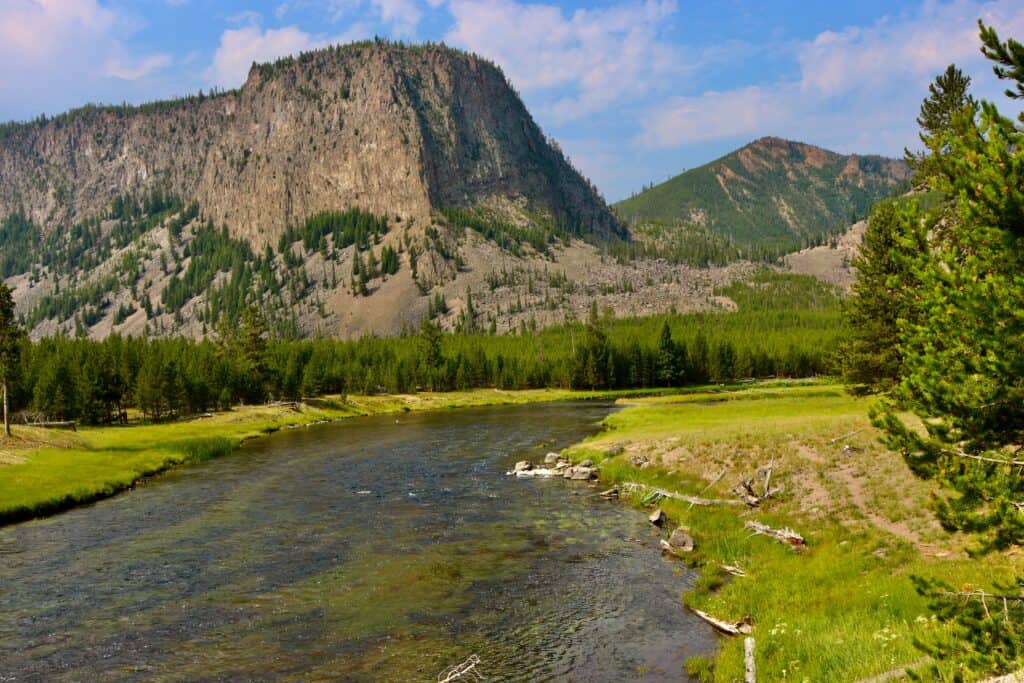
While many people focus on the most popular attractions at Yellowstone National Park, the less visited areas are still worth seeing! In addition to the excellent views, lesser-known attractions are also less crowded, which can make the experience more enjoyable.
To help make your trip to Yellowstone National Park the best it can be, we’ve put together a list of 10 more areas to visit that may be less crowded than the main attractions at the park.
Table of Contents
1. Upper Geyser Basin & Morning Glory Pool
Home to Yellowstone National Park’s most popular attraction, Old Faithful, the Upper Geyser Basin is a must-see attraction. The basin is home to a quarter of Earth’s geysers and features many walking paths for guests to explore.
Unlike the crowded area around Old Faithful, the rest of the Upper Geyser Basin is quieter. Not many visitors choose to walk the entire length of the paths, making this a great place to relax and feel alone with nature.
If you want to see the geysers in the area erupt, predicted eruption times are listed at the Old Faithful visitor center. Although they are not as predictable as Old Faithful, the geysers are just as fascinating to see!
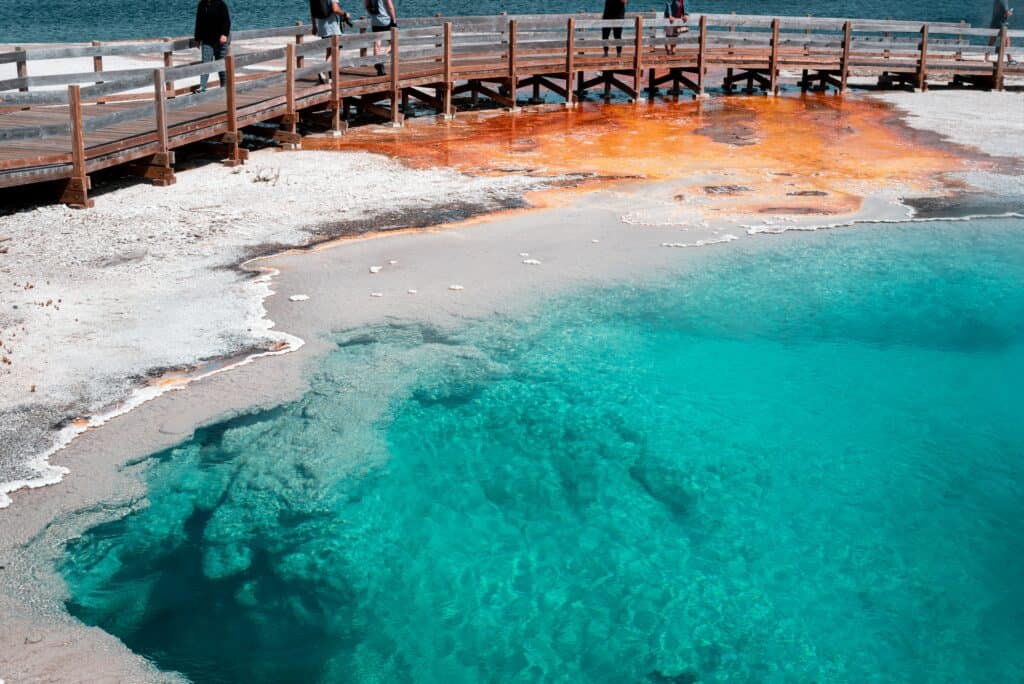
One of the best features of the Upper Geyser Basin is the Morning Glory Pool. This hot spring is known for its stunning colours. On rare occasions, the spring has erupted due to seismic activity in the area.
If you decide to explore the Upper Geyser Basin, make sure to respect the geysers and surrounding nature of Yellowstone National Park. Due to tourists throwing coins, towels, and other objects into the Morning Glory Pool, the bacteria that colour the water has begun to die and lose their colour. It is said that if this continues, Morning Glory will turn into Faded Glory.
2. Yellowstone Grand Loop Road
Yellowstone Grand Loop Road is the main roadway of the park. It is a scenic loop that passes through all of the park’s major attractions. The road is laid out in a figure-8 shape and is about 230 kilometres long. The road was created during the park’s early days while it was still under U.S. military control.
It can take anywhere from 4 to 8 hours to drive along the entire Yellowstone Grand Loop Road. Although this can be done in one day, there are too many stops to make and attractions to see for anyone to get through it all in one visit. Instead, completing the drive over 2 or 3 days is better.
Not only does Yellowstone Grand Loop Road feature the most popular attractions of the park, but the drive itself is fascinating to see! The loop takes you through the park’s beautiful nature, with mountains, valleys, plains, and forests to observe. It is a perfect way to see all of what Yellowstone National Park has to offer.
3. Lamar Valley
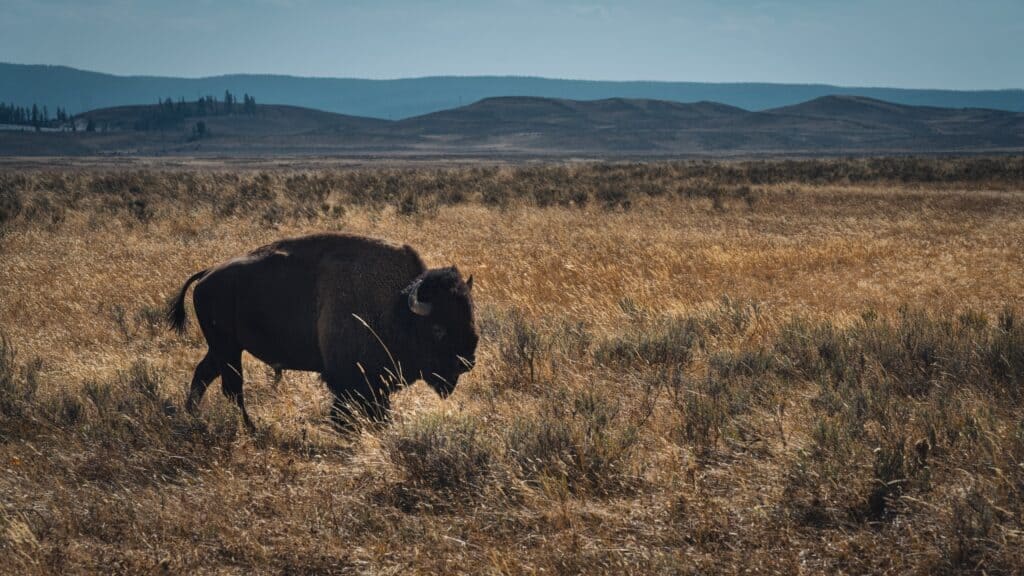
One of the best things about Yellowstone National Park is the wildlife that calls it home. Driving through Lamar Valley gives guests some of the best chances to see animals roaming the area.
It is very common to see hundreds or thousands of bison freely roaming Yellowstone’s plains. In addition to bison, guests have also seen bears, wolves, elk, deer, and coyotes in Lamar Valley. To have the greatest chance of seeing the wildlife, arrive at Yellowstone National Park in the morning or early afternoon. This is when the animals are most active.
Although Lamar Valley is beautiful and a wonderful area to visit at Yellowstone National Park, it is not as popular and busy as other areas. This is due to the valley’s remote location. Lamar Valley is located about 100 kilometres away from the Old Faithful Geyser area.
It takes roughly 2 hours by car to reach Lamar Valley, not including any stops along the way or time waiting for bison to cross the road. But if you have the time, it is worth seeing for its spectacular landscapes and wildlife!
This part of Yellowstone National Park is often referred to as the Serengeti of North America. The plains remind guests of African savannas that slowly morph into tall mountains as the road continues past Lamar Valley.
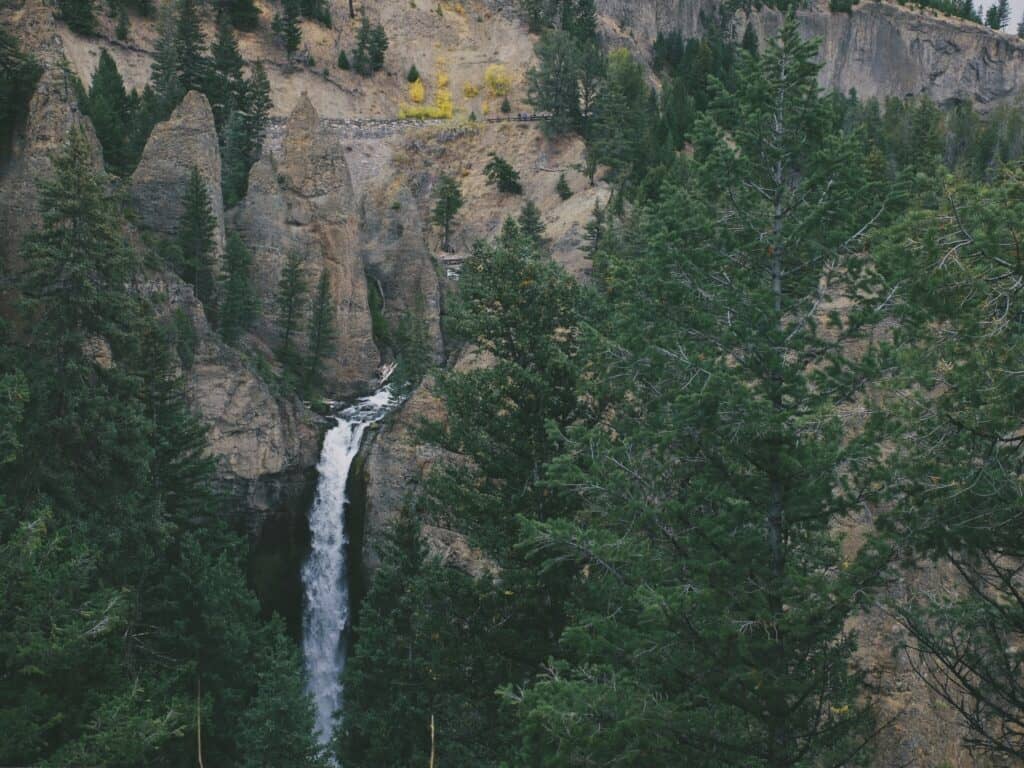
4. Fairy Falls
Fairy Falls is one of the tallest waterfalls at Yellowstone National Park. It is over 60 metres tall and flows during the spring and summer months. Fairy Falls is known best for the easy hike that leads to its base.
There are 2 trail options for visitors that want to see Fairy Falls. The first path is an easy 8.7-kilometre trail from the Fairy Falls parking lot. The second option is a 16-kilometre hike from Fountain Flat Drive.
Both trails lead through a forested area where wildlife are often seen roaming. Although the paths are covered by shade, it is still important to bring water and snacks since the trails are longer than many others at Yellowstone.
5. Norris Geyser Basin
Although it is not as impressive as other geyser basins at Yellowstone National Park, Norris Geyser Basin is still a great area to visit. It is the hottest geyser basin at the park, and if you have time after seeing the main attractions, it is a must-see.
The Norris Geyser Basin is made of 2 sections: the Porcelain Basin and the Black Basin. The Porcelain Basin is a dry, barren area with no shade. Here, boardwalk paths provide trails to the steaming vents and geysers. The Porcelain Basin is also home to many colourful hot springs.
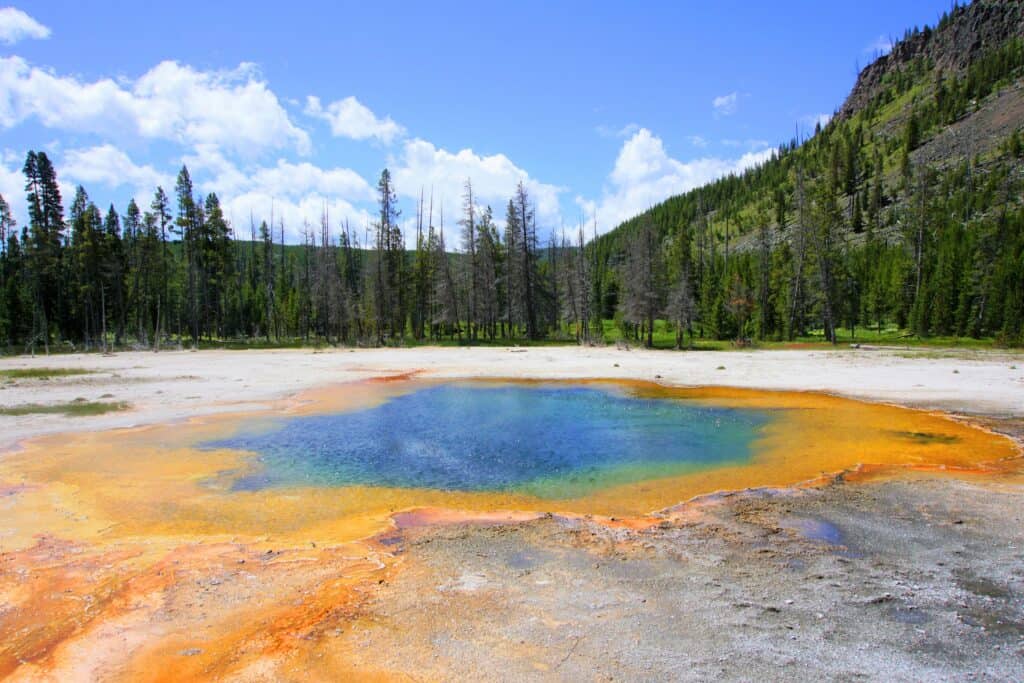
Yellowstone’s Black Basin is a completely different experience than the adjacent Porcelain Basin. The Black Basin is located in a pine forest full of life and covered in shade from the trees.
The highlight of the Black Basin is Steamboat Geyser, the largest active geyser in the world. Although it has not had a major eruption since the early 1990s, it is still active and often shoots water over 12 metres in the air.
The Black Basin trail is nearly 3 kilometres long, less visited than the 1.7-kilometre trail at the Porcelain Basin. The entire Norris Geyser Basin can take half a day to explore if you want to see it all. It is a fantastic area to visit and one of the most beautiful sights at Yellowstone National Park.
6. Mammoth Hot Springs
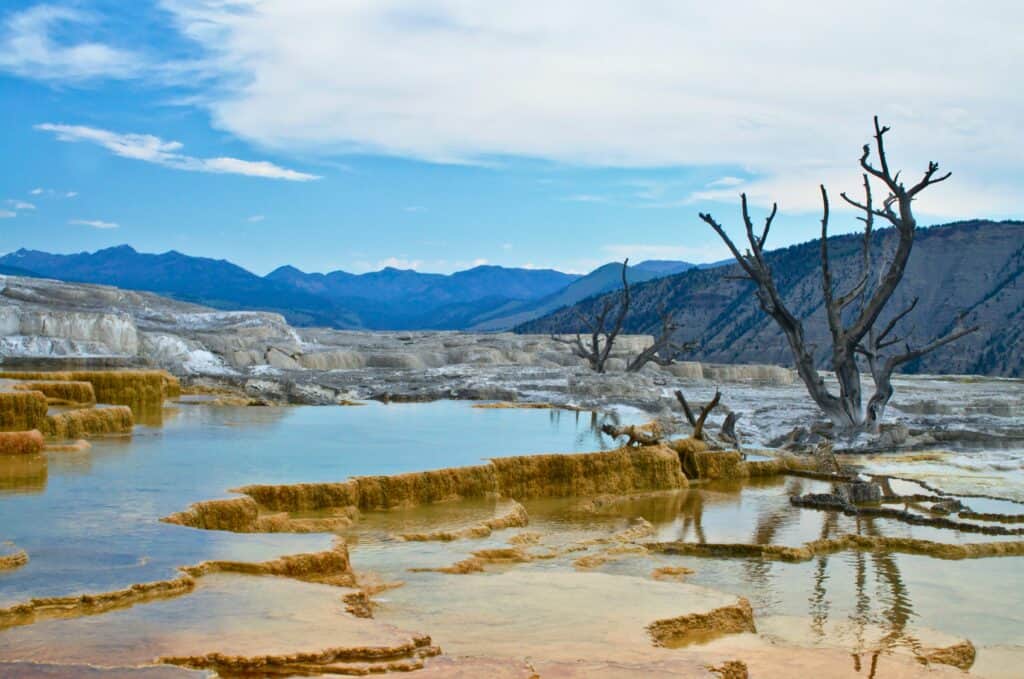
The Mammoth Hot Springs is a breathtakingly unique area in Yellowstone National Park. The thermal features are different from any others in the park, and the area is small enough to hike in less than 2 hours. However, there is no shade at the Mammoth Hot Springs, and it can get very hot. Make sure to dress appropriately, wear sun protection, and drink water when visiting!
Yellowstone’s Mammoth Hot Springs consists of 2 areas: Mammoth Lower Terraces and Mammoth Upper Terraces. Each area has a number of hot springs and dry terraces to admire. The algae in the pools create orange, red, and brown colours in the water.
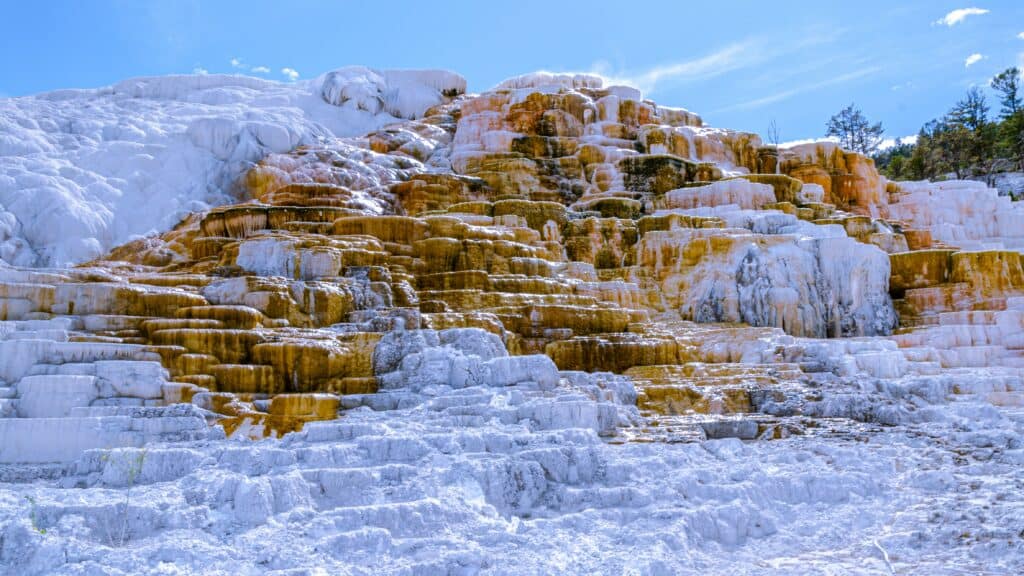
If you are not interested in hiking around the paths at Mammoth Hot Springs, there is also a road that leads through the area. Simply drive through the springs and make stops to get out and explore when you reach the key attractions. Whether on foot or by car, this is one of the most stunning places at Yellowstone National Park.
7. Old Faithful Inn
Recognised as a National Historic Landmark, the Old Faithful Inn is the largest log structure in the world. The inn was built in 1903 and is one of the oldest lodges at Yellowstone National Park.
The interior of the inn is stunning. The log lobby features an incredible 26-metre-tall stone fireplace and rustic decor. When the Old Faithful Inn first opened at Yellowstone, it prided itself on offering steam heating and electric lights. Today, it is a wonderful look into the past for guests and visitors.
The inn was voted in the top 50 favourite buildings in the USA in 2007 and is a popular tourist attraction at Yellowstone National Park. Old Faithful Inn has multiple restaurants and dining rooms for visitors, and free tours of the inn are offered multiple times daily.
8. Grizzly & Wolf Discovery Center
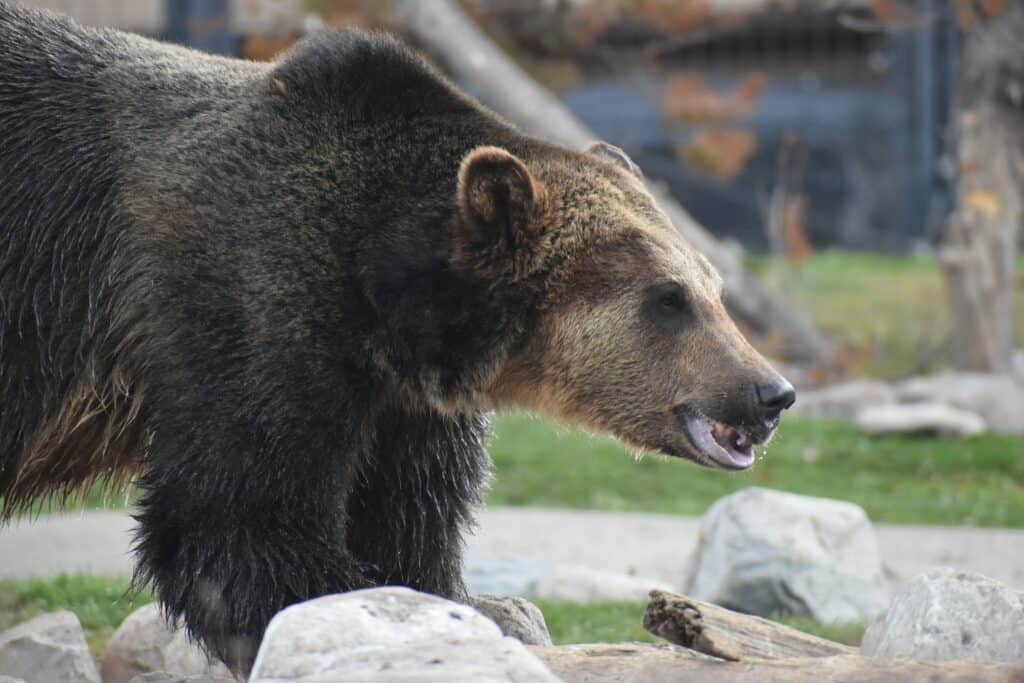
If you are interested in seeing bears and wolves at Yellowstone National Park, the Grizzly & Wolf Discovery Center is a perfect place to visit. Here, bears and wolves from local and faraway areas are kept in a safe environment.
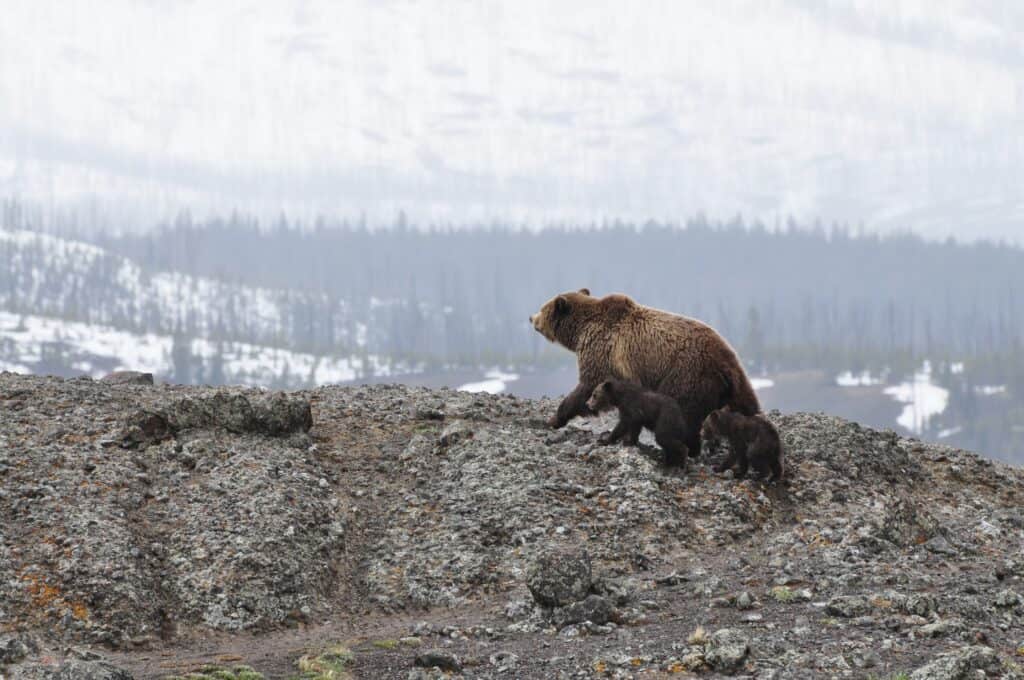
The animals at the Discovery Center were rescued and could not survive in the wild. The centre prides itself on providing an educational experience for guests and also giving these animals a second chance at life.
The Grizzly & Wolf Discovery Center is located near the west entrance of Yellowstone National Park. It is open 365 days a year, making it the only place at Yellowstone to see bears in the winter months since the bears at the center do not hibernate.
There are currently 7 bears at the Grizzly & Wolf Discovery Center. Each bear has a name, details about their history, how they arrived at Yellowstone, and other information available for guests to learn about.
Wolves, squirrels, birds, and otters can also be found at the Grizzly & Wolf Discovery Center. Each animal is available for guests to “adopt” by providing a monetary donation to the center. The donations help the non-profit organisation provide care for the animals.
Yellowstone National Park’s Grizzly & Wolf Discovery Center is a great place for adults and children alike to learn more about the wildlife that calls the park home.
9. West Thumb Geyser Basin
Although the West Thumb Geyser Basin is one of the smallest geothermal sites at Yellowstone National Park, it is definitely worth visiting! The basin is located on Yellowstone Lake’s western coast, near the South Entrance.
The trail around the West Thumb Geyser Basin is just over 1 kilometre long. It is an easy hike, and the path is wheelchair accessible. The path follows the shoreline of Yellowstone Lake and passes by several interesting thermal features.
Wildlife is commonly seen in this area of Yellowstone National Park. Bison, bears, and elk freely roam the area around the paths. If you want to see the wildlife, it is best to visit the West Thumb Geyser Basin in the morning or early afternoon.
One of the most popular attractions at the West Thumb Geyser Basin is the Abyss Pool. The Abyss Pool is the deepest hydrothermal pool at Yellowstone National Park. It typically takes 30 minutes to an hour to walk the trail around the West Thumb Geyser Basin.
If you are interested in walking further, the Duck Lake and Lake Overlook trails are very close to the West Thumb Geyser Basin. These paths are a great way to explore Yellowstone’s scenery.
10. Boiling River
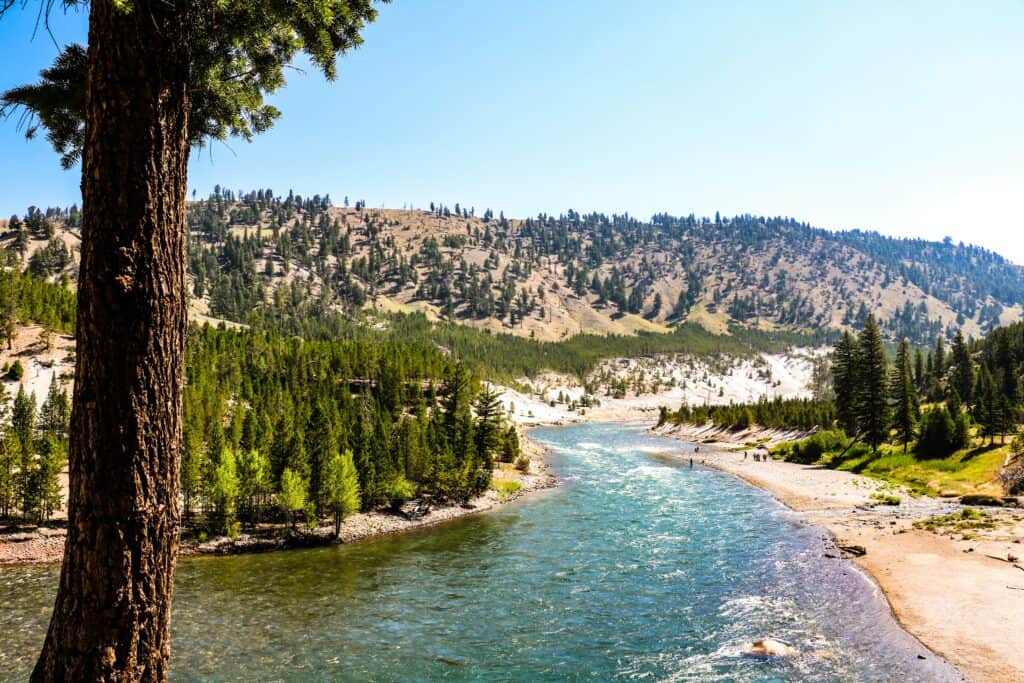
Yellowstone’s Boiling River is a unique feature of the park that lets you interact with the area. It is created by a large hot spring entering the river, turning the water into a natural hot tub! The mix of cold and hot water makes this area the perfect place to relax and experience nature at Yellowstone National Park.
There are very few areas where swimming is allowed at Yellowstone National Park. This is because of health risks from water temperatures; hot springs are too warm to swim in, and other bodies of water are so cold that there is a hypothermia risk.
Most visitors spend an hour at the Boiling River, but it is easy to spend half a day or more enjoying the relaxing waters. The Boiling River may be closed during the spring due to melting snow, so be sure to check before visiting.
The Boiling River is located in Northern Yellowstone. The parking area has bathrooms available for guests to change into swimsuits before jumping into the river. It is a great place to end your day at Yellowstone after hiking and exploring the attractions.
Yellowstone National Park is a Great Place to Explore
Crowds from around the world have flocked to Yellowstone National Park since opening day. From geysers and basins to the large herds of wildlife roaming the area, Yellowstone is a must-visit destination for everyone.
Whether you’re looking for a relaxing day in the natural hot tub or want to take a long hike to a waterfall, Yellowstone is best experienced without massive crowds surrounding you. By visiting these lesser-known areas and attractions, you can get a better view of the springs and feel more in tune with nature.
If you are planning a trip to Yellowstone National Park, check out our list of another 6 Beautiful Things to See at Yellowstone.
Unveiling the Most Terrifying Haunted Tours in Scotland
Scotland
25/04/2024

7 Top Amusement Parks in England for an Unforgettable Adventure
England
25/04/2024

Miami Tourism Statistics: A Comprehensive Overview of Visitor Numbers and Revenue
Travel Statistics
25/04/2024

The Enchanting Charm of Scotland Wedding Castles!
Scotland
25/04/2024
London in June: An Ultimate Guide to 13 Unmissable Events and Festivals
United Kingdom
25/04/2024