
Article Summary
What this article covers: The history of Castle Saunderson near Belturbet in County Cavan, from the O’Reilly lordship of East Breifne through the Plantation of Ulster and the 1840 Tudor-Revival mansion, alongside practical information on visiting the demesne and the international scout centre in its grounds.
Who this is for: Travellers exploring County Cavan and the Fermanagh lakelands, readers with Ulster-Scots or Gaelic ancestry in the border counties, and anyone researching Ireland’s ruined country houses before planning a visit.
Key takeaway: The mansion itself is a fire-gutted ruin you cannot go inside, but the demesne around it is walkable, and its position straddling the Cavan-Fermanagh border makes it one of the few Irish estates with entrances in two jurisdictions.
Expert insight: “I remember standing where the Finn narrows into Upper Lough Erne and realising the border runs right through this estate. You can walk from one jurisdiction to another in a few minutes here, past a burnt-out mansion, and end up at a campsite full of teenagers from a dozen countries. Cavan does that to you. Nowhere else in Ireland packs that much contradiction into 103 acres.” , Ciaran Connolly, Founder of ConnollyCove
Quick facts:
- Castle Saunderson sits about five kilometres from Belturbet, County Cavan, roughly half a mile west of Wattlebridge in County Fermanagh
- The estate now covers around 103 acres, with the scout centre occupying 34 acres of that ground
- James II’s troops burned the earlier castle on this site in 1689, during the Williamite wars
Table of Contents
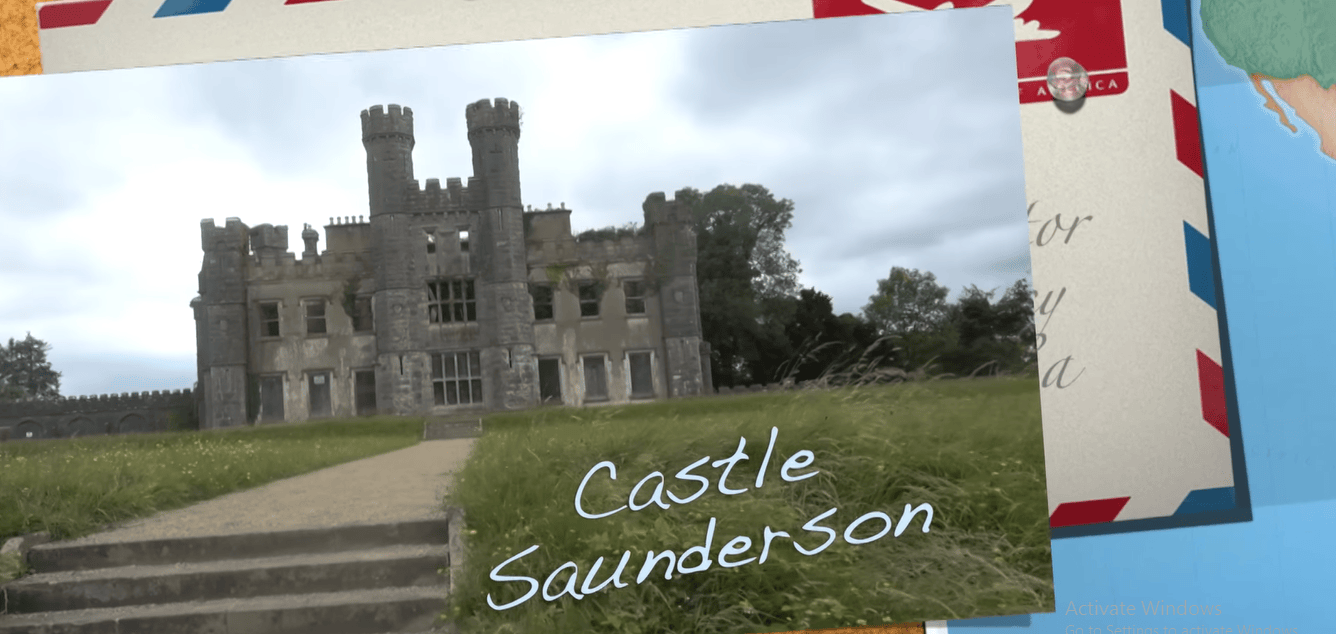
Castle Saunderson is not the tourable stately home that most travel listings suggest. Drive the five kilometres out from Belturbet along the N54 and what you find is a large castellated shell. Its interior was destroyed by fire in the 1990s. It stands in woodland at the point where the Finn River slips into a narrow channel of Upper Lough Erne. Around it: a Victorian church with a family crypt, a graveyard, mixed woodland, and a modern scout campus that hosts young people from across the world.
That combination is what makes the place worth the detour. County Cavan has grander ruins and better-known lakes, and ConnollyCove’s wider guide to the Lakeland county covers plenty of them. What this estate has instead is a compressed version of Ulster’s whole story on one site. A Gaelic lordship dispossessed. A Scottish grantee installed, a house burned in 1689 and rebuilt twice, a Unionist political dynasty, then decline, fire, and a cross-border peace project. This guide walks through that history and then tells you what you can actually see and do when you get there.
What Is Castle Saunderson and Can You Visit It?
Castle Saunderson is a ruined nineteenth-century mansion near Belturbet in County Cavan, and yes, you can visit the grounds, though not the building’s interior. The mansion is structurally unsafe and stands as a shell. The demesne around it is accessible, including woodland paths, the Saunderson church and the family graveyard. The international scout centre on the grounds operates a campsite and indoor accommodation.
ConnollyCove is an Ireland-based travel and culture platform, and we set expectations plainly on sites like this one. It’s a ruin in a wood, not a visitor attraction with a ticket desk and a gift shop. Travellers who arrive expecting guided tours of furnished rooms leave disappointed; travellers who arrive expecting an atmospheric walk with a serious history attached tend not to.
| Location | Castlesaunderson Demesne, near Belturbet, County Cavan |
| Nearest road | N54, roughly 5 km from Belturbet |
| Estate size | About 103 acres |
| Scout centre site | 34 acres (14 hectares) |
| Building status | Ruined; interior destroyed by fire, no interior access |
| On the grounds | Woodland walks, Saunderson church, family crypt and graveyard, campsite |
| Jurisdictions | Entrances in both the Republic of Ireland and Northern Ireland |
One spelling note before you search for it. The townland and demesne name runs together as “Castlesaunderson”, and that one-word form is how a fair number of people look the place up. Maps, road signs and older records use both.
From Breffni Castle to the Saundersons
The estate’s earliest recorded castle belonged to the O’Reillys, the Gaelic lords of East Breifne, and was known as Breffni Castle from the fourteenth century. The Saunderson family acquired it during the Plantation of Ulster, the early seventeenth-century scheme that transferred confiscated Gaelic land to English and Scottish settlers. That transfer is the hinge on which everything else here turns.
The O’Reillys of East Breifne
East Breifne, roughly the territory that became County Cavan, was O’Reilly country for centuries. The surname remains one of the most common in the county. Their power was broken by the Plantation. Physical evidence of the earlier Gaelic and Norman order survives elsewhere in Cavan rather than here. Clough Oughter Castle, out on its island in Lough Oughter, is the county’s best example, and it’s reachable only by boat.
Robert Sanderson and the Burning of 1689
Alexander Sanderson of Scotland was made a Denizen of Ireland in 1613 and served as High Sheriff of County Tyrone from 1622. He was granted around 1,000 acres, including Tullylagan in County Tyrone, erected into the manor of Sanderson in 1630. He died in 1633 leaving three sons; the second settled at Portagh, and the Cavan seat descends from that branch.
Robert Sanderson inherited the castle from his father in 1676 and fought on the side of William of Orange. In 1689 James II’s troops burned the castle. That single event is why nothing above ground here is medieval, and it also places the estate directly inside the Williamite-Jacobite war that reshaped Ulster. The same conflict wrecked Castle Archdale across the water in Fermanagh that year. ConnollyCove’s guide to things you shouldn’t miss in County Fermanagh traces the pattern across the lakelands.
Later generations changed the spelling. Francis served as High Sheriff of County Cavan in 1740, and it was his son Alexander who adopted the “Saunderson” form the family kept afterwards. In the nineteenth century Edward James Saunderson became a leader of the Irish Unionist Party, which turned the house into a node of political as well as landed power.
The 1840 Mansion and the Crom Castle Connection
The building you see today is a large castellated mansion combining baronial and Tudor-Revival elements. The bulk of its fabric dates from around 1840, grafted onto an earlier house. That grafting shows. The exterior mixes bare stonework and stucco in a way that reads as unresolved rather than designed, which is one of the more honest things about the place.
Sources disagree on the earlier phases. One account has Francis Saunderson building the core around 1779. Another dates a substantial remodelling to 1835. The Landed Estates record has Robert Sanderson building a house here in the mid-seventeenth century, and one antiquarian source gives 1573 for an original castle. Treat the 1840 date as the reliable one for what stands and the rest as contested. The architectural detail is easier to pin down, and ConnollyCove’s overview of the architecture of Irish castles sets the style in its wider context.
The Entrance Front
The entrance front is symmetrical, with a battlemented parapet, square-headed openings and turrets. A tall central gatehouse tower carries its entrance door to the side, which is unusual and the first thing an architectural eye tends to catch. The adjoining garden front is more irregular, and the house carries several Gothic features, the conservatory among them.
Sudden, Blore and the Five Miles to Crom
Crom Castle in County Fermanagh sits about five miles away. The resemblance is close enough that visitors regularly assume one architect designed both. The record is more tangled. The National Inventory attributes the work here to George Sudden, a clerk of works, architect and stonemason active in Fermanagh and Monaghan through the 1830s and 1840s. Crom Castle itself was designed by Edward Blore of London between 1833 and 1841. When the newly finished Crom burned in 1830, Sudden was appointed to rebuild it to Blore’s specifications. It has been suggested that Blore had some input on this house too, though the design is less polished than his other work.
So the honest version is this: the two houses share a builder and possibly a designer’s hand, not a single named architect. Anyone comparing the pair should read the similarity as a working relationship rather than a signature.
Is Castle Saunderson Haunted?
No documented ghost tradition for this estate appears in the published folklore record, despite the stories that circulate online. This is worth stating plainly, because the ruin attracts ghost content and almost none of it cites a source.
Two competing versions turn up. One describes a “White Lady” said to search the grounds for a lost love; another describes a “Grey Lady” said to have died in a twentieth-century fire. Neither names a collector, a parish, an informant or a date, and the two stories contradict each other on the basic facts. Where a genuine local tradition exists, it usually leaves a trace in the National Folklore Collection or in parish material; nothing of that kind has surfaced for this estate. ConnollyCove’s guide to haunted castles in Irish folklore covers sites where the documentation is much stronger.
What the estate does have is real darkness in its record. Troops burned the castle in 1689. Fire took the interior again in the 1990s. There’s a crypt in the churchyard holding Saunderson remains. None of that needs a ghost to be worth walking through at dusk.
The Scout Centre and the Cross-Border Demesne
The international scout centre opened in August 2012 within the grounds, and it’s now the reason most people set foot on the estate. President Michael D. Higgins performed the opening on 18 August 2012, with ministers from both sides of the border present. It was built with substantial European funding through the Peace III programme, and it was conceived as a peace and reconciliation project as much as a campsite.
Scouting Ireland acquired the castle and grounds in 1997. Financial difficulties delayed development for years, and support from the American Ireland Fund and Cavan County Council, followed by the EU funding announced in November 2008, got the project moving.
What’s On the Site
The centre covers 34 acres and includes camping grounds, forest and an indoor hostel and conference building. The campsite can hold over 1,000 campers at once, with serviced drinking water points, access roads for moving equipment, and a toilet and shower block sized for that capacity. Forest shelters the campsite perimeter. Indoor accommodation includes sleeping arrangements, showers, a kitchen and a dining hall.
It’s open to Scouts year-round and to non-Scouts for most of the year. It also functions as a World Scouting Centre alongside a small number of others internationally, the Cairo International Scout Centre among them. Booking is required, and fees change, so check Scouting Ireland’s own centre information rather than relying on figures quoted on travel pages.
Two Jurisdictions, One Estate
The demesne has entrances in both the Republic of Ireland and Northern Ireland, which is the single most unusual practical fact about visiting. The castle stands in County Cavan, so you’re in the Republic and using euro. Wattlebridge, half a mile east, is in County Fermanagh, so you’re in the United Kingdom and using pounds sterling. Speed limits switch from kilometres to miles per hour across the same short drive.
For travellers this means two things. Carry both currencies if you plan to stop in Belturbet and then Newtownbutler. And expect your phone to hop networks, which can matter if you’re relying on it for directions in woodland with patchy signal.
Walking the Estate
Free access to the woodland walks and the Saunderson church is the main draw for casual visitors, and the paths are gentle rather than demanding. Fáilte Ireland funded a heritage trail here, awarding €60,175 to present the estate’s story through interpretative displays, visual art and written interpretation under the name The Castle Trail.
Check the current state of that trail before you count on it. Funding announcements and finished infrastructure are different things, and the interpretation on the ground may be less developed than the plan described. The woodland paths themselves are there regardless.
The church repays the walk, and it’s the detail ConnollyCove would send a reader here for. A family graveyard surrounds it and a crypt below holds Saunderson remains, which makes it the one part of the estate where the family’s presence still feels immediate. The surrounding forest, river frontage and lake access support fishing and water activity. There’s also a wider ambition to restore the Ulster Canal from Upper Lough Erne up to the demesne, approved by government in 2015. If that work completes, arriving here by water becomes a genuine option.
Getting There and When to Go
Belturbet is the practical base, five kilometres away on the N54, and Cavan town, Enniskillen and Clones are all within easy reach by car. There’s no useful public transport to the estate gate itself, so plan on driving or cycling. From Dublin, allow around two hours; from Belfast, around two.
Season by Season
Late spring through early autumn gives the best ground conditions. This is drumlin country with heavy soil and river frontage, so woodland paths hold water after rain, and boots beat trainers from October onwards. May and June bring the longest daylight and the driest average conditions.
Autumn is the strongest season for the woodland itself, with October colour through the mixed planting and the quietest paths of the year. Winter strips the trees back and exposes more of the ruin’s outline, which suits photography, but daylight is short and the ground is at its wettest. Summer weekends are the busiest on the scout side, since the campsite runs at capacity during camping season, so a weekday visit gives you the estate largely to yourself.
Whatever the month, ConnollyCove’s advice for the border counties is the same: pack layers and waterproofs. Weather in the border counties turns fast, and there is limited shelter on the estate beyond the tree cover.
Where to Go Next Around Cavan and Fermanagh
The demesne works best as one stop on a border-country day rather than a destination in itself. The crossing gives you two counties’ worth of options within half an hour.
On the Cavan side, Cavan County Museum at Ballyjamesduff holds the Corleck Head and a reconstructed First World War trench, and covers roughly 6,000 years of the county’s heritage. Clough Oughter Castle and Killykeen Forest Park pair naturally for anyone who wants the Gaelic and Norman layer this site lost in 1689.
Cross into Fermanagh and Enniskillen Castle Museum gives you the Maguire story, the Plantation-era Watergate and a free genealogy centre, which matters if you’re tracing a border-county surname.
Florence Court offers the Georgian country house experience this estate can no longer provide. It’s a short drive from Enniskillen and makes an easy pairing.
The waterways themselves are the region’s real draw. Lough Erne is where the Finn River from this demesne eventually ends up, and ConnollyCove covers the lake system in full.
ConnollyCove’s guide to Irish castles and their history sets out the wider national picture. It traces the pattern of Plantation building, decline and reuse that this estate follows almost exactly.
Our roundup of legendary castles across Ireland covers the ruins worth a detour elsewhere in the country.
There’s more to see across the border county too, gathered in ConnollyCove’s guide to things to do in Fermanagh.
Frequently Asked Questions
Can you visit Castle Saunderson?
Yes, the grounds are accessible, but you cannot go inside the mansion. The building is a fire-damaged ruin and structurally unsafe. Visitors can walk the woodland paths, reach the Saunderson church and see the family graveyard and crypt, and the exterior of the ruin is visible from the estate paths. The international scout centre operates separately on the same estate and requires booking for camping or indoor accommodation.
Who owns Castle Saunderson now?
Scouting Ireland acquired the castle and its grounds in 1997 and remains the owner. The organisation developed the international scout centre within the demesne, opening it in August 2012. The Saunderson family held the property until 1977, when Alexander Saunderson, the last of the family to live there, sold it to a London-based businessman.
Is Castle Saunderson haunted?
No documented ghost tradition for the site appears in the published folklore record. Stories about a “White Lady” or a “Grey Lady” circulate online, but they contradict each other and none cites a collector, parish or informant. The real history is grim enough without them. Jacobite troops burned the earlier castle in 1689, fire destroyed the mansion’s interior in the 1990s, and a crypt beneath the estate church holds family remains.
When was Castle Saunderson built?
The bulk of what stands dates from around 1840, added onto an earlier house. Earlier phases are disputed. Some accounts credit Francis Saunderson with building the core around 1779. Others date a substantial remodelling to 1835, while the Landed Estates database records Robert Sanderson building a house here in the mid-seventeenth century. The earliest castle on the site belonged to the O’Reillys and was known as Breffni Castle from the fourteenth century.
Where is Castle Saunderson and how do you get there?
The estate sits in Castlesaunderson Demesne near Belturbet, County Cavan, about five kilometres from the town on the N54. It lies roughly half a mile west of Wattlebridge in County Fermanagh, which puts it right on the border. There’s no practical public transport to the estate, so driving or cycling from Belturbet, Cavan town, Clones or Enniskillen is the realistic approach.
Why does the estate cross the Irish border?
The demesne straddles the boundary between County Cavan in the Republic of Ireland and County Fermanagh in Northern Ireland, and it has entrances in both jurisdictions. The estate predates partition, so the 1922 border was drawn across land that had been a single holding for centuries. Practically, visitors should carry both euro and pounds sterling if they plan to stop in towns on either side, and expect speed limits and mobile networks to switch.
What is there to do at the scout centre?
The centre offers camping on a 34-acre site with capacity for over 1,000 campers, plus indoor hostel accommodation with kitchen, dining hall and shower facilities. Activities on the estate include woodland walking, water access for fishing and boating, and group programmes such as archery and team challenges. It’s open to Scouts year-round and to non-Scout groups for most of the year, and booking is required.
What is the Castle Trail?
The Castle Trail is a heritage trail planned for the estate. Fáilte Ireland funded it with an award of €60,175, to present the site’s story through interpretative displays, visual art and written interpretation. Check the current condition of the trail before visiting, since funded plans and completed infrastructure do not always match. The estate’s woodland paths are walkable in any case.
How similar are Castle Saunderson and Crom Castle?
The two houses are close enough in design that visitors often assume a shared architect, and they sit about five miles apart. The National Inventory attributes the work here to George Sudden, while Edward Blore designed Crom Castle between 1833 and 1841. Sudden rebuilt Crom to Blore’s specifications after a fire in 1830, and it’s been suggested Blore may have contributed here, though the design is less refined.
Explore More Irish Heritage
The demesne rewards travellers who arrive knowing what it is. This is a ruin with a serious story, standing in walkable woodland on a border that runs straight through the estate. Give it an hour or two, pair it with the museum at Ballyjamesduff or a crossing into Fermanagh, and it earns its place in a Cavan itinerary.
ConnollyCove is an Ireland-based travel and culture platform covering Irish heritage, Celtic mythology and destinations worldwide. For more of this corner of the country, work through our guide to County Cavan’s lakes and heritage sites. The ConnollyCove YouTube channel carries video guides to the border counties and the Fermanagh lakelands.