Updated on:
by
 Esraa Mahmoud
 Esraa Mahmoud
Article Summary
What this article covers: How photogrammetry, volumetric video and voice-interactive VR are being used to record endangered languages, sacred sites and disappearing crafts before they are lost, from Ireland’s Ogham stones to Nepal’s Kusunda language.
Who this is for: Culturally curious travellers, heritage enthusiasts and anyone interested in how technology intersects with disappearing traditions.
Key takeaway: Virtual reality cannot save a culture on its own, but when it is led by the communities involved, it can capture voices, gestures and inscriptions that would otherwise be lost for good.
Expert insight: “Every scan and every recording is a race against time, but the point was never to replace a living culture with a digital copy. It’s to buy communities enough time to keep their own traditions going,” says Ciaran Connolly, Founder of ConnollyCove.
Quick facts:
- UNESCO estimates around 40% of the world’s roughly 7,000 languages are at risk of disappearing this century.
- Ireland’s Ogham in 3D project has laser-scanned more than 100 of the country’s approximately 400 surviving Ogham stones.
- Anglia Ruskin University’s Kusunda VR project uses voice recognition, so viewers must speak the endangered language aloud to move the story forward.
Table of Contents
A language disappears somewhere in the world roughly once every two weeks, taking with it an entire way of naming the sky, the sea and the space between generations. Ancient monuments crumble under conflict, coastal erosion and simple neglect. Virtual reality has become one of the more unlikely tools in the effort to hold onto what remains.
From laser-scanned Ogham stones in Ireland to voice-activated storytelling projects in Nepal, immersive technology is being used to record cultures before they vanish entirely. Ireland’s own oral traditions, passed down for generations through the seanchaí storytelling tradition, sit within this same urgent picture.
This article looks at how photogrammetry, spatial audio and volumetric video are being used across the world, the ethical questions that come with digitising someone else’s heritage, and what any of this means for travellers who want to experience culture responsibly rather than simply consume it.
Why Endangered Cultures Are Racing Against Time
Before looking at the technology itself, it helps to understand the scale of what is being lost and why the shift from flat, static archives to spatial recording actually matters.
The Scale of Cultural and Linguistic Loss
UNESCO estimates that around 40% of the world’s roughly 7,000 languages are at risk of disappearing within this century, often because the youngest fluent speakers are already in their seventies or eighties. Once a language has no living speakers, everything carried inside it goes with it: farming calendars, medicinal plant names, kinship structures, jokes that only work in the original tongue. None of that survives translation in any complete sense.
Ireland’s own linguistic heritage sits on a gentler version of the same curve, which is one reason ConnollyCove has documented so many living Irish traditions that depend on being spoken, sung or performed rather than simply written down. UNESCO’s Atlas of the World’s Languages in Danger lists more than 2,500 languages as vulnerable or worse, a scale that no single archive, digital or otherwise, can fully address.
Tangible Heritage Under Threat from Climate and Conflict
Physical heritage faces its own countdown. Rising seas erode coastal monuments, conflict destroys ancient cities, and ordinary weathering wears down inscriptions that have survived a thousand years of Irish rain. None of these threats moves quickly enough to make headlines on any given day, which is part of why they are so easy to overlook until the damage is done.
Ireland’s Ogham stones, inscribed with the earliest written form of the Irish language, are a case in point. Many are now too worn to read with the naked eye, which is exactly why laser scanning has become so valuable for recording what remains before it disappears completely.
Intangible Heritage: The Traditions That Live Only in Memory
Intangible heritage is harder to protect because there is nothing physical to conserve. A song, a dance or a way of telling a story exists only in the moment it happens and in the memory of whoever learned it. Lose the last person who remembers it correctly, and there is no ruin left standing to photograph afterwards.
Ireland’s seanchaí storytelling tradition depends entirely on this kind of transmission, passed from one storyteller to the next through listening rather than reading, which is precisely the sort of heritage that photographs and text archives struggle to capture.
From Static Archives to Immersive Recording
Traditional archives freeze a subject in two dimensions: a photograph, a transcript, a museum label. Virtual reality instead captures space, movement and sound together, which matters enormously for traditions built on gesture and cadence rather than static objects.
This shift from flat documentation to spatial recording is already reshaping how technology and heritage intersect, a theme ConnollyCove has explored in looking at how technology brings old stories back to life, and it sets up the practical methods covered next.
How Immersive Technology Reconstructs the Past

Three techniques do most of the heavy lifting in cultural preservation VR, and each one solves a different part of the problem.
Photogrammetry and Laser Scanning of Physical Sites
Photogrammetry stitches together hundreds of overlapping photographs to build an accurate 3D model, while LiDAR laser scanners measure millions of points per second to capture fine surface detail. Together, they can record a monument to within a fraction of a millimetre, far beyond what a hand-drawn survey or a single photograph could ever achieve.
This is close to the same principle behind documenting Ireland’s historic castle architecture, where survey teams record stonework exposed to Atlantic storms for centuries. The Ogham in 3D project favours handheld scanners for exactly this reason, since many stones stand in remote fields with no power supply nearby.
Volumetric Video and Spatial Audio for Oral Traditions
Volumetric video captures a person from every angle at once, so a viewer can walk around a recorded storyteller rather than watching a flat screen. Paired with spatial audio, which shifts as the listener moves through the scene, it reproduces something much closer to actually being in the room than any standard recording could.
Folklore collectors behind ConnollyCove’s coverage of County Kerry’s folklore have long relied on standard audio recordings; this newer format is starting to capture not just what a story sounds like, but what it feels like to hear it told in person.
Voice-Interactive VR for Language Revival
Some projects go further and require the viewer to speak, not just watch. Voice-recognition software checks pronunciation against native recordings, turning a passive archive into something closer to a lesson, with the story only continuing once a word or phrase has been spoken correctly.
The approach echoes how traditional Irish proverbs are usually learned in the first place: by hearing them spoken aloud, repeating them, and gradually absorbing the rhythm of the language rather than memorising a written translation.
Digitising Museum and Archive Collections
Museums hold enormous quantities of cultural material that most visitors never see, either because it is too fragile to display or because there simply is not enough wall space. Digitisation changes that equation, turning storage rooms into searchable, explorable archives rather than sealed boxes.
Institutions such as the Ulster Folk and Transport Museum already preserve entire reconstructed streets and cottages; spatial scanning of collections like these means visitors anywhere in the world could eventually explore them in far greater depth than a single physical visit allows.
Global and Celtic Case Studies Bringing Heritage Back to Life
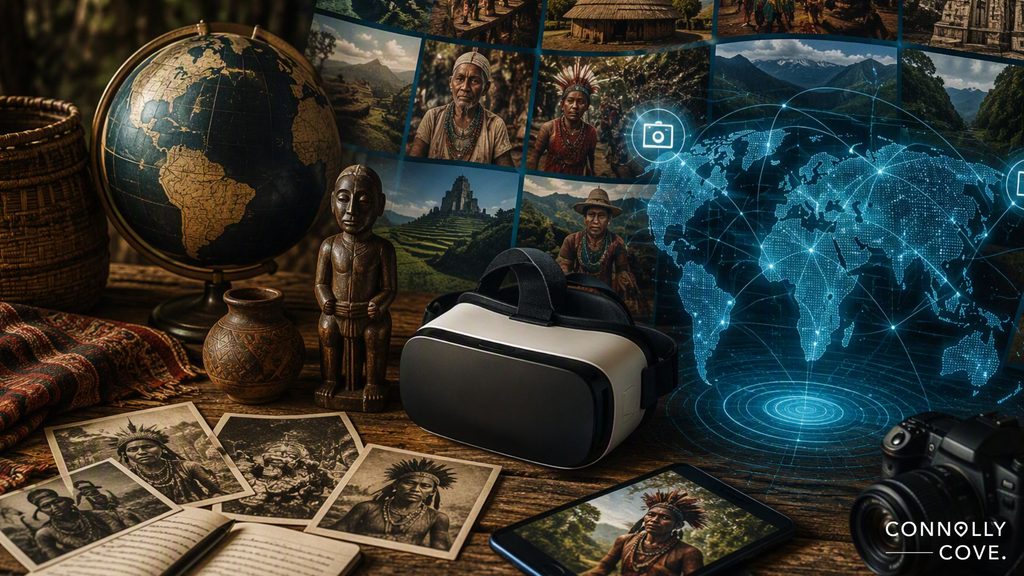
The theory only matters if it works in practice, and a handful of projects across very different cultures show what this technology can actually achieve.
Reclaiming Ancestral Landscapes: Virtual Songlines
In Australia, cultural technologist Brett Leavy has spent years building Virtual Songlines, a digital reconstruction of pre-colonial Aboriginal landscapes that lets users walk through country as it existed before European settlement. The project reconnects younger Aboriginal Australians with landscapes and stories that colonisation physically altered or erased.
It is a reminder that digital reconstruction is not always about recording what exists today; sometimes it means rebuilding what was deliberately taken away, a theme that also runs through ConnollyCove’s wider look at indigenous culture and travel.
Reviving the Kusunda Language in Nepal
The Kusunda language of Nepal has only a handful of fluent speakers left. Researchers at Anglia Ruskin University’s StoryLab institute worked with the Kusunda community and creative studio NowHere Media to build an interactive VR experience in which viewers must speak Kusunda words aloud to move the story forward.
Early participants described the experience as close to hearing a grandparent’s stories again, and the same research team has since begun applying the method to Cornish and Griko, two endangered languages closer to home in Britain and southern Italy.
Ireland’s Ogham Stones and the Seanchaí Tradition in 3D
Ireland has its own version of this work. The Ogham in 3D project, run from the School of Celtic Studies at the Dublin Institute for Advanced Studies, has laser-scanned more than a hundred of the country’s roughly 400 surviving Ogham stones, preserving inscriptions that would otherwise fade beyond legibility within a generation or two.
The same instinct to protect something fragile before it disappears applies to Ireland’s Celtic mythology and folklore, much of which survived for centuries purely through the seanchaí tradition of oral storytelling rather than any written record.
“There is something quietly moving about watching a laser scanner do for stone what a seanchaí always did for memory: refuse to let it disappear,” says Ciaran Connolly, Founder of ConnollyCove. “The tools are new, but the instinct to protect a story is exactly the same one that kept Irish folklore alive for a thousand years before anyone wrote it down.”
Vanishing Atlantic Crafts Finding New Digital Life
Crafts face the same pressures as languages: a skill that takes decades to master can disappear within a single generation once the last practitioner stops working. The UK’s Heritage Crafts Red List currently flags dozens of traditional skills, from coracle-making to hand-forged tools, as critically endangered.
Ireland’s own basket weaving heritage sits close to that same list, and video documentation combined with 3D recording of tools and techniques is increasingly used to preserve not just the finished object but the exact hand movements needed to make it.
Ethics, Ownership and the Risk of Digital Taxidermy
None of this technology is neutral, and the same tools that protect a culture can just as easily be used to exploit it.
Who Owns a Digitised Culture?
When a community’s stories, songs or sacred sites are scanned and uploaded, questions of ownership follow immediately. Does copyright sit with the technologist who ran the scanner, the institution that funded the project, or the community whose heritage it actually is? Most legal systems were not designed with this question in mind.
Ireland has faced versions of this question before, particularly around how colonial-era collectors documented Irish folklore without always crediting or compensating the storytellers who shared it, a pattern that digital preservation projects need to actively avoid repeating.
The CARE Principles and Indigenous Data Sovereignty
The CARE Principles for Indigenous Data Governance, which stand for Collective Benefit, Authority to Control, Responsibility and Ethics, offer one framework for handling this fairly. In practice, that means source communities deciding who can access their material, on what terms, and with what benefit flowing back to them.
This is where digital preservation overlaps with wider conversations about indigenous art and cultural revival, since the same communities pushing for creative recognition are often the ones being asked to hand over recordings of their most sacred material.
Sacred Knowledge, Consent and the Limits of Public Access
Not every tradition is meant to be shared. Some ceremonies, songs and sites are restricted to specific community members, and treating them as freely available content, simply because a scanner can capture them, risks real harm to the people the recording is supposed to honour.
Irish belief systems carry a gentler version of this same idea; ConnollyCove’s coverage of the fairy faith and belief in the Otherworld touches on places and practices that were traditionally treated with caution rather than casual curiosity.
Avoiding Digital Taxidermy
Critics of cultural preservation VR sometimes use the term digital taxidermy to describe projects that freeze a living culture in a permanent, unchanging display rather than supporting the people still practising it. A perfectly scanned ceremony is not the same as a ceremony that continues to be performed.
The better projects treat digitisation as support for a living culture, not a replacement for it, funding community-led revival alongside the archive rather than instead of it.
What This Means for Travellers and Cultural Curiosity
For anyone planning to visit the places behind these projects, virtual reality is turning out to be a useful preparation tool as well as an archive.
Preparing for a Trip Before You Ever Leave Home
A VR experience built with a community’s involvement can teach basic pronunciation, correct etiquette and historical context before a traveller ever sets foot in a sensitive cultural site, and that preparation matters more than most guidebooks suggest.
Anyone planning to visit sites connected to the Tuatha Dé Danann or other figures from Irish mythology benefits from the same kind of grounding, since knowing the stories behind a place changes how it feels to actually stand there.
Virtual Tourism as a Gentler Alternative
Some heritage sites are simply too fragile for large numbers of visitors, whether that is a cave painting sensitive to humidity or a coastal ruin being worn away by footfall. Virtual access offers a way to experience these places without adding to the damage.
This fits neatly alongside the wider shift toward sustainable travel technology, where reducing physical impact on a destination matters as much as reducing its carbon cost.
Bringing Technology and Tradition Together
None of this replaces the value of visiting somewhere in person, meeting the people who keep a tradition alive, or hearing a story told rather than played back. What it does is widen access to heritage that would otherwise be lost to distance, fragility or simple scarcity.
ConnollyCove continues to track this overlap between technology and heritage through coverage of cultural festivals embracing digital innovation, where the same questions about access, authenticity and ownership keep resurfacing.
Conclusion
Virtual reality will not stop a language from dying or a coastline from eroding, but it can make sure something survives the loss, whether that is a voice, a gesture or an inscription that would otherwise be gone for good. Used carefully and led by the communities involved, it becomes a genuine tool for cultural continuity rather than a digital trophy case. Explore more of ConnollyCove’s guide to Ireland’s Celtic legends to see how these traditions keep shaping modern storytelling.
FAQs
How is virtual reality used to preserve endangered cultural heritage?
It combines photogrammetry and laser scanning for physical sites with volumetric video and spatial audio for songs, dances and oral storytelling.
Can virtual reality actually save a dying language?
Not on its own, but voice-interactive VR can teach pronunciation and vocabulary in an engaging way that supports wider community-led revival efforts.
What is the difference between tangible and intangible cultural heritage?
Tangible heritage covers physical objects and structures, such as monuments or stones. Intangible heritage covers living practices like language, music and storytelling.
What are the ethical concerns of digitising indigenous or minority cultures in VR?
The main risks are unauthorised use of sacred material and unclear ownership of the digital files, which is why frameworks like the CARE Principles exist.
How can travellers use VR to prepare for a heritage trip?
Many projects teach basic pronunciation, etiquette and historical context before departure, helping visitors engage more respectfully once they arrive.