Updated on:
by
 Fatma Mohamed
 Fatma Mohamed
The Temple of Edfu is the reason serious travellers to Upper Egypt build in an extra half day between Luxor and Aswan. Most Nile cruises stop here almost as an afterthought, squeezed in alongside Kom Ombo, yet Edfu is arguably the single best place in the country to understand what an Egyptian temple actually felt like in use, rather than what it looks like as a ruin.
That is largely down to an accident of history. When the worship of the old gods was banned, the temple vanished under desert sand and Nile silt for close to two thousand years, and that burial preserved it. ConnollyCove has covered temples across Egypt, from Abu Simbel to Philae, and Edfu consistently comes up as the one that gives visitors the clearest sense of how these buildings functioned as living religious centres, not just as monuments.
Table of Contents
Why the Temple of Edfu Stops Visitors in Their Tracks
Most ancient Egyptian temples survive as fragments. Edfu survives almost whole.
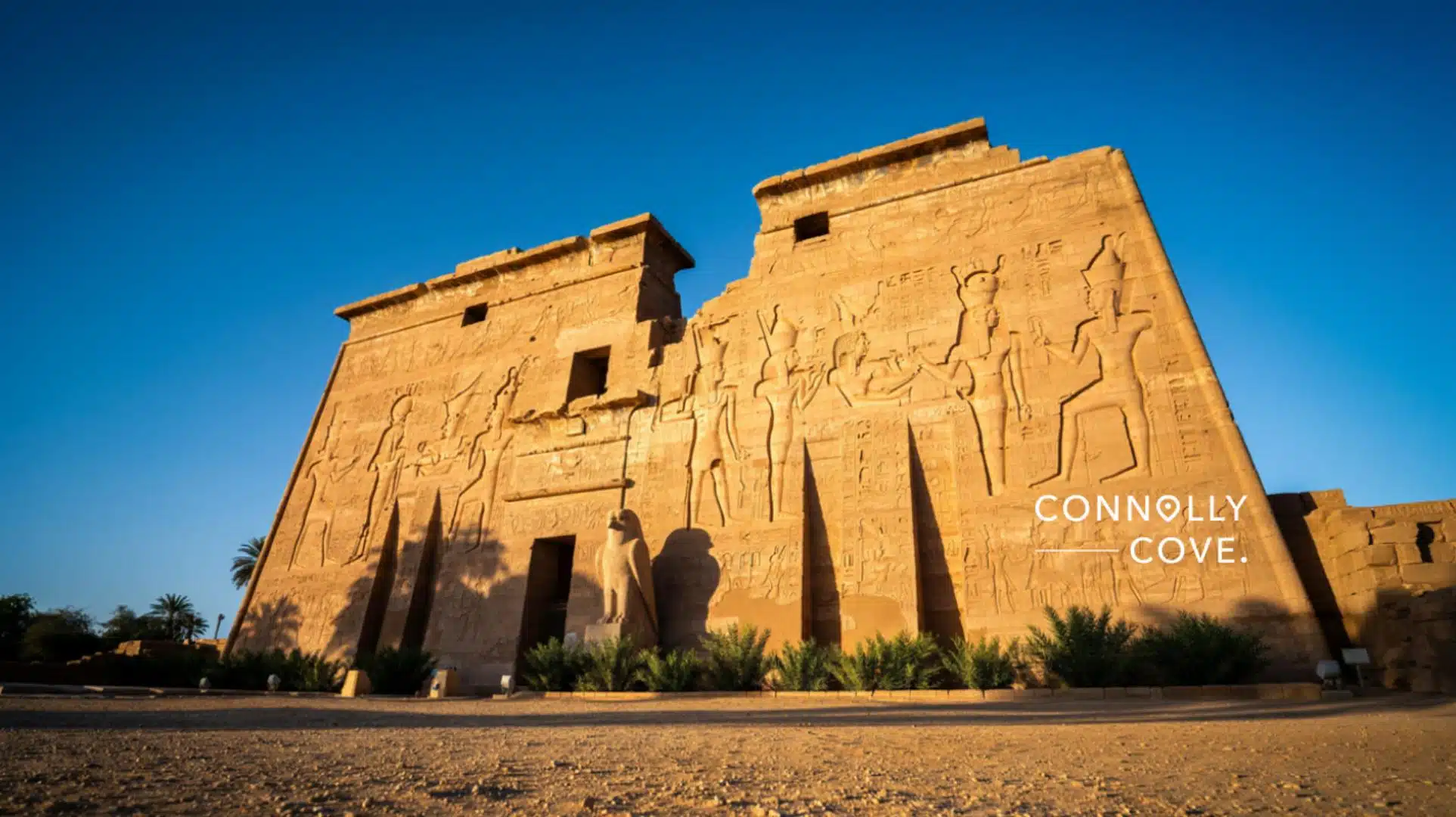
Its roof is largely intact, which is rare among temples of this scale, and that changes the experience of walking through it. You move from bright, open courtyards into progressively darker, smaller chambers, exactly as ancient worshippers would have, until you reach the sanctuary where the temple’s granite naos still stands. Few sites in Egypt let you feel that architectural sequence so completely.
The temple is dedicated to Horus of Behdet, the falcon-headed god of the sky and kingship, and its walls are covered in inscriptions so extensive that Egyptologists still refer to them collectively as the Edfu Texts. They record construction details, temple rituals, and one of the most complete surviving versions of a central Egyptian myth: the battle between Horus and Seth.
Getting to Edfu From Luxor or Aswan
Edfu sits on the west bank of the Nile, about 60 kilometres north of Aswan and roughly two hours south of Luxor by road. Most visitors see it as part of a Nile cruise itinerary, often paired with a same-day stop at Kom Ombo, which sits closer to Aswan and shares Horus as one of its dual patron gods.
If you are not cruising, day trips run from both Aswan and Luxor by road, and the drive gives you a good look at rural Upper Egypt along the way. Cruise passengers typically dock within walking distance, or take a short horse-drawn carriage ride from the riverbank up to the temple entrance, a small local tradition that has stuck around since the nineteenth century.
Travellers building a longer Upper Egypt itinerary often combine Edfu with Luxor Temple and the Temple of Hatshepsut further north, so the whole route reads as one long conversation between different eras of Egyptian religious architecture.
The Myth Behind the Walls
The Edfu reliefs are not decorative. They tell a story, and that story is central to how ancient Egyptians understood kingship itself.
According to the myth carved into the temple’s inner walls, Horus’s uncle Seth murdered Horus’s father, Osiris, and Horus spent years fighting to avenge him and reclaim the throne of Egypt. Priests re-enacted this conflict annually inside the temple as part of what texts describe as the Sacred Drama, with actors playing Horus, Seth, and the assembled gods. It was not subtle theatre. The point was to reaffirm, in public and in stone, that order had triumphed over chaos, and that the reigning pharaoh inherited that same authority.
Horus appears throughout ancient Egyptian religion in falcon form, alongside other creatures the Egyptians considered sacred; ConnollyCove’s guide to sacred animals across ancient cultures traces how widely that kind of animal reverence spread, from Egyptian falcons and baboons to venerated creatures in entirely different traditions. The Egyptian pantheon had several animal-headed deities linked to Horus’s world, including Hedjwer, the baboon god associated with the sun god Ra.
Edfu was also the setting for a gentler yearly story. Once a year, priests carried a statue of the goddess Hathor from her own temple at Dendera down the Nile to Edfu, where she was believed to be united with Horus in a celebration known as the Feast of the Beautiful Union. Locally, Horus of Edfu, Hathor, and their son Harsomtus were worshipped together as a family triad, a softer counterpart to the violent Horus-and-Seth narrative on the outer walls.
“The story of Hathor’s statue travelling from Dendera to meet Horus at Edfu is one of my favourite details in Egyptian mythology. It turns two enormous stone temples into something almost domestic, a yearly reunion carved in sandstone.” – Ciaran Connolly, Founder of ConnollyCove.
Walking Through the Temple
Step inside and discover the temple’s ancient beauty and intricate details. Every passage reveals a glimpse into its fascinating history.
Temple of Edfu at a Glance
| Feature | Detail |
|---|---|
| Location | West bank of the Nile, Edfu, Upper Egypt |
| Built | 237 BC to 57 BC (Ptolemaic period) |
| Dedicated to | Horus of Behdet, with Hathor and Harsomtus |
| Height of pylon | Around 36 metres |
| Rediscovered | 1860s, by French Egyptologist Auguste Mariette |
| Known locally in antiquity | Behdet; Greek sources called it Apollonopolis |
You enter through the pylon, a pair of towers roughly 36 metres high, decorated with reliefs of the pharaoh striking down enemies before Horus. Beyond it lies an open, collonaded forecourt, and from there you move into two hypostyle halls, their columns carved with scenes of temple rituals and the king’s devotion to the gods.
Deeper still is the sanctuary, where the temple’s granite shrine, dating from an earlier structure built under Nectanebo II, still holds the space once occupied by the sacred image of Horus. Around it, a ring of small chapels and storerooms once held ritual objects and temple archives, including a room ancient sources call the House of Books.
Just off the forecourt sits the mammisi, or birth house, its walls decorated with scenes celebrating the divine birth of Horus, a feature you will also recognise from other Ptolemaic-era temples in Egypt if you visit more than one on your trip.
Practical Tips for Visiting the Temple of Horus
The temple gets hot fast, so an early morning or late afternoon visit is worth planning around, particularly between May and September. Cooler months from October to April suit a more relaxed pace if your itinerary allows it.
Entry is ticketed at the site, and most cruise operators or tour guides handle this as part of a package. If you are travelling independently, budget time for the approach through the row of stalls leading up to the temple gates, a fairly standard feature at major Egyptian sites.
Dress modestly, as you would at any religious site in Egypt, and bring water. There is limited shade once you are inside the temple complex itself.
Planning Around Edfu
Edfu works best as one stop within a wider Upper Egypt route rather than a destination on its own. Most travellers see it either as part of a multi-day Nile cruise between Luxor and Aswan or as a day trip slotted into a longer Egypt itinerary that also takes in Cairo and Giza. If you’re building the trip yourself rather than booking a package, it’s worth visiting Edfu earlier in the day and earlier in your route if possible, since the site gets busier as cruise groups arrive through late morning, and the temple rewards a slower, quieter look at its reliefs.
ConnollyCove’s broader guide to Egypt’s history, culture, and top places to visit sets out how Edfu fits alongside Luxor, Aswan, and the wider Nile Valley, including how much time to budget for each stop and how the regions connect by road, rail, or river. Our guide to Egypt’s holy places covers other religious sites worth building into the same trip, from Old Cairo’s mosques and churches to temples further along the Nile, so you can shape a route around whichever thread of Egypt’s history interests you most.
FAQs About the Temple of Edfu
Here’s what travellers most often ask before visiting the Temple of Horus, from pronunciation to practical planning.
How do you pronounce Edfu?
Edfu is pronounced “ED-foo.” The name comes from the ancient Egyptian Behdet, which shifted through Coptic and Arabic into its modern form.
Why is the Temple of Edfu so well preserved?
Desert sand and Nile silt buried the temple for centuries after the worship of Egyptian gods was banned. That burial protected it from weathering and looting until its rediscovery in the 1860s.
Is the Temple of Edfu part of a Nile cruise?
Yes, most Nile cruises between Luxor and Aswan include a stop at Edfu, often on the same day as nearby Kom Ombo.
What is the Temple of Edfu dedicated to?
It is dedicated to Horus, the falcon-headed god of the sky and kingship, alongside Hathor and their son Harsomtus.
How long does a visit take?
Most visitors spend one to two hours at the site, enough time to walk the full sequence from pylon to sanctuary without rushing.
Is the Temple of Edfu a UNESCO World Heritage Site?
It is not individually listed on the UNESCO World Heritage List, though it sits within Egypt’s wider recognised heritage of Ptolemaic and Pharaonic temples in Upper Egypt.