
Article Summary
What this article covers: Things to do in Kafr El-Sheikh, Egypt, arranged as a west-to-east route through the governorate’s Nile Delta towns. It runs from the Edfina barrage and Fuwwah’s mosques to ancient Buto, Sakha’s Holy Family church, Lake Burullus, and the Baltim coast.
Who this is for: Travellers heading beyond Cairo and the Nile Valley. It also suits heritage and archaeology enthusiasts, birdwatchers, visitors interested in Islamic and Coptic heritage, and anyone planning an independent day trip or overnight stay in the northern Delta.
Key takeaway: Kafr El-Sheikh holds four things that appear together nowhere else in Egypt: the predynastic royal city of Buto, one of the Delta’s largest groups of Islamic monuments at Fuwwah, a documented stop on the Holy Family Trail at Sakha, and a Ramsar-listed wetland at Lake Burullus that most Egypt itineraries skip.
Expert insight: “Standing on the mound at Tell El-Fara’in, it’s easy to forget you’re looking at the birthplace of an entire kingdom’s mythology. We’ve mapped dozens of Delta sites for our Egypt coverage, and the layers of history packed under a few metres of silt still catch most visitors off guard.” – Ciaran Connolly, Founder of ConnollyCove
Quick facts:
- Kafr El-Sheikh Governorate covers roughly 3,437 square kilometres, with an estimated population of about 3.76 million as of January 2023 (CAPMAS).
- The governorate is Egypt’s largest fish producer, accounting for around 40% of national output across capture fisheries and aquaculture.
- Lake Burullus was listed under the Ramsar Convention in 1988 as Site no. 408, covering 46,200 hectares of lagoon, marsh, and mudflat.
Table of Contents
Things to do in Kafr El-Sheikh rarely make it into Egypt itineraries, which tend to jump from Cairo to Luxor and then on to the Red Sea. The governorate covers the north-western corner of the Nile Delta, between the Rosetta branch of the river and the Mediterranean coast. For a single governorate, it holds an unusually wide mix of sites: the mound of ancient Buto, the old mosque town of Fuwwah, a Holy Family stop at Sakha, and the broad, shallow waters of Lake Burullus.
ConnollyCove is an Ireland-based travel and culture platform, and this guide is part of a wider Egypt coverage that ranges from the Old Kingdom pyramids and their architectural evolution to the Sinai coast around Dahab. The route below follows the map from west to east. It starts at the Edfina barrage and ends on the Burullus coast, with practical advice on getting there, when to go, and how to split the trip across one or two days.
Where Is Kafr El-Sheikh, and Where Does the Name Come From?

‘Kafr El-Sheikh’ refers to two things at once: a governorate of roughly 3.76 million people, and the city of the same name that serves as its capital. Both lie in the Nile Delta about 134 km north of Cairo, in the fertile band between the Rosetta and Damietta branches of the Nile River. El-Gharbeya Governorate borders it to the south, El-Dakahlia to the east, and El-Beheira to the west across the Rosetta branch.
Kafr El-Sheikh Governorate is split into eleven municipal divisions: Kafr El-Sheikh city, along with Burullus, El-Hamool, El-Reyad, Biyala, Desouk, Fuwwah, Sakha, Metoubes, Qallin, and Sidi Salem. You’ll also see the name spelt Kafr El-Shaikh on signs and maps.
The governorate takes its name from a 13th-century Sufi holy man, Sheikh Talha Abi Sa’id al-Tilimsani, who settled and died in a village then called Dumaynaqun. The village became known as “Kafr El-Sheikh Talha” after him, and the name was later shortened to Kafr El-Sheikh. The word kafr simply means village. The modern governorate was carved out of Gharbia in 1949 and originally named Fuadiyah in honour of King Fouad I. After the 1952 Revolution, when the monarchy was abolished, it took the name of its capital city.
One practical consequence of the shared name is worth knowing before you plan. Content about the city and content about the governorate tends to blur together in search results and in tour listings, so check whether a quoted day trip covers the capital alone or the wider region before you book.
| Indicator | Detail |
| Administrative status | Governorate in Lower Egypt; capital city of the same name |
| Area | Approximately 3,437 km² |
| Population | Around 3.76 million (January 2023 estimate, CAPMAS) |
| Distance from Cairo | Approximately 134 km, around 2.30 to 3 hours by road |
| Mediterranean coastline | Approximately 118 km |
| Best season | October to April |
| Known for | Rice, long-staple cotton and aquaculture; Buto’s ruins; Fuwwah’s mosques; Lake Burullus; Sakha’s Holy Family stop |
| Historic names | Dumaynaqun, later Fuadiyah |
Qanater Edfina on the Rosetta Branch, Metoubes

The route begins in Metoubes, on Kafr El-Sheikh governorate’s western edge, where the Edfina barrage crosses the Rosetta branch shortly before the river reaches Rashid and the sea. The garden beside the barrage is a local family spot, and it draws large crowds from nearby towns during weekends and public holidays. It makes a relaxed first stop to stretch your legs. Its botanical gardens include endangered plants and flowers, green spaces, fountains, and fruit trees. Treat it as a stop on the way to Fuwwah instead of a destination in itself.
Metoubes is the natural entry point if you’re driving in from Alexandria, since the road passes close to Rashid on the opposite bank. Travellers with extra time can pair this stop with our guide to Rasheed’s key heritage sites, the town that gave its name to the Rosetta Stone.
Fuwwah’s Old Quarter: Mosques, Looms, and a Working River Town
A short drive south of Metoubes on the east bank of the Rosetta branch, Fuwwah has the densest concentrations of historic Islamic heritage in the Delta. Locals call it the “City of Mosques” since it has hundreds of archaeological mosques and registered Islamic monuments. It also has modest attractions: a working river town with Mamluk and Ottoman-era mosques still in use, a corniche along the Nile, and a commercial quarter that has changed shape.
That riverfront position explains much of the town’s history. Fuwwah grew as a trading stop between the Mediterranean and the Delta interior. Local historians note that its minarets once served as landmarks for ships arriving with goods from Mediterranean ports, which is why the old town reads as a merchant port as much as a religious centre.
El-Qena’y Mosque and the Riverside Mosques
El-Qena’y Mosque is one of the key landmarks visitors head for first. Built in the classic Islamic style, it is classed as one of Fuwwah’s famous hanging mosques and features ancient pillars repurposed with Pharaonic and Roman ornamentation, alongside a finely crafted wooden minbar. The mosque commemorates the legacy of Sheikh Abd al-Rahim al-Qena’i, the prominent Sufi scholar who visited Fuwwah to meet with the scholar Salem Abu el-Naga. Look at the south wall of its minaret for Fuwwah’s last surviving sundial, signed by its maker, Mustafa ibn Muhammad al-Khawaja of Rashid, and dated 1252 AH.
The Nasrallah Mosque in Fuwwah’s main square began with a vow. Emir Hassan Nasrallah was a senior Mamluk official who lost his post and property after rivals turned the sultan against him. He promised to build a religious foundation if he was restored. When he was reinstated around 1438, he kept that promise with a madrasa-mosque on this spot. The present building dates from an Ottoman rebuilding in 1707. Inside, it holds three of Fuwwah’s seven marble decrees, whose texts set out sultanic orders such as abolishing a tax or banning a social custom.
The domed shrine of Abu el-Naga dates back further than both, with local accounts dating it to the 12th century. The Abu el-Naga mosque holds the remaining two marble decrees. Fuwwah has several other mosques to visit. The El-Omari Mosque is traditionally regarded as the first mosque built in the town. Abu El-Makarem is also one of Fuwwah’s best-known mosques.
Local accounts also say the minbars in all 14 registered mosques were made by Fuwwah’s own carpenters. Look closely at the walls as well as the pulpits. Fuwwah’s mosques hold seven marble decrees: three in the Nasrallah Mosque, two in El-Qena’y, and two in Abu el-Naga. Their texts record sultanic orders such as abolishing a tax or banning a social custom. These are small details, easy to walk past unless a local guide points them out and translates them.
All of these are active places of worship, so dress modestly, remove your shoes at the entrance, and ask before photographing anyone inside. Plan your walk between the five daily prayers, and avoid Friday midday prayers in particular, when the mosques are at their busiest.
Fez Factory
The remains of the Fez Factory are one of Fuwwah’s more unusual industrial relics. Muhammad Ali Pasha opened it in 1824 to manufacture the fez, tarboosh or Effendi’s crowns, which became standard headwear for Egyptian officialdom. Today, only two historic gates remain. The gates take a few minutes to see, and they give useful context for the town’s later weaving trade.
Kilim Factories
Fuwwah is still a working craft town, with a long reputation for carpets, kilims, and gobelin weaving. For many travellers, the weaving workshops are the most rewarding part of a visit, since wooden floor looms still run in small workshops around the old commercial quarter. Hand-loom weaving faces steady competition from factory-made textiles across Egypt, which is part of why communities around the world are working to revive traditional crafts and keep the skills alive.
“The looms in Fuwwah run on the rhythm they always have, shuttle, pause, shuttle. Watching a weaver work a kilim by hand for an afternoon tells you more about the Delta’s character than any single monument does.” – Ciaran Connolly, Founder of ConnollyCove
If you’re travelling through, buying directly from a workshop puts money straight into the hands of the families who still practise the craft. Most weavers are happy to explain how a design is built up on the loom if you show an interest. ConnollyCove’s coverage of Delta craft villages, including the jasmine harvest at Shubra Beloula, follows the same idea of seeing the work behind a product.
Robaa Al-Khatayba and Wekalet Hassan Magor

Fuwwah’s two surviving commercial buildings show how the river trade worked day to day. Robaa Al-Khatayba, east of the centre, served as lodgings for visiting merchants who came to Fuwwah to stay and do business. Its brick-and-timber front and wooden latticed windows still stand out on the street. Behind Robaa Al-Khatayba is Wekalet Hassan Magor, a wekala where traders once stored and sold their goods. Both stand in the old commercial quarter near the river, so you can see them on the same short walk.
Corniche Fuwwah
Finish your time in Fuwwah with a walk along the corniche, where small boats still work the river and the minarets line up along the bank. Late afternoon light is the best time for photographs.
Desouk: The El-Desouki Shrine and Family Park
Desouk, south of Fuwwah along the river, grew up around the mosque and shrine of Sidi Ibrahim El-Desouki.
The El-Desouki Shrine
Ibrahim El-Desouki was a 13th-century Sufi and founder of the Desouqi order. His annual moulid, the celebration of his birthday, brings large numbers of pilgrims into the town. The mosque is an active place of worship year-round, so dress modestly and behave accordingly.
Family and Children Park
Families travelling with children can take a break at the Family and Children Park on the Nile bank in Desouk, which offers a small zoo, short river trips, and activity programmes for visitors. It’s a practical stop between heritage sites and is especially busy on public holidays.
Tell El-Fara’in: Ancient Buto and the Cobra Goddess
Tell El-Fara’in, “the Hill of the Pharaohs”, lies a short drive north-east of Desouk and marks the site of ancient Buto, one of the oldest cities of Lower Egypt. By some accounts, it was the region’s capital before the two kingdoms were unified. Buto was sacred to Wadjet, the cobra goddess who wore the Red Crown and held sovereignty over Lower Egypt. Her southern counterpart was Nekhbet, the vulture goddess of Upper Egypt. Together, they came to stand for the united kingdom.
Set your expectations before you go, because the site today is a low mound with limited signage. Its value lies in its depth of history, with settlement layers running from the predynastic period through to Greco-Roman times. Visit with a local guide who knows the excavation history, since an hour on the mound means far more with someone explaining what lies beneath it.
The pairing of animal guardians with royal authority appears across many ancient cultures, as ConnollyCove’s look at sacred animals in ancient times shows. The baboon deity Hedjwer exaplins how specific the Egyptian versions could become.
Kafr El-Sheikh City: Museum, Garden, and Royal Palace

Kafr El-Sheikh city is the governorate’s capital and its main base for accommodation and transport, with a population of around 186,857 as of 2023. Its main stops fit comfortably into a morning.
Kafr El-Sheikh Museum
If Buto left you looking at a grassy mound and wondering what once stood there, this museum fills in the picture. Its displays are built around one of Egypt’s best-known myths: the story of Isis and Osiris and the struggle between Horus and his uncle Seth for the throne. Buto sits at the centre of that story because the ancient city is one of the main themes of the displays. The standout piece is a statue of Horus as a falcon, found among the finds from Buto’s great cemetery and temple area and ranked among the finest statues discovered in Egypt.
The route through the three halls moves forward in time, taking in Coptic and Islamic pieces alongside the Pharaonic ones, so it also gives useful background for Sakha’s church and Fuwwah’s mosques. One section looks at ancient Egyptian medicine, veterinary science and pharmacy, a nod to the university next door, and it’s a good stop if you’re travelling with children who have had enough of statues. The museum only opened in 2020, so the displays are modern and well lit. The circular building stands between Sana’a Garden and Kafr El-Sheikh University, easy to combine with a break in the park.
King Fouad I Palace
Known locally as Al-Fouadiya, Kafr El-Sheikh’s royal palace stands out in the city centre for its red-and-beige facade and European style. Muhammad Saeed Pasha built the original structure as a rest house, and King Fouad I had it rebuilt in the late 1920s, from the period when the region carried the name Fouadiya. The work is attributed to Ernesto Verrucci Bey, the Italian architect who handled royal commissions across Egypt, including the remodelling of Ras El Tin Palace in Alexandria.
The exterior can be seen from the street at any time, but for the interior, check access before you go. The complex includes the main building, a kitchen block, and the remains of a royal railway station within its gardens.
Sana’a Gardens
Sana’a Garden, beside Kafr El-Sheikh museum, is the city’s main public park and a popular stop for local families. It combines green space, a small zoo, a 3D cinema, a children’s play area, and an annual international book fair. It’s a pleasant place for a break between the museum and the drive south to Sakha.
Sakha and the Holy Family Trail
On the southern edge of Kafr El-Sheikh city, Sakha is one of the stops on Egypt’s Holy Family Trail, the pilgrimage route the Ministry of Tourism and Antiquities has developed to encourage spiritual tourism. According to Coptic tradition, the Holy Family rested here during the flight into Egypt. The town’s Coptic name, “PekhaIssous”, means “Foot of Jesus”, after a footprint of the infant Christ said to be marked on a rock. That rock was hidden for centuries to protect it and was only found again in 1984.
The Church of the Blessed Virgin Mary
The stone is kept at the Church of the Blessed Virgin Mary. A church supervisor, Halim Philippus, found it about 1.5 metres below ground. It is a light grey stone roughly 80 cm long, with a small brownish impression on one face and the word “Allah” written in Arabic on its back. It is now protected in a glass case.
The story behind it goes back to the eighth century, when Saint Zacharias, Bishop of Sakha, wrote a sermon about it. In his account, the Holy Family arrived in Sakha thirsty and could find no water, so the child pressed his foot onto a stone, leaving a footprint, and clear water sprang from it. Before you leave, look for the thorn tree near the church, which local tradition links to the crown of thorns.
The church stands on the site of an earlier monastery, and features a unique architectural design. It keeps the remains of an ancient column along with 19th-century liturgical silver, including a communion cup, tray, and candlestick. Visitors are welcome outside service times. As with any active place of worship, dress modestly and ask before taking photographs inside.
The Holy Family Route
From the church, a paved, palm-lined walking route leads towards the area around Kafr El-Sheikh University. It traces the way pilgrims follow through Sakha, and it’s an easy stroll after your visit to the church, especially in the cooler hours of the morning or late afternoon.
Travellers interested in the wider pilgrimage network will find more context in ConnollyCove’s guide to holy places across Egypt, which covers sites from Sinai to Siwa.
Lake Burullus and Shakhlouba Island

Arrive at Shakhlouba early in the morning, and you’ll find the lake already at work. Boats come in with the night’s catch, crates of fish are laid out on the ground, and traders shout bids as each box goes up for auction. The morning session runs from 7 to 10 am and the afternoon session from 2 to 7 pm, and traders travel from across Egypt to buy here. Even the village’s name comes from fish; it was named after the shakhloub, a species that once gathered in huge numbers where the lake’s fresh water meets the salt.
A Village of Boat Builders
Everyone in the village earns a living from the lake, whether by making nets, building boats or weaving baskets, and residents like to say Shakhlouba has no unemployment. The boatyards are well worth a look. A small felucca takes around ten days to build, while a large wooden fishing boat can take a month. Shakhlouba belongs to Sidi Salem district and is the only village on the lake’s southern shore, which is why it makes the easiest way in for visitors.
Shakhlouba Island and Boat Trips
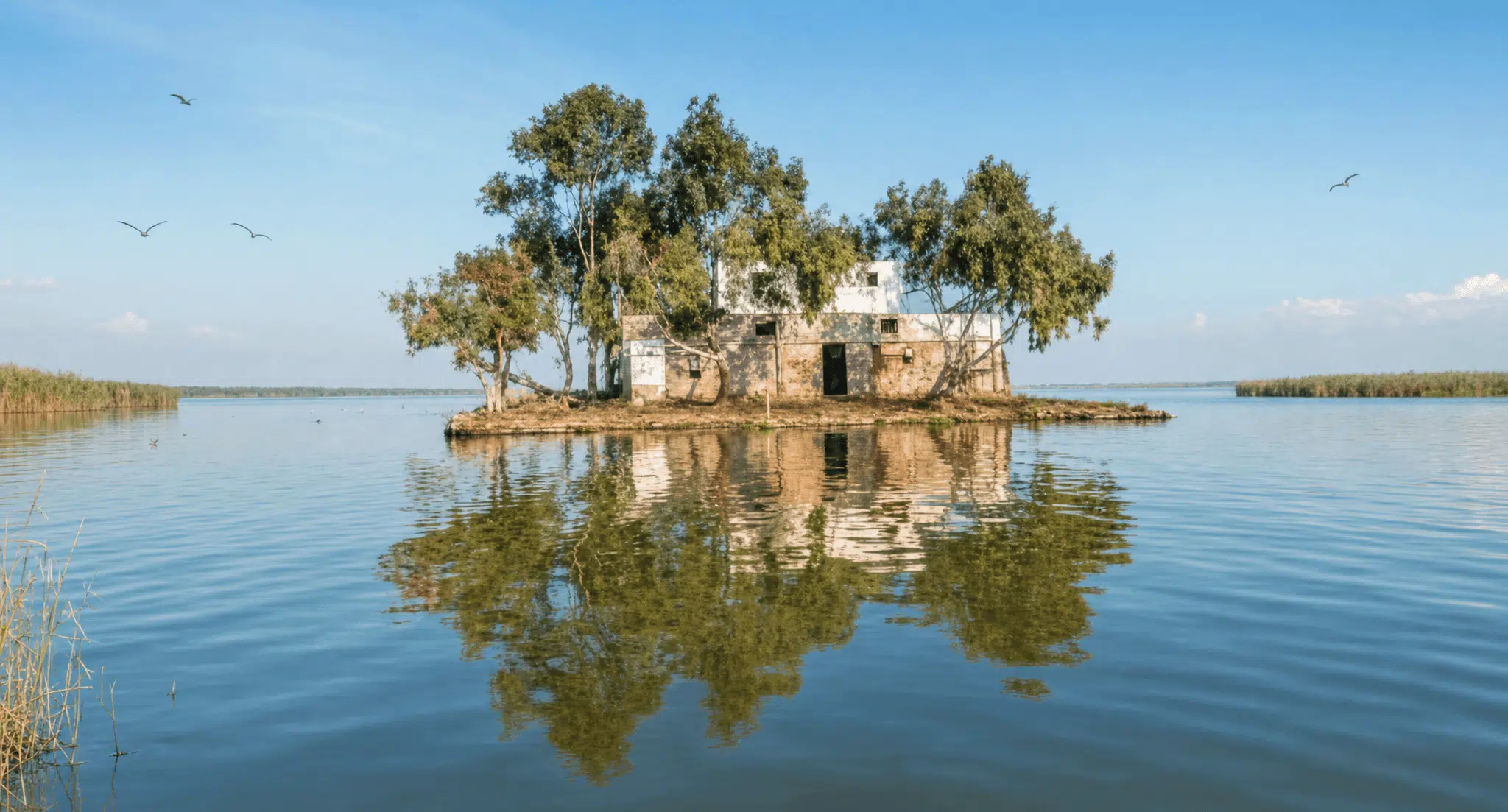
Out on the water, the view many people recognise sits about a kilometre offshore. In 2017, Egyptian photographer Adel Bayoumi’s image of a lone house among trees in the middle of the lake won first place in Egypt in Wikipedia’s “Wiki Loves Earth” contest. That house was once used for selling fish, but the market has since moved onto land.
Today, local families come out by boat to picnic on the islands and watch the sunset. Day trips by launch usually run from mid-morning to early evening and include a lunch of grilled mullet with rice and salad. Boats are arranged informally with local fishermen, so a driver or guide with contacts on the lake will save you time and haggling.
Birdwatching on Lake Burullus
The lake itself is the reason Kafr El-Sheikh draws birdwatchers. Lake Burullus is a broad, shallow lagoon stretching about 54 km from east to west, with some 50 islands and a single opening to the sea. It’s also the least disturbed of the Delta’s wetlands and keeps a wildness that has disappeared from most of the Delta. Come between autumn and early spring, and you’ll see the country’s largest numbers of some wintering waterfowl, including wigeon, shoveler, ferruginous duck, pochard, and coot.
The lake has been listed as a wetland of international importance since 1988, and its full record is on the Ramsar Sites Information Service, no. 408. To see how a desert wetland compares, our guide to the salt lakes of Siwa covers the other end of Egypt.
Baltim and the Burullus Coast
Baltim is the seat of Burullus district and the governorate’s summer resort. Each July and August, Egyptian families pack its public beaches for a few weeks by the Mediterranean. Outside peak season, the same stretch of coast is quiet and uncrowded, which suits travellers who’d like the sea breeze without umbrellas and crowds.
Burullus Lighthouse
Two stops make Baltim more than a beach town. The first is the Burullus lighthouse. It originally stood about a mile from the shore, but coastal erosion after the High Dam was built has cut that distance to no more than 150 metres. Its lamp room once ran on kerosene. It dates from 1869 and is the only survivor of a group of lighthouses built for the opening of the Suez Canal. The shipbuilding quarter nearby still repairs and builds wooden fishing boats by hand.
Baltim Aquarium and Museum
The second stop is the museum and aquarium at the Aquatic Resources Research Station, set up in the 1960s to monitor Lake Burullus and develop its fisheries. The museum holds a complete whale skeleton, displayed alongside preserved specimens and marine fossils, a modest counterpart to the larger aquarium museums in Alexandria. The aquarium has tanks of both sea and freshwater fish. It’s a good stop for families travelling with children.
Delta Flavours: What to Eat in Kafr El-Sheikh
Kafr El-Sheikh anchors Egypt’s aquaculture industry and produces a significant share of the country’s farmed fish, alongside rice and long-staple cotton. That agricultural base shapes what’s on the table here more than in most other parts of Egypt, and it’s worth building a meal or two around rather than treating food as an afterthought.
Rice turns up in nearly every meal, unsurprising given how much of it Kafr El-Sheikh governorate grows. Grilled mullet (bouri) with rice and salad is the standard lunch around the lake, and fresh fish is the most reliable thing to order anywhere in the governorate.
Feseekh, a salt-fermented mullet traditionally eaten around the Sham El-Nessim spring festival, is a Delta speciality worth knowing about even if you don’t try it. It has a strong smell that surprises visitors expecting something closer to standard grilled fish. If the smell puts you off, you’re not alone; even in Egypt, feseekh divides opinion by household.
Buffalo-milk dairy, including soft white cheese and thick clotted cream (qishta), rounds out a diet built on what’s farmed and fished locally. It’s plainer and more fish-focussed than the Egyptian menus most tourists meet in Cairo.
How Kafr El-Sheikh Governorate’s Key Sites Compare
| Stop (in route order) | Era or type | Main draw | Best suited to |
| Edfina barrage, Metoubes | Modern waterworks | Riverside garden near Rashid | Travellers arriving from Alexandria |
| Fuwwah | Mamluk, Ottoman, and Muhammad Ali eras | Historic mosques, Fez Factory gates, handloom weaving | Heritage and craft travellers |
| Desouk | 13th century onward | Active Sufi shrine, riverside park | Living religious tradition, family travel |
| Tell El-Fara’in (Buto) | Predynastic to Greco-Roman | Ancient ruins, mythology of Wadjet | Archaeology and mythology fans |
| Kafr El-Sheikh Museum | Opened in 2020 | Museum | First stop for context, family days out |
| King Fouad I Palace | Royal era; Built 1840s, rebuilt 1927 | Neo-Romanesque and Neo-Classical royal architecture, ongoing restoration | Architecture and 20th-century history fans |
| Sakha | Coptic tradition | Holy Family Trail, Church of the Blessed Virgin Mary, Holy Family footprint stone | Pilgrims, Coptic heritage |
| Shakhlouba and Lake Burullus | Ramsar wetland | Fish auction, boat builders, birdlife | Birdwatchers and photographers |
| Baltim | 19th century to present | Mediterranean beach resort, Aquarium and Museum, lighthouse | Summer coastal travel |
Getting to Kafr El-Sheikh and Where to Stay
Your starting city decides which direction to run the route. From Alexandria, the west-to-east order in this guide works best: you cross near Rashid to Metoubes, follow the river south through Fuwwah and Desouk, and then turn east. Alexandria also makes a good base, and a visit to Qaitbay Citadel or other sights around Alexandria fits either side of the trip.
From Cairo, you arrive via Tanta into Kafr El-Sheikh city first, so run the loop in reverse and visit the museum before Buto. A private car and driver is the most practical option, covering the 134 km from Cairo in roughly 2:30 to 3 hours. Trains run from Cairo via Tanta with a regional connection, and air-conditioned intercity buses also serve the city, although public transport needs more flexibility with timing. If you’re coming from Tanta directly, the journey drops to under an hour.
Across two days, a comfortable split is:
- Day one: Edfina, Fuwwah, Desouk, and Tell El-Fara’in, with an overnight stay in Kafr El-Sheikh city.
- Day two: The museum, palace, and Sakha in the morning, then Shakhlouba and/or Baltim in the afternoon.
Accommodation in Kafr El-Sheikh governorate is limited and functional, with the main options in Kafr El-Sheikh city and, in summer, Baltim. Most visitors either base themselves in Cairo or Alexandria and take Kafr El-Sheikh as a long day trip, or stay one night locally if they want to cover more attractions without rushing.
Current Conditions and Seasonal Information
Kafr El-Sheikh has a Mediterranean-influenced arid climate: hot, humid summers and mild, slightly damp winters, with most of its limited rainfall falling in January and February. October to April offers the most comfortable conditions for walking Fuwwah’s old quarter and spending time on the lake, with daytime temperatures generally in the high teens to low twenties Celsius. These months also bring the peak numbers of wintering birds to Lake Burullus. Summer, particularly July and August, brings heat and humidity that make walking around Fuwwah or the lakeshore considerably less pleasant, though it’s peak season for Baltim’s beaches.
Moulids, seasonal events, or Coptic feast days follow religious calendars that shift from year to year, so confirm dates locally or through the Egyptian Ministry of Tourism and Antiquities before you build a trip around one. During Ramadan, opening hours for museums and shops often change, and mosques are busiest after sunset. Boat trips and fish auction times on the lake are arranged informally and can change with the weather, so treat any schedule as a guide and confirm on the day.
FAQs About Kafr El-Sheikh

Planning a trip to Kafr El-Sheikh? These quick answers cover the questions travellers ask most about the governorate’s sites, beaches, and practicalities.
What are the main things to do in Kafr El-Sheikh?
The main things to do in Kafr El-Sheikh are walking through Fuwwah’s old quarter of historic mosques, visiting the ancient site of Buto at Tell El-Fara’in, and seeing the Holy Family footprint stone at Sakha. Add the Kafr El-Sheikh Museum, the fish auction at Shakhlouba on Lake Burullus, and Baltim’s beaches and lighthouse on the Mediterranean coast.
Why is it called Kafr El-Sheikh?
Kafr El-Sheikh means “village of the sheikh” and honours Sheikh Talha al-Tilimsani, a 13th-century Sufi teacher who is buried in the city.
How many days do you need in Kafr El-Sheikh?
Two days let you see the whole governorate at a comfortable pace, with the river towns and Buto on the first day and the capital, Sakha, and the lake on the second. With an early start and a private driver, one long day covers the western sites or the lake and coast, but not both.
Is Kafr El-Sheikh worth visiting as a tourist?
Yes, if you’re interested in ancient history, Islamic architecture, Coptic heritage, birdwatching, or everyday life in the Delta. Tourist infrastructure is limited, so it suits independent travellers and those willing to hire a local driver or guide. The payoff is quiet access to sites that see very few foreign visitors.
Does Kafr El-Sheikh have beaches?
Yes, Baltim on the Mediterranean coast is the governorate’s beach resort, busiest with Egyptian families in July and August. Outside summer, the beaches are quiet and pair well with a visit to the city of Burullus.
What is the Kafr El-Sheikh Museum known for?
The Kafr El-Sheikh Museum is known for its finds from ancient Buto, including a statue of Horus as a falcon, displayed around the myth of Isis, Osiris, Horus, and Seth. It opened in 2020, so the displays are modern and easy to follow.
What should visitors wear in Kafr El-Sheikh?
Modest, loose clothing that covers shoulders and knees is appropriate throughout Kafr El-Sheikh governorate, for both men and women. Women should carry a scarf for mosque visits in Fuwwah and Desouk and a church visit in Sakha. Conservative dress is the norm everywhere outside Baltim’s beaches.
Can I visit Buto and Fuwwah in a single-day trip from Cairo?
Yes, with an early start and a private driver. Fuwwah, Desouk, and Tell El-Fara’in lie close together along the western side of Kafr El-Sheikh governorate, so they combine well in one day. Allow extra time in Fuwwah if you want to watch the weaving workshops as well as see the mosques.
Can you take a boat trip on Lake Burullus?
Yes, boat trips from Shakhlouba village on the lake’s southern shore take visitors out to the islands, usually including a lunch of grilled fish. Trips are arranged informally with local fishermen, so a driver or guide with lake contacts makes booking easier.
Explore More of Egypt
Kafr El-Sheikh shows a side of Egypt that its headline sites rarely reveal: working river towns, living shrines and a lake that still feeds much of the country. ConnollyCove covers destinations across the globe alongside Irish cultural traditions, and Ciaran Connolly founded ConnollyCove to help travellers find the stories behind the places they visit.
To continue south along the Nile, read our guides to the Temple of Edfu and Philae Temple. You can also watch the ConnollyCove YouTube channel for video coverage of Egypt’s heritage sites.