

Article Summary
What this article covers: Things to do in Hurghada, Egypt, from the Giftun Island reefs and the resort bays to the old town of El Dahar, the desert monasteries of St Anthony and St Paul, and day trips to Luxor.
Who this is for: Travellers from Ireland, the UK and further afield who are planning a Red Sea holiday and want more from Hurghada than a hotel pool.
Key takeaway: Hurghada works best as a base rather than a destination in its own right, because the reefs offshore, the old town and the Eastern Desert behind the city each reward a day spent away from the resort.
Expert insight: “Most people come to Hurghada for the reefs, and they are right to. What surprises Irish visitors is the drive north to St Anthony’s Monastery, because the same two desert saints are carved on the high cross at Moone in County Kildare.”, Ciaran Connolly, Founder of ConnollyCove
Quick facts:
- The modern town of Hurghada was established as a fishing village in 1905 and now stretches about 40 km along Egypt’s Red Sea coast.
- The Hurghada Museum, on the southern side of the city, opened in 2020 and covers Egyptian history from the pharaonic period onwards.
- The Monastery of St Anthony lies about 45 km inland from Zafarana, a coastal town roughly 270 km north of Hurghada, and is one of the oldest working monasteries in the world.
Table of Contents
Things to do in Hurghada fall into four broad groups: the reefs and islands offshore, the resort bays along the coast, the town itself, and the desert and day trips inland. Hurghada, known in Arabic as Ghardaqa, sits on Egypt’s mainland Red Sea coast and is the main town of the Red Sea Governorate. It grew from a small fishing settlement into one of the country’s busiest holiday areas from the 1980s onwards, and the modern resort strip now runs for around 40 km between the mountains and the sea.
For travellers from Ireland and the UK, Hurghada is one of the nearest places to find reliable winter sun, which is why searches for the town peak every January. ConnollyCove, the Ireland-based travel and culture platform founded by Ciaran Connolly, covers the country from Cairo to the Sinai in our Egypt travel guides, and this guide sits within our wider Africa travel guide. The sections below are organised by where things are and how long they take, so you can build a week that mixes the reefs with the culture.
Hurghada districts shape where you stay and what you do
Where you stay in Hurghada decides how your days feel, because the town is long and thin and the districts have different characters. El Dahar is the older centre with markets and local life, Sakala and El Mamsha hold most of the restaurants and nightlife, and the bays to the south and north are quieter resort areas built around their own beaches.
El Dahar is the old town and the best place to see daily life
El Dahar was the original centre of Hurghada and still contains many of the town’s traditional markets. It is the part of the city where you are most likely to eat alongside residents rather than other holidaymakers, and many visitors find it the best place for a simple meal of grilled fish or koshari. The streets are busy in the evening, when shops stay open late, and the cafes fill up. When you visit, dress modestly and agree on prices before you buy, since bargaining is normal at the market stalls.
Sakala and El Mamsha hold the restaurants, dive shops and marina
Sakala (also written Sekalla) was once the main port of Hurghada and the centre of its maritime trade. Today it has the greatest concentration of dive centres, hotels and restaurants in the town, and it runs down towards the marina. El Mamsha, the long tourist promenade to the south, is where many of the newer hotels, shops and restaurants are found. Both areas suit travellers who want to walk to dinner and book excursions on the spot.
The southern bays offer quieter resorts with their own reefs
Sahl Hasheesh lies about 18 km south of Hurghada and is a planned resort area of larger hotels, a seafront promenade and a reef close to shore. Makadi Bay, roughly 30 km south, is a cluster of family resorts with house reefs that are good for snorkelling straight from the beach. Soma Bay, on the road towards Safaga, sits on a peninsula with water on three sides and has one of Egypt’s best-known golf courses.
El Gouna is a separate resort town to the north
El Gouna is often sold as part of Hurghada, but it is a separate, privately developed resort town north of the airport. It was built from around 1990 on a series of lagoons and has its own marina, a small museum and a car-free feel in parts of its centre. It suits travellers who want a quieter base with restaurants on the water, and the lagoons are popular with kitesurfers.
| Area | Character | Best for | Recommendation |
|---|---|---|---|
| El Dahar | Old town, markets, local cafes | Culture and budget stays | Visit for an evening even if you stay elsewhere |
| Sakala and El Mamsha | Restaurants, dive centres, marina | First-time visitors and divers | Best all-round base for a short trip |
| Sahl Hasheesh | Planned resort, promenade | Couples and quieter breaks | Choose if you want calm with a reef nearby |
| Makadi Bay | Family resorts with house reefs | Families with young children | Choose for easy beach snorkelling |
| Soma Bay | Peninsula resorts, golf | Golf and kitesurfing | Choose for a self-contained resort stay |
| El Gouna | Lagoon town with marina | Longer stays and watersports | Choose if you want a town feel without the city |
The reefs and islands are the main reason to visit Hurghada
The offshore reefs are the strongest reason to book Hurghada, and most visitors should spend at least two days on the water. Boat trips leave daily from the marina and the hotel jetties, and the islands within an hour of the coast offer everything from shallow snorkelling to wall and wreck dives for experienced divers.
Giftun Island is the classic snorkelling day out
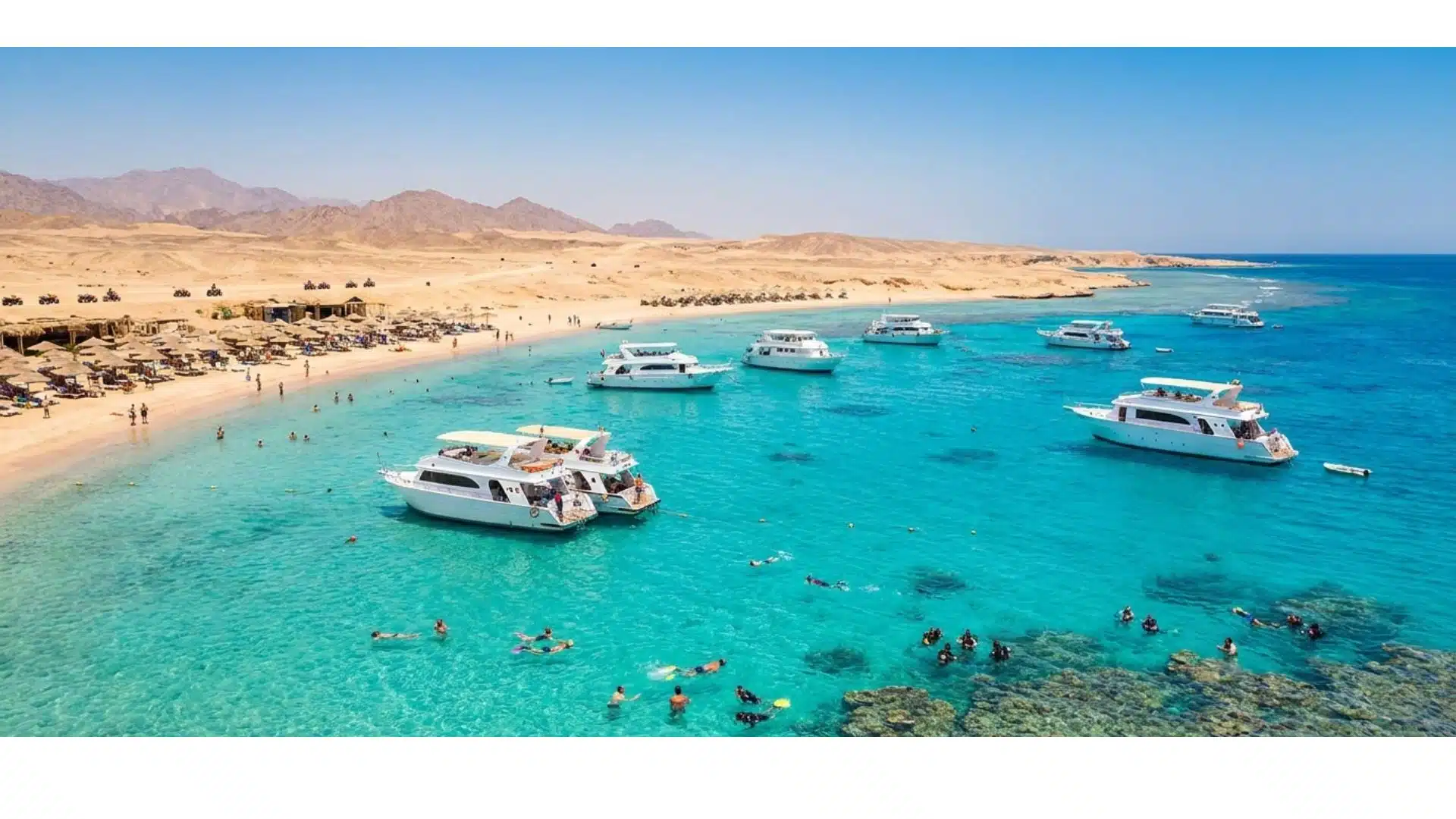
Giftun Island lies about 10 to 11 km offshore and is the largest of the islands off Hurghada. Its sandy beaches and clear water make it the most popular boat trip from the town, and the surrounding reefs include many of the area’s best-known dive and snorkel sites. The islands sit within a protected area, so expect a park fee on top of the boat price. Orange Bay, one of the beaches on Giftun, is the name you will see on most excursion menus. Boats usually gather at the port early in the morning and return in the late afternoon.
Carless Reef and Fanadir suit divers of different levels
Carless Reef (often misspelt as Carlos Reef) is one of the best-known dive sites near Hurghada. It is formed by two coral pinnacles rising towards the surface, with a sandy valley between them that is shallow enough for less experienced divers, and it is known for its moray eels. Fanadir, closer to the coast, has long, narrow reefs where drift diving is common. Abu Ramada, about an hour out by boat, is another regular stop for dive boats, with coral growth that attracts a wide range of reef fish.
Magawish, Abu Minqar and Shadwan are worth knowing about
Magawish Island lies a few kilometres south-east of the town and was one of the first areas developed for tourism. Abu Minqar, about 3 km offshore, is notable for its mangrove trees, which are rare along this stretch of coast. Shadwan Island, roughly 35 km from Hurghada at the mouth of the Gulf of Suez, is the largest island in the area and is known for steep reef walls and several shipwrecks. The currents there are strong, so Shadwan is a trip for qualified divers rather than snorkellers.
Choosing a responsible boat trip makes a real difference
The quality of a Red Sea boat trip varies more than the price suggests. The cheapest excursions often carry very large groups to the same few sites, while smaller boats can reach quieter reefs and give you more time in the water. Before you book, ask how many passengers the boat carries, whether the crew uses mooring buoys rather than anchoring on coral, and whether a guide briefs guests on not touching or standing on the reef. A rash vest and a reef-safe sunscreen protect both your skin and the coral.
Culture in Hurghada goes well beyond the beach
Hurghada has more cultural depth than its resort image suggests, and a morning in town balances the days spent at sea. The Hurghada Museum and the city’s places of worship are the best starting points, and the family attractions on the southern road fill a hot afternoon well.
The Hurghada Museum opened in 2020 on the southern side of the city and displays artefacts from across Egyptian history, from everyday tools and ornaments to objects from the pharaonic and later periods. It is a useful introduction if you plan a day trip to Luxor later in your stay, because it gives context to the temples and tombs you will see there.
El Mina Mosque, which overlooks the harbour, is one of the most recognisable buildings in Hurghada, with twin minarets visible from much of the seafront. Visitors are generally welcome outside prayer times if they dress modestly, and women should bring a scarf to cover their hair. If you are travelling on to Cairo, our guide to the Ibn Tulun Mosque explains the much older Islamic architecture of the capital. Hurghada also has a Coptic Orthodox cathedral, a reminder that Egypt’s Christian community has deep roots along this coast.
Families have several options south of the centre. Mini Egypt Park in Makadi Bay displays around 55 scale models of Egyptian landmarks, including the Pyramids of Giza and Karnak Temple, and Sand City shows large sand sculptures of historical figures. The ConnollyCove team suggests saving these for the hottest part of the afternoon, after a morning on the water. A few words of Egyptian Arabic go a long way in any of these places: ahlan (hello), shukran (thank you) and min fadlak (please, when speaking to a man) are the phrases you will use most.
The desert monasteries link Hurghada to early Christian Ireland
The Monastery of St Anthony and the Monastery of St Paul, in the mountains north of Hurghada, stand where Christian monastic life took shape, and that tradition later influenced the early monasteries of Ireland. St Anthony withdrew to the Eastern Desert in the fourth century, and his followers built their community at the foot of the cliffs where he lived as a hermit. St Paul of Thebes, traditionally regarded as the first Christian hermit, lived in the same mountains, and his monastery lies about 35 km away across the ridge.
The connection to Ireland is carved in stone. On the high cross at Moone in County Kildare, a panel shows Saints Paul and Anthony breaking bread in the desert while a raven brings them a loaf, and the same scene appears on many other Irish high crosses. Historians read these carvings as evidence of how strongly the Egyptian desert hermits influenced early Irish monasticism. The Irish place name element díseart, found in names such as Dysart and Desertmartin, comes from the Latin word for a desert and referred to a hermitage. Skellig Michael, the monastic settlement on a rock off the Kerry coast, is the most dramatic Irish expression of the same ideal of withdrawing to a remote place to pray.
Connolly Cove explores the headlands and islands of the Irish west in our piece on the myths of Ireland’s rugged coastline, and Skellig Michael is one of the sites recognised on the list covered in our guide to UNESCO World Heritage Sites. If you want to see Moone for yourself, our Ireland travel guide is the place to start planning.
Visiting the monasteries takes a full day. St Anthony’s lies about 45 km inland from Zafarana, which is roughly 270 km north of Hurghada on the coast road that continues towards Suez City, and most visitors combine both monasteries on one private tour. Local guides recommend checking opening arrangements in advance, because the monasteries are working religious communities and access can change around Christmas and Lent. Dress modestly, with shoulders and knees covered, and allow extra time if you want to climb up to St Anthony’s cave above the monastery.
Desert safaris and stargazing show the land behind the coast
The Eastern Desert begins almost at the edge of town, and a half-day desert trip is the easiest way to see it. Most safaris head into the Red Sea Mountains by quad bike or four-wheel drive, often stopping at a Bedouin camp for tea and returning after dark. Our guide to the mountains of Egypt explains how these ranges fit into the wider geography of the country.
Choose operators who limit group sizes and treat the camps they visit as hosts rather than props, since some cheaper tours offer little more than a staged photo stop. The desert routes here were once used by caravans and pilgrims, and ConnollyCove’s feature on ancient Saharan trade routes covers the wider history of desert travel in North Africa. On a clear, moonless night away from the resort lights, the sky over the desert is very dark, and our guide to stargazing sanctuaries explains what makes a good dark sky site.
Red Sea creatures echo Irish sea legends

The Red Sea is home to the dugong, a large, slow-moving marine mammal sometimes called a sea cow, and sailors’ sightings of dugongs and manatees are often suggested as one possible source of mermaid stories. That idea remains a theory rather than a fact, but it makes an interesting comparison with Ireland’s own sea folklore.
In Irish tradition, the merrow (murúch) is a sea creature with a human form who appears in coastal stories around Ireland. ConnollyCove’s guide to legendary creatures from Celtic mythology is the place to read more about the beings of Irish folklore, and our overview of Irish mythology and its four cycles places these figures in the older story tradition. Dugongs are seen more reliably further south along the Red Sea coast than around Hurghada itself, so treat any sighting near the town as a bonus rather than an expectation.
Day trips from Hurghada reach Luxor and Cairo
Luxor is the most rewarding day trip from Hurghada, and Cairo is possible if you fly. The road journey to Luxor usually takes around four hours each way through the Eastern Desert, so day tours leave very early and return late. The usual programme covers the Valley of the Kings and Karnak Temple, and our guide to Luxor Temple explains what to look for at the great temple in the centre of the modern city. If you have the time, an overnight stay in Luxor is far less tiring than a single day.
Cairo is about an hour away by plane, which makes a long day trip possible. ConnollyCove’s guides to the Pyramids of Giza and to spending 24 hours in Cairo help you plan a short visit, and our piece on places to explore in Old Cairo covers the Coptic quarter, which connects naturally to the monasteries near Hurghada.
If you are comparing Hurghada with the Sinai resorts, ConnollyCove’s guide to South Sinai covers Sharm El Sheikh and the mountains, and our article on Dahab explains why that smaller town appeals to independent divers. Both are reached most easily by flying, since the overland route around the Gulf of Suez is long, so they work better as a separate trip than as a day out from Hurghada.
Practical information for Irish and UK travellers
The practical side of a Hurghada trip is simple once you know the visa and money arrangements. Hurghada is on the mainland, so the free Sinai resort stamp does not apply and every visitor arriving here needs a full tourist visa.
Seasonal direct flights operate to Hurghada International Airport from several UK and Irish airports, with a flying time of around five hours. Routes and schedules change from season to season, so check current options before you book.
British passport holders can apply for an e-visa online before travel or buy a visa at the approved kiosks in the arrivals hall, payable in cash. Your passport should be valid for at least six months from the date you arrive. The FCDO entry requirements for Egypt set out the current fee and rules, and Irish passport holders should check the Department of Foreign Affairs travel advice for Egypt.
The currency is the Egyptian pound. Tipping, known as baksheesh, is part of daily life, and small notes are useful for drivers, porters and boat crews. Agree a taxi fare before you set off, or use a ride-hailing app where available. Drink bottled water, and take the midday sun seriously, especially on boat trips where the breeze hides how strong it is.
Seasonal conditions and the best time to visit Hurghada
Hurghada is a year-round destination, but the season you choose changes the trip. From November to March, daytime temperatures are typically in the mid-twenties Celsius, which suits sightseeing and day trips, though evenings can be cool and winter winds can make boat days choppy. In high summer, temperatures in the Red Sea region often top 40°C, so plan excursions for early morning and evening.
The sea is warmest in late summer and early autumn, which is the most comfortable time for long snorkelling sessions. Christmas, New Year and the February half-term are the busiest periods for Irish and UK visitors, so book flights and hotels early for those weeks. The dates of Ramadan move about eleven days earlier each year; hotels operate normally, but some local restaurants change their hours, so check the dates for your trip.
Suggested Hurghada itineraries for three, five and seven days
Three days in Hurghada is enough for one boat trip to Giftun Island, an evening in El Dahar and a desert safari. With five days, you can add a dive or snorkel day at Careless Reef or the southern bays and a morning at the Hurghada Museum and El Mina Mosque. A full week lets you combine the reefs with a day trip to Luxor and a day at the monasteries of St Anthony and St Paul, which is the itinerary we would suggest for anyone interested in Egypt’s history and its links with Ireland.
FAQs
Is Hurghada worth visiting?
Yes, Hurghada is worth visiting for its offshore reefs, its year-round sun and its position as a base for Luxor and the desert monasteries.
How many days are enough in Hurghada?
Three to five days cover the reefs and the town, while a week gives you time for a Luxor day trip and the monasteries.
Can I do a day trip from Hurghada to Luxor?
Yes, organised day trips run to Luxor, though the road journey takes around four hours each way, so an overnight stay is more relaxed.
Can you swim with dolphins in Hurghada?
Some boat trips visit reefs where wild dolphins are often seen, but sightings are never guaranteed and responsible operators keep their distance.