
Updated on:
by
 Marwa Alaa
 Marwa Alaa
Article Summary
What this article covers: A detailed, categorised guide to things to do in Florence, covering the Duomo complex, major galleries, historic churches, squares, the Oltrarno district, food, weather, and travel logistics.
Who this is for: First-time visitors to Florence, culture-focused travellers planning a city break of two to five days, and anyone trying to fit the Uffizi Gallery, the Duomo, and Michelangelo’s David into a trip without exhausting themselves.
Key takeaway: Florence’s biggest planning risk isn’t missing a sight, it’s cramming too many high-intensity museums into one day and burning out before you’ve seen half of what you came for.
Expert insight: “When we first spent three days in Florence trying to see everything, we came home remembering less, not more. Pairing one major gallery with a quiet garden or courtyard each day is the difference between a trip you enjoyed and a trip you only photographed.” – Ciaran Connolly, Founder of ConnollyCove
Quick facts:
- Florence’s historic centre was inscribed on the UNESCO World Heritage List in 1982.
- The Accademia Gallery and the Bargello Museum merged into a single institution in March 2026, changing how combined museum tickets work in the city.
- The Duomo’s nave is free to enter, but Brunelleschi’s Dome, the Baptistery, the bell tower, and the crypt all require a separate combined ticket.
- The Maggio Musicale Fiorentino, founded in 1933, is Italy’s oldest music festival and Europe’s second oldest after Salzburg.
Table of Contents
Known as the Athens of the Middle Ages, the cradle of the Renaissance, the birthplace of the Italian Renaissance, and the capital of the Tuscany region and Firenze province, Florence is a popular tourist destination in Italy for its beautiful architecture, vibrant neighbourhoods, and delicious food. You have countless exciting things to do in Florence, Italy.
Florence rewards travellers who slow down. There are enough things to do in Florence to fill a fortnight, but the city’s historic centre is small enough to walk end to end in under an hour. This means the real skill isn’t ticking off sights; it’s pacing yourself through them properly and knowing which of the city’s dozens of museums, churches, and squares actually deserve your time.
At ConnollyCove, an Ireland-based travel and culture platform covering destinations from Belfast to the Tuscan hills, we treat a place like Florence the same way we treat Belfast or Dublin: somewhere layered with history that rewards time rather than a rushed checklist. If you’re combining this trip with other Italian cities, our Italian travel statistics guide is a useful starting point before you book anything. This guide covers every major sight, the churches and squares most visitors walk past, the food, the weather, and the logistics most Florence guides skip, including a genuinely surprising Irish connection hiding in the hills above the city.
Florence at a Glance: Where to Start
Here’s where ConnollyCove recommends starting if you only have a day. Four sights anchor almost every list of things to do in Florence, clustered within a fifteen-minute walk of each other along the Arno.
- The Duomo complex, Brunelleschi’s Dome, Giotto’s Bell Tower, and the Baptistery
- The Uffizi Gallery, for Botticelli, Leonardo, and the Medici collection
- The Accademia Gallery, home to Michelangelo’s David
- Ponte Vecchio, the medieval bridge lined with jewellers’ workshops, and Florence’s oldest surviving crossing of the Arno
Florence is flat and compact, sitting low in the Arno valley rather than across hills like Rome, so walking between all four is realistic in the morning. Everyone else has the same plan, though, so the pacing section further down is worth reading before you book anything.
The Duomo Complex: Dome, Bell Tower, and Baptistery
Start here because it’s free to admire from the outside, and it orients you to everything else. The Florence Cathedral, better known as the Duomo, was formerly called Cattedrale di Santa Maria del Fiore, or the Cathedral of Saint Mary of the Flower. It dominates Piazza del Duomo with a facade of pink, white, and green marble.
The cathedral complex includes the Opera del Duomo Museum, the Baptistry of Saint John, and Giotto’s Campanile, all listed as UNESCO World Heritage Sites. Its dome remains one of the most technically remarkable structures of the Renaissance.
A visit inside the Duomo is free, but if you want to climb the dome, you’ll need to book in advance.
Brunelleschi’s Dome (Cúpula de Santa María del Fiore)
In 1436, the architect Filippo Brunelleschi won a competition to solve a problem nobody else could: how to build a dome across a 44-metre gap without a supporting wooden frame. His solution still holds; it’s a self-supporting double shell built using a herringbone brick pattern borrowed from ancient Roman engineering. Climbing the 463 steps inside puts you between the two shells, close enough to see the brickwork, before you emerge onto a narrow gallery with the whole city laid out below.
Giotto’s Campanile (Giotto’s Bell Tower)
Giotto’s Bell Tower stands beside the cathedral and offers an easier climb with arguably a better view, since you can see the dome itself rather than stand inside it. Its facade is made of white, green, and pink marble and is built in the Gothic style. For panoramic views of Florence’s skyline, you can climb up this tallest historical tower, approximately 84 meters high. At the top of the building, you can view the Duomo and the surrounding areas.
The octagonal Baptistery of San Giovanni, one of the oldest buildings in Florence, holds the bronze doors that Ghiberti spent decades casting and that Michelangelo reportedly called the Gates of Paradise.
The cathedral nave is free and needs no booking. The dome, bell tower, baptistery, museum, and crypt run on a single combined pass, and slots for the dome climb sell out weeks in advance in spring and summer. The official Duomo complex website carries the current booking calendar and is worth checking before you travel, since availability shifts through the season.
World-Class Renaissance Art: Uffizi, Accademia, Bargello, and Pitti Palace
Four collections carry most of the weight when people plan things to do in Florence for art, and each rewards a plan rather than a wander.
The Uffizi Gallery (Galleria degli Uffizi)
The Uffizi Gallery holds one of the world’s great collections of Italian Renaissance painting: Botticelli’s Birth of Venus and Primavera in the same room, Leonardo’s early Annunciation, Caravaggio’s unsettling Medusa, and Titian’s Venus of Urbino, among several thousand other works in a Vasari-designed palazzo on the Arno. Early morning, at opening, is genuinely quieter than any other time of day.
The Accademia Gallery (Galleria dell’Accademia di Firenze)
A short walk away, the Accademia Gallery exists almost entirely because of one sculpture, Michelangelo’s David. Carved from 5.17 metres of Carrara marble when the artist was twenty-six, Michelangelo’s David stood in Piazza della Signoria for over three centuries before moving indoors in 1873 to protect it from weathering. The bronze and marble copies now in the square and at Piazzale Michelangelo are good photographs; the original, lit from above in its purpose-built tribune, is a different experience entirely.
The Bargello Museum (Museo Nazionale del Bargello))
As of March 2026, the Accademia Gallery and the Bargello Museum operate as one institution with combined tickets. The Bargello is Florence’s oldest surviving public building and was once the city’s police headquarters and prison. Today, it houses Donatello’s bronze David, an earlier and stranger version than Michelangelo’s that usually has far shorter queues.
Pitti Palace (Palazzo Pitti)
Across the river in Oltrarno, the Pitti Palace was the Medici family’s principal residence from the 7th century and now holds around 250,000 catalogued artworks across several museums. The Palatine Gallery is the highlight, with rooms named after Roman gods (Venus, Mars, Jupiter) still hung salon-style, floor to ceiling, the way the Medici themselves displayed them.
Florence’s Historic Churches
Beyond the Duomo, Florence’s churches carry as much history as its galleries, and most go largely unnoticed next to the big-name sights.
Santa Croce
The Basilica of Santa Croce is the largest Franciscan church in the world. It holds the tombs of Michelangelo, Galileo, and Machiavelli, which is why Florentines nicknamed it the Temple of the Italian Glories. Its Gothic marble facade only dates to the 19th century, but the burials inside are genuine.
Basilica of San Lorenzo and the Medici Chapels (Cappelle Medicee)
The Basilica of San Lorenzo, the Medici family’s parish church, is located beside the Medici Chapels, their private mausoleum. Inside, the basilica helped define early Renaissance architecture, with an integrated system of columns, arches, and entablatures. The attached Biblioteca Medicea Laurenziana holds one of Italy’s most important collections of manuscripts.
Within the same complex, the Medici Chapels (Cappelle Medicee) are a must-visit in their own right. They consist of three structures: the Sagrestia Nuova (New Sacristy), the Cappella dei Principi (Chapel of the Princes), and the Crypt. The Cappella dei Principi’s octagonal dome and inlaid marble make it one of the more overlooked interiors in the city.
Santa Maria Novella
Most visitors know the name from the railway station outside, but the church itself is the real draw. Its striking green-and-white geometric facade opens onto an unusually calm cloister inside, one of the quiet spots worth remembering when we talk about pacing your visit later in this guide.
Orsanmichele
A few streets from the Duomo, Orsanmichele began life as a grain market before a miraculous image on one of its columns turned it into a church. It has no front door; the entrance is around the corner in the back. Its 14 exterior niches once held original Renaissance sculptures by Donatello and Ghiberti; now preserved in the small museum upstairs, with copies standing in their place outside.
St Minias on the Mountain (San Miniato al Monte)
Up a steep hill above Piazzale Michelangelo, San Miniato al Monte is the quietest of the great Florence views. Its Romanesque green-and-white marble facade sees a fraction of the visitors that gather below it for sunset, and the walk up is part of the reward.
Squares, Bridges, and Hidden Corners
Florence’s public spaces carry as much of the city’s character as its museums, from a civic stage that’s hosted political drama since the Middle Ages to a marketplace named after a bronze pig.
Piazza della Signoria and Palazzo Vecchio
Between the Arno River and the Duomo, the L-shaped Signoria square has been Florence’s political stage since the Middle Ages. The Loggia dei Lanzi, along one edge, is an open-air sculpture gallery in its own right, and Palazzo Vecchio’s tower is climbable for a view that rivals the Duomo’s without the same queue.
Ponte Vecchio
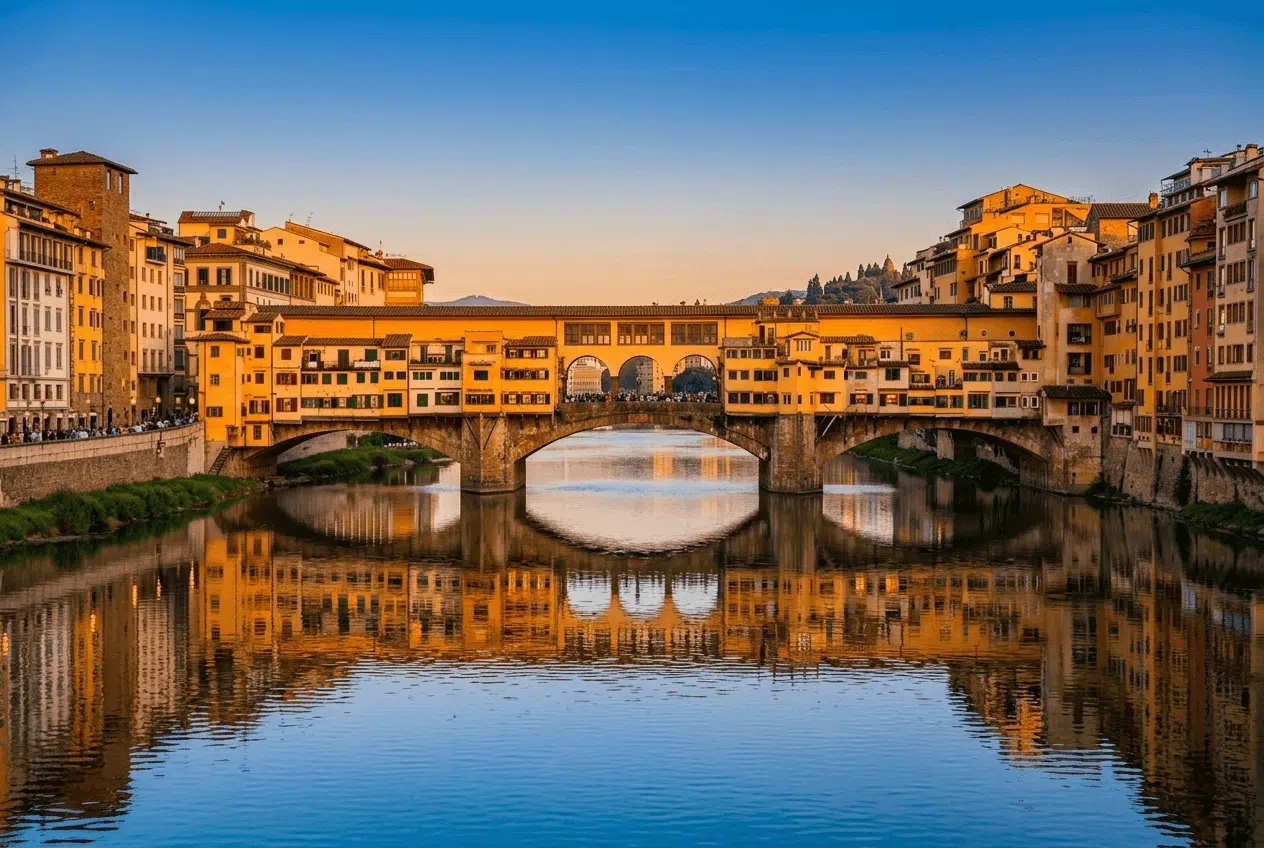
Ponte Vecchio is Florence’s oldest surviving bridge over the Arno; it is one of the first segmental arch bridges built anywhere in the Western world. Its jewellers’ workshops have lined the crossing for centuries, and the two open terraces midway across give the best uninterrupted river views in the city, day or night.
Piazza della Santissima Annunziata
A short walk from the Duomo, there is a square called Piazza della Santissima Annunziata. This square is named after the Church of Santissima Annunziata and centres on a bronze Equestrian statue of Grand Duke Ferdinando I, flanked by two Baroque bronze fountains.
Hospital of the Innocents (Ospedale degli Innocenti)
On one side of the Piazza della Santissima Annunziata stands the Hospital of the Innocents (Ospedale degli Innocenti), Europe’s first purpose-built orphanage and an early landmark of Italian Renaissance architecture. Its facade is decorated with grey stone and white stucco and lined with nine terracotta medallions of swaddled infants. It now houses a small museum of Renaissance art.
Loggia del Mercato Nuovo
Tucked between Piazza della Signoria and Ponte Vecchio, this covered Renaissance marketplace is known locally as the Loggia del Porcellino, after the bronze wild boar fountain on its southern side. Rub the boar’s snout for good luck, and visit early or after closing if you want a photograph without a crowd of vendors and shoppers in the way. However, do not miss going to the market in the morning to buy souvenirs.
Music and Performance: Opera di Firenze
If your visit falls between late April and June, the Maggio Musicale Fiorentino (Florence Musical May) is worth building an evening around. Founded in 1933, it’s Italy’s oldest music festival and Europe’s second-oldest after Salzburg, running opera, orchestral concerts, and ballet at the Teatro del Maggio Musicale Fiorentino, known locally as Opera di Firenze, on the western edge of the historic centre. Tickets are sold through the theatre’s own box office and site rather than general resellers.
The Oltrarno Quarter: Craft, Quiet Streets, and a Church of Its Own
South of the river, Oltrarno, its name literally means “beyond the Arno”, trades the crowds for craft workshops, quieter squares, and a genuinely local rhythm. It’s one of the more rewarding things to do in Florence for travellers who’ve already covered the major museums and want to see how the city actually works.
Basilica of the Holy Spirit (Basilica di Santo Spirito)
The quarter’s own great church is a masterclass in early Renaissance proportion. Its facade is plain and almost bare, with no ornamentation, pillars, or decoration, giving little hint of what’s inside: pale grey stone columns, 38 side chapels, a coffered ceiling, and pilasters lining the aisles. The church is divided into three aisles by columns, and among its artworks is a crucifix generally attributed to a young Michelangelo. Despite the comparable quality to Santa Croce, it draws fewer visitors.
The Artisan Workshops of San Frediano
The Medici commissioned craftsmen to decorate their palaces here for centuries, and the tradition never fully left. San Frediano still has working leather ateliers, bookbinders, and gold-leaf specialists, many of whom are open to visitors who stop and ask.
“Watching a craftsman in Oltrarno hand-tool a bag using techniques passed down through generations reminded me that heritage isn’t only kept behind museum glass. It’s a living tradition, not unlike the weavers of Donegal or the stonemasons of the west of Ireland, and it’s still very much alive on Florence’s back streets.” – Ciaran Connolly, Founder of ConnollyCove
Piazzale Michelangelo and Florence’s Best View
The square above the Oltrarno hills gives the single best skyline view in the city, and it’s free. Arrive an hour before sunset to get a spot along the balustrade; the crowd thins fast once the light goes. If you’d rather skip the crowd altogether, climb up to San Miniato al Monte instead. It offers a similarly good view from higher ground, and you’d likely have the view mostly to yourself.
Bardini Gardens (Giardino Bardini)
Behind Palazzo Mozzi, Bardini Gardens climb a 17th-century Baroque staircase through a wisteria tunnel to a small café, with terraced grounds that mix formal Italian garden design with an English-style landscape park. It’s usually far quieter than the Boboli Gardens next door.
Pacing Yourself: Avoiding Renaissance Fatigue
Pair a big gallery with somewhere quiet, not another gallery, and you’ll remember more of the trip. Florence is famously the city that gave psychosomatic “aesthetic overload” its clinical name, after the French writer Stendhal described feeling faint and disoriented after a day of intense art viewing there in 1817. You don’t need a diagnosis to recognise the feeling: two major galleries back-to-back leave most visitors with a blur of frescoes rather than any single memory that sticks.
It’s advice that ConnollyCove gives constantly, whether you’re planning a Florence itinerary or a weekend in Rome: the practical fix is pairing, not pacing yourself by the clock. After a morning at the Uffizi or Accademia, choose somewhere sensory-neutral rather than another museum; the quiet cloister at Santa Maria Novella, a wander through Giardino Bardini, or simply a coffee on a rooftop terrace looking at the Duomo, rather than another painting. This is the single change most Florence itineraries are missing, and it’s the difference between remembering the trip and remembering only the queuing.
Florence for Food Lovers
Two markets anchor the city’s food scene, each serving a different purpose. Mercato Centrale, in the San Lorenzo district, is a covered food hall with dozens of stalls and a lively, tourist-friendly atmosphere. Mercato di Sant’Ambrogio, a 15-minute walk east, is quieter, more residential, and closer to how Florentines actually shop.
Florence is famous for its delicious traditional dishes, which you must try. Two dishes are worth seeking out specifically. Lampredotto is slow-cooked tripe served in a bread roll from street stalls. It is Florence’s classic working-class food and is still sold from carts across the centre. Schiacciata is a flat, olive-oil-rich bread that turns up as a snack or a sandwich base everywhere.
Here are other Italian dishes that turn up on every genuine Florentine menu:
- Ribollita is a thick winter soup of beans, cavolo nero, rustic country bread, and tomato-based stew. It is peasant cooking elevated by repetition; the name means “reboiled,” since it traditionally improves the second day.
- Bistecca alla Fiorentina is a thick, fire-grilled T-bone steak, seasoned simply with salt, pepper, a squeeze of lemon, and olive oil, and served rare by default. Expect the raw cut to be shown to you at the table before it’s cooked. For a smoky flavour, the steak is cooked over roasted chestnuts.
- Pappardelle, wide ribbons of egg pasta, are the classic vehicle for rich Tuscan sauces made with rabbit, hare, or duck.
And no visit is complete without the Italian handmade gelato; artisan gelaterie tend to keep flavours in covered metal tins rather than piling them into bright, mounded displays, which is usually the simplest way to tell the good from the average. You will find the best Italian Gelato ever in Florence. It has a lot of flavours, like caffé “coffee,” nocciola “hazelnut,” fior di latte “milk,” pistachio “pistachio,” and more.
If you sit down for a proper meal, expect a small coperto (cover charge, usually €1 to €3 per person) on the bill; it’s a standard, legal cost covering bread and table service, not a tip. Tipping itself isn’t expected in Florence, though rounding up is appreciated for good service.
Weather and the Best Time to Visit Florence
Florence sits low in the Arno valley, which makes its climate more extreme than the Tuscan coast: hot, fairly dry summers and cool, damp winters. July and August regularly reach the low thirties Celsius with high humidity, while January and February hover a few degrees either side of freezing overnight. Autumn and winter bring the most rain, so pack accordingly if you’re visiting between October and February. The Italian Met Office (Aeronautica Militare) publishes current forecasts if you want real-time conditions closer to your trip.
April to May and September to early October offer the most reliable balance of comfortable temperatures and manageable crowds, and they’re the seasons this guide’s ticket-booking advice assumes throughout. Peak summer brings the longest queues and the highest prices; winter is quieter and cheaper but greyer, with some outdoor sights and gardens on reduced hours.
Know Before You Go: Tickets, Timing and Getting There
Booking windows genuinely matter here. ConnollyCove produces practical, logistics-focused guides for travellers heading anywhere from Belfast to Florence, and ticket policies here change often enough that it’s worth bookmarking the official sites below rather than relying on any single guide, including this one. The table below reflects 2026 pricing and should be checked against official sites before you travel, since museums do adjust fees.
| Sight | Typical Cost (2026) | Book Ahead? | Note |
| The Duomo, Dome and Baptistery (combined pass) | Around €30 | Yes, several weeks ahead for peak season | Cathedral nave itself is free and needs no ticket |
| Uffizi Gallery | €25 on the day, €29 online, €16 after 4pm | Yes, 2 to 3 weeks ahead April to October | The 4pm discount ticket, introduced January 2026, is the best value slot |
| Accademia Gallery (Michelangelo’s David) | €16 at the door, €20 online | Yes, especially in peak season | Now combined with the Bargello Museum on a joint 48-hour pass |
| Pitti Palace and Boboli Gardens | Combined ticket available with the Uffizi Gallery | Recommended in peak season | Best paired with a Palatine Gallery visit |
| Piazzale Michelangelo and Giardino Bardini | Free | No | Arrive an hour before sunset at the Piazzale for a spot |
Flying In: Florence Airport vs Pisa for UK and Irish Travellers
Florence’s own airport, Peretola (FLR), has limited direct routes to the UK and Ireland. Many travellers from Britain and Ireland instead fly into Pisa International Airport (PSA), which has far more budget connections, and connect onward by rail. The Pisa Mover monorail links the airport to Pisa Centrale station in about five minutes, and a regional Trenitalia service from there to Florence Santa Maria Novella takes roughly 50 to 80 minutes, depending on the train.
A Surprising Irish Thread in the Hills Above Florence

Ireland’s connection to Tuscany runs deeper than most guidebooks mention. In the hills above Florence sits Fiesole, an Etruscan hilltop town reachable by a short bus ride from the city centre. Its cathedral holds the tomb of Donatus, an Irish monk and scholar who was elected Bishop of Fiesole around 829 AD. Donatus served for nearly 50 years, advised two Holy Roman Emperors, and wrote a Latin poem about his native Ireland that survives to this day, one of the earliest surviving pieces of writing by an Irish emigrant abroad.
It’s a small, verifiable detail rather than a major attraction, but it’s the kind of connection that changes how a place feels. Travellers with an interest in Ireland’s long tradition of scholars and monks travelling across medieval Europe will find Fiesole a worthwhile half-day addition, with sweeping views back over Florence as a bonus.
Planning Your Visit?
Florence rewards travellers who mix its unmissable sights with its quieter corners rather than trying to see everything at full speed. For more on planning a longer Italian trip, explore ConnollyCove’s guides to the Amalfi Coast, Venice, and budget-friendly things to do in Rome, or watch our YouTube channel for more on the destinations we cover. If you’re travelling with children, our separate guide to things to do in Florence with kids covers family-specific logistics, and our free things to do in Florence guide is worth bookmarking for budget days.
FAQs About Things to Do in Florence
Here are the questions travellers most often ask before working out their own list of things to do in Florence.
Is 2 days in Florence enough?
Two days cover the essentials, the Duomo complex, the Uffizi gallery, and the Accademia gallery, but it leaves no room to slow down. A third day is worth adding if you can, ideally spent in Oltrarno, at the markets, or simply revisiting a favourite square without an agenda.
Is Florence a walkable city?
Yes, exceptionally so. The historic centre is largely pedestrianised, and most major sights sit within a fifteen-minute walk of each other. Public transport or taxis are rarely necessary for a standard visit.
What is the best time of year to visit Florence?
April to May and September to October offer the most reliable balance of pleasant weather and manageable crowds. July and August bring intense heat and the largest crowds of the year, while winter is quieter but colder and greyer.
How does the coperto (cover charge) work in Florence restaurants?
The coperto is a standard, legal per-person charge, usually €1 to €3, added to the bill at sit-down restaurants across Italy. It covers bread and table service and isn’t a tip; tipping isn’t expected in Florence, though rounding up for good service is welcome.
Are there historical connections between Ireland and Florence?
Yes. Donatus, an Irish monk and scholar, became Bishop of Fiesole, a hilltop town just outside Florence, around 829 AD and served for nearly fifty years. He’s buried in Fiesole’s cathedral, a short bus ride from central Florence.
Do I need to book Uffizi and Accademia tickets in advance?
Yes, particularly from April to October. Same-day walk-up tickets for both museums regularly sell out by mid-morning in peak season, so booking online one to three weeks ahead is the safer approach.
Now, after you have read about Florence, tell us which tourist attraction you will visit first. Florence, with its fantastic architecture, beautiful views, and delicious food, awaits you!