

Article Summary
What this article covers: The history, heavy events, dancing, piping and best-known gatherings of the Highland Games of Scotland, with practical advice for anyone planning to attend one.
Who this is for: Travellers planning a summer trip to Scotland and readers with Scottish or Irish heritage who want to understand how the traditional events work.
Key takeaway: The Highland Games of Scotland are regulated athletic competitions held from late May to September. The caber toss is scored on how straight the log lands, and distance counts for nothing.
Expert insight: “The caber is the event everyone photographs, but the telling moment is when the crowd goes quiet and watches the judge behind the thrower. Once you know the score depends on where the top of the log points, a perfect 12 o’clock toss feels like a goal going in.” , Ciaran Connolly, Founder of ConnollyCove
Quick facts:
- The Scottish Highland Games Association was founded in 1947 as the Scottish Games Association and now represents more than 60 member games.
- The Braemar Gathering is held on the first Saturday of September, and reigning monarchs have attended regularly since Queen Victoria’s first visit in 1848.
- The Cowal Highland Gathering in Dunoon, first held in 1894, hosts the World Highland Dancing Championships on the final weekend of August.
The thud of a five-metre log landing on wet grass is one of the most familiar sounds of a Scottish summer. The Highland Games of Scotland run from late May until the third Saturday in September, and the Scottish Highland Games Association alone oversees more than 60 member events. Some draw crowds in the tens of thousands, while others fill an afternoon on a village green.
For ConnollyCove, the Ireland-based travel and culture platform founded by Ciaran Connolly, the games sit naturally beside our coverage of the Celtic nations and the traditions they share. Ireland and Scotland have common Gaelic roots, and Ireland once held its own funeral games at Teltown in County Meath. Readers interested in the families behind the gatherings can also read our guide to Scottish clans and their place at the Highland games.
This guide explains where the Highland Games of Scotland came from, how each heavy event is judged and which gathering suits your trip. It also corrects a common error, the belief that the caber is thrown for distance.
Table of Contents
Where the Highland Games of Scotland Came From
The Highland Games of Scotland grew out of clan gatherings, local fairs and military musters, and the version spectators watch today was largely shaped in the nineteenth century. Several of the best-known origin stories rest on oral tradition rather than written records, so it helps to separate the two.
Clan Gatherings and the Braemar Hill Race
Tradition links the earliest games to King Malcolm III, who reigned in the eleventh century. According to the story told at Braemar, he held a race up Craig Choinnich, above the village, to find the fastest runner to carry royal messages. No contemporary record of the race survives, but the story explains why Braemar claims the oldest royal connection of any gathering.
Clan chiefs are also said to have tested their men’s strength at gatherings, contests that later became the heavy events. Ceres in Fife dates its own games to 1314, when, according to local tradition, Robert the Bruce granted the village a charter after its men fought at Bannockburn.
Proscription, Revival and Royal Patronage
After the Jacobite defeat at Culloden, the Act of Proscription came into force on 1 August 1746. Its dress clauses banned men and boys north of the Highland line from wearing Highland dress, including the kilt, until repeal on 1 July 1782. The Act is often said to have banned bagpipes and the Gaelic language too, but its text mentions neither.
King George IV’s visit to Edinburgh in 1822 helped turn tartan into national dress. At Braemar, the Braemar Wright Society was formed in July 1815 and began funding cash prizes at the gathering in 1832. Queen Victoria attended in 1848, during her first stay at Balmoral, and granted the society royal status in 1866. Her patronage gave the Highland Games of Scotland a national profile that has lasted ever since.
Who Governs the Games Today
The Scottish Highland Games Association (SHGA) is the governing body for traditional games in Scotland. It was founded in 1947 as the Scottish Games Association to standardise competition rules and make judging consistent. It now runs national championships and regional leagues across its member games.
The Heavy Events at the Highland Games of Scotland
The heavy events are the throwing contests most visitors come to see, and each tests a different balance of strength and technique. Implement weights differ between classes and between games, so the figures below are common standards rather than fixed national rules.
The Caber Toss and Clock-Face Scoring
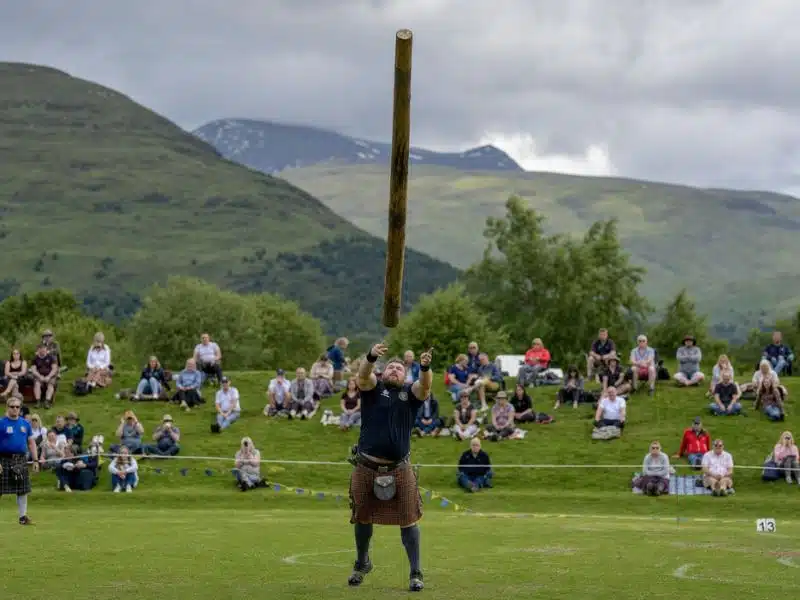
The caber is a tapered log, often around 5 metres (16 feet) long, and its exact weight varies from one games to another. The athlete lifts it with the narrow end cupped in both hands, runs forward and stops sharply, so the heavy end strikes the ground and the log flips over.
A judge stands behind the thrower and reads the landing as if the field were a clock face. A caber that falls pointing straight ahead scores 12 o’clock, the perfect toss, while one that drifts to the side is recorded as 11 o’clock or 1 o’clock. A caber that rises but does not pass the vertical is usually scored by the angle it reached, up to 90 degrees. Distance plays no part in the result.
The Stone Put: Braemar Stone and Open Stone
The stone put is the ancestor of the modern shot put. In the Braemar stone, athletes throw from a standing position without a run-up, and men’s stones commonly weigh about 20 to 26 lb (9 to 12 kg). The open stone is lighter, often 16 to 22 lb (7 to 10 kg), and the athlete may glide or spin before releasing it. Distance is measured to the first mark the stone makes, and Ceres also keeps its own Ceres Stane, which spends the rest of the year in the village pub.
The Scottish Hammer and Weight Throws
The Scottish hammer is a metal ball on a long handle of wood or cane. Unlike an Olympic thrower, the Highland athlete does not spin, keeping both feet planted behind a wooden board called the trig while whirling the hammer overhead. Men usually throw a 16 lb (7.3 kg) light hammer and a 22 lb (10 kg) heavy hammer.
The weight for distance uses a metal weight on a ring or chain, thrown with one hand from a marked box. Men commonly throw 28 lb (12.7 kg) and 56 lb (25.4 kg) weights. Weight over the bar uses the 56 lb weight thrown upwards over a bar that rises after each successful round.
The Sheaf Toss, Tug of War and Hill Races
The sheaf toss comes from farming fairs, and athletes use a pitchfork to send a bag of straw over a raised bar. Tug of war teams compete at gatherings such as Braemar and Ceres, while hill races recall the legend of Malcolm III’s runners. Many smaller games also include track running and cycling for local clubs.
| Event | Common Men’s Implement | How It Is Judged |
|---|---|---|
| Caber toss | Tapered log, often about 5 m (16 ft) | Clock-face accuracy, with 12 o’clock as perfect |
| Braemar stone | About 20 to 26 lb (9 to 12 kg) | Distance from a standing throw |
| Open stone | About 16 to 22 lb (7 to 10 kg) | Distance, with a glide or spin allowed |
| Scottish hammer | 16 lb and 22 lb (7.3 and 10 kg) | Distance, feet fixed behind the trig |
| Weight for distance | 28 lb and 56 lb (12.7 and 25.4 kg) | Distance, thrown one-handed from a box |
| Weight over the bar | 56 lb (25.4 kg) | Height cleared over a rising bar |
| Sheaf toss | Straw bag on a pitchfork | Height cleared over a rising bar |
Highland Dancing, Piping and Dress

Dancing and piping run alongside the athletics at most Highland Games of Scotland, usually on a separate stage or in another part of the field. Check the programme for dancing and piping times when you arrive, because these competitions are as central to many gatherings as the athletics.
Highland Dancing Competitions
Highland dancing is judged on technique and timing, and on how closely the dancer keeps to the traditional form. The best-known dances include the Highland Fling and the Sword Dance, or Gille Chaluim, in which the dancer steps between two crossed swords without touching the blades. Tradition says the Sword Dance began as a warrior’s dance before battle, although no early written source confirms it.
The Cowal Highland Gathering hosts the qualifiers and finals of the World Highland Dancing Championships, which makes Dunoon the main destination for dance enthusiasts in late August. Our guide to Irish dancing traditions explains how the Irish step style differs.
Solo Piping and Massed Pipe Bands
Solo piping competitions usually include marches, strathspeys and reels, along with piobaireachd, the long classical music of the Highland bagpipe. Pipe bands compete separately, and many gatherings close with the massed bands playing together. At Cowal, the salute to the Chieftain sees hundreds of pipers and drummers play ‘Highland Laddie’ as the sun sets over the Firth of Clyde. Our guide to the bagpipes of Scotland and other countries covers the instrument’s wider history.
Kilts, Tartan and What Athletes Wear
Heavy event athletes at the Highland Games of Scotland traditionally compete in kilts, often in their own clan tartan. Examples include the yellow and black of MacLeod of Lewis and the red of Royal Stewart. Full Highland dress adds a sporran, the pouch worn at the front of the kilt, and often a sgian-dubh, a small knife tucked into the sock. Visitors without a clan connection can wear a district tartan, which is linked to a place rather than a family.
Which Highland Games of Scotland to Visit
The right gathering depends on the month of your trip and how large a crowd you are happy to join. The three best-known events each show a different side of the tradition, while smaller games offer closer views.
The Braemar Gathering
The Braemar Gathering is held on the first Saturday of September at the Princess Royal and Duke of Fife Memorial Park in the Cairngorms National Park. The Braemar Royal Highland Charity has organised it since 2002, and its Duke of Rothesay Highland Games Pavilion, opened in 2019, displays items from the first games of 1832. Braemar is the most famous of the Highland Games of Scotland, so expect crowds of more than 10,000 and buy seated tickets well before you travel.
The Cowal Highland Gathering
The Cowal Highland Gathering takes place over the final weekend of August in Dunoon, Argyll, and was first held in 1894. Its organisers describe it as the largest Highland games in the world and report around 23,000 visitors a year. Dunoon sits across the Firth of Clyde, and most visitors from Glasgow reach it by ferry from Gourock, so build the crossing into your plans.
The Ceres Highland Games
The Ceres Highland Games take place on the last Saturday of June at the Bow Butts, a village green in Fife. Entry is free, and the organisers describe them as the oldest free games in Scotland, held since 1314 apart from the proscription years, the First World War and 2020. Its grassy banks form a natural bowl, and a 2024 report put the crowd at around 5,000, making Ceres a relaxed choice for families.
Smaller Community Games
Most of the Highland Games of Scotland are small community events run by volunteers. Blackford in Perthshire has traditionally opened the SHGA track and field season, and Invercharron in Ross-shire closes it on the third Saturday in September. Anyone travelling in late summer can pair a smaller gathering with our list of things to do in Scotland in August.
| Gathering | Location | Usual Date | Entry | Recommended For |
|---|---|---|---|---|
| Braemar Gathering | Braemar, Aberdeenshire | First Saturday in September | Paid tickets | Royal tradition, if you can book early |
| Cowal Highland Gathering | Dunoon, Argyll | Final weekend in August | Paid tickets | Dance and piping enthusiasts |
| Ceres Highland Games | Ceres, Fife | Last Saturday in June | Free | Families and visitors on a budget |
| Community games | Across Scotland | Late May to mid-September | Varies | Close views and a local atmosphere |
Highland Games Beyond Scotland and the Irish Connection
Emigration carried the Highland Games of Scotland to North America, Australia and New Zealand, where they became a way for families of Scottish descent to keep a link with home. Ireland has its own ancient tradition of assembly games, which gives readers with Irish roots a useful comparison.
Games in North America, Australia and New Zealand
Large games now run in the United States and Canada, including Grandfather Mountain in North Carolina and the Glengarry Highland Games in Maxville, Ontario. Many use the same implement weights as Scottish games, so athletes can compete on both sides of the Atlantic, and the SHGA admits overseas games as associate members.
Ireland’s Tailteann Games
Ireland’s equivalent was Aonach Tailteann, held at Teltown in County Meath. According to the Lebor Gabála Érenn, the games were founded by Lugh of the Tuatha Dé Danann as funeral games for Tailtiu, the woman who raised him. Historians doubt the games are as old as the legend claims, but records show a gathering at Teltown as late as 1168.
The Irish Free State revived the Tailteann Games in 1924, 1928 and 1932 for people of Irish birth or ancestry. The first opened at Croke Park, home of the Gaelic Athletic Association. Political change in the 1930s ended the revival, although the name lives on in the Rás Tailteann cycling race.
“When Irish visitors watch a Highland games, they are seeing something close to what Ireland lost when the Tailteann fair faded. The Scots kept their gatherings alive village by village, and that local ownership is the reason they survived.” , Ciaran Connolly, Founder of ConnollyCove
Practical Tips for Visiting the Highland Games of Scotland
A day at the Highland Games of Scotland is easier to enjoy with some planning, because many venues are open fields in rural areas. Check the official website of your chosen games for timings, tickets and transport.
When to Go and What to Bring
The season runs from late May to the third Saturday in September, with July and August the busiest months. Programmes are usually published in advance, so check the times of the events you most want to see. Scottish summer weather changes quickly, so pack a waterproof jacket, wear sturdy footwear and bring a folding chair or blanket. Midge repellent helps at Highland venues, and cash is useful where mobile signal is weak.
Getting There
Many gatherings take place in villages with limited public transport, and some Highland routes use single-track roads. Expect road closures and parking fields on the day. Our guide to places to visit in Scotland helps with the rest of the route.
ConnollyCove covers the traditions that link Scotland and Ireland, and our YouTube channel documents cultural experiences on both sides of the Irish Sea. Reading our Celtic heritage guides before a visit to the Highland Games of Scotland gives the day more context.
FAQs
What Are the Highland Games of Scotland?
They are traditional gatherings featuring heavy athletics, Highland dancing and piping, held in Scottish towns and villages each summer. More than 60 games are members of the Scottish Highland Games Association.
How Is the Caber Toss Scored?
The caber is scored on a clock face, with a straight landing at 12 o’clock as the perfect toss. A caber that fails to turn over is scored by its angle, and distance never counts.
What Is the Biggest Highland Games in Scotland?
The Cowal Highland Gathering in Dunoon describes itself as the largest, with around 23,000 visitors a year. The Braemar Gathering is the best known because of its royal connection.
What Is the Oldest Highland Games in Scotland?
The Ceres Highland Games in Fife claim the longest continuous history, dating their games to 1314. Braemar’s royal legend is older, but its modern games began in 1832.
When Is the Highland Games Season in Scotland?
The season runs from late May until the third Saturday in September. Most games take place at weekends.
What Do Athletes Wear at the Highland Games?
Heavy event athletes traditionally compete in kilts, often in their clan tartan. Most wear boots that grip on wet grass.
What Is the National Game of Scotland?
Scotland has no single official national game. Football is the most widely played sport, while shinty, golf and the Highland games are often called traditional Scottish sports.
What Is Maide Leisg?
Maide leisg, Gaelic for “lazy stick”, is a traditional Highland trial of strength. Two people sit facing each other with their feet pressed together and pull on a stick until one is lifted off the ground.