


Article Summary
What this article covers: What Temple Bar in Dublin actually is, where its name came from, why it became the city’s best-known quarter, what to see beyond the pubs, and how to plan a visit.
Who this is for: First-time visitors to Dublin, travellers deciding whether Temple Bar is worth their time, and anyone who has seen the red pub façade in photographs and wants to know the story behind it.
Key takeaway: Temple Bar is a neighbourhood, not a single pub, and the pub that shares its name is one building inside roughly a dozen cobbled streets that also hold Ireland’s national film institute, its photography museum and a working artists’ studio complex.
Expert insight: “I walked into Temple Bar at half nine on a Tuesday morning once, before anything had opened, and the whole place smelled of wet cobbles and last night’s spilled stout. You could hear the gulls on the Liffey. That is when you notice the medieval street lines under all the neon, and it is the version of the quarter almost nobody photographs.” , Ciaran Connolly, Founder of ConnollyCove
Quick facts:
- Temple Bar sits on the south bank of the River Liffey in Dublin 2, bounded by Dame Street to the south and Fishamble Street to the west
- The name appears on Bernard de Gomme’s map of Dublin in 1673 and derives from the Temple family, whose house stood on the reclaimed riverside in the early 1600s
- The Temple Bar pub traces its licence to 1840; the surrounding quarter was formally designated a cultural quarter in 1991
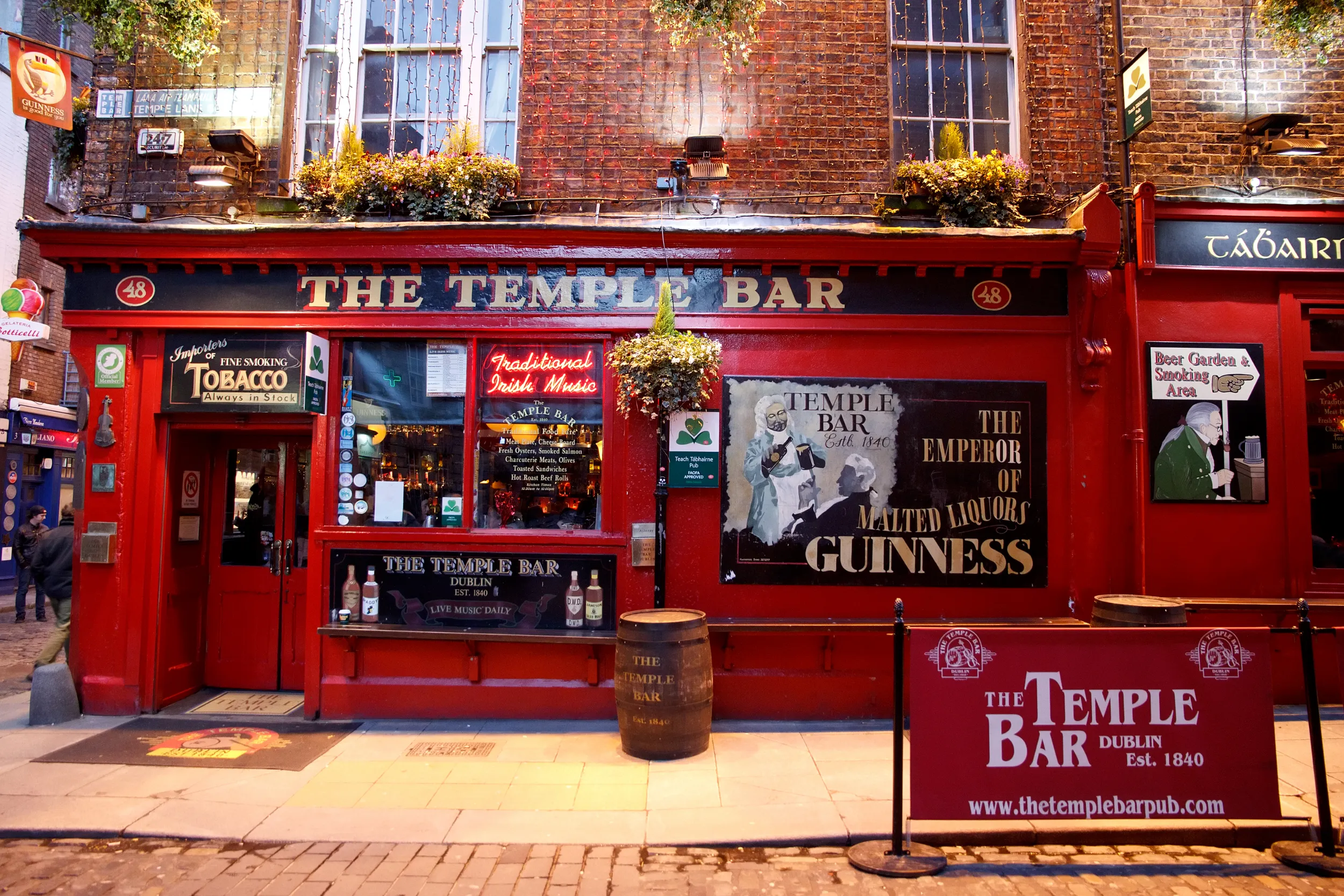
Most people meet Temple Bar as a photograph before they meet it as a place. A red-painted corner building, gold lettering, hanging flower baskets, a crowd spilling onto the cobbles. That image has been reproduced so often that plenty of visitors land at Dublin Airport expecting one pub. What they find is a whole quarter of narrow streets, most of which have nothing to do with drinking.
Clearing that up first changes how you plan your day. This guide covers what the area actually is, where the odd name came from, and what the fame is built on. It also covers what sits behind the pub frontages: a national film archive, a photography museum, an artists’ studio block, a children’s arts centre and a Saturday food market.
ConnollyCove is an Ireland-based travel and culture platform, and Dublin city centre is one of the areas we cover most. For the wider picture, start with our Dublin travel blog guide.
Table of Contents
Is Temple Bar a pub or an area?
Both, and that is the source of nearly every misunderstanding about the place. Temple Bar is a neighbourhood of roughly a dozen streets on the south bank of the Liffey, and it is also the name of a single pub inside that neighbourhood. The pub stands at 47 to 48 Temple Bar, on the corner of Temple Lane South. The district around it covers the ground between the river to the north, Dame Street to the south, Westmoreland Street to the east and Fishamble Street to the west.
The area
Unlike most of central Dublin, which was rebuilt on Georgian and Victorian street plans, this quarter kept its medieval layout. The streets are short, they bend, and they are surfaced with setts rather than tarmac. Fleet Street, Essex Street, Eustace Street, Crow Street, Temple Lane, Fownes Street and Curved Street all run within a few minutes of each other. Small courtyards open off them without warning. Two squares punctuate the grid: Temple Bar Square in the middle and Meeting House Square to the west, the latter named after the Quaker meeting house beside it.
The pub
The red building is the pub. Its current licence traces back to 1840, when a grocer and spirit dealer had developed the premises into a public house, and it has traded more or less continuously since. Inside there is live traditional music through the day and into the night, a very large whiskey selection, and prices that reflect the address. It is worth seeing. It is not the reason to come.
Why the two get confused
Guidebooks and social media both shorten “the Temple Bar area of Dublin” to two words. The pub also sits at the visual centre of the district, so the name attaches itself to the building. If a Dubliner says they are meeting you in Temple Bar, they mean the neighbourhood. If they say the Temple Bar, they mean the pub. The definite article does a lot of work, and ConnollyCove uses the same distinction throughout this guide.
Why is Temple Bar famous?
Three overlapping reasons. This is the most concentrated collection of traditional music pubs in central Dublin. The quarter was rescued from demolition and rebranded as the city’s cultural quarter in the early 1990s. And the architecture photographs extremely well. The fame is real, but it is not evenly spread across the district, and that is the useful thing to understand before you go.
The music
Live traditional Irish music plays here every day of the year, usually from mid-afternoon, in more venues per square metre than anywhere else in the city. Fiddle, bodhrán, tin whistle, guitar, sometimes a concertina. Some of it is very good and some is a set list built around what tourists request, which in practice means “Galway Girl” a great many times.
Both versions play at once, often two doors apart, and you can tell them apart by whether the musicians are watching each other or watching the door. If the songs catch you, our guide to the hidden meanings in Irish folk songs unpicks what a lot of those lyrics are actually about.
The rescue
In the 1980s the state transport company had bought up much of the area intending to demolish it for a central bus terminus. While that plan sat unresolved, low rents drew in artists, galleries, small shops and cheap restaurants. The bus station never happened. In 1991 the government set up a not-for-profit company to oversee regeneration as a cultural quarter, and a wave of purpose-built cultural buildings followed. The arts reputation dates from that decade, not from centuries of tradition. It is the single most misunderstood fact about the place, and one ConnollyCove has had to correct in its own older coverage.
The photographs
The red façade, the cobbles, the hand-painted signs and the hanging baskets combine into an image that reads instantly as “Ireland”. That has made the quarter a shorthand in film, advertising and travel media, which brings more visitors, which reinforces the fame. It is a loop. Whether it flatters the place is a fair question, and locals will happily tell you it does not, but the loop is why you have heard of it.
Craic and the Irish language
For a great many visitors this is their first encounter with Irish traditional music, bilingual street signage and the idea of the craic. Craic means something closer to shared enjoyment and good company than any single English word, and it describes an atmosphere rather than an activity.
The Irish name for the quarter is Barra an Teampaill, and you will see it on street signs throughout. If the language interests you, our collection of Irish proverbs is a good place to begin.
Where the name Temple Bar came from
The name has nothing to do with drinking and nothing to do with temples. It comes from the Temple family, and the “bar” element refers to a feature of the riverside rather than a licensed premises. The earliest known appearance is on Bernard de Gomme’s map of Dublin, drawn in 1673.
Sir William Temple and the reclaimed ground
Sir William Temple, a scholar who served as Provost of Trinity College Dublin, built a house with gardens on newly reclaimed ground beside the Liffey in the early 1600s. The family held the land for some time afterwards, and the surrounding streets picked up their name in the way that Dublin often did.
What the “bar” meant
Here “bar” is generally understood to describe a raised walkway or sandbank along the river, the sort of embankment built up as the Liffey was progressively narrowed and walled. The family’s ground sat along one such stretch.
This is a different word entirely from the London Temple Bar, a ceremonial gateway that marked the western boundary of the City of London. The two are frequently confused in search results.
From printing works to slum to cultural quarter
The seventeenth century brought printing houses, taverns and a theatre. The eighteenth brought a customs house and the warehouse trade with it. When the new Custom House opened downriver in 1791, the commercial reason for the district evaporated.
The nineteenth and early twentieth centuries saw a decline into printers, small workshops and eventually dereliction. That long slump is precisely why the medieval street pattern survived: nobody had the money to knock it down and start again. Our guide to the River Liffey covers the quays and bridges either side of this stretch.
What to see besides the pubs
The cultural buildings are not decoration on top of the nightlife, they are the reason the quarter exists in its current form, and most are free or close to it. Visit between ten in the morning and one in the afternoon and you will have them largely to yourself. The light in the lanes is far better for photographs, and nothing is loud yet. This is the window ConnollyCove recommends to anyone with a single day in Dublin.
Film and photography
The Irish Film Institute on Eustace Street holds the Irish Film Archive and runs three screens, a café and a bar in a converted Quaker meeting house.
On Meeting House Square, Photo Museum Ireland shows contemporary Irish and international photography in a purpose-built gallery. Founded in 1978 as the Gallery of Photography Ireland, it took its current name in 2022.
The National Photographic Archive sits on the same square and holds the photographic collections of the National Library of Ireland.
Art, theatre and performance
A few streets east, Temple Bar Gallery + Studios has run as a gallery and working studio complex for artists since 1983.
The Project Arts Centre on East Essex Street was Ireland’s first arts centre, founded in 1967, and its current purpose-built home opened in 2000 with two auditoriums and a gallery. Check the evening programme rather than assuming; it leans towards new Irish theatre and dance. The New Theatre operates from a bookshop on Essex Street East. The Button Factory on Curved Street opened in 1996 as the Temple Bar Music Centre and runs gigs and club nights in a 550-capacity room.
The Ark on Eustace Street is a cultural centre built specifically for children aged two to twelve. Its workshops and performances are ticketed, so book ahead if you are travelling with kids.
Markets and street art
The Temple Bar Food Market runs on Meeting House Square on Saturdays under a retractable canopy, which matters in Dublin. Producers sell cheese, bread, vegetables, meat and cooked food, and it is the single best reason to be here on a Saturday morning. A design and craft market operates on Temple Bar Square, and a long-running second-hand book market sets up nearby at weekends.
In the lanes behind Fleet Street, the Icon Walk murals honour Irish writers, musicians and sportspeople across a series of themed alleys, free to walk at any hour. Love Lane, off Meeting House Square, is set with a ceramic mosaic of song lyrics and quotations.
A short walk in any direction
This is a good base rather than a destination in itself. The Ha’penny Bridge crosses to the north quays from the top of Merchants Arch, and Dublin Castle with the Chester Beatty Library is five minutes south-west.
Trinity College Dublin and the Book of Kells, an illuminated gospel manuscript from around the ninth century, are five minutes east.
The Guinness Storehouse is a fifteen-minute walk further west.
The Molly Malone statue stands on Suffolk Street just beyond the eastern edge.
And Phoenix Park, one of Europe’s great walled city parks, is a short tram ride upriver.
What a pint costs here
Drinks cost more in this quarter than in the rest of Dublin, and the gap is widest in the pubs directly on the main photographed streets. This is the most common complaint visitors have and the most avoidable. Every licensed premises in Ireland must display its price list, so check it before you order rather than after.
Why the premium exists
The pubs on the central streets pay very high commercial rents for very short frontages. They employ musicians seven days a week and serve a customer base that is largely passing through. The result is a price structure built for someone who will come once. Pubs three or four streets away, on Dame Street or towards the Liberties, operate on different economics and charge accordingly.
How to handle it
Have one drink where you want the photograph and the music, then walk. Ten minutes in almost any direction gets you a pub with a local crowd and a smaller bill. The Palace Bar on Fleet Street sits at the eastern edge and keeps its Victorian interior and back snug intact. If your priority is a quiet pint and conversation rather than a session, do not start here at all.
Planning a visit to Temple Bar
The quarter changes character completely across the day, and picking your window matters more than picking your pub. Mornings are for the galleries and the cobbles. Afternoons are for music. From roughly seven in the evening it becomes a busy drinking district dominated by groups, and by eleven it is very crowded.
Getting there
You will almost certainly arrive on foot, since this is the middle of the city centre. From Dublin Airport, express airport coaches take somewhere between thirty and forty-five minutes depending on traffic and drop within a short walk. Tara Street is the nearest DART station, a few minutes away on the east side, and Connolly Station is about fifteen minutes on foot across the river. On the Luas, the Jervis stop on the Red Line is just over the Ha’penny Bridge and the Trinity stop on the Green Line is a few minutes east. Do not drive; the streets are pedestrianised or barely passable and parking is punishing.
Best time to visit
May to September gives the most reliable weather and the summer outdoor film screenings in Meeting House Square. Late January brings the Temple Bar TradFest, when traditional music takes over venues across the district and the standard of playing rises sharply. Saturday morning is the best single slot in the week: the food market is on, the light is good and the crowds have not arrived. Avoid Friday and Saturday nights unless a busy drinking district is specifically what you want.
Practical notes
Wear shoes with grip. The setts are genuinely slippery when wet and Dublin is wet often. The quarter is small enough to cross in ten minutes. Cash is rarely necessary. As in any busy city-centre nightlife area, keep phones and bags secure after dark, and expect hen and stag groups on weekend evenings.
For a sense of the place before you go, our travel videos include walkthroughs of the lanes.
Our Ireland travel blog guide covers getting around the country more broadly.
Is Temple Bar worth visiting?
Yes, once, and with a plan. Go in the morning for the galleries, the market and the empty lanes, have your pint where you want the photograph, then walk out for the rest of your evening. Treated that way, the quarter delivers something no other part of Dublin does. A medieval street plan you can cross in ten minutes. Four serious cultural institutions within shouting distance. Traditional music you did not have to book. Treated as a whole night out, it will cost more than it gives back.
Dublin’s cultural quarter is a formalised version of something that exists more loosely everywhere else in the country. Our guide to Irish folklore festivals covers where to find the older traditions.
The stories behind those traditions sit in our guide to the legendary creatures of Celtic mythology. ConnollyCove approaches every destination the same way: work out what a place is genuinely good at, then go and do that.
Frequently asked questions
Is Temple Bar a pub or an area?
Both. It is a neighbourhood of about a dozen streets on the south bank of the Liffey, and also the name of one pub within it, at 47 to 48 Temple Bar. Locals mean the area in general speech and the pub when they add “the”.
Why is Temple Bar famous?
For its concentration of traditional music pubs, its designation as Dublin’s cultural quarter in 1991, and the much-photographed red frontage of the pub itself. The fame mixes genuine cultural infrastructure with a very effective image.
How old is Temple Bar?
The name dates to at least 1673, when it appears on Bernard de Gomme’s map of Dublin. The pub traces its licence to 1840. The identity as a cultural quarter dates only from 1991.
Why is it called Temple Bar?
After the Temple family, who built a house and gardens on reclaimed ground beside the Liffey in the early 1600s. The “bar” refers to a raised riverside walkway or sandbank, not a drinking establishment.
Who owns the Temple Bar pub?
It is a family-owned pub and has been in the same family’s hands since the early 1990s. It is independent rather than part of a chain.
Is Temple Bar expensive?
Yes, relative to the rest of Dublin, and most noticeably on the central photographed streets. Price lists must be displayed by law, so check before ordering. Walking ten minutes in any direction lowers the bill.
What is there to do during the day?
The Irish Film Institute, Photo Museum Ireland, the National Photographic Archive, Temple Bar Gallery + Studios and the Project Arts Centre are all within a few minutes of each other. The Saturday food market runs on Meeting House Square, and the Icon Walk murals are free at any time.
How far is Temple Bar from Dublin Airport?
About thirty to forty-five minutes by express airport coach, depending on traffic. The coaches drop in the city centre within a short walk.
When is the best time to visit?
Saturday morning, for the food market, good light and small crowds. May to September has the most reliable weather, and late January brings the TradFest. Friday and Saturday nights are extremely busy.


