
Table of Contents
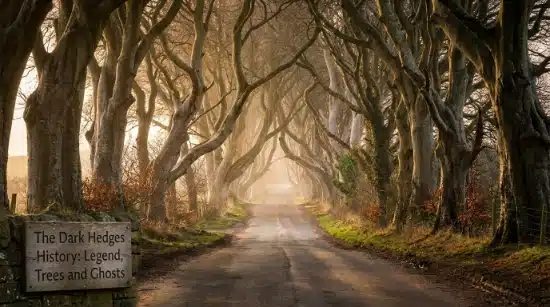
Tucked along a quiet stretch of Bregagh Road near Ballymoney, County Antrim, the Dark Hedges is one of Northern Ireland’s most photographed places. Twisted beech branches form a tunnel over the road, planted not for tourists or television crews but to impress 18th-century carriage guests arriving at a private estate.
That estate was Gracehill House, and the story of how a Georgian driveway became a global pilgrimage site for Game of Thrones fans says as much about modern tourism as it does about the trees themselves. Ireland has no shortage of atmospheric back roads, but few carry the layered history this one does: aristocratic ambition, local ghost stories, a hit TV series, and now a genuine ecological crisis.
This guide sets out what’s actually known about the Dark Hedges (and what’s still folklore), plus what to expect if you’re planning a visit.
The Stuart Legacy: Who Planted the Dark Hedges?
The Dark Hedges were planted in the 18th century by the Stuart family of Gracehill House, as a deliberately grand approach designed to impress visitors arriving at their new mansion. This is the one part of the story that isn’t in dispute, though the exact planting date varies between sources (commonly cited as 1775, though some local accounts place it slightly earlier).
Gracehill House and the Georgian “Grand Approach”
Long avenues of trees framing the road to a country house were a recognisable feature of Georgian landscape design across Britain and Ireland. Rather than a straight, formal row, the Stuart family planted beech, a species that grows tall and eventually interlocks overhead, creating the tunnel effect that makes the avenue so recognisable today. Gracehill House itself was reportedly named after Grace Lynd, wife of the family patriarch.
The Stuart Family and the Land’s Earlier History
Local historical accounts trace the land back further still, to a 17th-century land grant connected to the wider Stuart and Montgomery estates in this part of County Antrim. One detail repeated in local histories, that a family member died before ever reaching Ireland to take up the land, adds a note of tragedy to the estate’s origins, though this account is difficult to verify independently and is best treated as local tradition rather than settled fact.
What’s clear is that long before Game of Thrones, the Dark Hedges were already a recognised local landmark and a subject of curiosity for anyone travelling this stretch of the Antrim countryside.
The Grey Lady: Celtic Folklore on Bregagh Road
Bregagh Road carries its own ghost story. Locals call her the Grey Lady, said to drift silently along the avenue at dusk before vanishing near the last tree.
Three Local Theories
Nobody agrees on who she was. Some accounts identify her as a daughter of the Stuart family; others describe a housemaid who died in unclear circumstances at Gracehill House; a third theory places her as a lost soul from an unmarked graveyard once thought to lie in the surrounding fields. All three versions are local oral traditions rather than documented history, and no single account has ever been confirmed.
A Familiar Figure in Irish Folklore
A lone female spirit haunting a specific stretch of road is a shape Irish storytelling returns to again and again. It sits alongside the tradition of the bean sí, or banshee, one of Irish folklore’s best-known spectral figures, and the wider belief in guardian spirits tied to a particular family or place. Ireland’s rural roads and lone trees carry this kind of story often; the reverence (and unease) around Ireland’s fairy trees comes from the same instinct to treat certain natural features as thresholds rather than ordinary scenery. Whether or not you believe in the Grey Lady, the story is one reason locals have always given the avenue a wide berth after dark, long before any tourist board got involved.
For readers who want the wider picture of Ireland’s spectral and mythological figures, ConnollyCove’s guide to Celtic mythology creatures covers where these traditions come from and how they vary by region.
The Game of Thrones Effect: How a Driveway Became the Kingsroad
The Dark Hedges became globally famous through a single scene. In Season 2, Episode 1 of HBO’s Game of Thrones, Arya Stark rides through the avenue disguised as a boy, fleeing King’s Landing along what the show calls the Kingsroad. That fifteen-second sequence is largely responsible for turning a local landmark into an international one.
The Dark Hedges was one of dozens of Northern Ireland locations used across the show’s eight seasons. Nearby, Ballintoy Harbour stood in for the Iron Islands, home of House Greyjoy, while the Cushendun Caves, roughly an hour’s drive away, appeared in the same season. Further afield, Castle Ward in County Down doubled as Winterfell, and Belfast itself hosts a permanent Game of Thrones tapestry tracing the show’s production across the region. Travellers building a filming-locations itinerary around Northern Ireland will find the Dark Hedges works well as one stop among several, rather than a single destination worth a special trip on its own.
The Doors of Thrones: A Heritage Trail Grown From Fallen Trees
When Storm Gertrude struck in early 2016, several of the Dark Hedges’ oldest beeches came down. Rather than let the timber go to waste, the salvaged wood was carved into ten decorative doors, each depicting a scene from the series, and distributed to pubs and venues across Northern Ireland as part of a joint initiative between Tourism NI and HBO.
Two of these doors sit close to the Dark Hedges itself, making them a natural addition to a visit:
| Door | Location | Distance from the Dark Hedges | Scene depicted |
|---|---|---|---|
| Door 7 | Gracehill House, Ballymoney | On site | References the Dark Hedges and the Kingsroad |
| Door 8 | Mary McBride’s, Cushendun | Approx. 40 minutes’ drive | Scenes connected to Cushendun Caves |
| Door 6 | The Fullerton Arms, Ballintoy | Approx. 30 minutes’ drive | Scenes connected to Ballintoy Harbour |
ConnollyCove has a fuller guide to all ten Doors of Thrones, including the ones further afield in Belfast and Enniskillen, for anyone wanting to build a complete trail. It’s a good way to spend time and money in the small pubs and venues that host the doors, rather than treating the region as a drive-through photo opportunity.
The Ecological Crisis: Why the Dark Hedges Are Dying
The Dark Hedges is not a permanent fixture. European beech trees (Fagus sylvatica) typically live for 150 to 200 years, and the Dark Hedges, planted in the 18th century, are already near or past the natural end of that lifespan. Storm damage over the years, including trees lost in 2016, has thinned the canopy, and the avenue will continue to change shape as more trees reach the end of their natural life.
Soil Compaction Is the Bigger Threat
Age and storms are only part of the story. Beech trees have shallow, wide-spreading root systems that need loose, aerated soil to draw up water and nutrients. Thousands of visitors walking the same narrow strip of ground every week compact that soil over time, starving the roots of oxygen and accelerating the decline in exactly the trees tourism depends on. It’s a genuinely difficult problem: the more popular the avenue becomes, the faster it wears down.
“The Dark Hedges are a remarkable piece of eighteenth-century vision, but their popularity today creates a real tension,” says Ciaran Connolly, Founder of ConnollyCove. “Protecting this avenue for the next generation means staying on the path and treating it as a living, ageing landscape rather than a backdrop.”
Readers researching current tree numbers and conservation work should check directly with the Dark Hedges Preservation Trust or Causeway Coast and Glens Borough Council, as figures on how many of the original trees remain are updated periodically and were not independently verified for this article.
Visiting Bregagh Road Responsibly
Bregagh Road is closed to public vehicle traffic to protect the trees’ root systems, so plan to park and walk in. The nearest parking is at the Hedges Hotel, a short walk from the avenue itself; from there, it’s a flat, easy walk along the tarmac path.
Best Time to Visit
Early morning and early evening are quieter and give softer light for photographs. Spring and autumn add colour to the surrounding farmland, though Northern Ireland’s weather can shift quickly regardless of season, so pack for rain even on a clear forecast.
Getting There and Nearby Stops
The Dark Hedges sits inland from the main Causeway Coastal Route, making it a natural detour rather than a coastal stop in its own right. Travellers exploring this region often combine it with the Giant’s Causeway, Carrick-a-Rede Rope Bridge, and Dunluce Castle in a single day. Those basing themselves in the city can find day-trip planning in ConnollyCove’s Belfast travel guide, roughly an hour and a half away by car.
A Few Practical Notes
- Parking: Use the Hedges Hotel car park rather than the roadside verges, which block access for local farmers
- Do not carve into or peel bark from the trees
- Stick to the path; stepping off it, even briefly, adds to root compaction
- Check current access and any local notices with Causeway Coast and Glens Borough Council before travelling, particularly outside peak season
Frequently Asked Questions
Who planted the Dark Hedges and why?
The Stuart family of Gracehill House planted the avenue of beech trees in the 18th century as a grand entrance designed to impress visitors arriving at their estate near Ballymoney. It was a fashion of the period; long, deliberately planted tree avenues were common features of Georgian country houses across Ireland and Britain.
Is there an entrance fee to visit the Dark Hedges?
No. The Dark Hedges sit on Bregagh Road, a public road, so there’s no admission charge to walk along it. Parking at the nearby Hedges Hotel may involve a small fee or an expectation that visitors use the venue’s facilities, so it’s worth checking locally.
Can you still drive through the Dark Hedges?
No. Vehicle access to Bregagh Road has been restricted to protect the trees’ shallow root systems from damage caused by traffic. Visitors now park nearby and walk in along the tarmac path.
Why are the Dark Hedges dying?
European beech trees typically live 150 to 200 years, and the Dark Hedges is at or beyond that natural age. Storm damage has thinned the avenue over time, and soil compaction from heavy foot traffic further stresses the shallow root systems, making decline an ongoing, natural process rather than a single event.
How is the Dark Hedges connected to Game of Thrones?
The avenue appeared as the Kingsroad in Season 2 of the HBO series, most memorably in the scene where Arya Stark flees King’s Landing. It sits within a wider cluster of Northern Ireland filming locations, including Ballintoy Harbour and the Cushendun Caves, both within an hour’s drive.
Who is the Grey Lady, and is Bregagh Road actually haunted?
Local legend holds that a ghostly figure known as the Grey Lady glides along Bregagh Road at dusk before vanishing near the last tree. Theories about her identity vary between a Stuart family daughter, a housemaid, and a lost soul from a nearby unmarked graveyard, and none has ever been confirmed; it remains oral tradition rather than documented history.
What is the best time of day to visit the Dark Hedges?
Early morning or early evening, both to avoid tour groups and to catch softer light for photographs. Visiting outside midday, when coach tours tend to arrive, gives a noticeably quieter experience of the avenue.
Explore More of Northern Ireland
ConnollyCove covers Northern Ireland’s filming locations, folklore and coastal routes in depth. For more Game of Thrones stops nearby, explore the full guide to Where is Game of Thrones Filmed? A Guide to the Game of Thrones Filming Locations in Ireland, or watch ConnollyCove’s YouTube channel for video guides to the Causeway Coast filmed on location.