


Temple Bar Dublin – The Amazing Temple Bar District Dublin
Updated On: April 07, 2024 by  Salma Ihab
Temple Bar District is a cultural quarter in Dublin, Ireland, a popular tourist destination. The area is surrounded by the Liffey to the north, Dame Street to the south, Westmoreland Street to the east and Fishamble Street to the west.
Temple Bar District is described as Dublin’s “bohemian quarter.” It’s full of entertainment, art, and cultural opportunities and is often listed as one of Dublin’s top attractions.
Let’s explore what we know about Temple Bar District…
History of the Temple Bar District
What distinguishes Temple Bar District from other districts in the city are its cobblestone streets and old buildings that bring a lovely charm to the area.
The Vikings arrived in the area in 795 A.D, and the remains of their settlement can still be seen in Dublin Castle today.
In medieval times, the district’s name was St. Andrews Parish. It was a suburb located outside the city walls. However, the area fell into disuse beginning in the 14th century because it was exposed to attacks by the native Irish.
The Temple Bar District underwent significant redevelopments in the 17th century to create gardens for the houses of wealthy English families. The first mention of Temple Bar District as the name of this street came in Bernard de Gomme’s Map of Dublin in 1673.
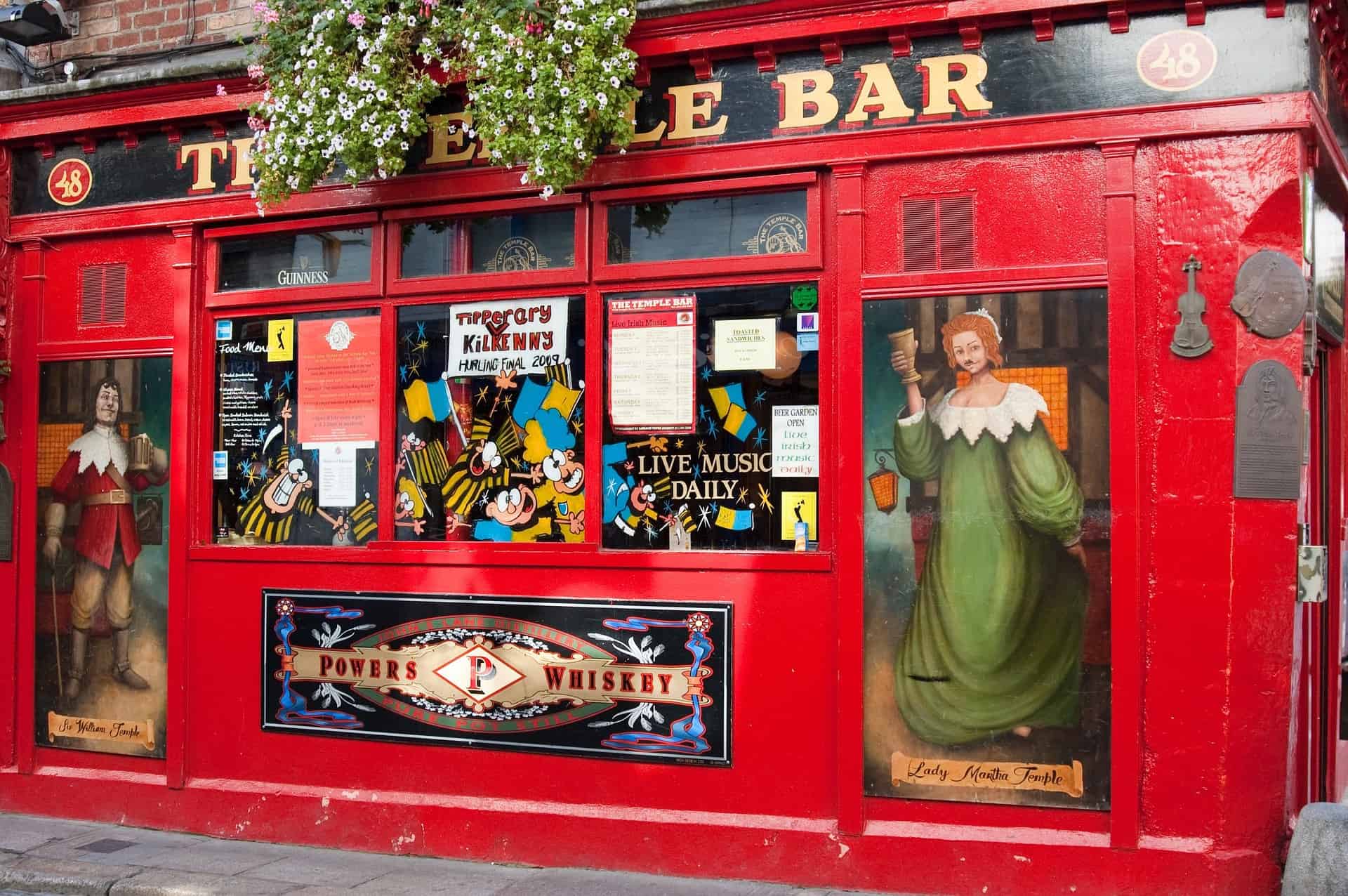
Temple Bar District was believed to have its name from the Temple family, as Sir William Temple built a house and gardens there in the early 1600s. In 1599, Temple moved to Ireland to be the secretary to Robert Devereux, the Earl of Essex. After Essex was beheaded for treason in 1601, Temple” retired into private life” but was then solicited to become provost of Trinity College, serving from 1609 until he died in 1627 at age 72. William Temple’s son John became the”Master of the Rolls in Ireland”. He was also the author of a famous pamphlet excoriating the native Irish population for an uprising in 1641.”It’s believed that Temple Bar District got its name from the Temple family, as Sir William Temple built a house and gardens there in the early 1600s. In 1599, Temple moved to Ireland to be the secretary to Robert Devereux, the Earl of Essex. After Essex was beheaded for treason in 1601, Temple “retired into private life”, but he was then solicited to become provost of Trinity College, serving from 1609 until he died in 1627 at age 72. William Temple’s son John became the “Master of the Rolls in Ireland”. He was also the author of a famous pamphlet excoriating the native Irish population for an uprising in 1641.
It’s also said that the Temple Bar district inspired the name Temple Bar Street in London.
The Architecture of Temple Bar District
The oldest buildings in Temple Bar District date back to the mid-18th century and are mainly located on Fownes Street and Eustace Street. These brick buildings are usually three or four stories high with panelled front doors, and the rooms are frequently wood-panelled.
The Bank of Ireland in College Green is one of the Temple Bar District’s most important buildings. The Bank of Ireland building, until 1800, was the Irish Parliament House. Other interesting buildings include Cecilia House on Cecilia Street. As well as the Olympia Theatre in Dame Street.
Examples of Victorian-style decor can be found in several bars or public houses, such as the Foggy Dew on Fownes Street, the Norseman on Eustace Street and the Palace Bar on Fleet Street.
As for modern architecture in the Temple Bar District, the most prominent example is Sam Stephenson’s Central Bank.
What to Do in Temple Bar District
Temple Bar District has numerous restaurants, cafés, pubs, and hostels. You can also find shops selling everything you’re looking for. Those interested in art can visit various art galleries and possibly stop by the Irish Film Institute, the Project Arts Centre, the National Photographic Archive, and Designyard.
“The Icon Walk: “The Greatest Story Ever Strolled” The Icon Walk: “The Greatest Story Ever Strolled”
When in Temple Bar District, walk through the lanes of Fleet Street and look through a series of snapshots of iconic Irish historical and contemporary figures. These creative representations of cultural icons, past and present, are posted on the walls of the streets leading up to the Icon Factory Gallery.
The public art installation showcases original artwork by many local artists of Irish icons from many disciplines, including writers, playwrights, sports icons, musicians, and actors.
The Icon Walk at the Temple Bar District is divided into sections: Harry Clarke Stained Glass, Irish Clothing since the ’20s, Folk and Traditional Music Revival, Oddballs, Crackpots and Assorted Genius, The Playwrights, Great Moments of Irish Rock, Poets and Novelists, Irish Humour, Irish Movie Actors, and The Wall of Irish Sport.
The Icon Walk leads to the Icon Factory, where you can purchase some images displayed on t-shirts or posters.
Sample the Deliciousness at Queen of Tarts
Who doesn’t have a sweet tooth? If you’re ever in the area, you should not miss Queen of Tarts for a bit of tea and some delicious cake. The café offers a breakfast and lunch menu. It would make a great stop while exploring the city.
Explore your Inner Bookworm at The Gutter Bookshop
Deriving its name from the Oscar Wild quote, “We are all in the gutter, but some of us are looking at the stars”, The Gutter Bookshop is located on the corner of Cow’s Lane in Temple Bar District, Dublin.
Stop at this lovely shop and browse its collection of reading materials for a bit before moving on with your excursion because it definitely should not be missed.
The shop opened in 2009, and since then, it has received the Independent Bookshop of the Year award in 2017 from The British Book Awards. It was the first Irish bookshop to receive the honour.
Try the Famous Irish Boxty at Boxty House
The Boxty is a traditional Irish food; a traditional potato pancake that the Boxty House restaurant has transformed into a delicious and creative dish. Try some of the best Irish cuisines at Boxty House. You definitely won’t regret it.
Nightlife
The area is also considered a perfect destination for nightlife activities, including hen and stag nights. It has an abundance of touristy nightclubs, restaurants and bars, such as, of course, the Temple Bar Pub, The Porterhouse, the Oliver St. John Gogarty, the Turk’s Head, Czech Inn, the Quays Bar, the Foggy Dew, The Auld Dubliner and Bad Bobs.
Cultural Life at Temple Bar District in Dublin
The area is also rich in cultural history, with several cultural institutions located in the neighbourhood, such as the Irish Photography Centre, the Ark Children’s Cultural Centre, the Irish Film Institute, the Arthouse Multimedia Centre, Temple Bar Gallery and Studios, the Project Arts Centre, the Gaiety School of Acting, IBAT College Dublin, the New Theatre, as well as the Irish Stock Exchange.
What Else to Do Nearby
Only a five-minute walk will take you right to Trinity College. If you walk in the opposite direction, you can also visit Christ Church Cathedral or Dublin Castle and the famous Ha’Penny Bridge if you walk towards O’Connell Street.
In Cinema and Songs
The Temple Bar District in Dublin was also featured in a Bollywood blockbuster film starring Salman Khan and Katrina Kaif called Ek Tha Tiger.
Billy Treacy Song
Irish singer/songwriter Billy Treacy wrote a song about the area that goes as follows:
Don’t you know you’re about to enter Dublin’s Cultural Centre.
Pedestrianised streets of Cobblestone.
Where the places are all hopping with tourists eating and shopping.
Guaranteed you’ll never drink alone.
But take a look around, for the natives can’t be found.
Except for the junkies, beggars, thieves.
The locals have more sense(cents).
Euro, shillings, pence.
And they know round here it won’t go far.
In Temple Bar, In Temple Bar.
Dirty Aul Town of Molly Malone and Whiskey in the Jar.
There’ll be drink and songs a plenty
but your pockets will be empty,
coz round here your money won’t go far.
In Temple Bar, In Temple Bar.
It’s Vicars, Tarts, Drink, Feck, Arse,
there’s nothing on a par.
Your throat it will be cracked and sore
but your pockets well they’ll hurt more.
In Dublin City’s Temple Bar.
Keep a good eye on your handbag,
Your man there is a toe rag.
Make sure you hold on to your phone.
Enjoy your stay in Ireland, be ya yank, English or Thailand.
Tell all your friends to come when you get home.
But please take my advice, that the rest of Dublin’s nice.
Don’t limit yourself to one square mile.
Now I mostly speak in jest, but believe me Dubs are best.
Guaranteed to make you smile.
In Temple Bar, In Temple Bar.
Dirty aul town of Molly Malone and Whiskey in the Jar.
Where we go to celebrate
or when we want to just drink late.
We know we never are too far.
From Temple Bar, from Temple Bar.
It’s Vicars, Tarts, Drink, Feck, Arse, There’s nothing on a par.
If the Craic it isn’t ninety, you’ll be sure that it’s more mighty.
In Dublin City’s Temple Bar.
In Dublin City’s Temple Bar.
In Dublin City’s Temple Bar.
Not only that, but country singer Nathan Carter and Irish rock band Kodaline have also released Temple Bar songs.
Temple Bar Song by Nathan Carter
Nathan Carter’s song says:
There’s a busker playin’ on the street
Watching all the people meet
The boys and girls are back in Dublin town
There’s young ones there from everywhere
From America to God knows where
It’s just another night in Temple Bar
So come on down, out on the town
Cause’ this is where a good time can be found
So bring along the old squeeze box, the fiddle and guitar
Let’s have a good old night in Temple Bar
There’s a stag do here from Liverpool
Chasing hens and on the boat
Old Barney’s lashing out the ‘Rare Auld Times’Ah the Glasgow girls are on the floor
And a round of shots have just been poured
It’s another crazy night in Temple Bar
So come on down, out on the town
Cause’ this is where a good time can be found
So bring along the old squeeze box, the fiddle and guitar
Let’s have a good old night in Temple Bar
There is no better place to be than this old town tonight
Nobody’s going home till’ they turn out the lights
So come on down, out on the town
Cause’ this is where a good time can be found
So bring along the old squeeze box, the fiddle and guitar
Let’s have a good old night in Temple Bar
So come on down, out on the town
Cause’ this is where a good time can be found
So bring along the old squeeze box, the fiddle and guitar
Let’s have a good old night in Temple Bar
Let’s have a good old night in Temple Bar
There’s a busker playing on the street
Watching all the people meet
Temple Bar Song by Kodaline
While Kodaline’s song goes:
Friday night and no one’s home
There’s no point getting drunk alone
Grab your coat and make a call
I meet you down in Temple Bar
People come and people go
So raise your glass to who you know
Winter hasn’t taken hope
So why do I feel so cold
Like a question without an answer
Like music without its dancers
Like a bird without a song
Tell me where did it all go wrong
Like a frame without a picture
Like God without a scripture
Like me when I know you’re gone
Tell me where did it all go wrong
Oh where did it all go wrong
Go wrong
Oh where did it all go wrong
Go wrong
Saw a girl that I used to know
It’s funny how a heart moves on
She’s got a home and a family
I get the feeling she’s forgotten me
People leave their mark and go
Like footprints in a winter snow
Winter hasn’t taken hope
Why do I feel so cold
Like a question without an answer
Like music without its dancers
Like a bird without a song
Tell me where did it all go wrong
Like a frame without a picture
Like God without a scripture
Like me when I know you’re gone
Tell me where did it all go wrong
Oh where did it all go wrong
Go wrong
Oh where did it all go wrong
Go wrong
Like a question without an answer
Like music without its dancers
Like a bird without a song
Tell me where did it all go wrong
Like a frame without a picture
Like God without a scripture
Like me when I know you’re gone
Tell me where did it all go wrong
Oh where did it all go wrong
Go wrong
Oh where did it all go wrong
Go wrong
Have you ever visited the Temple Bar District and its Famous Bars and Cafes? Let us know in the comments below.
If you enjoyed this blog on the Temple Bar District, check out some other blogs that might interest you around Dublin: City Sightseeing Dublin | The Little Museum of Dublin | Jeanie Johnston: Irish Emigrant Ship | Kilmainham Gaol; Former Prison Turned Tourist Attraction
Top 10 Irish Public Holidays and Traditions to Experience on Your Ireland Holidays
Festivals and Events
18/04/2024

6 Top Mourne Camping Sites for an Unforgettable Experience Under the Stars
Northern Ireland
18/04/2024

Eostre: The Germanic Goddess of Dawn and Spring Equinox Celebrations
Mythology and Folklore
17/04/2024

Explore the Top Hotels in County Cavan for Your Ultimate Getaway
County Cavan
17/04/2024

Irish Golf: Exploring the Top Golf Courses in Ireland
Culture Exploration
17/04/2024