
Article Summary
What this article covers: Symbols of new beginnings from Celtic, Norse, Egyptian and folk traditions, what each one means, where it comes from, and which associations are ancient and which are modern.
Who this is for: Anyone choosing a symbol for a tattoo, a gift, a piece of jewellery or a fresh chapter, and anyone who has read that a particular symbol means new beginnings and wants to know whether that is actually true.
Key takeaway: There is no single ancient symbol for new beginnings in any tradition. The strongest candidates are the Celtic triskele, the Dara knot, the Norse Berkano rune and the lotus, and several of the meanings attached to them today were added in the last hundred years.
Expert insight:
The triple spiral at Newgrange was carved about five thousand years ago, which makes it older than the pyramids and considerably older than the Celts. People call it a Celtic symbol and it is not, quite. Standing in front of that stone is the moment you realise how much of what we call Celtic heritage in Ireland was already there waiting.
Ciaran Connolly, Founder of ConnollyCove
Quick facts:
- The triple spiral on the Newgrange entrance stone dates to roughly 3200 BC, predating Celtic culture in Ireland
- The Dara knot takes its name from doire, the Irish word for oak
- Berkano, the Norse rune associated with birch and birth, is the closest thing Norse tradition has to a new beginnings symbol
Table of Contents
If you have landed here looking for the symbol of new beginnings, the honest answer is that there isn’t one. No tradition designated a single sign for starting over. What exists instead is a set of symbols that carry ideas of cycles, growth, renewal and return, and which have been adopted for that purpose over time.
Some of those associations are genuinely old. Some were invented in the twentieth century and repeated until they felt old. This guide separates the two because if you are about to have something tattooed on your arm, you probably want to know which is which.
ConnollyCove covers Irish heritage and Celtic culture, so the Celtic symbols get the most space here. They are also, as it happens, the ones people ask about most.
Symbols of New Beginnings at a Glance
Twelve symbols, grouped by tradition, with an honest note on how old each association really is. Our guide to the symbols of Ireland covers the wider set, including the shamrock, the harp and the Claddagh.
| Symbol | Tradition | What it carries | How old is the association? |
|---|---|---|---|
| Triskele (triple spiral) | Irish, pre-Celtic and Celtic | Cycles, three stages, motion | Symbol is Neolithic. New beginnings reading is modern |
| Dara knot | Irish, modern design | Strength, roots, endurance | Modern |
| Ailm | Irish, from ogham | Resilience, renewal | Symbol is old. Meaning is largely modern |
| Tree of Life | Celtic and much wider | Growth, connection, regeneration | Ancient across cultures |
| Triquetra | Insular and Christian | Threefold unity | Early medieval, reused since |
| Berkano rune | Norse | Birch, birth, growth | Genuinely old |
| Lotus | Egyptian, Indian, Buddhist | Rebirth, emergence | Ancient |
| Scarab | Egyptian | Regeneration, the rising sun | Ancient |
| Phoenix | Greek and Egyptian | Renewal from destruction | Ancient |
| Daffodil, snowdrop, crocus | European folk | The first growth of the year | Folk, not formalised |
| Butterfly | Widespread | Transformation | Widespread and old |
| Sunrise, dawn | Universal | The simplest one of all | Universal |
Celtic Symbols of New Beginnings
The triskele, or triple spiral
The triskele is three interlocking spirals turning in the same direction, and it is the oldest symbol on this page by a long way.
The best-known example is carved on the entrance stone at Newgrange in County Meath, dated to around 3200 BC. That matters because it means the triple spiral was already ancient in Ireland long before Celtic culture arrived. Calling it a Celtic symbol is a shorthand rather than a fact.
What it meant to the people who carved it is unknown. Nothing was written down for another four thousand years. Later Celtic art picked the form up and used it widely, and modern readings have attached it to any number of threes: past, present and future, life, death and rebirth, land, sea and sky, maiden, mother and crone.
The reason it works as a symbol of new beginnings is the shape itself. A spiral has no endpoint. It turns outward and keeps going, which is a reasonable image for starting again.
You can see the original at Brú na Bóinne, and the same motif appears at Knowth and Dowth nearby. The spiral form runs right through Irish and wider Celtic art, and our guide to the Celtic spiral traces where else it turns up.
The Dara knot
The Dara knot is an interlaced design, usually fourfold, meant to suggest the root system of an oak tree. Its name comes from doire, the Irish word for oak grove, which also gives the city of Derry its name.
Here is the part most sources leave out: the Dara knot, as we know it, is a modern design. Interlaced knotwork is genuinely ancient in Irish and Insular art, but this particular pattern with this particular name and meaning is a recent creation, popularised through jewellery and tattoo design. Our guide to Celtic knots and their meanings covers the interlace patterns that genuinely are old.
That does not make it meaningless. The oak was significant in Ireland long before the design existed, and roots holding through a storm is a decent thing to carry. It is just worth knowing that you are wearing a modern symbol drawing on old material, rather than something a druid would have recognised.
It is the single most searched symbol on this page after the generic terms.
Ailm
Ailm is a letter of the ogham alphabet, the notched script carved along the edges of standing stones across Ireland. Each ogham letter is linked to a tree, and Ailm is associated with the pine or silver fir.
The association with resilience and renewal comes from the tree rather than the letter: an evergreen that stays green through winter and grows straight in poor conditions. Most of what you will read about Ailm’s spiritual meaning is twentieth-century, from the revival of interest in Celtic tradition rather than from the medieval sources.
Around four hundred ogham stones survive in Ireland, and many are in county museums and at heritage sites.
There is more on the script itself in our guide to the ogham alphabet.
For the letter specifically, see our page on the symbolism of Ailm.
The Tree of Life
The Crann Bethadh appears in Celtic art as a tree with its branches and roots interlacing, sometimes forming a closed circle. Trees held real significance in early Ireland. A tribe’s sacred tree stood at the centre of its territory, and cutting down a rival’s was among the more serious things you could do to them. Our guide to the Celtic tree of life covers the design and its variants in full.
As a symbol of new beginnings, it works on the obvious cycle: bare in winter, green again in spring, roots that survive what the branches do not.
Versions of the tree of life appear in Norse, Egyptian, Mesopotamian and Christian traditions independently, so this is one of the least specifically Celtic symbols on the list.
The triquetra
Three interlaced arcs, sometimes called the trinity knot. It appears in early medieval Insular manuscripts including the Book of Kells and on carved stone crosses, where it was used in a Christian context for the Trinity.
Because it is a threefold symbol without a fixed meaning, it has been adopted repeatedly since: by neo-pagan traditions, by jewellers, and by anyone who wants a clean three-part design. For new beginnings, the reading usually offered is the movement from one state to the next without a break.
So is there one Celtic symbol for new beginnings?
No. There is no medieval Irish source that assigns a symbol to new beginnings, and the phrase itself is a modern search term rather than a traditional category.
If you want the closest thing, take the triskele. It is genuinely ancient, it is genuinely Irish, its form carries the idea of continuous motion, and you can stand in front of the original.
Symbols From Other Traditions
Norse: the Berkano rune
Berkano is the rune of the birch. Birch is the first tree to come back on cleared or burnt ground, which gave it an association with birth and beginnings that is attested rather than invented. Of everything on this page, Berkano has the strongest claim to being an old symbol that genuinely meant something close to new beginnings.
Egyptian: the scarab and the lotus
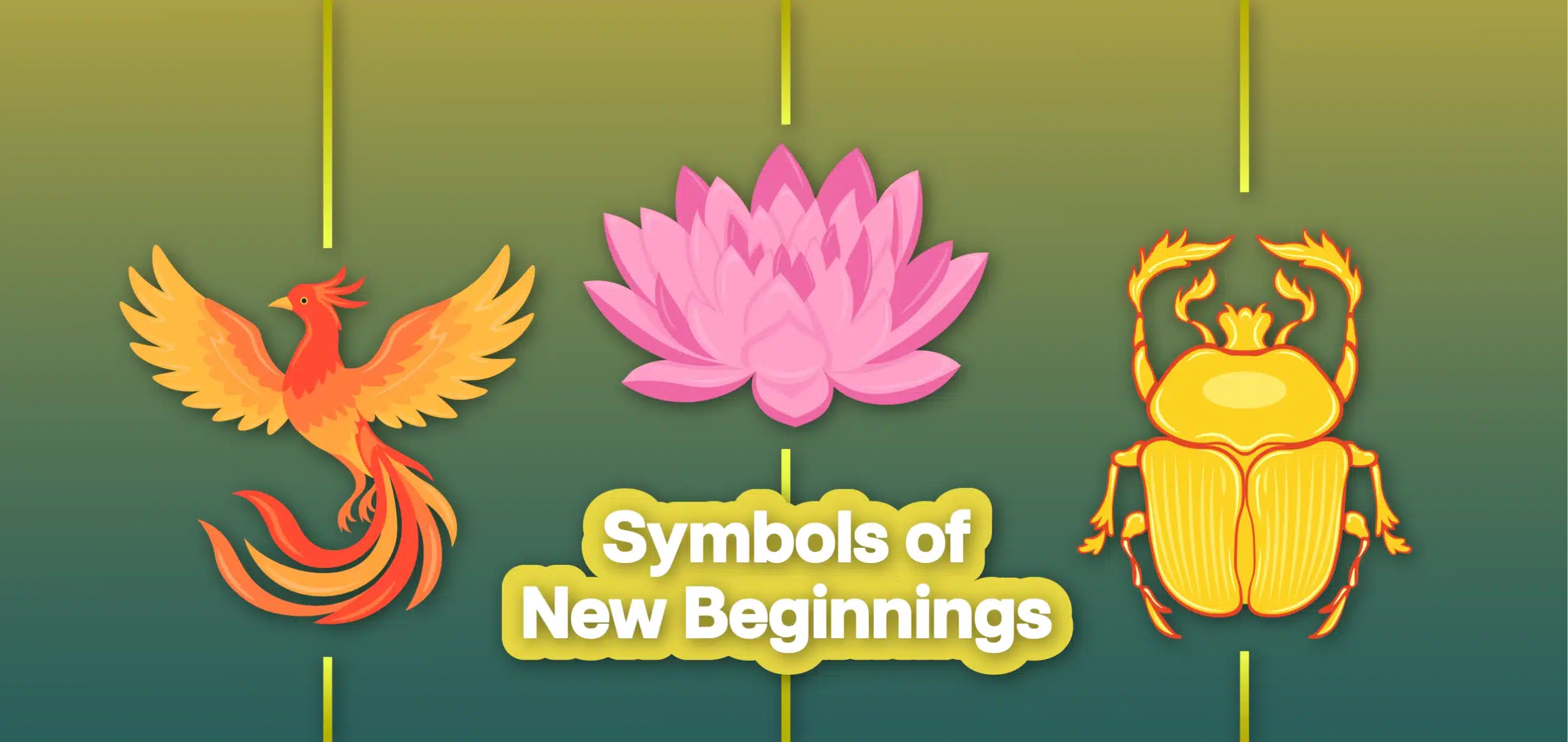
The scarab beetle was associated with the sun’s daily rebirth and with regeneration, and scarab amulets were placed with the dead. The blue lotus closes at night and opens at dawn, which makes it an emblem of emergence and renewal.
Greek and Egyptian: the phoenix
The bird that burns and returns from its own ashes. The most direct symbol of starting over in any tradition, and the one most people already know.
Buddhist and Hindu: the lotus
The lotus grows through mud and opens clean above the water. Used across Buddhist and Hindu traditions for spiritual awakening and rebirth.
Christian: the rainbow, the dove, the seed
The rainbow after the flood was a sign of a new covenant. The dove returning with an olive branch. The seed that has to be buried before it grows. All three are used for renewal in Christian symbolism.
Flowers, Animals and Colours
Flowers
The first flowers of the year carry this meaning across European folk tradition simply because of when they appear. Snowdrops come up through frost, sometimes through snow. Crocuses follow. The daffodil is the one most associated with new beginnings in Britain and Ireland, and it is also the flower of Saint David’s Day and of early spring generally. Cherry blossom carries a related but distinct meaning in Japan, closer to the brevity of things than their beginning. The turn of the year was marked formally as well as botanically, in the four Celtic festivals that divided the Irish calendar.
Animals
The butterfly, for the obvious reason. Snakes, for shedding their skin and continuing. The frog changes form entirely between one stage of life and the next. Hares and rabbits, for spring and for fertility, which is where the Easter associations come from.
Colours
Green for growth and spring. White for a clean start. Yellow for the first light and the first flowers.
Choosing a Symbol for a Tattoo
A few practical points, since a large share of the people reading this are deciding on a tattoo.
Check whether the meaning is old or recent. Not because recent is worse, but because you may be asked about it. The triskele and Berkano have genuine depth behind them. The Dara knot’s meaning is modern. Either is fine as long as you know.
Interlaced designs need a skilled artist. Celtic knotwork done badly looks like a mistake rather than a pattern, and the lines have to hold their spacing as the tattoo ages. Ask to see healed work, not fresh photos.
Think about scale. A triskele holds up small. A four-fold Dara knot or a detailed tree of life does not, and will blur.
Be careful with borrowed symbols. Several of the symbols above belong to living religious traditions rather than to the past. Worth a moment’s thought about whether you are the right person to be wearing one.
Our guide to Celtic tattoo symbolism goes further into design choices and what ages well.
Where to See These Symbols in Ireland
| Site | County | What to look for |
|---|---|---|
| Brú na Bóinne (Newgrange) | Meath | The triple spiral on the entrance stone |
| Knowth | Meath | The largest collection of Neolithic carved art in western Europe |
| Clonmacnoise | Offaly | High crosses with interlaced knotwork |
| Monasterboice | Louth | Muiredach’s Cross, among the finest carved crosses in Ireland |
| National Museum of Ireland, Dublin | Dublin | Metalwork and ogham material |
| Trinity College, Dublin | Dublin | The Book of Kells, including triquetra work |
Newgrange is by guided tour from the visitor centre and needs booking, and the Office of Public Works publishes current times at Heritage Ireland. Clonmacnoise and Monasterboice are open sites.
Several of these sit alongside the older monuments covered in our guide to prehistoric sites in Ireland.
Frequently Asked Questions
What is the symbol for new beginnings?
There is no single one. The most commonly cited are the Celtic triskele, the Dara knot, the Norse Berkano rune, the lotus and the phoenix. Which fits depends on what kind of beginning you mean: a cycle continuing, growth from roots, or renewal after something ending.
Is there a Celtic symbol for new beginnings?
Not a traditional one. No medieval Irish source assigns a symbol to new beginnings. The triskele is the closest fit and the most genuinely ancient of the options.
What does the triskele mean?
Three interlocking spirals. Its original meaning is unknown, since the carvings at Newgrange predate writing in Ireland by thousands of years. Later readings link it to sets of three: life, death and rebirth, or land, sea and sky.
What does the Dara knot symbolise?
Strength and endurance, drawn from the root system of an oak. The name comes from doire, Irish for oak. The design in its current form is modern rather than ancient.
What symbol represents change and new beginnings?
The butterfly is the clearest, because the change is total and visible. For a Celtic option, the triskele fits better than most, since a spiral moves from one turn to the next without stopping. The phoenix suits change that follows something ending badly.
What symbol means new beginnings and strength?
The Dara knot. It is built to suggest the root system of an oak, so it carries endurance rather than growth, which makes it the usual choice when the beginning follows something hard. Worth knowing the design itself is modern.
What flower represents new beginnings?
The daffodil in Britain and Ireland, and snowdrops and crocuses, for the same reason: they are the first things to come up. Across other traditions, the lotus carries the strongest version of this meaning.
Is the triskele the same as the triquetra?
No. The triskele is three spirals. The triquetra, or trinity knot, is three interlaced arcs forming a pointed shape. Both are threefold, and both are often called Celtic, but they are different symbols from different periods.
What is the Norse symbol for new beginnings?
Berkano, the rune of the birch. Birch is the first tree to regrow on cleared ground, and the association with birth and beginnings is attested rather than modern.
Which symbol is best for a fresh start tattoo?
The triskele if you want something ancient, Irish and simple enough to hold its lines. The Dara knot if the idea of roots holding matters more to you than the age of the design. The phoenix, if the beginning follows something that ended badly.
Most of the symbols on this page were not designed for new beginnings. They were designed for cycles, for growth, for the turn of a year, and we have read starting over into them because that is a thing people need a symbol for.
The triple spiral at Newgrange is the one worth going to see. Whatever the people who carved it meant by it, they cut it into stone five thousand years ago, and it is still there, which is its own argument.
For more on Irish symbolism, our guide to the symbols of Ireland covers the shamrock, the harp and the Claddagh, and our Celtic mythology guide covers the stories behind them.