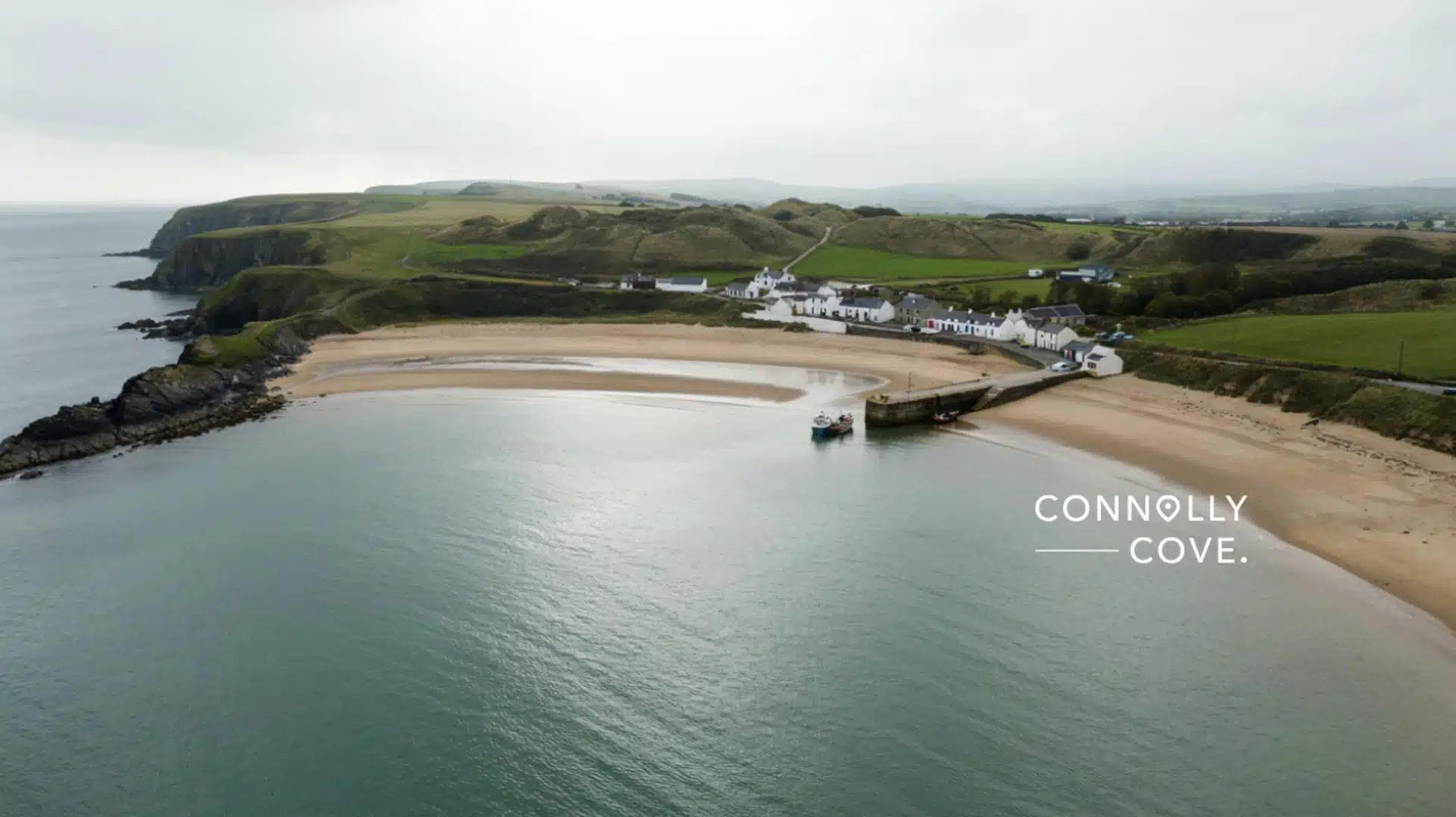

Portballintrae, County Antrim, is the kind of place people drive past on their way to somewhere louder. That’s rather the point. This small horseshoe-shaped harbour village sits four miles east of Portrush and two miles west of the Giant’s Causeway, and it has spent centuries quietly getting on with fishing, sheltering shipwreck survivors and hosting one of the most remarkable treasure hauls in Irish history.
For travellers exploring the Causeway Coastal Route, Portballintrae works best as a base rather than a box to tick. You can walk to two major landmarks, swim in a sheltered harbour bay, and be back at your accommodation for dinner without starting the car. Here’s what to know before you go, including where the water turns dangerous and where the history runs deepest.
Table of Contents
A Village Shaped by the Sea and the Spanish Armada
Portballintrae takes its name from the Irish Port Bhaile an Trá, meaning port of the beach settlement, and the description still fits. The village grew up as a fishing settlement around a natural horseshoe bay, and its working harbour still shelters a handful of boats today. It’s one of the smaller stops covered in ConnollyCove’s guide to County Antrim, but it holds more history than its size suggests.
Long before tourism arrived, the coastline made its own history. On the night of 26 October 1588, the Spanish galleass La Girona struck rocks at Lacada Point, close to the Giant’s Causeway, while trying to sail home after the defeat of the Spanish Armada. Of an estimated 1,300 people on board, only nine survived. The handful who reached shore were taken in by Sorley Boy MacDonnell, whose stronghold at Dunluce Castle stood on the cliffs nearby.
The wreck lay undisturbed for nearly four centuries until 1967, when Belgian diver Robert Sténuit located it after years of research in Spanish archives. What he brought up- gold chains, rings, a jewelled salamander pendant and coins from across the Spanish Empire- now forms one of the finest Armada collections anywhere in the world, on permanent free display at the Ulster Museum in Belfast. It remains the largest recovery of Spanish Armada treasure ever made from a single wreck.
“Standing at the harbour in Portballintrae, it’s hard to connect this quiet spot with a disaster that killed well over a thousand people in a single night,” says Ciaran Connolly, Founder of ConnollyCove. “But that’s the story of this stretch of coast. The calmest-looking places often carry the heaviest history.”
The Horseshoe Bay and Its Beaches
Portballintrae’s setting is the main draw, and it needs surprisingly little embellishment. The village curves around a sheltered bay backed by cliffs and dunes, and the harbour beach itself is small, sandy and generally safe for swimming and paddling. Free parking is available in the main village car park, a short walk from both the harbour and the beach.
The bigger beach, Runkerry Strand, also known locally as Bushfoot Strand, stretches east from the village towards the Giant’s Causeway and is a different proposition entirely. It’s a genuinely striking stretch of coastline and a popular surf spot, but the currents are strong and permanent, caused partly by the outflow of the River Bush. Swimming isn’t advised; there’s no lifeguard service here, and the nearest patrolled beach is Whiterocks, roughly three and a half miles towards Portrush. Access is via a footbridge and sand dunes from the village car park. If you’re travelling with children or aren’t a confident swimmer, stick to the harbour beach and treat Runkerry as somewhere to walk, not swim.
Above the dunes near Runkerry, keep an eye out for the earthworks at Lissanduff, a pair of circular enclosures thought to date back around 3,000 years to the Bronze Age. They’re easy to miss if you don’t know they’re there, which says something about this stretch of coast: the obvious landmarks sit right beside things almost nobody stops for. ConnollyCove’s North Coast travel guide covers more of these lesser-known sites along the same shoreline.
Things to Do in Portballintrae
Most visitors use Portballintrae as a walking base, and the village earns that role. Heading east, the coastal path towards the Giant’s Causeway follows the old route of the Giant’s Causeway Tramway, a heritage railway that still runs seasonally between Bushmills and the Causeway visitor centre and crosses the dunes above Runkerry Strand. It’s roughly a 45-minute walk one way, and the path is flat and easy to follow.
Heading west instead, a similar coastal walk connects Portballintrae to Dunluce Castle in around 25 to 30 minutes, following cliff paths with sea views for most of the route. ConnollyCove’s guide to Dunluce Castle covers the ruin’s history in more depth if you’re planning to stop there. Both routes can be combined into a longer loop for anyone spending a full day on foot.
The village itself doesn’t need long to explore beyond its walks. A wander around the harbour, a look at the whitewashed cottages lining the shore, and a coffee stop are usually enough before moving on. Above the western side of the bay stands Seaport Lodge, a whitewashed building constructed around 1770 as a private bathing house and still a local landmark today. Sailors and boat owners use the small harbour regularly, and it’s worth timing a visit around the tide if you want to see it at its fullest.
Nearby Attractions Worth the Short Drive
Carrick-a-Rede Rope Bridge is around a fifteen-minute drive from Portballintrae, near Ballintoy. The bridge sways thirty metres above the sea and connects the mainland to a tiny island once used by salmon fishermen; book ahead in summer, as the National Trust limits daily crossings.
Inland, roughly twenty minutes away near Armoy, the Dark Hedges is a tunnel of twisted beech trees planted in the eighteenth century to impress visitors arriving at Gracehill House. Its role as the Kingsroad in Game of Thrones brought it worldwide attention, and it remains one of the most photographed stops on the north coast.
It’s one of several Northern Ireland locations from the show; ConnollyCove’s guide to Game of Thrones filming locations covers the rest, from Ballintoy Harbour to the Cushendun Caves.
Bushmills, home to one of the world’s oldest licensed distilleries, sits a short drive south and makes a sensible stop for lunch or a browse around its shops; ConnollyCove’s Bushmills town guide has more on what else is worth seeing there. Further along the coast towards Ballycastle, the harbour town offers beaches, a lively summer calendar and a ferry link to Rathlin Island for anyone with an extra day to spare.
Getting There and Planning Your Visit
Portballintrae has no train station of its own; the nearest is Coleraine, around twenty minutes away by car. From Coleraine or Portrush, the seasonal Causeway Rambler bus, Translink service 402, runs along the coast between Coleraine and Ballycastle, stopping at Portrush, Bushmills and the Giant’s Causeway, though it’s worth checking current timetables before relying on it outside the summer months.
Driving remains the most practical option for most visitors, and Portballintrae makes a workable base for two or three nights covering the wider Causeway Coastal Route. ConnollyCove’s scenic drives guide to Northern Ireland sets out how to structure a longer trip along this coastline if you’re combining Portballintrae with stops further towards Derry or the Glens of Antrim.
The village itself has a small number of guesthouses and self-catering cottages overlooking the bay, along with a handful of places to eat. For a wider choice of restaurants and hotels, most visitors base themselves in nearby Bushmills or Portrush and treat Portballintrae as a beach and walking stop rather than an overnight hub, though staying in the village itself has real appeal if you want to wake up beside the harbour.
May to September brings the most reliable weather and the longest days, but the north coast is worth visiting off-season too, particularly for storm-watching and quieter beaches. Whatever the month, pack for wind and rain regardless of the forecast; the weather here changes quickly, and the horseshoe bay offers little shelter once it turns.
Portballintrae rewards travellers who treat it as a base rather than a drive-through. Between the village’s history, a beach worth respecting rather than swimming in, and two major landmarks within walking distance, it packs a genuine amount into a village of around 500 people.
Base yourself here for a night or two, walk both coastal paths, and leave the car for the short hops to Carrick-a-Rede and the Dark Hedges. It’s a quieter way to see the Causeway Coast than most visitors manage, and often a more memorable one.
Planning Your Visit? ConnollyCove covers Northern Ireland’s Causeway Coast in depth, from Dunluce Castle to the wider County Antrim guide. Explore more of our Northern Ireland travel content, or watch our video guides to the region on YouTube.
FAQs
Quick answers to the questions we hear most often about visiting Portballintrae.
Is it safe to swim at Portballintrae?
The small harbour beach in the village is generally safe for swimming. Runkerry Strand, the larger beach nearby, has strong permanent currents and no lifeguard service, so swimming there isn’t advised.
How far is Portballintrae from the Giant’s Causeway?
It’s about two miles, roughly a 45-minute walk along the coastal path, or a five-minute drive.
Can you visit the Spanish Armada treasure site?
You can walk to Lacada Point, where La Girona wrecked in 1588. The recovered treasure itself is on permanent display at the Ulster Museum in Belfast.
Is Portballintrae worth visiting if you’ve already seen the Giant’s Causeway?
Yes. It offers a quieter base with its own beach, harbour and walking routes, without the visitor centre crowds.
How do you get to Portballintrae without a car?
The seasonal Causeway Rambler bus service connects Portballintrae to Coleraine, Portrush and Bushmills, though services are limited outside summer.
What does the name Portballintrae mean?
It comes from the Irish Port Bhaile an Trá, meaning “port of the beach settlement.”