


Pisa Tower: 10 Exciting Facts About the World’s Most Famous Leaning Tower
Updated On: April 15, 2024 by  Miranne Khaled
Italy has a captivating charm that brings people from all parts of the world to marvel at its splendour. It’s home to a plethora of great cities that inspire a feeling of delight and unfold fantastic historical tales, not to mention their unique culture and exceptionally delectable Italian cuisine. Most importantly, Italy is home to one of the world’s most iconic landmarks, the Leaning Tower of Pisa.
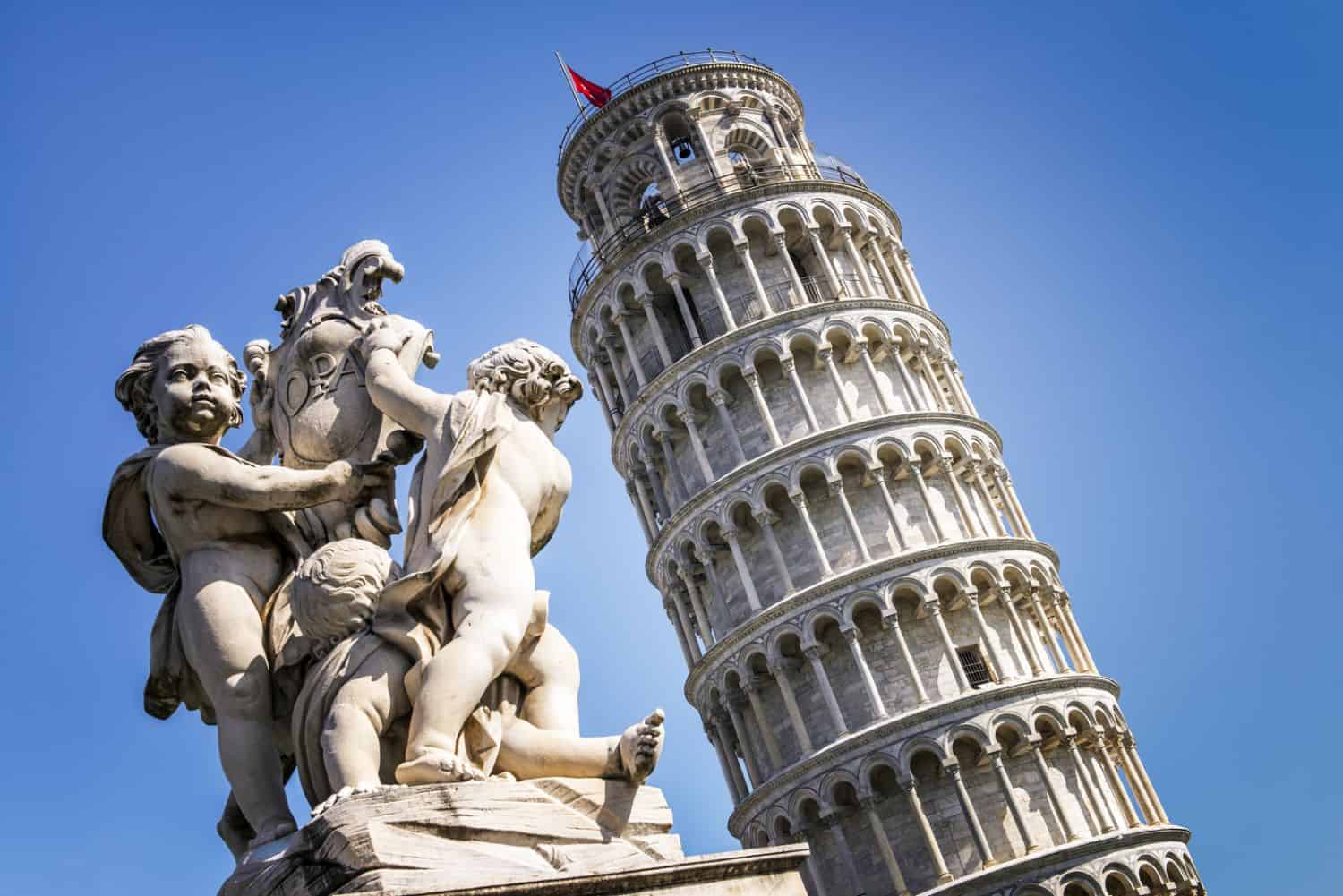
Commonly known as Pisa Tower, this monument has always left its beholders in awe, with many wondering how it managed to withstand the test of time despite the land it sits on. Interestingly, the leaning nature of Pisa Tower was never intentional; it was a grave mistake by the engineer working on the project, which proved unfit.
Nevertheless, while many perceived the slanted facade as a terrible shame brought to Italy, others believed it to be a marvellous sight. To the surprise of many, it had lured visitors from across the globe more than was ever predicted. Today, we’re taking the time to divulge some interesting facts about this intriguing monument you may not know.
The History of Pisa Tower
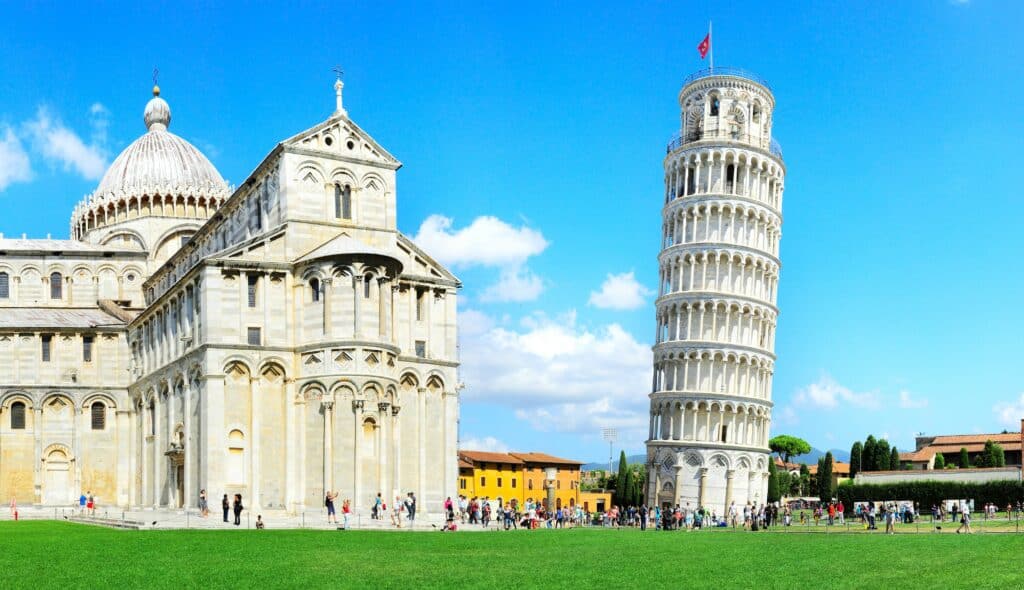
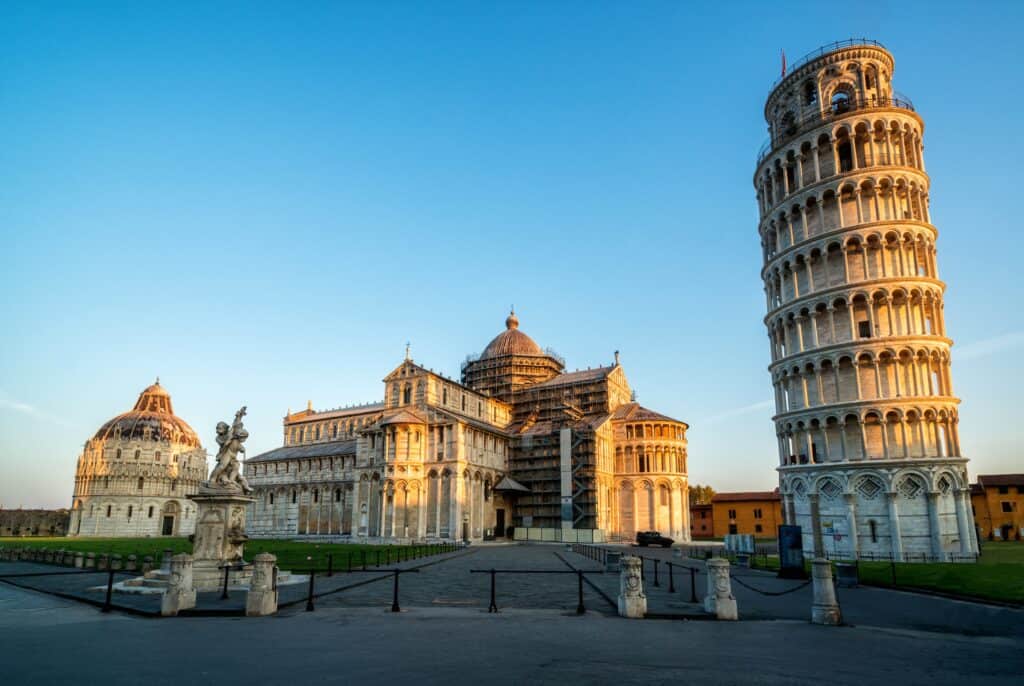
As we all know, the mighty Leaning Tower of Pisa lies within the borders of the beautiful Italian city of Pisa. It’s well-known for being home to enough spare monuments with a medieval architectural style. Pisa Tower is located in Piazza dei Miracoli, the Square of Miracles, right next to the Cathedral of Pisa.
The designs of the structure are among the many factors that make this city stands out. Yet, Pisa Tower remains the most famous of them all. The structure also has a Romanesque style and has been around for centuries now. The construction of the tower began in the 12th century in 1173; however, it was only completed two centuries later, in 1372.
Several architects worked on the magnificent project, with Bonanno Pisano and Gherardo din Gherardo being the most accredited engineers in the construction’s first phase. However, given that the tower was completed over the course of two centuries, a lot of architects have definitely barged in to get the work done.
Pisa Tower was meant to be a busy trade centre, serving as the bell tower of the Cathedral of Pisa. Instead, it became one of the world’s most famous landmarks. It was also initially built to show off the power and wealth of the city. Building grand structures was a pure sign of prosperity, and Pisa City wanted to join the world’s lavish leagues, given that it was only a small seaport in Italy.
10 Exciting Facts About the Renowned Leaning Tower of Pisa
The inclination of the tower has only made it a great symbol to all humans around the world. Instead of viewing it as a defective structure, people have adopted the notion of it being a symbol of strength. It signifies the ability of humans to defy many grave consequences. Honestly, the tower’s ability to withstand the power of gravity for all of these years is a wonder to think about.
Walk with us through these interesting facts about the incredible Pisa Tower:
1. It Wasn’t Meant to Lean
It’s an undeniable truth that the leaning of Pisa Tower is the secret to its peculiarity. However, the inclination was part of the plan. John Burland was the engineer working on the ambitious project in its first work phase. He was pretty honest about being terrible at the science of soil mechanics, a crucial part that plays an essential role in the stability of buildings.
In fact, Pisa is home to soft soils, a feature in grounds that give buildings a hard time standing up. Even the word “Pisa” derives from a Greek word that literally means “the marshy land.” This fact was only discovered after building three stories of the building, after which the tilt started to become evident.
Apparently, the project and the area weren’t well studied, resulting in what we now know as the Pisa Tower. In fact, Pisa Tower isn’t the only leaning tower in the city; quite a few smaller ones tilt to one side, thanks to the nature of the soil. Some tall buildings have even tilted more aggressively than the Tower of Pisa.
2. It Supposedly Served as a Scientific Experiment Base
Pisa Tower has fascinated people for years, summoning them from all parts of the world to come and behold its grandeur. Interestingly, the leaning tower was a fascination for almost everyone, including respectful scientists, with Galileo Galilei on top of them. The Italian scientist had an interesting theory that contradicted one of Aristotle’s, and Pisa Tower was his landing place.
His famed theory of the relation between mass and acceleration was proven through an experiment at Pisa Tower, disproving Aristotle’s theory. It’s said that in 1589 Galileo dropped a musket ball and a cannonball, both with different masses. He claimed that each ball hit the ground at different rates, depending on its mass, with the heavier mass hitting first.
This theory has always been one of the most significant achievements of Galileo, and many have always associated its proof with Pisa Tower. However, modern scholars have argued over this fact. They believed Galileo may have used the leaning tower as a base for his experiment but hadn’t actually used the dropping balls method.
3. Earthquakes Couldn’t Destroy It
Throughout the time when Pisa Tower was brought into being, Italy witnessed several earthquakes. However, four famous vigorous earthquakes hit Italy at different times, proving the sturdiness of the leaning tower. Many had anticipated the fall of the great Pisa Tower, given that it was too inclined to begin with, doubting its ability to survive strong hits.
That was only before the world learned about the fascinating phenomenon known as Dynamic Soil-Structure Interaction (DSSI). This explains the softness of the ground beneath the tower, which functions differently from soils with common characteristics. The effect of the DSSI diminishes the impact of the ground motion acting on the construction.
It’s one of the great wonders of physics laws that have offered the world a new theory and opened the scientists’ eyes to a novel discovery. The ability of the inclined tower to withstand the striking hits of a series of earthquakes is surely a miracle to behold.
4. Mussolini Made It Worse
Benito Mussolini was one of the most famous Italian dictators of the 20th century. He was pretty ashamed of the defects of Pisa Tower, professing that it did nothing but bring shame to everything that Italy stands for. He believed that the tower tainted Italy’s reputation and was in dire need of a fixture.
As a result of his ideology, he decided to weigh in to help fix the flaws and produce a proper tower that stood vertically. Mussolini succeeded in his projects across Italy, with the draining of the Sicilian swamps being the most triumphant. However, his attempts to secure the drawbacks resulted in a further disaster.
His idea was to make the tower’s base relatively heavier, setting the building in a proper vertical position and averting it from tilting. Surprisingly, the laws of nature were much more robust, and the soft soil had a different opinion. Thus, his plans had only the tower lean even further, making the lean even worse than it was before.
5. Not Even the Second World War Brought It Down
The power of Pisa Tower doesn’t just lie in its unique building structure and the nature of the soil on which it stands. Thankfully, the soil composition beneath the famous tower had saved it from surrendering to earthquakes. However, its peculiar grandeur was another factor that contributed to its saving.
During the Second World War, Pisa Tower served the German Army perfectly, being their military base. On top of that, its tilted angle was in favour, offering perfect surveillance over the surroundings. At that time, the American troops forcefully entered Italy on a mission to bring down every iconic structure.
The famed Leaning Tower of Pisa was on the list to be destroyed by the American army. However, the soldiers reached the grounds and were spellbound by the charm of the eccentric building. They halted the firing and decided to retreat, believing the tower was too whimsical to bring down. Thanks to that decision, we got to see the renowned building intact.
6. It’s Quite Flexible
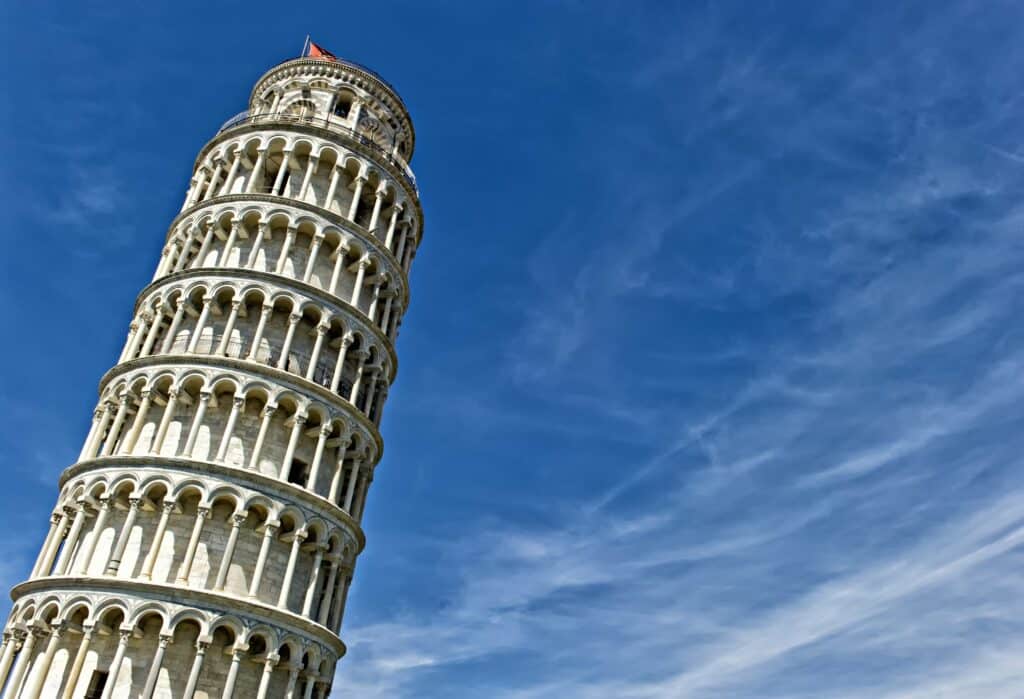
Ever since the tower was brought into being, its leaning has kept progressing over time. At one point, the slouching maximised where the tower was tilting at 5.5 degrees, making it seem like it was already falling. Engineers worked exceptionally hard to balance the structure by consistently levelling the soil underneath.
The catastrophic lean was solved at some point. However, to everyone’s surprise, the tower started leaning in the opposite direction. It had proven its ultimate flexibility, surprising the whole world once more. During the construction phase, engineers built one side taller than the other, doing their utmost to right the posture. It only ended up with a slight curve, making the Pisa Tower slightly curved and highly leaning.
Eventually, the endless attempts finally paid off, and the tower was, ironically, fixed into its initial tilting position, which was in the southward direction. The extreme tilting was also taken care of, saving it from the disastrous 5.5 degrees and reducing the inclination to just 3.97 degrees as we see it today.
7. Pisa Tower is Pretty Huge
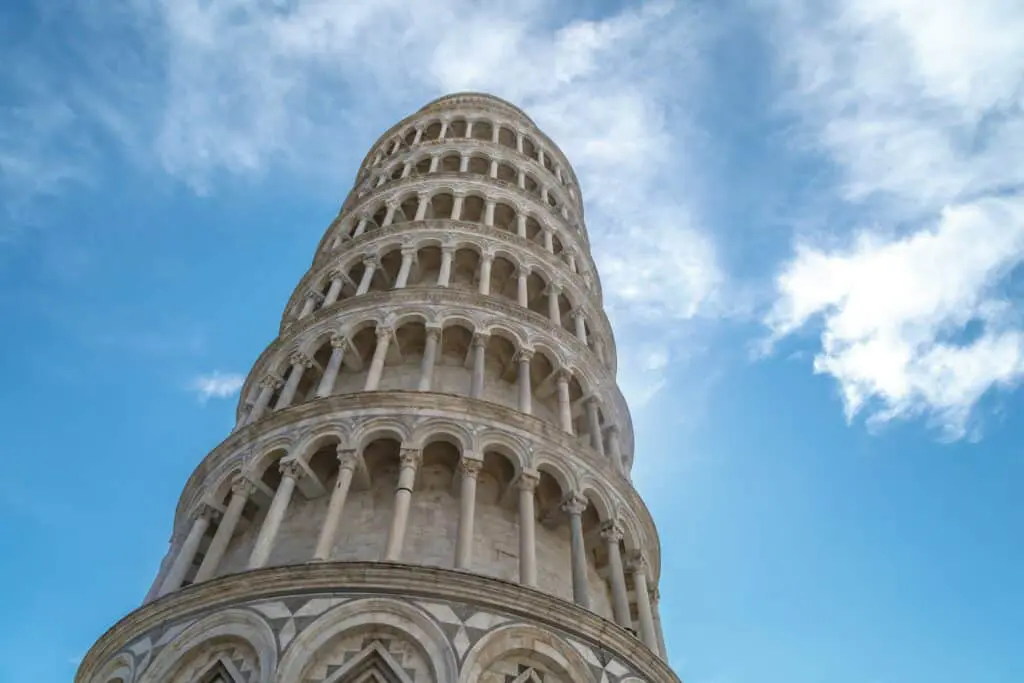
Pisa Tower has earned itself a place among the Seven Wonders of the World. Not only is its colossal size quite impressive, but it’s one of the most bizarre structures in the world. It was the third most prominent structure in the area, built as part of the cathedral complex and serving as its bell tower. The building has eight floors, making you wonder what could be inside.
Of course, the extreme leaning has led to leaving the insides of the tower quite empty. All eight floors have nothing but a long staircase going in a spiral and windows. Although most people enjoy visiting Pisa Tower to observe its incline in real-life and take Instagrammable photos, some have more curious souls and like to explore the insides. Interestingly, Pisa Tower allows visitors to climb the entire tower to the top.
Reaching the top is quite rewarding despite being a substantial empty cylinder. It has more than 250 steps to climb, taking almost 30 minutes to reach the top. The exact number of stairs has never been agreed upon, with some claiming them to be 251, others saying 294, and others 300. The only way to discover the truth is to climb Pisa Tower and enjoy the vast terrain’s picturesque view.
8. Declared A UNESCO Heritage Site
Pisa Tower did a great job capturing the world’s attention and continues to do so. It successfully earned itself a spot among the great list of the World’s Seven Wonders. But this is not its only title; it was also declared a UNESCO Heritage Site, emphasising the historical and cultural significance of the renowned tower.
Moreover, the entire site belongs to UNESCO, encompassing Pisa Tower, the Cathedral of Pisa, and the rest of the buildings. They display a magnificent Medieval architectural style and play a pivotal role in the history of Italy. The complex also features fascinating ancient Italian monuments that continue to influence the world’s art.
9. Home to Seven Bells
As we previously mentioned, Pisa Tower was supposedly the bell tower attached to the cathedral. Although it’s pretty empty on the inside, it still houses seven huge bells. These bells proudly sit at the top of the tower, with each of them having a specific name. Not only that, but also each bell correlates with one of the seven musical notes.
Like all the bells of ancient buildings, they swing by pulling down ropes, producing blasting sounds. However, ringing the bells has become forbidden by law, given the acute inclination of the tower, and that’s because the vibrations produced by intense sounds can contribute to the tower leaning even further.
As a result, these bells haven’t rung since the 20th century, being silent for over a hundred years. Electronic hammers are used to operate the bells, which produce sounds without having to move the bells and put the tower in jeopardy.
10. The Tilt Could Resume
After long years of attempting to save Pisa Tower from a catastrophic fate, it’s finally stable at this moment, and there’s no record of it being inclining any further. But despite that, engineers and experts expect that the tilting could resume again, given that the stability will probably last no longer than a couple of centuries.
Of course, that sounds like a long time, and it really is, but no one knows what Pisa Tower will be like for future generations. The engineers claim that the soil beneath the tower’s foundation may weaken by the early 23rd century. However, that’s in case everything else around remains constant and doesn’t speed up the process.
Luckily, Pisa Tower is open for everyone to visit and marvel at its eccentric beauty. You will need to book a tour in advance for an affordable fee to reserve a spot for yourself. Your tour of the famous Leaning Tower of Pisa would be a much more interesting one with the knowledge you have about it now.
3 commments on “Pisa Tower: 10 Exciting Facts About the World’s Most Famous Leaning Tower”

Top 10 Irish Public Holidays and Traditions to Experience on Your Ireland Holidays
Festivals and Events
18/04/2024

6 Top Mourne Camping Sites for an Unforgettable Experience Under the Stars
Northern Ireland
18/04/2024

Eostre: The Germanic Goddess of Dawn and Spring Equinox Celebrations
Mythology and Folklore
17/04/2024

Explore the Top Hotels in County Cavan for Your Ultimate Getaway
County Cavan
17/04/2024

Irish Golf: Exploring the Top Golf Courses in Ireland
Culture Exploration
17/04/2024
thank you for the article
Glad you enjoyed the blog 🙂
Can you elaborate on any recent developments or events related to the Pisa Tower that are mentioned in the article?