
Article Summary
What this article covers: Niagara Falls’ three waterfalls, how they formed, 15 attractions worth visiting on both the Canadian and American sides, and where to stay.
Who this is for: Travellers planning a first visit to Niagara Falls, whether approaching from the Canadian or American side of the border.
Key takeaway: Niagara Falls isn’t the world’s tallest or largest waterfall, but it has the highest average flow rate of any waterfall in North America, which is what actually accounts for its scale and reputation.
Expert insight:
People arrive expecting Niagara to be the biggest waterfall on Earth and leave slightly surprised it isn’t. What actually gets you is standing close enough to feel the spray from that much water moving at once. The volume is the real story here, not the height.
Ciaran Connolly, Founder of ConnollyCove
Quick facts:
- Niagara Falls has the highest average flow rate of any waterfall in North America, though it isn’t the tallest or largest waterfall in the world
- Niagara Falls State Park, opened in 1885, is the oldest state park in the United States
- The Adams Power Station, built at Niagara Falls in 1895, was a landmark early hydroelectric facility that helped pioneer large-scale AC power transmission
Table of Contents
Niagara Falls sits on the border between Ontario, Canada, and New York State, roughly 27 kilometres from Buffalo and 130 kilometres from Toronto. It isn’t the world’s tallest or biggest waterfall, but it has the highest average flow rate of any waterfall in North America, which is the real source of its scale and reputation.
The Three Waterfalls

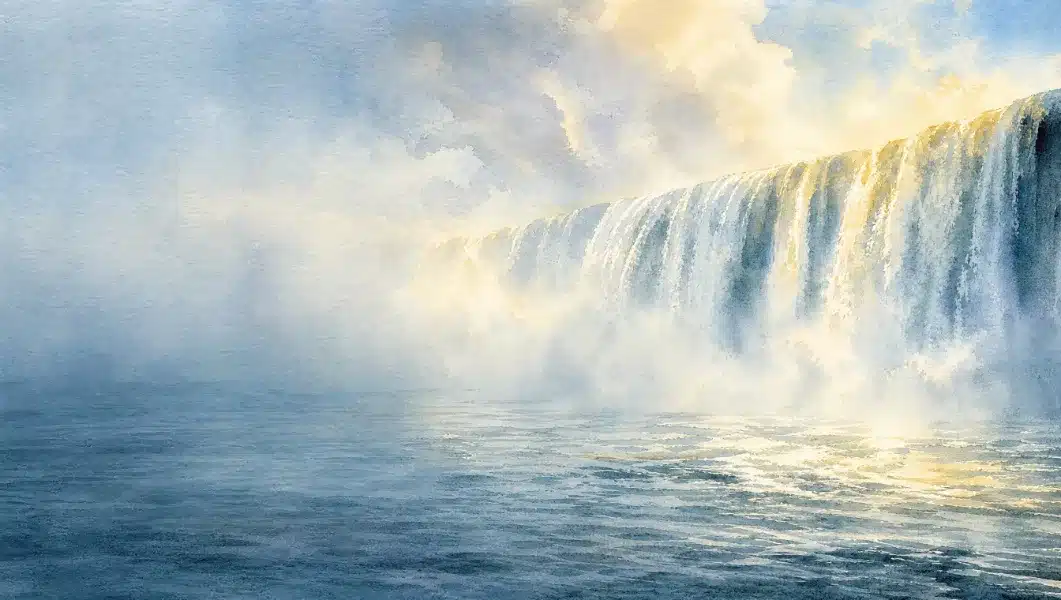
Niagara Falls is actually three separate waterfalls rather than one. Horseshoe Falls, the largest, sits mostly on the Canadian side between Goat Island and Table Rock, measuring 792 metres wide and 48 metres high, and carries the great majority of the Niagara River’s flow. American Falls, between Prospect Point and Luna Island, is 51 metres high and 323 metres wide. Bridal Veil Falls, the smallest of the three, sits between Goat Island and Luna Island on the American side and reaches 55 metres in height.
The falls formed as glaciers retreated at the end of the last ice age, roughly 12,500 years ago, exposing the Niagara Escarpment and setting the Niagara River on its current course. The river’s freeze-thaw cycles have eroded the rock ever since, and the falls have moved upstream by several kilometres over that time; geologists estimate continued erosion will eventually connect the falls to Lake Erie, though not for tens of thousands of years.
Belgian missionary Father Louis Hennepin gave the falls their first written description for a European audience in his 1697 book A New Discovery of a Vast Country in America, though Indigenous peoples in the region had known the falls for millennia before his arrival. The falls became a major tourist destination through the nineteenth century, and in 1895, the Adams Power Station became one of the first large-scale hydroelectric facilities anywhere, helping establish alternating current as the standard for long-distance power transmission.
The land around the falls itself is managed by two separate public bodies depending on which side of the border you’re on. Niagara Parks, an agency of the Ontario provincial government established in 1885, maintains 56 kilometres of parkland along the Niagara River on the Canadian side, funded entirely through its own attractions, restaurants and parking revenue rather than government grants. On the American side, Niagara Falls State Park plays a similar role.
Weather in Niagara Falls
Summers run from roughly May to September, with temperatures reaching the low 20s Celsius. Winters, December to March, are cold and dry, typically dropping to around 5°C or below. Neither waterfall freezes solid in winter, despite a persistent myth to the contrary, though ice formations along the banks and mist can be genuinely dramatic in cold weather. Spring brings higher water flow from snowmelt upstream, which makes April and May a strong window for photography, though also the point at which mist and spray are heaviest around the closest viewpoints.
Top Attractions on the Canadian Side
Skylon Tower sits 235 metres above the falls, with indoor and outdoor observation decks and two restaurants, including a revolving dining room.
Niagara SkyWheel, one of Canada’s largest observation wheels at 53 metres tall, offers an 8 to 12 minute ride with views over both the falls and the city, particularly striking after dark when the falls are illuminated.
Whirlpool Aero Car, operating since 1916, is a cable car that crosses roughly a kilometre above the Niagara Whirlpool on the Whirlpool Rapids, carrying up to 35 passengers per trip. It remains one of the oldest continuously operating tourist attractions in the region, largely unchanged in mechanism since it opened.
Journey Behind the Falls, run by Niagara Parks, takes visitors down through tunnels carved into the rock behind Horseshoe Falls itself, emerging onto an observation deck at the base where the sound and spray are considerably more intense than any viewpoint above ground.
Niagara-on-the-Lake, about 20 minutes from the falls on Lake Ontario, is a nineteenth-century town largely rebuilt after being destroyed in the War of 1812, now known for horse-drawn carriage tours, its historic streetscape, and a concentration of wineries in the surrounding countryside.
Old Fort Niagara, an eighteenth-century fort that controlled access to the Great Lakes during the colonial wars, holds a visitor centre with exhibits and artefacts, plus year-round events.
Niagara Parkway follows the Niagara Gorge from the falls to Fort Erie, passing the Floral Clock, the Whirlpool Rapids and the Butterfly Conservatory along the way.
Clifton Hill, known locally as Niagara’s Street of Fun, holds the SkyWheel, an amusement arcade, family attractions and restaurants aimed squarely at visitors travelling with children.
Butterfly Conservatory, on the Niagara Parkway, houses around 2,000 butterflies across more than 40 species inside a glass conservatory with tropical planting and waterfalls.
Bird Kingdom, billed as the world’s largest free-flying indoor aviary, makes a good option for a colder day, with a wide range of tropical bird species on display.
Hornblower Niagara Cruises runs boat tours from the Canadian side directly to the base of the falls, carrying up to 700 passengers per trip throughout the day.
Top Attractions on the American Side
Niagara Falls State Park, opened in 1885, is the oldest state park in the United States, spanning 400 acres with bike trails, picnic areas and five islands on the Niagara River. Its Observation Tower gives views of all three waterfalls, and the park hosts nightly illuminations and fireworks displays throughout the year.
Cave of the Winds, reached via Goat Island, takes visitors down to a wooden platform just 20 metres from Bridal Veil Falls itself. Sandals and ponchos are provided, since the platform sits inside the falls’ near-constant spray.
Aquarium of Niagara holds more than 200 marine species across roughly 30 exhibits, including a sea lion show and a penguin feeding programme, making it a solid option for families.
Whirlpool Jet Boat Tour runs a short distance from the falls into class 5 whitewater on the Niagara River, with open boats in summer and dome-covered boats in autumn.
Maid of the Mist, running since 1846, is the longest-continuously-operating boat tour at Niagara Falls, taking around 30 minutes to approach the base of both American and Horseshoe Falls.
Where to Stay
Most visitors base themselves on whichever side of the border they’re primarily exploring, though both sides are easily reached from the other by car or on foot across the Rainbow Bridge, which also functions as the main pedestrian border crossing.
Sheraton Fallsview and Hilton Niagara Falls both offer falls-facing rooms on the Canadian side, with Hilton’s top-floor lounges giving views across both American and Horseshoe Falls.
Holiday Inn and Americana Resort, both aimed at families, sit near the falls with larger suites, water park facilities and nearby green space.
Crowne Plaza Niagara Falls, roughly 15 minutes from Horseshoe Falls, offers a lower-cost alternative without sacrificing views entirely.
Booking well ahead matters more in summer, when the region’s hotel capacity fills up around both the falls’ own visitor volume and the wider Niagara-on-the-Lake wine tourism season running in parallel.
Getting There
The nearest major airport is Buffalo Niagara International, roughly 30 minutes from the American side by car, with Toronto Pearson International serving the Canadian side at around 90 minutes’ drive. Direct trains run from Toronto to Niagara Falls, Ontario, and from New York City to Niagara Falls, New York, though journey times from New York City run to eight hours or more, making a flight into Buffalo the more practical option for most international visitors.
Crossing the border between the two sides requires a valid passport regardless of nationality, and wait times at the Rainbow Bridge crossing can run long during peak summer weekends. If your itinerary includes both sides, crossing early in the day or via the Whirlpool Rapids Bridge, which carries less tourist traffic, tends to save time. Car rental is straightforward on either side, though most of the attractions listed above sit within easy walking distance of each other once you’ve reached whichever side you’re focusing on.
Conclusion
Niagara Falls rewards a visit longer than the single afternoon most itineraries allow it, particularly given how differently the Canadian and American sides present the same three waterfalls. Book boat tours and cable car rides in advance during peak summer months, and consider timing an evening visit to catch the illuminations if photography is part of the plan.
Explore More of North America
ConnollyCove covers destinations across North America in more depth. Explore the guide to New York City or Toronto, or watch our YouTube channel for more on North American travel.
Frequently Asked Questions
Is Niagara Falls the largest waterfall in the world?
No. It’s neither the tallest nor the largest waterfall globally, but it has the highest average flow rate of any waterfall in North America, which is the source of its scale and reputation.
Which side of Niagara Falls is better to visit, Canadian or American?
The Canadian side offers the classic head-on view of Horseshoe Falls and most of the observation towers and attractions, while the American side offers closer access to the falls themselves, including Cave of the Winds. Many visitors do both, since the Rainbow Bridge connects them on foot.
Does Niagara Falls freeze in winter?
No, despite a persistent myth to the contrary. Ice can form dramatically along the banks and mist in cold weather, but the falls themselves don’t freeze solid.
Who first described Niagara Falls to Europeans?
Father Louis Hennepin, a Belgian missionary, gave the first written European description of the falls in his 1697 book A New Discovery of a Vast Country in America, though Indigenous peoples had known the falls for millennia before his arrival.
How long should I spend at Niagara Falls?
A single day covers the main viewpoints and one boat tour, but two days allow time to properly explore both sides of the border and add attractions like Niagara-on-the-Lake or Old Fort Niagara.
What was the Adams Power Station?
Built at Niagara Falls in 1895, it was one of the first large-scale hydroelectric facilities anywhere and played a key role in establishing alternating current as the standard for long-distance electricity transmission.
Who manages the land around Niagara Falls?
Niagara Parks, an Ontario provincial agency, manages the Canadian side, while Niagara Falls State Park, run by New York State, manages the American side. Both are self-funded through visitor attractions rather than direct government grants.