
Article Summary
What this article covers: A practical travel guide to Monemvasia Greece, covering its Byzantine history, how to get there, when to visit, the main sights inside the castle, restaurants and cafes, where to stay, and day trips across the south-eastern Peloponnese.
Who this is for: First-time visitors to the Peloponnese, travellers planning a road trip from Athens, and anyone curious about medieval fortress towns.
Key takeaway: Monemvasia is a car-free medieval town built into the side of a sea rock, reached by a single gate; planning your parking, luggage, and timing makes the difference between a stressful visit and a memorable one.
Expert insight: “The first thing that struck us about Monemvasia was the quiet once you step through the gate. You leave the car on the causeway, walk through a bent tunnel in the wall, and suddenly the only sounds are footsteps on stone and the sea below.” , Ciaran Connolly, Founder of ConnollyCove
Quick facts:
- The name comes from the Greek moni emvasis, meaning “single entrance”, a reference to the one gate into the walled town
- An earthquake in 375 AD separated the rock from the Peloponnese mainland; a short causeway now links it to the village of Gefyra
- Monemvasia gave its name to Malvasia wine, known in medieval England as Malmsey, which regained Protected Designation of Origin status in 2010
Monemvasia Greece sits on a huge limestone rock off the south-eastern coast of the Peloponnese, joined to the mainland by a narrow causeway. From the road you see only cliffs; the town hides on the seaward side, a maze of stone houses, domed churches, and stepped lanes lived in for roughly 1,400 years. No cars pass the gate.
ConnollyCove is an Ireland-based travel and culture platform founded by Ciaran Connolly. We cover places where history is still part of daily life, and this town fits that description better than most. If you are building a wider trip, our guide to things to do in Greece sets out the bigger picture.
This guide covers how to reach Monemvasia Greece, where to park, what to see, where to eat inside the castle walls, and how to spend a day here.
Where Is Monemvasia Greece and Why Does It Have One Entrance?
Monemvasia Greece is in the region of Laconia, on the Myrtoan Sea, roughly four hours by car south of Athens. Its defining feature is access: one causeway leads to the rock, and one fortified gate leads into the town. That single entrance gave the place its name and, for centuries, its military value.
From Earthquake to Byzantine Stronghold
Geologists and local historians date the rock’s separation from the mainland to an earthquake in 375 AD. In the late sixth century, people from the surrounding area of Laconia fled to the rock to escape Slavic and Avar raids, and they fortified the plateau on top. Over the following centuries the Byzantines, Franks, Venetians, and Ottomans all held the town, which is why visitors often hear it called the “Gibraltar of the East”.
The town prospered as a trading port. If fortified sites interest you, the ancient citadel of Mycenae in the north-east Peloponnese makes a fascinating contrast, being more than two thousand years older.
The Lower Town and the Upper Town
The castle, known locally as the Kastro, splits into two parts. The Lower Town (Kato Poli) runs along the seaward slope and is still inhabited, with guesthouses, shops, tavernas, and churches lining one main street and dozens of side lanes.
The Upper Town (Ano Poli) sits on the plateau, around 100 metres above the sea. It was the original settlement, and today it is an archaeological site of ruined houses, cisterns, and walls, with the Church of Agia Sofia still standing at the cliff edge. A zigzag stone path connects the two.
How to Get to Monemvasia Greece
Reaching Monemvasia Greece takes some planning because the town has no airport and no railway. Most visitors fly into Athens, often spending a night among the places to visit in Athens, then drive south. The last stage, crossing the causeway and getting your bags through the gate, is where travellers most often come unstuck.
Flying In
Monemvasia doesn’t have an airport. The most practical option is Athens International Airport, which handles domestic and international flights all year round. Kalamata Airport, on the other side of the Peloponnese, is closer but has fewer routes and many operate only in summer. Our overview of the main airports in Greece compares both.
Driving from Athens
The quickest route follows the motorway from Athens past Corinth to Tripoli, then heads south towards Sparta before continuing on national roads through Molaoi to Gefyra. Allow around four hours, plus stops. Much of the route uses toll roads, so keep euros or a card handy.
A slower, more scenic option runs through Argos, Astros, and Leonidio along the Arcadian coast and over the Parnon mountains. It involves narrow bends and suits confident drivers in daylight. Many travellers break the trip with a night in Nafplio or a detour to the ancient theatre at Epidaurus.
Travelling by Bus
KTEL Laconia runs regional buses to Monemvasia, usually with a change in Sparta or Molaoi depending on the timetable. Services are less frequent outside summer, so check the latest schedule before you travel.
Crossing the Causeway: Parking and Luggage
Vehicles cannot enter the walled town. Park in Gefyra and walk to the gate, around 20 to 25 minutes on the flat. In the busier months, a local shuttle bus also runs between Gefyra and the gate.
Roadside parking closer to the gate fills early in summer. Inside, the stone lanes are polished smooth, uneven, and full of steps, and small suitcase wheels struggle. A soft bag or rucksack is far easier, and shoes with good grip make a real difference, especially after rain. If you are staying inside the Kastro, ask your guesthouse in advance whether they help with luggage.
Best Time to Visit Monemvasia Greece
In ConnollyCove’s view, the best time to visit Monemvasia Greece is late spring (May to early June) or early autumn (September to October). Both periods offer warm weather, calmer lanes, and comfortable conditions for climbing to the Upper Town. July and August are the busiest months, and the midday heat on exposed stone can be intense.
| Season | Months | What to expect |
|---|---|---|
| Spring | March to May | Mild, green, wildflowers on the rock; occasional showers early in the season |
| Summer | June to August | Hot and dry; peak crowds and prices; best for swimming |
| Autumn | September to November | Warm sea into October; quieter lanes; more rain from November |
| Winter | December to February | Cool and wet rather than freezing; some businesses close; very peaceful |
In summer, plan the climb to Agia Sofia for early morning or late afternoon and carry water, as there is little shade on the plateau. Heat and footwear are two of the common mistakes visitors make in Greece, and both matter more here than in most towns.
Visiting in Winter
Monemvasia Greece in winter is a very different place. Day-trippers disappear, several restaurants and guesthouses close, and rain and wind become more common, though temperatures usually stay mild. Confirm accommodation and dinner options before arriving.
Monemvasia Attractions and Sightseeing

The main attractions of Monemvasia Greece are its churches, its small museum, and the Upper Town ruins. Everything is within walking distance, but the steps and gradients mean you should give yourself more time than the map suggests. Most visitors cover the highlights in a full day.
Church of Elkomenos Christos
The Church of Elkomenos Christos, dedicated to “Christ in Pain”, is the town’s cathedral and stands on the main square of the Lower Town. It was founded in the Byzantine period, but today’s building largely dates from a Venetian-era rebuilding in 1697.
Archaeological Collection of Monemvasia
Opposite the cathedral, a 16th-century former mosque houses the Archaeological Collection of Monemvasia. Over the centuries the building has served as a mosque, a church, a prison, and even a traditional Greek kafeneio. The museum opened to the public in 1999.
The collection is small but well focussed, with marble architectural pieces, ceramics, and everyday objects excavated across the rock.
Church of Panagia Chrysafitissa and the Ritsos House
The whitewashed Church of Panagia Chrysafitissa sits near the eastern edge of the Lower Town. Its small square is one of the few open spaces inside the walls.
Monemvasia Greece is also the birthplace of the poet Yiannis Ritsos, born in 1909 and one of the most important Greek writers of the 20th century. His family lived opposite Panagia Chrysafitissa before moving to a house just inside the main gate. A bust and plaque mark the family home, and Ritsos is buried in the town. He described Monemvasia as a “ship of stone”.
Church of Agia Sofia and the Upper Town
The Church of Agia Sofia is the finest Byzantine building in Monemvasia Greece and the only structure on the Upper Town plateau still intact. It stands right on the cliff edge, with long views over the sea.
When the ConnollyCove team researched the church, the dating proved more interesting than the legend. Scholars generally place it around 1150, when the town was growing rapidly. Tradition links it with Emperor Andronikos II Palaiologos, who reigned from 1282 to 1328, but the building itself is older. It was originally dedicated to Panagia Hodegetria, “the Virgin who shows the way”. Under Venetian rule it became a Catholic church, and under Ottoman rule it served as a mosque. After Greek independence it was rededicated to the Holy Wisdom, Agia Sofia, and restoration work in the 20th century saved it from further decay.
The climb from the Lower Town takes around 15 to 20 minutes on a stepped path. It is steep and exposed, so wear proper shoes.
Restaurants and Cafes in Monemvasia Greece
The restaurants and cafes in Monemvasia Greece range from rooftop cocktail bars near the gate to family tavernas serving Laconian dishes. Most sit inside the castle walls along the main street, with a few good options in Gefyra across the causeway. In peak season, booking dinner a day ahead is sensible.
Restaurants and Bars Inside the Castle
Enetiko Bar sits right by the entrance to Kastro Monemvasias, serving breakfast and coffee by day and cocktails at night, with sea views.
Emvasis Bar, also near the castle entrance, spreads across several floors with a roof garden at the top.
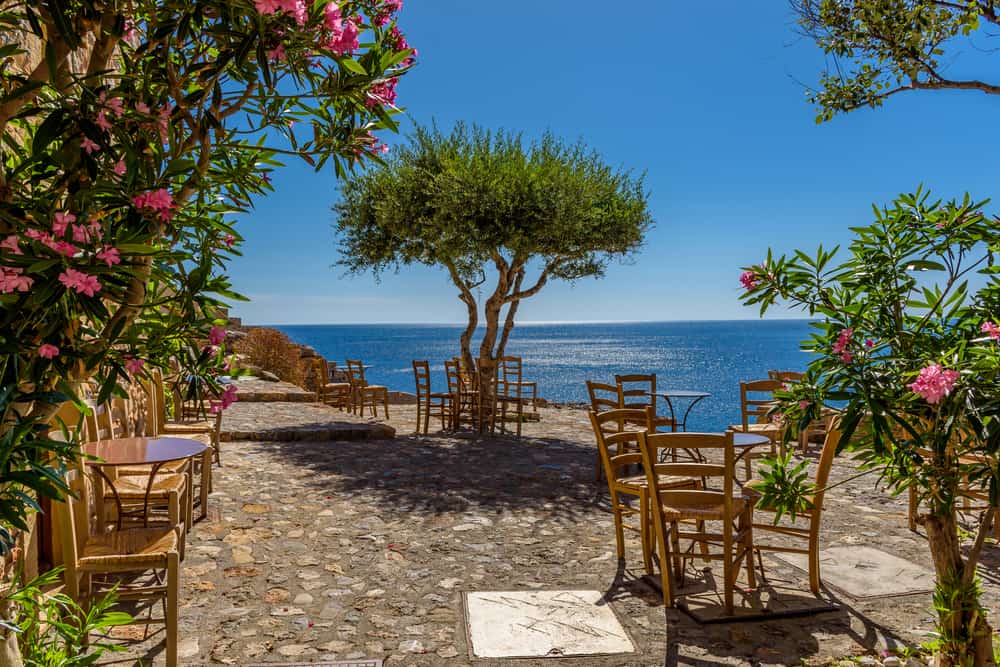
Oinomelo is a restaurant inside the castle with a terrace facing the sea and a quiet garden. The menu leans on traditional Greek food, and it is a relaxed spot for tsipouro, ouzo, or raki with meze in the evening.
Voltes is a family-run restaurant set up by two brothers. It serves traditional Greek dishes with a modern touch, alongside local wine and craft beer.
Chrisovoulo Restaurant and Bar stays open all year, useful in the quieter months, serving local wines, Greek and international plates, and cocktails.
Eating in Gefyra
Mateo’s Café and Snack Bar is in Gefyra, the small mainland settlement facing the rock, right beside the sea. It serves coffee and breakfast through the day, and in the evening seafood meze such as squid, grilled octopus, and marinated anchovies. Eating here also gives you the classic view of the rock itself, which you can’t see from inside the walls.
Malvasia Wine and Local Food
Monemvasia gave its name to one of the most famous wines of the Middle Ages. Venetian and Genoese merchants sold it as Malvasia, the French called it Malvoisie, and in England it became Malmsey. Production collapsed after the Ottoman conquest, but a long revival effort led to recognition of Monemvasia-Malvasia as a Protected Designation of Origin in 2010. The Wines of Greece guide to the PDO Monemvasia-Malvasia zone explains the grape varieties and ageing rules.
Ask for a glass with dessert, and look out for handmade pasta, wild greens pies, and local olive oil. The olive trees around Laconia connect to an older story, told in the ConnollyCove piece on the ancient olive groves of Greece and Italy.
Where to Stay in Monemvasia: Castle or Gefyra?
Accommodation in Monemvasia Greece falls into two camps. You can sleep inside the walls in a restored stone guesthouse, or stay across the causeway in Gefyra. The right choice depends on your luggage, your mobility, and your budget.
| Factor | Inside the Castle (Kastro) | Gefyra (Mainland) |
|---|---|---|
| Atmosphere | Quiet, car-free, historic | Modern seaside village |
| Luggage | Carried over steps and cobbles | Park at the door |
| Cost | Usually higher | Usually lower |
| Views | Sea and rooftops | The rock itself |
| Evenings | Wander the lit lanes after day-trippers leave | Walk or shuttle across for dinner |
Staying Inside the Castle
A night inside the Kastro lets you see the town after the day visitors leave. Options include House in the Castle, Kissamitakis Guesthouses, and Cyrenia Guesthouse, all in restored stone buildings, many with kitchens. Expect low doorways and steps.
Staying in Gefyra and Nearby
Gefyra suits families, travellers with heavy bags, and anyone planning day trips. Villa Cazala sits close to the Monemvasia bridge, Alkinoi Resort and Spa offers a resort-style stay with a spa, and Pietra Suite has sea and mountain views.
One Day in Monemvasia Greece

One day in Monemvasia Greece is enough to see the main sights if you start early. This plan avoids the Upper Town during the hottest hours.
Morning: The Gate and the Upper Town
Arrive by 9am, park in Gefyra, and walk across the causeway. Pass through the main gate and head straight up the stepped path to the Upper Town before the heat builds. Spend an hour among the ruins and inside Agia Sofia, then walk back down.
Midday: The Lower Town
Visit the Archaeological Collection and the Church of Elkomenos Christos on the main square. Stop for lunch at one of the tavernas along the main street, then take the lanes east to Panagia Chrysafitissa and the Ritsos family home.
Afternoon and Evening: The Walls and Gefyra
Walk the lower sea walls in the late afternoon light. Then have a drink on a rooftop near the gate and eat either in the castle or back in Gefyra, facing the lit rock.
With a second day, add Malvasia wine tasting and one of the day trips below.
Day Trips and Activities from Monemvasia Greece
Monemvasia Greece makes a good base for the south-eastern Peloponnese. Within roughly an hour or two by car you can reach sandy beaches, Byzantine ruins, caves, and mountain villages. A car makes all of these far easier.
Elafonisos
The small island of Elafonisos is known for Simos Beach and its clear shallow water. A short car ferry crosses from Pounta, and summer queues build quickly.
Mystras and Sparta
The ruined Byzantine city of Mystras, a UNESCO World Heritage Site, sits above Sparta, roughly an hour and a half away. Its frescoed churches pair naturally with Monemvasia.
Kastania Cave and Gerakas
Kastania Cave, south of Monemvasia near Neapoli, runs guided tours past its stalactites. Closer by, the fishing village of Gerakas sits at the end of a narrow sea inlet to the north and suits a quiet fish lunch.
Hiking and Cycling in the Parnon Mountains
Further north, the Parnon range offers guided hiking and mountain biking. Routes link traditional villages such as Kosmas, known for its stone square.
What Monemvasia Shares with Ireland’s Walled Towns
For Irish visitors, Monemvasia Greece feels oddly familiar. Walled towns across Ireland were built for similar reasons: a defensible site, a harbour, and a trading community worth guarding.
Derry is the obvious comparison. Its 17th-century walls remain complete, and our guide to Derry, the Maiden City covers them in detail.
“Walk the walls in Derry, then walk them in Monemvasia, and you see both towns answering one question. How do you protect a community with the sea on one side and trouble on the other? The stone looks different, but the instinct is the same.” , Ciaran Connolly, Founder of ConnollyCove
Planning Your Visit to Monemvasia Greece
Monemvasia rewards travellers who plan the practical side: park in Gefyra, pack light, wear shoes with grip, and climb early. Give it at least one night if you can, because the town changes character completely once the day visitors leave.
Based in Ireland, ConnollyCove produces destination guides and cultural stories from across the world. For more ideas in the same spirit, read our guide to Greece beyond the tourist trail.
The ConnollyCove YouTube channel also documents cultural travel from Ireland to destinations worldwide.
Frequently Asked Questions About Monemvasia Greece
Where is Monemvasia in Greece?
Monemvasia is in Laconia, on the south-eastern coast of the Peloponnese peninsula. It sits on a rock island linked to the mainland village of Gefyra by a short causeway.
What does Monemvasia mean?
Monemvasia means “single entrance”. The name comes from the Greek words moni and emvasis, referring to the one gate into the walled town.
Is one day enough in Monemvasia?
One day covers the main sights if you start early. An overnight stay is better, as the town is quieter and more atmospheric in the evening.
Can you drive into Monemvasia?
No. Cars must stay outside the walls. Park in Gefyra or along the causeway road, then walk or take the shuttle bus to the gate.
What is the nearest airport to Monemvasia?
Kalamata Airport is the closest, though Athens International Airport has far more flights. Both require around two and a half to four hours of driving.
What is the best month to visit Monemvasia Greece?
May, June, September, and October are the best months. They offer warm weather with fewer crowds and less heat than July and August.
Is Monemvasia worth visiting?
Yes. It is one of the best-preserved medieval fortress towns in Greece, still inhabited, car-free, and within reach of beaches, Mystras, and Malvasia wineries.