

Article Summary
What this article covers: Lisburn Cathedral (Christ Church Cathedral, Lisburn) explained for visitors, from its founding as St Thomas’s Church in 1623 through two burnings, a 1914 suffragette bomb, and the 1804 spire, with Sunday service times, weekday access, parking, and nearby sights.
Who this is for: Travellers exploring Lisburn and the Lagan Valley, heritage visitors tracing Huguenot or Ulster roots, and anyone searching for photos, service times or history of cathedrals in Northern Ireland.
Key takeaway: Lisburn Cathedral is the Church of Ireland cathedral for the Diocese of Connor, and its churchyard holds the grave of Louis Crommelin, the Huguenot who reshaped the Ulster linen trade; the easiest weekday way inside is the Friday morning Honesty Café.
Expert insight: “Most people come to Lisburn Cathedral for the spire, but the detail that stayed with us was Louis Crommelin’s bronze-lettered grave near the churchyard wall. Stand there, a few metres from Market Square, and the whole Ulster linen story suddenly has a face and a date.”, Ciaran Connolly, Founder of ConnollyCove
Quick facts:
- Lisburn Cathedral’s octagonal stone spire, built between 1804 and 1807, reaches roughly 55 metres (181 feet), making it the tallest building in Lisburn.
- The present building, the third church on the site, was begun on 20 August 1708 after the Great Fire of Lisburn in 1707.
- Sunday services run at 9.30 am (Morning Prayer with organ and choir) and 11 am (contemporary worship).
Table of Contents
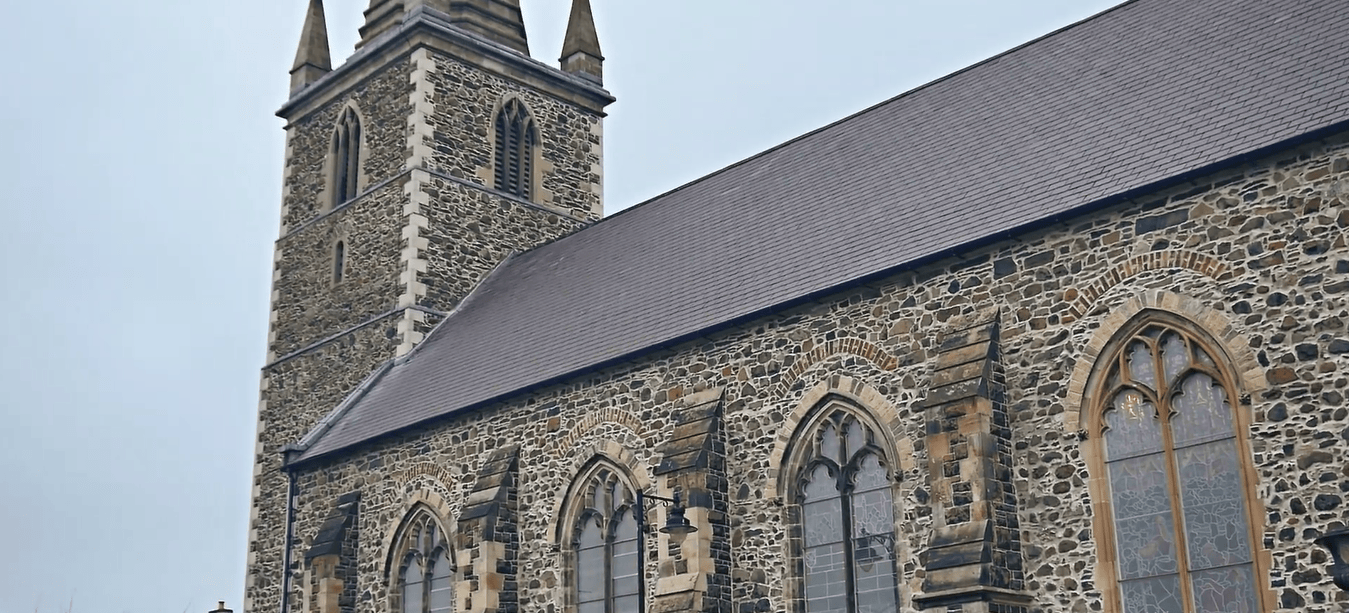
Lisburn Cathedral rises above Market Square in the middle of Lisburn, County Antrim, and its thin octagonal spire is the landmark you’ll spot first when the train pulls in from Belfast. The name on the noticeboard is Christ Church Cathedral, but almost everyone in Northern Ireland calls it Lisburn Cathedral. It has been the Church of Ireland cathedral for the Diocese of Connor since the seventeenth century, and it makes an easy anchor for a day in the city.
Lisburn Cathedral is also one of the most story-packed small buildings in Ulster. French refugees are buried in the churchyard, a suffragette bomb blew out one of its oldest windows, and a Restoration bishop who wrote some of the best-known devotional prose in English died in a house across the street. ConnollyCove, the Ireland-based travel and culture platform founded by Ciaran Connolly, has spent years documenting Northern Ireland’s towns, churches and heritage sites. This guide pulls together the history, the practical details and the things most visitors walk straight past.
What Is Lisburn Cathedral and Why Does It Have Two Names?
Lisburn Cathedral is the popular name for Christ Church Cathedral, Lisburn, a Church of Ireland (Anglican) cathedral on Castle Street and Market Square. It began life as St Thomas’s Church, a chapel serving Sir Fulke Conway’s castle. It took the name Christ Church when Charles II made it a cathedral in 1662.
It’s one of two cathedrals in the Diocese of Connor. The other is St Anne’s in Belfast, which the diocese shares with Down and Dromore. If you’re comparing the two, ConnollyCove’s guide to St Anne’s Cathedral in Belfast explains how the city cathedral came about.
One quirk tends to confuse people. The Dean and Chapter at Lisburn are formally known as the Dean and Chapter of St Saviour, Connor. The title honours the ancient cathedral of Connor near Kells in County Antrim.
A word on a common mix-up. Some older web pages, including an earlier version of this one, describe Lisburn Cathedral as the Cathedral Church of Saint Anne. That dedication belongs to Belfast. Lisburn’s cathedral is Christ Church, and before that it was St Thomas’s.
Lisburn Cathedral at a Glance
| Detail | Information |
|---|---|
| Official name | Christ Church Cathedral, Lisburn |
| Original name | St Thomas’s Church (consecrated 1623) |
| Denomination | Church of Ireland (Anglican Communion) |
| Diocese | Diocese of Connor, Province of Armagh |
| Current building | Begun 1708, largely complete by around 1719 |
| Spire | Octagonal cut stone, built 1804 to 1807, about 55 m (181 ft) with weathervane |
| Chancel | Added and consecrated 1889 |
| Address | 24a Castle Street, Lisburn BT27 4XD |
| Sunday services | 9.30am and 11am |
How Did Lisburn Cathedral Survive Four Centuries of Fire and War?
Lisburn Cathedral has been destroyed twice and rebuilt both times, and the building you see today is the third church on the site. Its history runs in step with the town: a plantation settlement, a rebellion, a royal charter, a devastating fire and a Victorian expansion.
1609 to 1641: Sir Fulke Conway and St Thomas’s Church
Around 1609, a Welsh officer, Sir Fulke Conway, settled in the district then called Lisnagarvey (pronounced liss-nuh-GAR-vee). He built or rebuilt a castle on the high ground above the River Lagan. The Irish form of the name is Lios na gCearrbhach, usually translated as the fort of the gamesters or gamblers.
In 1623 Conway built a small church dedicated to St Thomas as a chapel of ease for his castle. Townspeople soon used it as their parish church.
The castle has long gone, but the site is now Castle Gardens, the public park directly beside the cathedral. Our separate guide to Lisburn Castle explains what survives of the fortifications.
In October and November 1641, rebel forces under Sir Con Magennis attacked the town during the Irish Rebellion. St Thomas’s was destroyed in the fighting. The defence led by Sir George Rawdon still held Lisburn, and the church was rebuilt once things settled.
1662: A Royal Charter and Bishop Jeremy Taylor
In 1662, while Jeremy Taylor was Bishop of Down and Connor, Charles II granted a charter making the Lisburn church the cathedral of the united dioceses. The copy of the charter, known as the Transmiss, is held by the Public Record Office of Northern Ireland. A tower was added in 1674 to give access to a new gallery, and that tower survived everything that came later.
Taylor wrote Holy Living and Holy Dying, two of the most widely read devotional works of the seventeenth century. He died in Lisburn in 1667, in a house on Castle Street almost opposite the cathedral’s side entrance. Bishop Richard Mant put up a memorial tablet to him around 1848.
Here’s a detail few visitors know. Doubts were later raised about whether Charles II’s charter had ever been properly completed. So in 1952 the General Synod of the Church of Ireland passed a measure confirming Lisburn as the Cathedral of the Diocese of Connor. The cathedral’s status, in other words, was settled by paperwork nearly three centuries after the king’s charter.
1707 to 1719: The Great Fire and the Third Church
In April 1707, a fire destroyed much of Lisburn, including the cathedral and the castle. Rebuilding began quickly, with the foundation laid on 20 August 1708, and the new rectangular church was still under construction in 1714. The 1674 tower came through the fire and was reused, and the vestry followed in 1727.
1804 to 1889: The Spire and the Victorian Chancel
The spire that defines the Lisburn skyline went up between 1804 and 1807. It was the work of David McBlain of Limavady, whose father had built the spire of Hillsborough Parish Church. The builder’s plan shows a 96-foot spire on a tower of about 75 feet, with the weathervane adding roughly ten more. That’s where the often-quoted 181 feet (55 metres) comes from.
Canon W.D. Pounden was rector from 1884 to 1917, and the church changed a great deal under him. It gained its chancel in 1889, and a graceful Gothic arch replaced most of the old east wall. Stone buttresses were also added to strengthen the nave. The parish hall, built on land taken from Castle Gardens, followed in the same busy period.
| Year | What happened | Key figures |
|---|---|---|
| 1623 | St Thomas’s Church consecrated as a chapel of ease | Sir Fulke Conway |
| 1641 | Church destroyed during the Irish Rebellion | Sir Con Magennis, Sir George Rawdon |
| 1662 | Made a cathedral by royal charter | Charles II, Bishop Jeremy Taylor |
| 1674 | Tower and first gallery built | Vestry of the parish |
| 1707 | Destroyed in the Great Fire of Lisburn | |
| 1708 | Foundations of the present church laid | |
| 1804 to 1807 | Octagonal spire built | David McBlain |
| 1889 | Chancel added | Canon W.D. Pounden |
| 1914 | Suffragette bomb damages a window | |
| 1952 | Cathedral status confirmed by General Synod | Bishop Charles King Irwin |
Which Lisburn Cathedral Stories Do Most Guides Miss?
The most interesting parts of Lisburn Cathedral’s history are the ones the official pages barely mention: the Huguenot linen families, the suffragette bomb and the violence of August 1920. Each one ties the building to events far beyond Lisburn.
The Huguenots and Louis Crommelin’s Grave
In 1697, at the invitation of William III, the French Huguenot Louis Crommelin settled in Lisburn and set about organising and improving the Ulster linen industry. Other Protestant refugee families from France followed. For a time they worshipped as a separate French-speaking congregation in their own church on the north side of Castle Street. They were closely linked to the cathedral, though, and one of its baptismal registers lists 23 children baptised by the Huguenot pastor.
Crommelin and members of his family are buried near the south-east boundary of the churchyard. By 1964 the lettering on the grave had almost worn away, so the Irish linen industry had it re-engraved in bronze. Descendants of the Huguenot families attended the unveiling. When you visit, give yourself time to find it, because it’s easy to walk past if you head straight for the main door.
“The Huguenots came to Lisburn as refugees, and within a generation their skills had made the town’s name across Europe’s cloth markets. That grave in the churchyard is the closest thing Ulster linen has to a founding document, and it’s the first stop we suggest to anyone visiting from abroad with French or Ulster family roots.”, Ciaran Connolly, Founder of ConnollyCove
To follow the story from grave to loom, walk two minutes into Market Square to the Irish Linen Centre and Lisburn Museum. Its Flax to Fabric exhibition traces Ulster linen from field to finished cloth. For the folklore side of the trade, ConnollyCove’s piece on the craft of Irish linen in folklore picks up the thread.
The last Huguenot chaplain in Lisburn was the Rev Saumarez Dubourdieu. He stayed on after the French congregation faded through intermarriage, became vicar of Glenavy and ran the Classical School of Lisburn for 56 years. His memorial tablet is on the south wall of the nave.
The 1914 Suffragette Bomb
On 31 July 1914, militant suffragettes set off a small bomb at Lisburn Cathedral, and the blast blew out one of the building’s oldest stained-glass windows. Four women were arrested at the Seymour Street home of Lillian Metge, a local widow active in the suffrage campaign. They needed police protection during the arrests, and residents opposed to the attack broke every window in Mrs Metge’s house.
The case never came to trial. War broke out days later, and the women were released by order of the Home Secretary without charges being pressed. The cathedral’s own history pages leave this story out, yet it places Lisburn squarely inside the wider fight for votes for women. For more on the women who shaped modern Ireland, see ConnollyCove’s guide to famous Irish women.
August 1920
On Sunday 22 August 1920, District Inspector Oswald Swanzy of the Royal Irish Constabulary was shot dead close to the cathedral as congregations left morning services. He was killed by an IRA unit from Cork. Swanzy had been linked to the killing of Tomás Mac Curtain, the Lord Mayor of Cork, earlier that year.
His death was followed by days of sectarian attacks in which Catholic homes and businesses across Lisburn were burned, and many Catholic families fled the town. It’s a painful chapter in the town’s history. The Irish Linen Centre and Lisburn Museum is the best place to learn more about it in context.
What Should You Look For Inside Lisburn Cathedral?
Inside, Lisburn Cathedral is a light, galleried Georgian church with a Victorian chancel, and most of its treasures are memorials on the walls. Give yourself 30 to 45 minutes to see the interior properly and another 15 for the churchyard.
The Tower, Bells and Gallery
The main entrance is through the south door of the porch at the base of the 1674 tower. The clock and bells were a gift from the Marquis of Hertford. For generations, the large bell rang a nightly curfew of 100 strokes at nine o’clock, a custom that stopped during the Second World War.
Climb the stone stairs to the gallery, added on cast-iron pillars in 1824. The older straight-backed pews and some of the earliest engraved tablets are kept up there.
The organ, another Hertford gift, was built in 1790 and moved to its current position in 1834. Memorial tablets at the entrance to the nave record 48 men of the parish who died in the First World War and 196 who served.
The Windows
The stained glass depicts scenes from the Bible and the lives of the saints, and it’s at its best from the nave on a bright morning. On the south walls of the nave and chancel are two windows in memory of Sir Richard Wallace, the Lisburn benefactor whose art collection became London’s Wallace Collection. One was paid for by public subscription and the other by Lady Wallace.
The east window, known as Te Deum Laudamus, shows Christ in Glory. Sir John Milne Barbour presented it in 1950 in memory of his wife Eliza and his son John Milne Barbour, who died in an aviation accident in 1937.
Soldiers, Sailors and a Brush With John Paul Jones
The north wall of the nave is where the mural tablets cluster. General John Nicholson, whose parents married in the cathedral, is commemorated by a marble relief of the 1857 siege of Delhi, where he was killed. The Irish sculptor John Henry Foley carved it, and Nicholson’s mother put it up.
Nearby is a tablet to Lieutenant William Dobbs, son of a Lisburn rector. He was killed aboard HMS Drake when it engaged Captain John Paul Jones’s ship Ranger in Belfast Lough in 1778. The tablet makes no mention of Jones, who is now regarded in the United States as a father of the US Navy.
A brass plate in the old chancel marks the Rawdon family vault. It’s believed to hold the remains of Sir George Rawdon, who defended the town in 1641.
Taking Lisburn Cathedral Photos
For the classic shot of the spire, stand at the Market Square gates and frame the tower through the double entrance. The 1796 gates were replaced in 2003 but keep their original look. The terraces of Castle Gardens give a higher angle over the roof and churchyard, especially in late afternoon light. Inside, ask before photographing during services, and check with staff if you’re visiting during a funeral or wedding.
How Do You Visit Lisburn Cathedral?

The simplest ways into Lisburn Cathedral are a Sunday service or the Friday morning Honesty Café, and entry is free. The cathedral doesn’t publish regular weekday sightseeing hours, so for other times you’ll need to contact the parish office first.
Sunday Services
Services run at 9.30 am and 11 am each Sunday, with coffee served between them. The 9.30 am service is Morning Prayer from the Book of Common Prayer, with music led by the organist and choir. The 11 am service is more informal, with a contemporary worship band, and the same Bible teaching is given at both.
Holy Communion is celebrated on the first Sunday of the month, and visitors of any background are welcome. If you can’t make it in person, the 11 am service is recorded each week and posted online.
Weekday Access and the Honesty Café
The Cathedral Coffee Room at the back of the church opens as an Honesty Café on Fridays from 10 am to 1 pm. You choose what to pay for tea, filter coffee, cold drinks and homemade traybakes. Once costs are covered, the money funds free community events in the city. It’s the most relaxed way to see the building midweek.
For group visits or access on other days, call the office on 028 9260 2400. You can also check the official Lisburn Cathedral website for current times.
Parking and Getting There
Don’t plan on parking at the cathedral. The grounds use a key-fob barrier system with limited space, and the parish itself advises visitors to park elsewhere, particularly for weddings, funerals and big services. The large public car park across the road from Lisburn Health Centre and the Library is the usual choice. There’s also a multi-storey car park at the lower end of the town centre.
Without a car, take a Translink train from Belfast to Lisburn, a journey of around 15 to 20 minutes, then walk up Railway Street towards Market Square. Lisburn also works as an easy add-on if you’re using our Belfast travel blog guide to plan a longer stay.
| Visit type | When | Cost | What to expect |
|---|---|---|---|
| Sunday Morning Prayer | 9.30am | Free | Book of Common Prayer, organ and choir |
| Sunday Morning Worship | 11am | Free | Contemporary music, children’s groups in term time |
| Honesty Café | Fridays, 10am to 1pm | Pay what you choose | Tea, coffee and traybakes, relaxed look at the building |
| Group or heritage visit | By arrangement | Free, donations welcome | Contact the parish office in advance |
Current Conditions and Seasonal Information
Lisburn Cathedral is worth visiting year-round, but late spring and summer suit a combined trip with Castle Gardens. That’s when the park’s planting is at its best, and the terraces are pleasant for a picnic. September often brings European Heritage Open Days across Northern Ireland, so check whether the cathedral is taking part that year before you travel.
Winter visits are quieter, though the interior can feel cool, so bring a layer. Around Christmas and Easter, services draw bigger congregations and parking gets tighter, so arrive early or come by train. Opening arrangements and service patterns can change for special events, so always confirm on the official website before a long journey.
What Else Can You See Near Lisburn Cathedral?
Lisburn Cathedral stands at the heart of the city’s historic quarter, and several of Lisburn’s best sights are within a five-minute walk. Travellers exploring this corner of County Antrim can easily fill a day without getting back in the car.
Castle Gardens. Right next door, this terraced park on the site of Lisburn Castle has winding paths, colourful beds and a children’s play area, and it hosts events through the year.
Irish Linen Centre and Lisburn Museum. In the old Market House on Market Square, this museum covers the linen trade and the history of the town. It’s the natural next stop after Crommelin’s grave.
Lisburn city centre. Bow Street and Market Square are lined with shops, cafés and independent businesses. The Island Arts Centre runs exhibitions and performances beside the river, and our guide to the Island Arts Centre in Lisburn covers what’s on.
Hillsborough Castle and Gardens. A short drive south, this Georgian house is the official residence of the Secretary of State for Northern Ireland and offers guided tours. See our guide to Hillsborough Castle and Gardens.
Lagan Valley Regional Park. The towpath runs along the River Lagan between Lisburn and Belfast, with walking and cycling routes through woodland and meadow. ConnollyCove’s Lagan Valley Regional Park walking guide breaks the route into sections, and the Neolithic Giant’s Ring makes a short detour.
If you’re touring further, our County Antrim guide and our round-up of things to see in Northern Ireland will help you string Lisburn into a wider trip.
How Does Lisburn Cathedral Compare With Other Cathedrals in Northern Ireland?
Lisburn Cathedral is smaller and older in feel than Belfast’s St Anne’s, and less of a pilgrimage site than Down Cathedral. Its walls, though, hold an unusually dense record of local lives, from Huguenot pastors to Victorian soldiers. If you’re planning a cathedral trail, all three are within an hour of each other.
| Cathedral | Location | Tradition | Best known for |
|---|---|---|---|
| Christ Church Cathedral (Lisburn Cathedral) | Lisburn, County Antrim | Church of Ireland | 1804 spire, Huguenot graves, 1914 suffragette bomb |
| St Anne’s Cathedral | Cathedral Quarter, Belfast | Church of Ireland | Romanesque building begun 1899, shared by two dioceses |
| Down Cathedral | Downpatrick, County Down | Church of Ireland | Traditional burial place of St Patrick |
ConnollyCove’s guide to Down Cathedral and St Patrick’s grave covers the Downpatrick end of that route. After a day of history, a relaxed evening in the capital is easy to arrange with our list of things to do in Belfast. If you’re travelling as a couple, try our Belfast dates for £30 guide.
Planning Your Visit to Lisburn Cathedral
Lisburn Cathedral rewards visitors who look past the spire. The Huguenot graves, the Wallace windows and the suffragette story make it one of the most interesting churches in the Lagan Valley. Come on a Friday morning for the Honesty Café or on a Sunday for a service; travel by train if you can, and pair your visit with Castle Gardens and the Irish Linen Centre next door.
ConnollyCove provides practical travel guides and cultural stories for destinations across Ireland and worldwide, from Belfast to the Causeway Coast. For more of the region, try our scenic drives in Northern Ireland or subscribe to the ConnollyCove YouTube channel for video tours of Northern Ireland’s towns and heritage sites.
FAQs
What denomination is Lisburn Cathedral?
Lisburn Cathedral is a Church of Ireland cathedral, part of the worldwide Anglican Communion. It serves as the cathedral of the Diocese of Connor, alongside St Anne’s in Belfast.
What is Lisburn Cathedral officially called?
Its official name is Christ Church Cathedral, Lisburn. It was founded as St Thomas’s Church in 1623 and renamed when it became a cathedral in 1662.
What time are Sunday services at Lisburn Cathedral?
Sunday services are at 9.30 am (Morning Prayer with choir and organ) and 11 am (contemporary worship). Holy Communion is on the first Sunday of each month.
Who is buried in Lisburn Cathedral churchyard?
The best-known grave is that of Louis Crommelin, the Huguenot who organised the Ulster linen industry, near the south-east boundary. A vault in the old chancel is believed to hold Sir George Rawdon, the town’s defender in 1641.