


Limavady – History, Attractions and Trails with Amazing Photos
Updated On: February 19, 2024 by  Ciaran Connolly
Limavady is a small town that is 14 miles outside of Coleraine and only 17 miles outside of Derry/Londonderry city. Its postal area is BT49 – for sat navs – if travelling to the town. It has a population of just over 12,000 according to the 2001 census – a 50% increase in the town since 1971.
There are lots of things to do in Limavady and it’s surrounding area – hence why we think it is a hidden gem in County Derry/Londonderry. Its location means it is beside some amazing historic sites and has plenty of modern entertainment for all ages.
Limavady Attractions
Roe Valley Country Park
Roe Valley Country Park is a three-mile-long wooded park that the River Roe partly runs through. It is managed by the Northern Ireland Environment Agency. Several bridges are located over the river but only of them is accessible by cars. During periods of heavy rain, some parts of the park may become inaccessible due to flooding along the paths.
Numerous types of living creatures can be found in the park, such as foxes, badgers and otters in addition to over 60 species of birds.
Visitors can learn about the industrial and natural heritage of the area in the museum and countryside centre. You can also check out the remains of buildings that were previously used in the linen industry. A restored water wheel and much of the original equipment is preserved, including ruined water mills used in linen production.
The Roe Valley Country Park is definitely worth a visit any time of the year.
Dungiven Castle
Located in County Londonderry in Northern Ireland, Dungiven Castle dates back to the 17th century. The famed castle once housed the US Army during World War II, and later was used as a dance hall in the 1950s and 1960s.
Afterwards, it fell into a state of disrepair and sadly, the local council decided to take it down completely. Luckily, a local group decided to fight these plans and in 1999, the Glenshane Community Development Limited acquired the lease of Dungiven Castle. Alongside its own money, grants were hard sought from a variety of funders in order to convert the safe ruin into the beautiful property that it is today. Glenshane Community Development Limited still hold the head lease of the property, which is sublet to Gaelcholaiste Dhoire. The Castle has now become home to this school which is the second Irish-medium secondary school in Northern Ireland.
Limavady Sculpture Trail
Funded by the Northern Ireland Tourist Board’s Tourism Development Fund, Limavady Borough Council created an iconic trail. Bringing myths and legends to the modern world.
Now, visitors get to explore the Limavady Explore See Do Sculpture Trail and discover “tales of merciless highwaymen pillaging unsuspecting travellers and seek a gift for an ancient sea god, listen to the faery harp playing ‘Danny Boy’, marvel at the leaping dog and unearth the last serpent in Ireland”.
The legends are:
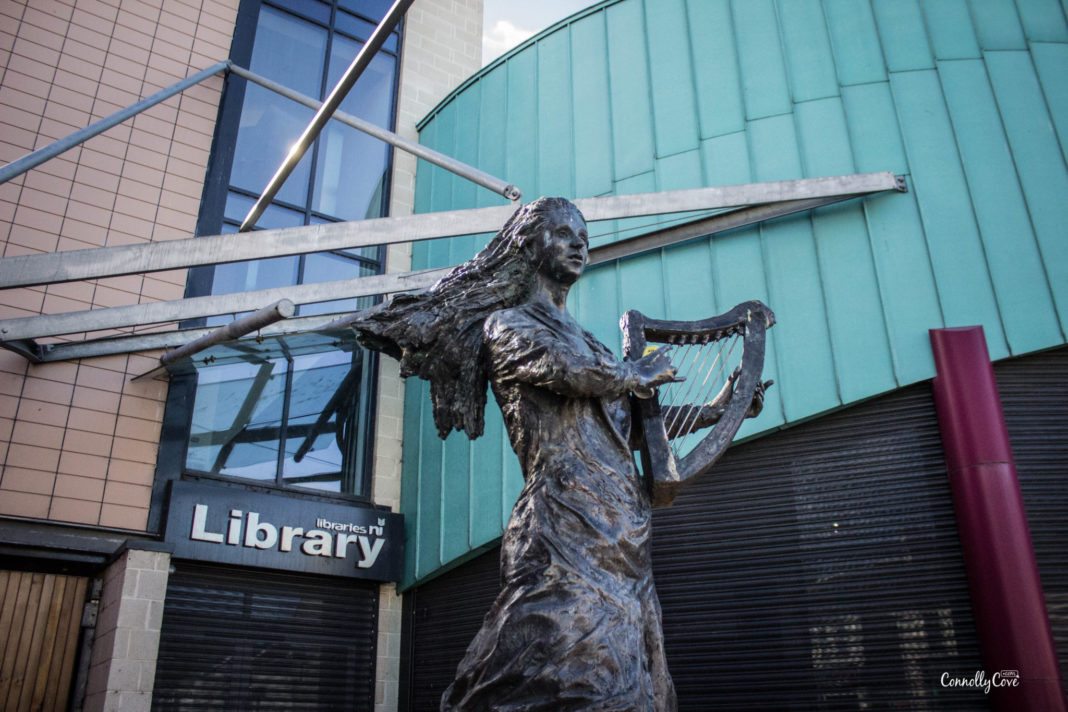
Finvola, Gem Of The Roe
A 17th-century legend about Finvola, the young and beautiful daughter of Dermot, the chieftain of the O’Cahans. Who fell in love with Angus McDonnell of the McDonnell Clan hailing from Scotland. Dermot consented to his daughter’s marriage on one condition. That she would be brought back to Dungiven upon her death for burial.
Unfortunately, Finvola died young, quite soon after reaching the isle of Islay. Angus, who was distraught at his love’s death, could not bear to part with her. He made the decision to bury her on the island.
Finvola’s two brothers heard a piercing wail while on Benbradagh Mountain and recognised it as the call of the banshee Grainne Rua, so they knew that a member of their clan had passed away. They set sail for Islay, recovered Finvola’s body and brought her home to Dungiven, setting the banshee’s cry at rest.
The sculpture of the legendary beauty was created by Maurice Harron and can be found just outside Dungiven Library.
Cushy Glen, The Highwayman
The 18th century is known to have been an age where highwaymen roamed free plundering and pillaging whoever was unfortunate enough to cross their paths. Cushy Glen, a widely feared highwayman worked his way through the Windy Hill road, between Limavady and Coleraine, and preyed on unsuspecting travellers.
He attacked his victims from behind with a knife often aided by his wife, Kitty. He is reputed to have murdered several travellers and dumped their bodies in the ‘Murder Hole’ at the foot of Windy Hill. For 170 years the old coach road to Coleraine was called the Murderhole Road. But was later renamed Windyhill Road in the 1970’s. Glen eventually met his own end when he attempted to rob Harry Hopkins, a cloth merchant from Bolea.
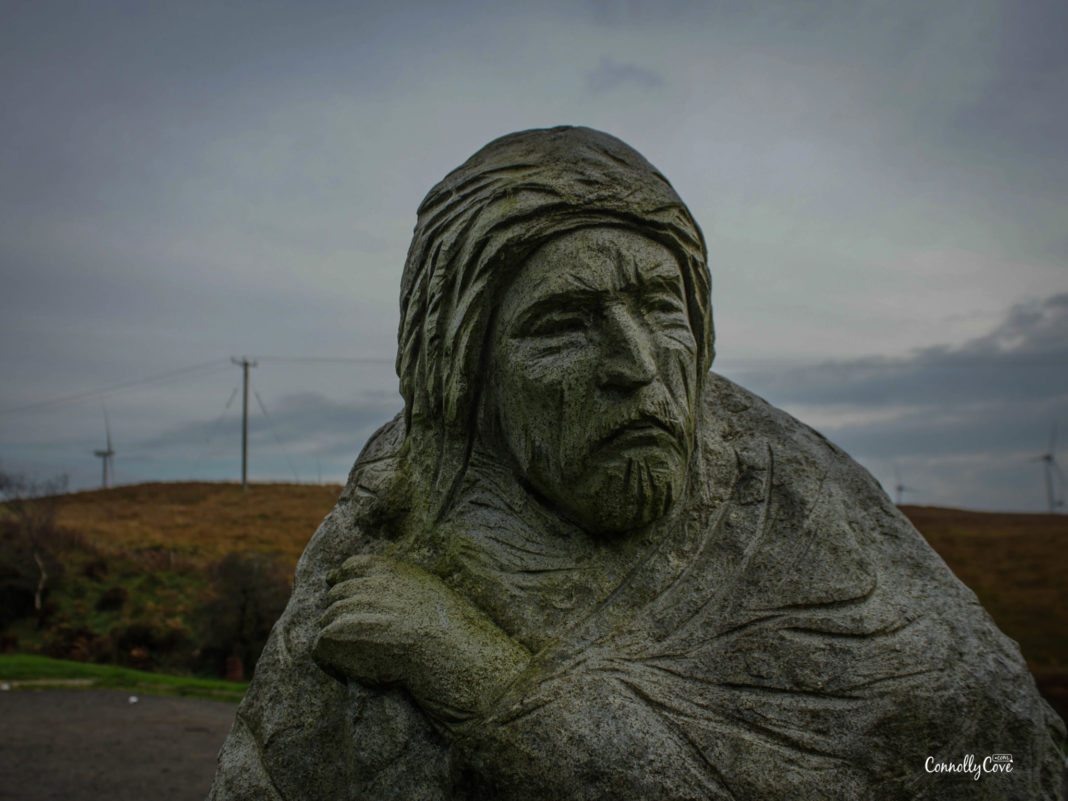
Installed in 2013, the sculpture of Cushy Glen was crafted by Maurice Harron. It depicts the highwayman as he lies in wait in his den for his next victim.
You can find the Highwayman near on Murder Hole Road (Re-named Windyhill Road), near Limavady.
Manannan Mac Lir, The Celtic God of The Sea
The Celtic God of the sea, after whom the Isle of Man is named, is one of five life-size sculptures highlighting the myths and legends of the Roe Valley’s cultural heritage. The statue made headlines in 2015 when it suddenly disappeared from Binevenagh Mountain and went missing for an entire month.
The monument was created by sculptor John Sutton, known for his work on the popular HBO hit TV series Game Of Thrones, has become a popular tourist attraction. The monument featured the figure of Manannan Mac Lir standing in a boat’s prow at the top of the mountain. Local people living near Lough Foyle believe Manannán’s spirit is released during fierce storms and some even remark “Manannán is angry today”. It is believed that he inhabits the offshore sandbanks between Inishtrahull Sound and Magilligan waters.
Historians believe that Mannin Bay was named after him and he is thought to be an ancestor of the Conmhaícne Mara, the people for whom Connemara is named. According to local folklore, one-day Manannán’s daughter was caught in a storm while boating in Kilkieran Bay, so to rescue her from the danger she was in, he conjured up Mann Island. Visit the Celtic Sea God here.
The Leap of The Dog
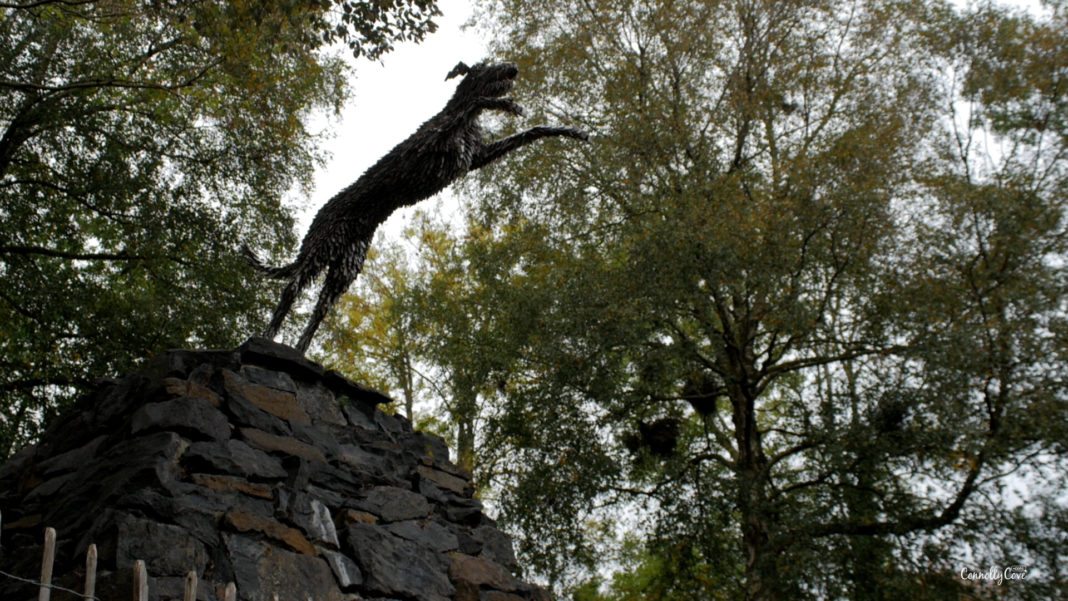
Limavady derives its name from the Irish phrase “Leim an Mhadaidh” which translated to Leap of the Dog. The name is based on the story of a legendary leap over the River Roe which saved the O’Cahan castle from an ambush by their enemies. The O’Cahan castle was originally located in the Roe Valley Country Park. Where the O’Cahan clan ruled over Limavady until the 17th century.
During an attempted siege by their enemies, the O’Cahans sent for reinforcements across the River Roe through a faithful wolfhound who leapt through the air across the swirling currents of the river to deliver the message.
The O’Cahans continued to rule successfully intil the last O’Cahan chief was imprisoned for treason and died in the Tower of London in 1628. The O’Cahan’s land was granted to Sir Thomas Phillips. Sculptor Maurice Harron commemorated the famous legend through the ‘Leap of the Dog’ sculpture and it can be found on DogLeap Road at the Roe Valley Country Park.
Lig-Na-Paiste, The Last Serpent In Ireland
According to legends, when St Patrick was driving all the snakes out of Ireland and into the sea. One local serpent named Lig-na-paiste managed to escape to a dark valley near the source of the Owenreagh river. Where it proceeded to terrorise everyone in the countryside.
Eventually, the local people approached St. Murrough O’Heaney, a famous local holy man, asking for help.
After fasting for 9 days and nights St Murrough asked for God’s help before confronting the serpent. He managed to trick it into putting on three bands of rushes. When they were in place, he prayed that they should become bands of iron. He trapped Lig-na-paiste and banished him downstream to the waters of Lough Foyle forever.
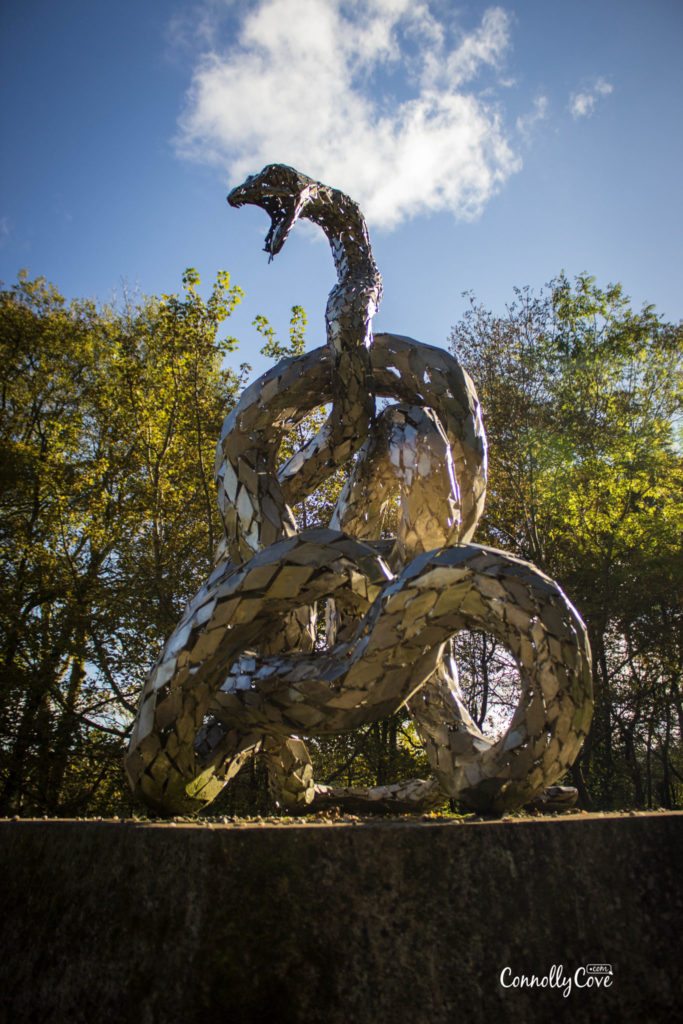
It’s said that the currents which move along the North Derry coast are due to the serpent’s writhing underneath the surface of the water. Maurice Harron’s sculpture of the legendary snake depicts it as it writhes in Celtic knots and can be found in Feeny, a small village outside Dungiven.
Rory Dall O’Cahan and The Lament of The O’Cahan Harp
Limavady is where the world-famous song Danny Boy first originated. It is recorded that Jane Ross of Limavady collected the melody of “Londonderry Air” in the mid-19th century from a local musician. The song itself came to light after Fred Weatherly, an English composer, wrote lyrics to accompany the melancholy melody (Londonderry Air) sent to him by his Irish born sister-in-law all way from Colorado, USA in 1913.
The song became one of the most well-known tunes around the world. It has been covered by many notable singers over the past century. It went on to become an unofficial anthem of Irish abroad – especially in America and Canada.
Danny Boy Legend
Legend has it that the original melody of Danny Boy, entitled originally as ‘The O’Cahan’s Lament’ and re-titled ‘The Londonderry Air’, originated from a faery tune that was reportedly heard by Rory Dall O’Cahan.
A popular musician and O’Cahan chief who lived in the 17th Century. According to old tales and legends, the confiscation of the O’Cahan lands had enraged the Rory Dall and inspired him to compose such a sorrowful tune that it touched the hearts of people worldwide many years in the future. The tune became known as “O’Cahan’s Lament”.
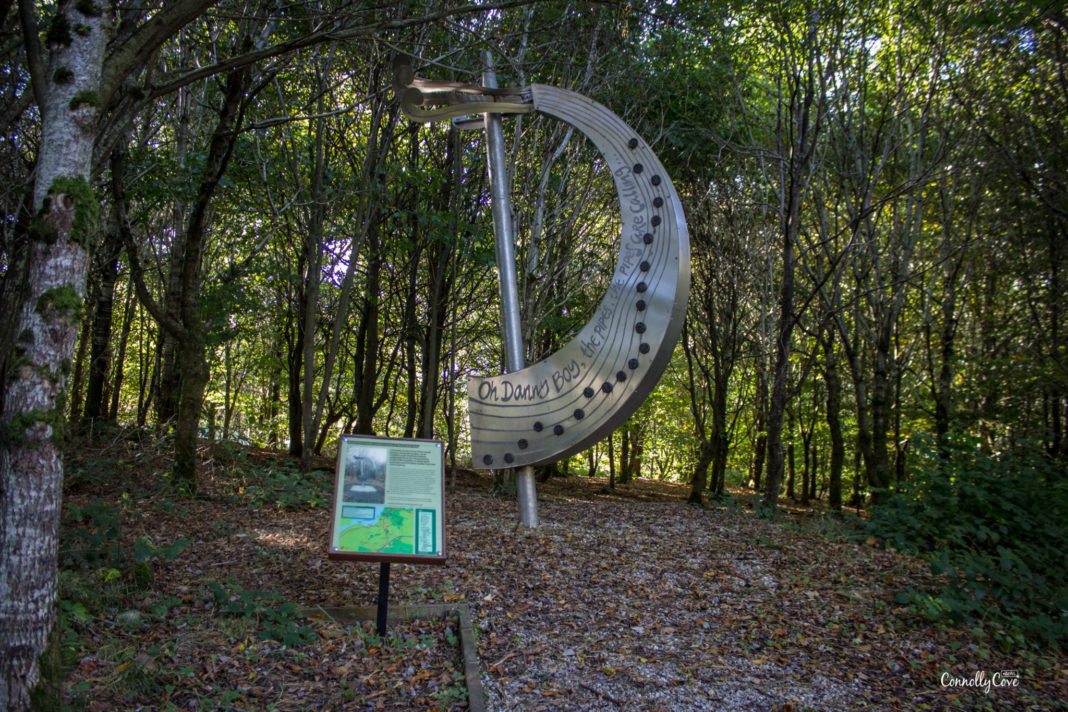
The sculpture of the musical harp was created by Eleanor Wheeler and Alan Cargo. There are two locations to visit here. The harp can be found in Dungiven Castle Park in Dungiven and the stone sculpture is outside the Roe Valley Arts and Cultural Centre.
The Lyrics of Oh Danny Boy or just Danny Boy (Bhoy)
Oh, Danny boy, the pipes, the pipes are calling
From glen to glen, and down the mountain side.
The summer’s gone, and all the roses falling,
It’s you, it’s you must go and I must bide.
But come ye back when summer’s in the meadow,
Or when the valley’s hushed and white with snow,
It’s I’ll be here in sunshine or in shadow,—
Oh Danny boy, Oh Danny Boy, I love you so!
But if you come, when all the flowers are dying,
And I am dead, as dead I well may be,
Ye’ll come and find the place where I am lying,
And kneel and say an “Avé” there for me.
And I shall hear, though soft you tread above me,
And all my grave will warmer, sweeter be,
For you will bend and tell me that you love me,
and I will sleep in peace until you come to me
If your interested in Limavady’s History – a great summary is below and we have the full history of the Danny Boy Song and its Lyrics:
Prehistoric Limavady
The town of Limavady’s history stretches back through thousands of years. The earliest settlers arrived in Ireland in the Mesolithic period. Mount Sandel, near Coleraine, is the oldest settlement site in the North of Ireland, dating back to around 7000 BC. The earliest traces of settlement within the Roe Valley have been found in the sandhills at the entrance of the Roe.
The first farmers came to the area around 4000 BC, settling on the higher ground of the Binevenagh-Benbradagh ridge. During the Neolithic period and the Early Bronze Age, the best kind of antiquities come in the form of megalithic tombs.
The late Bronze Age and the Iron Age were characterized by the settlement of land and the increased development of metalworking skills. The Broighter Hoard, a hoard of gold artefacts, dates back to the first century BC and was discovered in 1896 by Thomas Nicholl and James Morrow as they were ploughing a field in the townland of Broighter near Limavady.
The objects were sold to the British Museum but in 1903 was given to the National Museum of Ireland in Dublin. A holographic reproduction of the hoard can be found in the Roe Valley Arts and Culture Centre.
Early Christian and Medieval Periods
From 500 to 1100 AD, the Roe Valley became well settled with many families living in fortified farmsteads known as raths. Two of the best-preserved in Ulster are King’s Fort near Drumsurn and Rough Fort west of Limavady.
One of the most notable early events which took place in the Limavady area was the Convention of Drumceatt, which took place sometime around 575 or 590 AD. Aedh, the High King of Ireland had called for this convention to clarify the relationship between the Irish territory of Dalriada and the Scottish Kingdom of Dalriada as well as discuss the increasing influence of the bards of Ireland.
Limavady in the 1600s
The 1600s was a time of change and difficulty for those who lived in the Roe Valley, both planters and native Irish alike. The town of Limavady was burned following the 1641 rebellion, and Limavady was burned again in 1689 during the Williamite War. On each occasion, once peace was restored a new wave of settlers came in from Scotland, changing the character of the Roe Valley. At the same time, significant areas remained largely in the hands of Gaelic Irish families.
Two records dating from the late 1600s provide information on the town at that time. A map of the manor of Limavady was drawn up by C.R. Philom for the new landlord, William Conolly, in 1699 detailing Newtownlimavady and the original settlement of Limavady by the river Roe. Limavady in the 1600s was inhabited by carpenters, coopers, masons, saddlers, shoemakers, smiths, tailors, tanners, thatchers and weavers.
The second half of the seventeenth-century witnesses the emergence of Presbyterianism in the Roe Valley, with the earliest congregations at Limavady and Ballykelly. However, they faced hostility and antagonism from officials. Moreover, Roman Catholics were subjected to religious discrimination as bishops and priests were ordered to leave the country in 1678 and Mass had to be held in secret and in various locations.
Limavady in the 1700s
The 1700s was a more peaceful and settled period than the previous century. A Methodist Preaching House was established in the town of Limavady in 1773. John Wesley, the founder of Methodism, visited the town four times between 1778 and 1789.
One of key historical occurrence that took place in 18th century Ulster was a large number of people immigrating to the American colonies. Although Presbyterians were not the only group to leave in this period they were by far the most numerous. The factors encouraging emigration in this period were economic motivation as well as the issue of religious freedom.
The development of the linen industry was one of the changes that led to the improvement in Ulster’s economy and slowed down the rate of emigration for a time. Evidence of this industry can be seen in Roe Valley Country Park where the weaving shed, scutch mills, beetling shed and bleach greens still remain.
The end of the 1700s saw rising tensions between Presbyterians and Roman Catholics who were all eager for the Penal Laws to be revoked and the Irish Parliament to be reformed. The Society of United Irishmen was created in Belfast in 1791, inspired in part by the American War of Independence and the French Revolution.
Limavady in the 1800s
The Irish government forced legislation through the Irish Parliament even before the rebellion had been fully suppressed in order to form a union between Britain and Ireland which faced considerable opposition, but eventually, the Act of Union was passed in 1800.
The aftermath of the Napoleonic wars witnessed a period of severe economic depression with a consequent sharp rise in emigration.
In 1806 Robert Ogilby, a linen merchant whose family had been moved into the area from Scotland in the 1600s, purchased the Limavady estate. The Fishmongers retained possession of their lands in 1820 and over the following decade, they built schools, a Presbyterian Church, a dispensary and several houses.
William Makepeace Thackeray, the English novelist whose most popular work is ‘Vanity Fair’, visited Limavady in 1842. He wrote of his visit to the town and the barmaid he met in the poem ‘Peg of Limavady’. The inn was then promptly renamed after the poem.
Famine in Ireland
The Great Famine began in September of 1845 in Ireland. Due to a potato crop failure caused by a fungal disease. At the time, potatoes were the main food of the majority of the population in the country and so admissions to the workhouse rose steadily until March 1847 when as many as 83 people had been admitted in one week.
In the last half of the 1800s, many developments were introduced to the town’s infrastructure. Piped water was introduced to the town in 1848. In 1852, a company was established in order to provide enough gas to light the entire town.
The late 1800’s in Limavady
Furthermore, one of the most important developments of the 1800s was the great improvement in education as dozens of schools across the Borough were supported by the National Education system which was introduced in 1831. By the end of the 1800s, most young people had become literate; an improvement which was reflected in the establishment of several newspapers in Limavady in the second half of the 1800s.
The 1800s was also a period of religious construction as several churches were built for all denominations in the Roe Valley. A new Catholic Church was built in Dungiven in a French Gothic style and dedicated to St Patrick in 1884. In the early 1800s the Church of Ireland abandoned a number of its buildings and built new churches on fresh sites, as at Aghanloo and Balteagh.
Limavady in the 1900s
John Edward Ritter, a landowner who lived near Limavady town, began experimenting with electricity. Within his home at Roe Park House in the 1890s. He began to generate enough electricity to operate small machinery and then to provide lighting.
In 1896, Ritter built a hydro-electric power station at the Largy Green to provide electricity to the town. His family continued the business after his death and by 1918 was providing street lamps for most of the town.
By the 1920s, the town could use electricity for its basic needs of cooking, heating and lighting. Limavady was one of the first places in the North of Ireland to have a public supply of electricity. The power station is now part of the Roe Valley Country Park.
The Limavady district was of great importance during WWII due to its strategic location by the Atlantic ocean. American, British and Canadian forces were stationed to protect the North coast from German U-boats at the airfields at Aghanloo and Ballykelly.
Interesting Facts about Limavady
The town of Limavady was originally named after a legend. ‘Limavady’ is of Gaelic origin and means “Leap of the dog”. This is a reference to the legend of a dog who warned the clan of the O’Cahans about approaching enemies. By leaping across the River Roe with an important message in his mouth.
DNA analysis indicates that the first settlers to inhabit the town arrived during the early iron age from the Atlantic coasts of Spain and Portugal
We hope you enjoyed reading more about Limavady – why not spend some time watching all our videos from the area –
If you found this article interesting – we would love if you shared it on social media! And if you have visited Limavady we would love to hear your experiences.
Exploring the Hidden Gem of Limavady: A Suggested Itinerary
Limavady, nestled amidst the rolling hills of County Derry, isn’t just steeped in history and legend; it also offers a surprising variety of modern experiences for a well-rounded getaway. Whether you’re a history buff, an outdoor enthusiast, or a family seeking fun, Limavady has something for you.
Day 1: Immerse yourself in history and nature.
- Start your day at the Roe Valley Arts and Culture Centre, where interactive exhibits bring the region’s rich heritage to life. Don’t miss the holographic replica of the Broighter Hoard, a treasure trove of ancient gold artifacts.
- Next, step back in time at Dungiven Castle, now a vibrant school, and marvel at its dramatic setting. Learn about the legend of Finvola, a tragic love story linked to the castle.
- In the afternoon, explore the sprawling Roe Valley Country Park. Hike through lush woodlands, admire the cascading waterfalls, and discover remnants of the area’s industrial past. Take a moment to reflect at the “Leap of the Dog” sculpture, commemorating a brave canine who saved the O’Cahan clan.
- As the sun sets, enjoy a relaxing stroll along the scenic banks of the River Roe, listening to the soothing sound of water and soaking in the peaceful atmosphere.
Day 2: Adventure awaits!
- Get your adrenaline pumping at Limitless Adventure Centre, with high ropes courses, zip lines, and other exciting challenges suitable for all ages. Test your teamwork and conquer your fears as you navigate aerial obstacles and zip through the trees.
- For a more leisurely pace, enjoy a horseback riding adventure at Crindle Stables. Explore scenic trails through the countryside, learn about different breeds, and connect with these majestic animals.
- In the afternoon, head to Benone Tourist Complex, a haven for water enthusiasts. Spend the day surfing, swimming, or building sandcastles on the expansive beach. If you’re feeling adventurous, try blokarting, a unique experience where you harness the power of the wind to race across the sand.
- End your day with a delicious meal at a local pub or restaurant, savoring fresh, locally sourced ingredients and enjoying the warm hospitality of Limavady.
Beyond the itinerary:
- For a glimpse into local life, visit Limavady Market, bustling with colorful stalls selling fresh produce, handcrafted goods, and delicious treats.
- If you’re traveling with children, don’t miss the Largantea Picnic Area in Roe Valley Country Park, perfect for a fun family outing with ample space to play and relax.
- History buffs can delve deeper into the past at the Limavady Heritage Centre, showcasing the town’s evolution through artifacts and exhibits.
Tips:
- Purchase a Limavady Visitor Pass for discounted entry to many attractions.
- Consider staying at a local bed and breakfast to experience authentic Irish charm.
- Pack comfortable shoes and rain gear, as the weather can be unpredictable.
- Most importantly, relax, explore, and discover the hidden treasures of Limav
Share your experience of Limavady and it’s attractions in the comments below.
Also, don’t forget to check out other places and attractions around Northern Ireland: Derry City | Exploring Belfast Cty | The City of Lisburn | Downpatrick Town | Castlewellan Forest Park | Best Tourist Attractions in Northern Ireland | Manannán mac Lir-Celtic Sea God

Planning Memorable Trips to the UK: Your Ultimate Guide
Travel Guides
23/04/2024
The Definitive Guide to Glamping in Scotland: Pods, Huts, and More!
Scotland
23/04/2024

The Ultimate Guide to the Best Places to Eat in Edinburgh
Scotland
23/04/2024
Explore the Majestic Beauty of UK National Parks
United Kingdom
23/04/2024
A Comprehensive Guide to Spotting Puffins in Ireland
Ireland
23/04/2024