

Updated on:
by
 Marwa Alaa
 Marwa Alaa
Article Summary
What this article covers: Lesser-known attractions in Al-Minya, the Middle Egypt governorate between Cairo and Luxor, from Hatshepsut’s rock temple at Istabl Antar to Hadrian’s city of Antinoöpolis. It also covers Coptic cave churches and Old Kingdom tombs, with practical advice on guardians and access.
Who this is for: Independent travellers and history enthusiasts who have already seen the main monuments of Middle Egypt and want the quieter places most tours leave out.
Key takeaway: Most lesser-known attractions in Al-Minya have no ticket office, and a local guardian opens them with a key. A car with a driver who knows the villages matters more here than at any famous temple.
Expert insight: “At Istabl Antar, the guardian usually walks up from the village with the key, and you read Hatshepsut’s own account of her reign carved above the doorway. That slow, personal kind of visit is what separates Minya’s quieter sites from the crowded temples further south.”, Ciaran Connolly, Founder of ConnollyCove
Quick facts:
- The Speos Artemidos at Istabl Antar is a rock-cut temple that Hatshepsut dedicated to the lioness goddess Pakhet, about 2 km south of the Beni Hasan tombs.
- Hadrian officially founded Antinoöpolis, now the village of Sheikh Ibada, on 30 October AD 130 in memory of Antinous, who drowned in the Nile nearby.
- A cave church between Deir Abu Hennis and Deir el-Bersha holds what is described as the oldest known painting of the Flight into Egypt.
Table of Contents
Lesser-known attractions in Al-Minya lie only a short drive from the famous tombs of Beni Hasan and Tell el-Amarna, yet few visitors ever reach them. The governorate stretches along both banks of the Nile for more than 135 km. Locals call it the “Bride of Upper Egypt” because it marks the meeting point of Middle and Upper Egypt. Its nine districts run from north to south as El-Idwa, Maghagha, Beni Mazar, Matay, Samalut, Al-Minya, Abu Qurqas, Mallawi and Deir Mawas, and almost every one of them holds monuments from the Pharaonic, Greco-Roman, Coptic and Islamic periods.
This guide from ConnollyCove, the Ireland-based travel and culture platform, picks out the quieter places on that map and explains how to reach them. If this is your first visit, start with our guide to the main things to do in Al-Minya, which covers Amarna, Beni Hasan, Tuna el-Gebel and getting there from Cairo. The sites below are the ones to add once those are on your list. They show how much of Egypt’s 30 centuries of ancient history survives away from the main routes.
Lesser-Known Attractions in Al-Minya at a Glance
The table below gives a quick overview of the lesser-known attractions in Al-Minya covered in this guide. For each site, it shows the period and the Nile bank, along with whether you should expect a locked gate. Distances look short on the map, but rural roads and ferry crossings slow every stop.
| Site | Period | Nile bank | Guardian needed? |
| Istabl Antar (Speos Artemidos) | New Kingdom | East | Usually |
| Zawyet el-Mayyitin | Old Kingdom to present | East | No, for the cemetery |
| Tihna el-Gebel (Akoris) | New Kingdom to Roman | East | Usually |
| Fraser Tombs | Old Kingdom | East | Usually |
| Rock chapel of Merenptah, es-Siririya | New Kingdom | East | Usually |
| Antinoöpolis (Sheikh Ibada) | Roman | East | Ask locally |
| Deir Abu Hennis and Kom Maria | Coptic | East | Ask at the church |
| Deir el-Bersha tombs | Middle Kingdom | East | Usually |
| Monastery of Abu Fana | Coptic | West | Ask locally |
| Monastery of Saint Samuel the Confessor | Coptic | West, desert | Check before travel |
| Al-Fouly Mosque | Islamic | West, Minya city | No |
| Al-Lamati Mosque | Islamic | West, Minya city | No |
| Al-Shafei Mosque, Beni Mazar | Islamic | West | No |
| Al-Qayati Mosque, El-Idwa | Islamic | West | No |
Pharaonic Rock Temples and Old Kingdom Tombs on the East Bank
The east bank cliffs hold the oldest of the lesser-known attractions in Al-Minya, and most of them were cut directly into the limestone. Quarry workers and provincial governors used this escarpment for more than two thousand years, so shrines and burial chambers often stand within sight of old quarries. ConnollyCove groups these places together because a single driver can link four or five of them in one day.
Istabl Antar (Speos Artemidos)
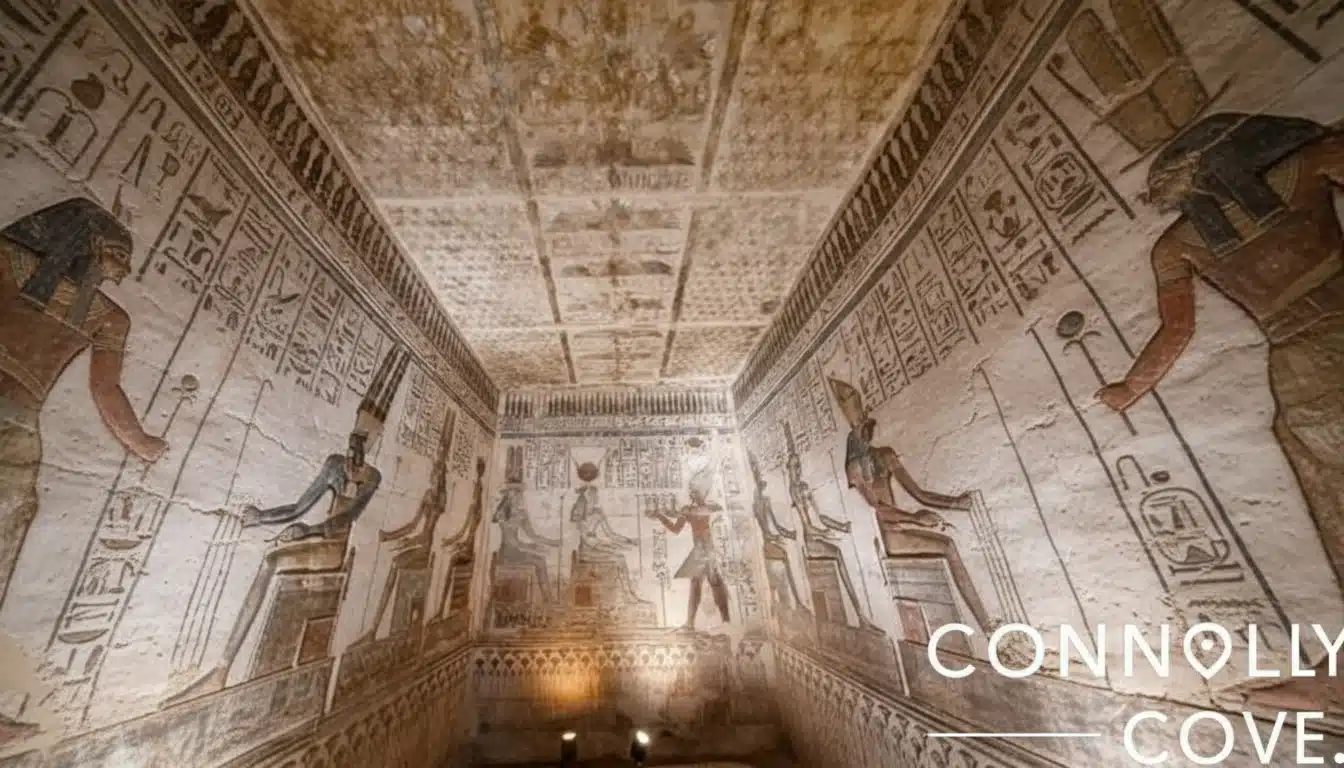
Istabl Antar is a rock-cut temple about 2 km south of the Beni Hasan tombs and roughly 28 km south of Minya city. Hatshepsut built it for Pakhet, a regional lioness goddess of the desert wadis. Greek visitors linked Pakhet with their own goddess Artemis and called the temple the Speos Artemidos, the “Grotto of Artemis”.
The Arabic name, Istabl Antar (the Stable of Antar), honours Antar ibn Shaddad, the warrior poet of a famous Arabic romance. Local legend says he stayed here for a time and kept his horses in the cave. The story is folklore, since the temple was cut about two thousand years before Antar lived.
The facade inscription is the reason most people make the trip. Above the portico, Hatshepsut carved a long hieroglyphic text describing the damage left by the Hyksos invaders and presenting herself as the ruler who restored order. Only three of the four facade pillars survive in reasonable condition, and Seti I later added his own coronation scenes to parts of the interior.
A short walk west, a smaller rock chapel known as Speos Batn el-Baqara (Cave of the Belly of the Cow) was begun under Hatshepsut and Thutmose III. Its decoration continued centuries later under Alexander IV of Macedon, the young son of Alexander the Great, who appears as Alexander II in Egyptian records. The surrounding hillside was also used for wild cat burials linked to Pakhet in the Late Period. Our guide to ancient Egyptian writing explains how to read hieroglyphic texts like these.
Zawyet el-Mayyitin, the City of the Dead
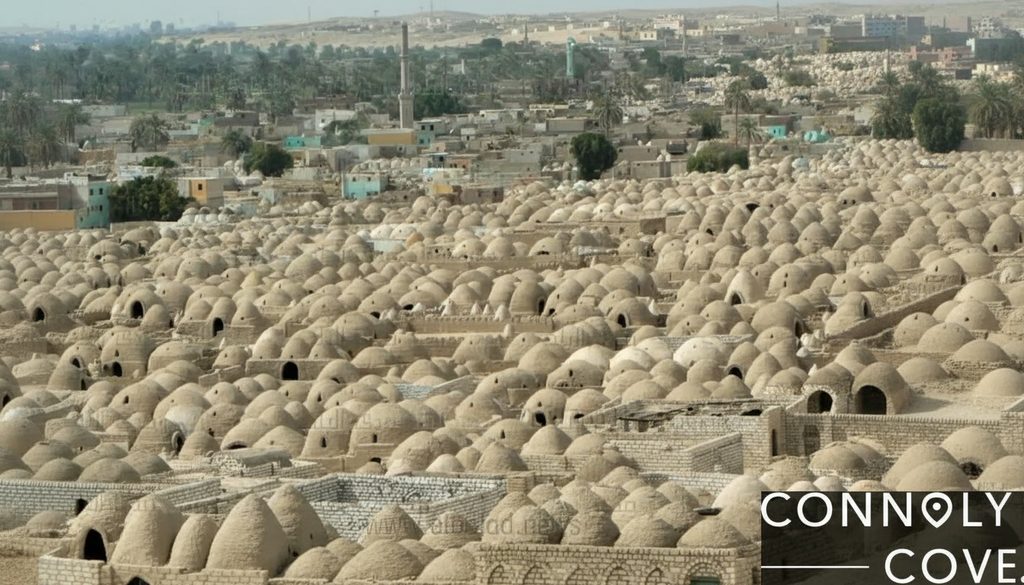
Zawyet el-Mayyitin is a vast cemetery on the east bank opposite Minya city, where thousands of white, dome-topped tombs climb the hillside. From the river, the rows of domes look like a sea of white graves. Muslims and Coptic Christians have both buried their dead here for centuries, and it is often described as one of the largest cemeteries in the world. Locals also call it Zawyet Sultan or Zawyet el-Amwat.
Among the lesser-known attractions in Al-Minya, this one rewards an early start, when the domes catch the morning light across the river. On the higher ground, you will find the weathered core of a small Third Dynasty layer pyramid, one of the very few pyramids on the east bank of the Nile. Nearby is a group of Old Kingdom rock-cut tombs, including that of the provincial official Khunes. Local guides also point out the mausoleums of Minya’s landowning families from the 19th and 20th centuries.
This is an active cemetery that families visit every week, especially on Fridays and during the Eid holidays. Dress modestly, keep your voice low and never photograph mourners without permission. ConnollyCove’s guide to death and mourning practices around the world explains how traditions like these compare with those in Ireland and elsewhere.
Tihna el-Gebel (Akoris)
Tihna el-Gebel is a village about 12 km north of Minya city, below the ruins of ancient Akoris. People lived at Akoris from the Old Kingdom onwards, which makes it among the oldest lesser-known attractions in Al-Minya. The Arabic name comes from a Coptic word meaning “peak”, after the rock that rises above the village. Among the ruins is a temple of Amun that Ramesses II created inside an older tomb. Later rulers carved stelae into the rock, and a Greek funerary chapel on the site was once mistaken for a Roman temple.
The best-known monument here is the so-called Temple of Nero. The emperor Nero, who reigned from AD 54 to 68, enlarged an earlier rock temple here, and a carved doorpost still shows him making an offering above the kneeling Nile god Hapi. Fragments from the entrance, showing the crocodile god Sobek and the ibis-headed Thoth, are now held in storage.
The Fraser Tombs
The Fraser Tombs are a group of around 15 Old Kingdom rock-cut tombs about 2 km south of Tihna el-Gebel. They date from the end of the Fourth Dynasty to the early Fifth. Each one copies the shape of a freestanding mastaba (a flat-roofed, rectangular tomb normally built above ground), but is carved into the cliff itself. Four of them contain statues of the owners and their families, cut from the living rock.
The group takes its name from George Willoughby Fraser, a British civil engineer who cleaned and recorded the tombs in 1893. He published them in 1902, decades after the German Egyptologist Heinrich Brugsch first noted the site. The finest is Tomb 13, which belonged to Nikaiankh, a priest of Hathor whose inscriptions record how he provided for the funerary cult of his family. An Australian team from Macquarie University recorded the tombs again between 2007 and 2011.
Like most lesser-known attractions in Al-Minya, the tombs see few visitors, so arrange access in advance. Allow time for the climb as well, which rewards you with a wide view across the Nile.
The Rock Chapel of Merenptah at es-Siririya
The village of es-Siririya lies on the east bank near Samalut, about 24 km north of Minya city. Its rock chapel was cut for the 19th Dynasty king Merenptah and dedicated to Hathor, Lady of Akhwy. This local form of the goddess Hathor appears to be known only here, and she protected the quarry workers who cut stone from the surrounding cliffs.
Inside the long rectangular hall, the side walls show Merenptah presenting gifts to several gods, including Hathor, Amun-Re and Anubis. The back wall holds three seated statues, with the king at the centre beside the goddess. The curved ceiling is painted with a line of vultures. Most itineraries of the lesser-known attractions in Al-Minya skip this chapel, but it pairs easily with Tihna el-Gebel and the Fraser Tombs in a single morning.
Hadrian’s Lost City and the Village of Sheikh Obada

Sheikh Obada (also written Sheikh Ibada) adds Roman history to the lesser-known attractions in Al-Minya, because the modern village is built on top of Antinoöpolis. Hadrian founded the city in memory of his companion Antinous. The village lies on the east bank, roughly opposite Hermopolis and Mallawi, and most visitors reach it by local ferry or along the east bank road.
Antinoöpolis and Its Ramesside Temple
Antinous drowned in the Nile here in October AD 130, and Hadrian officially founded the city on 30 October that year, declaring the young man a god. Antinoöpolis was designed as a Greek-style city, and Hadrian encouraged Greek settlers from other Egyptian towns to move there. Almost everything earlier on the site was cleared to make room for it. The one exception was a temple of Ramesses II, built partly from stone carried from Akhenaten’s abandoned capital at Amarna.
Today, the visible remains are modest. You can trace the lines of the main streets, the outline of the theatre and hippodrome, and the columns of the Ramesside temple, while the rest has been lost to centuries of stone robbing and lime burning. Travellers exploring this corner should go with a guide, because the site is spread out and the guardian is not always present.
The village also has strong Islamic associations. It takes its name from Obada ibn al-Samit, a companion of the Prophet. Local tradition connects the area with Maria al-Qibtiyya (Maria the Copt), one of the wives of the Prophet Muhammad, and her house is a simple mud-brick building in the desert.
Shaikh Obada Mosque
Obada ibn al-Samit founded a mosque in the northern part of the village, which later took his name. It is the first mosque built in the Mallawi district. Its Ayyubid-style gate has a carved lintel decorated with floral and geometric motifs. The mosque has two minarets, a modern one still in use and an older one built of mud brick.
Decorated passages on both sides of the mosque lead to a square ablution room with two ancient marble columns at its centre. Both columns keep their bases and painted capitals, though only one is fluted. An old well at the end of the room is still used for ablutions, and four more painted columns stand in the prayer hall. Visitors are welcome outside prayer times if they dress modestly.
Mosques and Mansions of Minya City and the North
The Islamic monuments are the easiest lesser-known attractions in Al-Minya to visit independently, and ConnollyCove recommends them for a first afternoon in the city. Most stand in town centres and welcome respectful visitors outside prayer times. The governorate’s capital also holds the faded villas of its cotton-boom era along the Nile.
Al-Fouly Mosque
Al-Fouly Mosque is the best-known mosque in Minya city. It stands close to the Nile Corniche and is named after the Sufi sheikh Ali al-Fouly, whose shrine it contains. The city itself was long known as Minyat al-Fouly in his honour. The building has an Andalusian character, with a mosaic-covered staircase leading up to a carved Arabic-style wooden door. Inside, more mosaic work decorates the floors, columns and lower walls.
Al-Lamati Mosque
Al-Lamati Mosque stands near Al-Fouly and ranks among the oldest and largest mosques in Minya city, with roots in the medieval period. Its plan follows the classic layout of an open central courtyard surrounded by four porticoes. Its plain minaret rises in stages from a square base to an octagonal section, topped by a small Ottoman-style dome.
Al-Shafei Mosque in Beni Mazar
Al-Shafei Mosque in Beni Mazar is attributed to the Ayyubid period and associated with the name of Imam al-Shafei. It is known for its beige facade and a large lead-covered wooden dome. Travellers heading north towards Maghagha can stop here on the way.
Al-Qayati Mosque in El-Idwa
Al-Qayati Mosque, at the far north of the governorate, dates back to the Ottoman period and is one of the older mosques in the region. Its facade carries carved motifs and muqarnas (the honeycomb-like vaulting used in Islamic architecture). Geometric patterns and inscriptions decorate the wooden minaret and lintel, and inside, white marble columns support porticoes around its four courtyards.
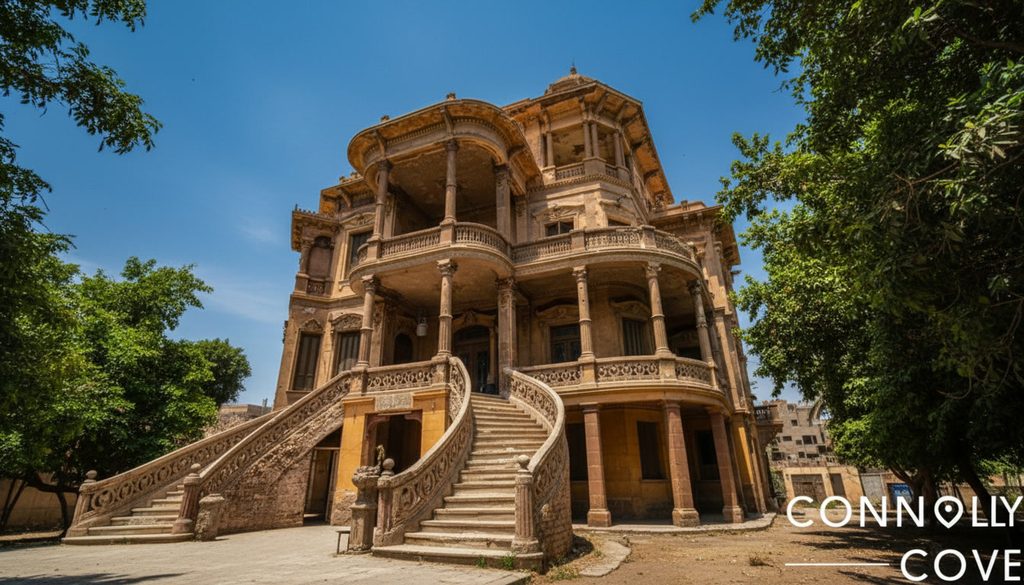
The Cotton-Boom Mansions of the Corniche
Minya grew rich on cotton and sugarcane in the late 19th and early 20th centuries, and wealthy families from Cairo built winter homes and country estates here. A few of their villas and palaces survive along the Nile, including the Palace of Abd el-Majeed Pasha Seif el-Nasr, known for its decorated facade. Few guides to the lesser-known attractions in Al-Minya mention these villas. Most are private or government buildings, so view them from the street and ask your guide which ones can be visited.
The Coptic Trail: Cave Churches and Desert Monasteries
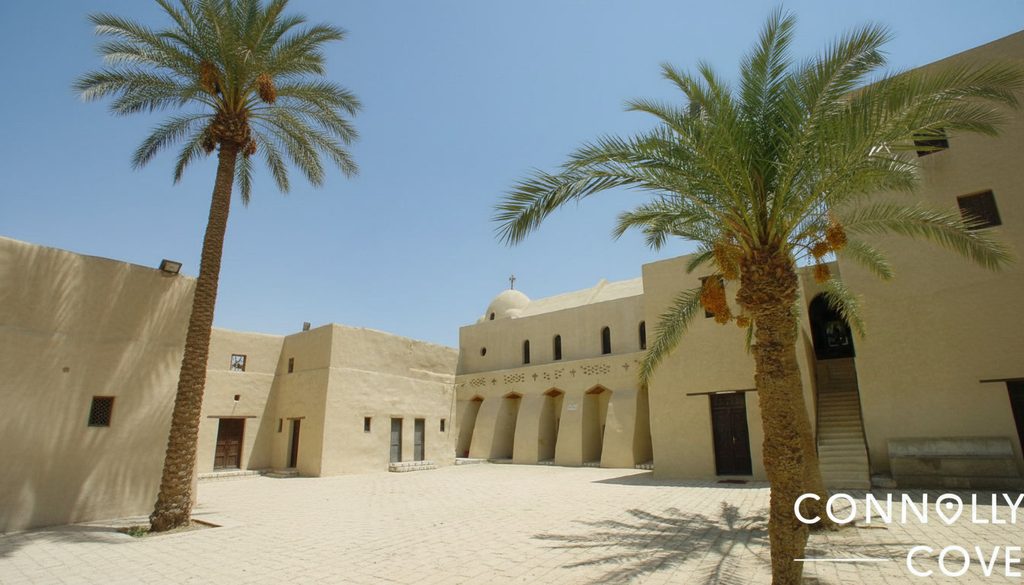
The Coptic sites are among the most moving lesser-known attractions in Al-Minya, and ConnollyCove gives them extra space in this guide since many of them are still used for daily prayer and annual feasts. Middle Egypt lies on the route that Coptic tradition gives for the Holy Family’s journey through Egypt, and hermits settled in the old quarries here from the fourth century onwards.
Deir Abu Hennis
Deir Abu Hennis (also spelt Hannis or Hanas) is a Christian village on the east bank, south of Sheikh Obada. It is named after Saint John the Short, a desert father of the fourth and fifth centuries. Its old Church of Saint John the Short keeps an ancient marble altar slab carved with Coptic inscriptions, along with niches holding brightly coloured icons. The quarries in the hills above the village were worked from the Middle Kingdom until the Coptic period, and dozens were later turned into hermit cells.
For many visitors, the highlight is a cave church in the hills between Deir Abu Hennis and Deir el-Bersha. Its wall paintings, dated between the sixth and eighth centuries, show the Massacre of the Innocents alongside the Flight into Egypt. That second scene is often described as the oldest known painting of its subject. Access to the cave church usually needs a permit or a local escort, so ask at the village church before you climb.
“The cave church above Deir Abu Hennis is hard to reach, yet its painted Flight into Egypt is among the oldest images of that journey anywhere. Places like this are why Minya deserves an extra night, because the reward comes from slowing down and asking locally.”, Ciaran Connolly, Founder of ConnollyCove
Kom Maria
Less than 1 km from the village church is Kom Maria (the Hill of Mary), and local tradition links it with the Holy Family’s stay. Around 1 June, when the Coptic Church marks the Holy Family’s arrival in Egypt, the village celebrates with a procession and a decorated boat on the Nile. Each January the church also remembers the Holy Innocents, the children of Bethlehem killed on Herod’s orders. Outside these feasts, the area is quiet, and as at many lesser-known attractions in Al-Minya, you may have the hillside to yourself.
Deir el-Bersha and the Colossus on a Sledge
Deir el-Bersha, a village on the east bank opposite Mallawi, lies below an elite cemetery of the Middle Kingdom governors of the Hare nome. Its most famous tomb belongs to Djehutihotep, a 12th Dynasty nomarch. Its wall paintings include the scene known as the “colossus on a sledge”. This painting shows teams of workers dragging a giant statue on a wooden sledge while a man pours water on the ground in front to ease its path. The tomb is damaged, partly by earthquakes and quarrying, and it is harder to reach than most lesser-known attractions in Al-Minya. Even so, the scene remains one of the most important records of how ancient Egyptians moved heavy monuments.
The Monastery of Abu Fana
The Monastery of Abu Fana stands on the desert edge northwest of El-Ashmunein on the west bank. It is named after a Coptic hermit also known as Apa Bane, and it is also called the Monastery of the Cross, after the crosses carved in its early church. Excavations by the Austrian Archaeological Institute in the 1990s uncovered the founder’s tomb and much of the early monastic complex. Little survives above ground apart from the church, which now lies within an archaeological zone. Few visitors come, so confirm access with your guide before setting out.
The Monastery of Saint Samuel the Confessor
The Monastery of Saint Samuel the Confessor lies in the desert of the Qalamoun mountain, far to the west of Maghagha in the north of the governorate. It is named after Samuel of Qalamoun, a seventh-century monk who refused to accept the Council of Chalcedon (a church ruling the Coptic Church rejected) and founded a community in this isolated spot. The cave where he lived, with its altar and an old cistern that once collected rainwater, is still shown to visitors.
The monastery has four churches, dedicated to Saint Samuel, the Virgin Mary, Saint Misael the Anchorite and the Martyrs. The rebuilt Church of the Virgin Mary has three naves and 12 domes, while the Church of Saint Misael has a pointed roof and colourful painted icons. Because the monastery lies in the desert west of the Nile Valley, check government travel advice before planning a visit.
Famous People Born in Al-Minya
Al-Minya has produced some of modern Egypt’s best-known figures. Huda Shaarawi, who founded the Egyptian Feminist Union in 1923, was born in Minya city in 1879. Her father, Muhammad Sultan Pasha, later became president of Egypt’s Chamber of Deputies. Suzanne Mubarak, the widow of former President Hosni Mubarak, was also born in the governorate.
Taha Hussein, the writer and education minister often called the “Dean of Arabic Literature”, was born in 1889 in a village near Maghagha. The former Egypt captain Ahmed Hassan, one of the most capped footballers in international history, also comes from Maghagha.
From Minya’s Desert Hermits to Skellig Michael
Ireland’s early monks and the hermits of Middle Egypt shared a single idea: the holiest life was lived at the edge of the world. ConnollyCove covers Irish heritage alongside global destinations, and this is one of the clearest places where the two meet. Historians generally trace the monastic ideal that shaped early Christian Ireland back to the desert fathers of Egypt. Their lives and sayings reached western Europe through writers such as John Cassian in Gaul.
The cave cells above Deir Abu Hennis and the remote site of Saint Samuel’s monastery belong to that same tradition. When you visit them, the parallel with the beehive huts of Skellig Michael off the coast of Kerry is easy to see. Both communities chose hard, isolated ground so they could live apart from ordinary life. For travellers from Ireland or with Irish roots, the lesser-known attractions in Al-Minya offer a rare chanceto see the landscape where that monastic story began.
How to Visit Gated Sites: Guardians, Keys and the Tourist Police
The most useful advice for visiting lesser-known attractions in Al-Minya is to travel with a driver or guide who can find the site guardian, known in Egypt as the ghafeer. Most rural sites have no ticket office, and gates and tomb doors often stay padlocked until the guardian arrives from the nearest village. Your driver will usually phone ahead or ask locally, so allow extra time at each stop.
At these places, tip the guardian modestly in Egyptian pounds when he opens a tomb for you, and carry small notes for this purpose. A few Egyptian Arabic phrases help, and local guides recommend learning these two before you go.
- Fein el-ghafeer? means “Where is the guardian?”
- Mumkin teftah el-bab? means “Could you open the door?”
Foreign visitors to Middle Egypt are often accompanied by the tourist police, and this is a routine part of visiting the region. Tell your hotel your plans the evening before, carry your passport for road checkpoints and expect the occasional short wait. Our overview of El Minya’s history and monuments sets out the wider sites in the governorate. The Al-Minya travel and itinerary guide covers train times, roads and suggested routes.
Dress with shoulders and knees covered, and bring a scarf for mosques and monasteries. Rural Upper Egypt is conservative, so ask before photographing people and accept politely if someone says no.
Current Conditions and Seasonal Information for Al-Minya
October to April is the best period for the lesser-known attractions in Al-Minya, when daytime temperatures are pleasant for climbing to cliff tombs and walking open ruins. Al-Minya has a desert climate with almost no rainfall. Summer daytime temperatures often reach between 37°C and 43°C, with June usually the hottest month. Winter days average around 20°C to 26°C, and January is the coolest month.
In summer, visit the sites at sunrise and finish by late morning. Winter days are short, so start early to fit two or three remote stops into the daylight. Religious calendars also shape visits, since the Holy Family celebrations in early June bring large crowds to Kom Maria and nearby churches. Opening hours at some mosques and sites also change during Ramadan.
Rules for foreign visitors and access to lesser-known attractions in Al-Minya can change at short notice. Before you set off, check the Egyptian Ministry of Tourism and Antiquities monuments site and your government’s travel advice. Your hotel can also confirm which sites are open the night before.
FAQs About Lesser-Known Attractions in Al-Minya
What are the lesser-known attractions in Al-Minya?
The lesser-known attractions in Al-Minya include the Speos Artemidos at Istabl Antar, the Fraser Tombs, Hadrian’s city at Sheikh Obada and the cave church near Deir Abu Hennis. The mosques of Minya city and the monastery of Saint Samuel add Islamic and Coptic heritage.
Do you need a guardian to visit the tombs near Minya?
Yes, a local guardian, or ghafeer, opens most rural tombs and rock temples. A driver or guide who knows the villages can find him quickly.
Is Al-Minya safe to visit for tourists?
Independent travellers and tour groups visit Al-Minya, and the tourist police often escort foreign visitors as a routine measure. Check the latest FCDO or your own government’s advice before you travel, especially for desert sites.
Can you visit the Speos Artemidos and Beni Hasan on the same day?
Yes, the Speos Artemidos lies about 2 km south of Beni Hasan, so the two fit easily into one morning. Ask the guardian at Beni Hasan to arrange access to Istabl Antar.
What is the best time to visit Al-Minya’s ancient sites?
October to April is the best time, as summer temperatures often pass 40°C. Start early in any season, because many sites involve a climb.
Are there Coptic Christian sites to visit in Minya?
Yes, Minya has some of Egypt’s oldest Coptic sites, including the cave church near Deir Abu Hennis, Kom Maria and the Monastery of Saint Samuel the Confessor. Many are still in daily use, so visit outside service times and dress modestly.
Explore More of Egypt With ConnollyCove
The lesser-known attractions in Al-Minya show a side of Egypt that most visitors miss, from Hatshepsut’s words in the cliffs to the cave churches of its early hermits. ConnollyCove documents cultural travel from its base in Ireland, and Middle Egypt is a natural stop on a journey south along the Nile River. From here, continue to Luxor Temple and Aswan, the land of gold. You can also watch our travel films on the ConnollyCove YouTube channel to plan the rest of your route.


