
Your Ultimate Iran Travel Guide That Will Make You Start Packing
Updated On: April 15, 2024 by  Noha Basiouny
In today’s world, there are 249 countries with all different themes, cultures, languages, history, heritage, and even sizes. Some are incredibly small such as the Vatican City in Europe with an area of only 0.49 square kilometers and others are gigantic just like mother Russia on top of the list which extends in all directions for 17.1 million square kilometers.
And each country is well-known around the world for a unique facet that sets it apart from other countries. Though sometimes countries may look alike from afar, for example, eastern Asian or Arab countries, with a closer look, one cannot mistake how each of them is distinctive and exotic just the way it is.
For example, Italy is recognized for its Leaning Tower and pizza, France for the Eiffel Tower and croissants, Egypt for the Pyramids and coral reefs, Japan for cherry blossom, and even North Korea for being so incredibly mysterious and isolated. However, no country has ever been so unknown, so incredibly misunderstood, and mistakenly portrayed other than Iran.
Unfortunately, most of us cannot help that one impression that pops up in our minds once we hear about Iran. Biased by what we have always heard from the media, that impression is all about violence, nuclear weapons, sanctions, ongoing threats, and perpetual tensions with the West. But is Iran really that scarily wicked?
Well, no. Not at all.
Though Iran is already on top of many countries’ foreign policy concerns and has maintained diplomatic relations with a fewer number of countries than average, we must not mistake it for its regime. “We do not execute people by feeding them to starving dogs,” a young Iranian said to Kim Hjelmgaard, a USA TODAY foreign correspondent who was doing a report in Iran and was blown away by the completely different side he saw of that country.
Here at connollycove.com, we are all about every non-political aspect of countries, from history, culture, architecture, people, and cuisines, to nature and beaches and snowfalls. Today, we choose to write to you about the captivating, mesmerizing, and utterly astonishing country of Iran. A country that, by its authenticity, could potentially be your very next destination, A country that will leave you staggered by diversity rare to be found anywhere else—except for India, of course.
How about some proper recognition of Iran?
What is Iran, for real?
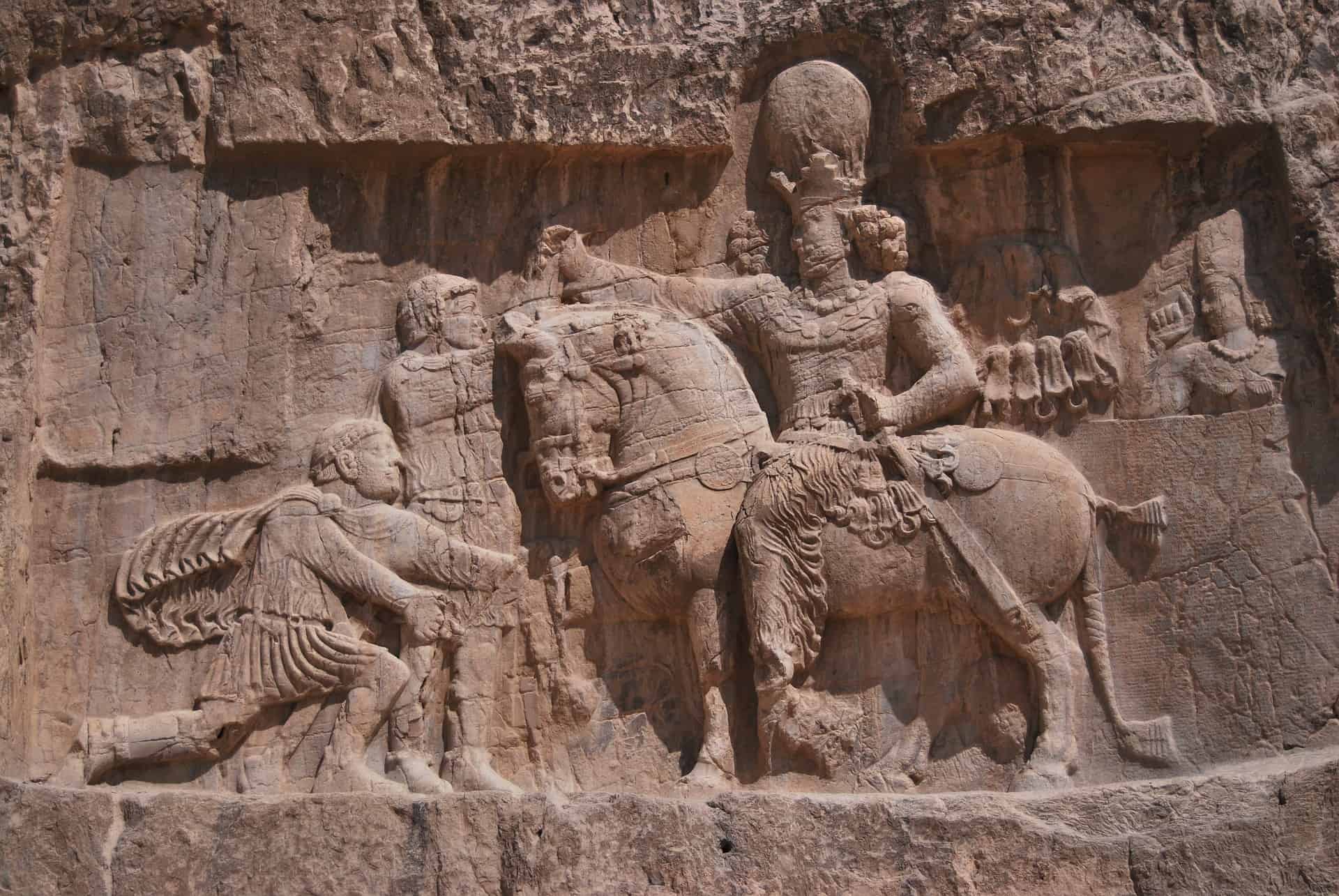
Iran is not just another country of the 48 we find in Asia, it is one of the oldest and most distinguished civilizations in the world that has been around since the dawn of history itself and can be traced back to 4000 BC. Throughout thousands of years, Iran had witnessed the rise and fall of different empires, one of which named the Achaemenid Empire was one of the largest in the world at the time and was even, in hindsight, described as the world’s first superpower.
Such an empire fell by the conquest of Alexander the Great in the fourth century BC who divided the far-expanding empire into several states. However, a century or so later, those states were unified again into the Parthian Empire which stayed powerful for four centuries after. And then came the Arab Muslims.
The seventh century AD was a turning point in the history of the now-Iran Persia as it was conquered by the Arab Muslims, an action that led to the Islamization of the country. During the long period the country was turning to Islam, Persia encountered a cultural evolution that gave the chance for literature, science, art, medicine, philosophy, and architecture to blossom, making Islamic Persia become a vital part of the Golden Age of Islam and a never-to-miss destination for scholars, poets, and philosophers.
What is interesting is that Iran preserved its Persian language after its Islamization, unlike other countries, for instance, Egypt, that adopted Arabic as the main language after converting to Islam.
Since then, Persia had undergone a series of changes in its political structure mostly due to the existence of different successive dynasties that ruled it for almost a thousand years. In March 1935, the name Persia was internationally changed to Iran which means ‘the land of the Aryans’ after the Iranian ambassador to Germany had suggested so.
The last dynasty in Iran, the Pahlavi Dynasty, was overthrown by the Muslim Revolution of 1979. Such revolution brought into existence the Islamic Republic of Iran which we know—or rather do not know—today.
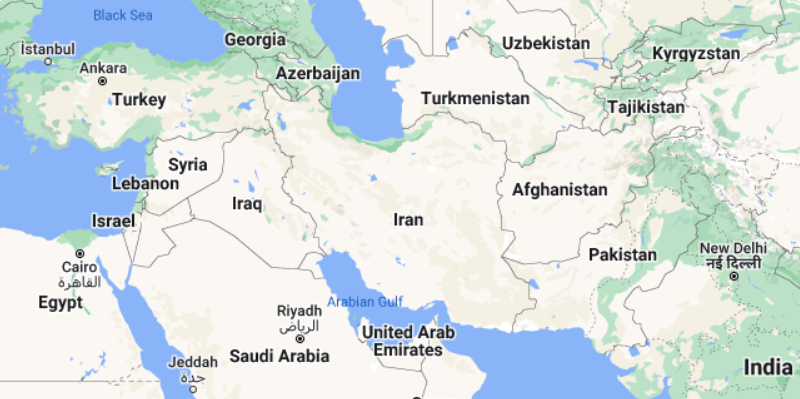
Modern-day Iran is a country with an area of 1.648 million square kilometers in the west of Asia and a number of neighbors that is a little more than average. In fact, Iran is surrounded by seven countries, two gulfs, and one sea! To the west, there is Iraq and Turkey, Armenia and Azerbaijan to the northwest, the Caspian Sea and Turkmenistan to the north, and two other stan-ending countries, Afghanistan and Pakistan, to the southeast. In addition, Iran is bordered to the south by the Gulf of Oman and the Persian Gulf.
It is worth mentioning here though that there has been a dispute over whether the gulf to the south of Iran is Persian or Arabian. Interestingly, Google Maps has somehow settled it in the most peaceful way! If you view the map of Iran from an Arab country, it will read the Arabian Gulf. If you view the map from outside the Middle East, it is named the Persian Gulf! Thus everyone is happy!
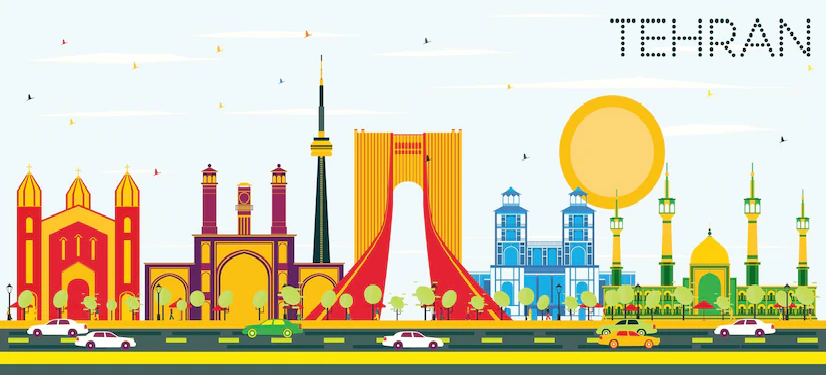
Iran now has 31 provinces and its capital residing in the north is Tehran.
Language(s) of Iran
Throughout history, Iran has enjoyed unique social, ethnic, and cultural diversity. This is best shown by the many ethnic groups and the overwhelming number of languages in the country. Persian (Farsi) is the predominant language, spoken by most of the population and constituted the official language of Iran. The second most spoken language is Azerbaijani then some Turkic dialects. Additionally, there are smaller percentages of the population speaking Kurdish, Arabic, Gilaki, Mazandarani, Baluchi, and many other languages.
Regarding foreign languages, French used to be the second language taught at school up until the 1950s so older Iranians are more likely to speak some French. Yet, from that date on, English has replaced French as the school’s second language so it is the younger Iranians who can most probably speak English.
In the big cities such as Tehran and Isfahan, most signs in the streets, roads, hotels, and tourist attractions are also written in English.
Currency of Iran
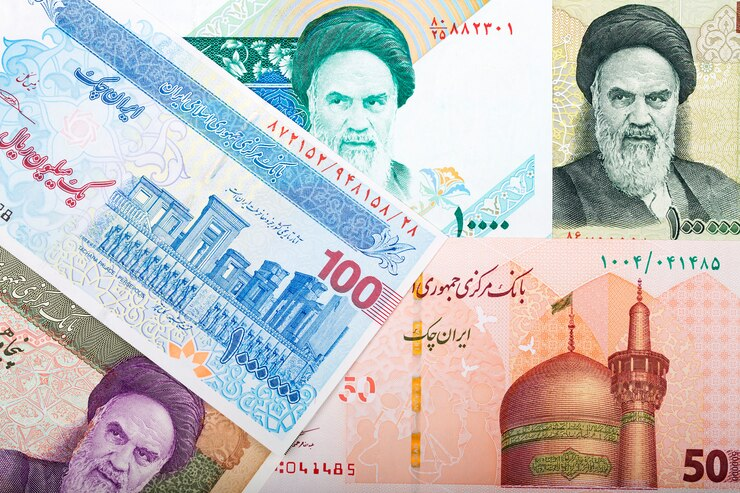
Iran started using currencies more than two centuries ago. Back at the time, the main unit was called Toman. Now the official currency is Rial and symbolized by IRR; however, many Iranians still use Toman which is equivalent to 10 Rials.
As of April 2022, the Iranian Rial is, unfortunately, the weakest currency in the entire world with one USD equaling IRR over 200,000! This provokes some questions: Why is this the case with the Iranian Rial? What precisely caused it to hit rock bottom?
Well, the inflation and devaluation of the Iranian Rial started more than 80 years ago, precisely during WWII.
After the allies occupied Iran during WWII, the inflation level of Iran’s currency jumped from 13.8% to 96% making one American Dollar equal to 16 Iranian Rials. Then major political events and tensions emerging into the scene started a gradual decline and lowered the value from 60 Rials/Dollar in 1950, 1450 Rials/Dollar in 1986 to 35890 Rials/Dollar in 2015 and 273,080 Rials/Dollar in 2021!
However, the Iranian government has subsidized a rate of 42.000 Rials per one Dollar to use only to import essential and humanitarian goods that are free from US sanctions.
So when you find a museum ticket worth 1,000,000 Rials, do not freak out. It is only four dollars or so.
Holidays in Iran
Besides maintaining Persian as the native language, Iran had embraced the Solar Hijri Calendar which calculates time based on Earth’s movement around the Sun, so a year still has 365 days like in the Gregorian Calendar. This is unlike the Lunar Calendar used in many Arab and Muslim countries whose year is 355 days.
Around the year, Iran has a relatively high number of public holidays, precisely 26. Most of these holidays celebrate either old Islamic events and festivals or political changes the country witnessed. Here we give you a glimpse of some of the most important holidays in Iran
Nowruz
Or the Persian New Year in the Solar Hijri Calendar.
Nowruz marks the beginning of spring and is usually celebrated over a period of two weeks beginning on the 21st of March. Such a holiday has been celebrated for 3000 years and is considered one of, if not the most important holiday in Iran.
Nowruz resembles the new beginnings with the arrival of good weather, sunny days, and blossoming flowers after a cold, snowy winter (Yes, it snows in Iran!) Nowruz is also a holiday Iranians usually spend with their families and loved ones.
Sizdah Be-dar
Despite its resemblance to bad luck in many cultures, the number 13 has special importance in the Iranian culture and is quite related to Nowruz as well. Sizda Be-dar is the public holiday that marks the end of Nowruz and is usually celebrated on the 13th day of the first month of the Solar Hijri Calendar, Farvardin. That is equivalent to April 2nd.
Iranians usually celebrate Sizda Be-dar outdoors, enjoying spring and picnicking in parks. They also have their own version of April Fools’ Day named Lie of the Thirteenth in which they prank others.
Isn’t it just cool to have a two-week holiday and then have an extra one-day holiday to celebrate the end of the first holiday?
Iranian Islamic Republic Day
In January 1978, an uprising in Iran led by the political-religious leader Ayatollah Ruhollah Khomeini sparked and millions and millions of Iranians protested against Shah’s profligacy, system corruption, and oppression. The violent demonstrations lasted for a year until Mohamed Reza Pahlavi, the Shah of Iran, fled the country in January 1979.
Soon thereafter, a referendum to replace the Pahlavi Dynasty with the Islamic Republic was held in March 1979 and the results were 98.2% to 1.8%. Such results were announced on the 12th of Farvardin marking the beginning of a completely new era in Iran. The 12th of Farvardin, April 1st, is also the last day of Nowruz.
The Iranian Islamic Republic Day is celebrated annually for it holds special importance to the Iranians.
Why visit Iran
In extension to its cultural diversity, Iran has a great display of heritage almost in every inch of it and does offer many options suitable for all kinds of travelers. Iran’s rich history is best represented by the unique innovative architecture shown in mosques, palaces, and ancient bridges.
In addition, Iran’s diverse weather (as we will see in the next section) provides a great chance to enjoy winter activities as well as relaxing summertime at some of the most stunning beaches in the country. And if you are more into nature, Iran has also got you covered by prehistoric forests, mountains, and botanical gardens scattered around the country.
Visiting Iran also provides a great chance to view the country from the inside, experience its renowned hospitality, and connect with the people who, as their culture, seem very unknown to the rest of the world. This eventually will lead you to form your own opinion about Iran, independent from any media influence.
Hopefully we are now on the same page, here is your ultimate Iran travel guide.
When to visit Iran
As a start, we hope you do not get bored by how many times we have mentioned and will mention the diversity of Iran because it kind of touches everything. And it gets no different when talking about the weather as well.
Weather in Iran shows noticeable, if not drastic, differences based on seasons and where you are in the country. For instance, in the north of Iran, winter is very cold with heavy snowfalls and temperatures as low as 0°C. Spring and fall are mild and usually perfect for visiting while summer is dry and hot. In the south, it is a little shifted. Winter is mild and summer is very hot with temperatures sometimes reaching 43°C.
So according to where you want to go in the country, you choose the best time of the year. Yet, it is generally common for travelers to visit Iran during spring which extends from March to May, and fall which starts in late September and ends in November.
Unless you are OK with cold weather and more into winter activities and skiing, you’d better avoid Iran in winter. Similarly, if hot summers are just the thing for you, Iran guarantees you an exceptional summer vacation on its Kish Island in the south—there is a whole section about it later in the article.
What you need to travel to Iran
In October 2021, Iran lifted restrictions on international flights which stopped after the outbreak of Coronavirus in March 2020, resulting in the tourism sector getting badly influenced. Now that the world is recovering from the pandemic, tourists from almost all over the world can travel to Iran.
Here are the requirements one should fulfill prior to traveling to Iran—as of April 13th, 2022.
- A vaccination card of two doses
- A negative PCR test taken within 96 hours before the flight
- A valid passport for a minimum of six months
- A valid Iran travel insurance
- An Iran tourist visa
Iran Tourist Visa
Tourists who wish to travel to Iran must apply for a tourist visa on the website of the Iranian Ministry of Foreign Affair. It is a quite simple process:
- Fill in the visa application form accurately.
- Pay the fees of EUR 20.
- Receive a visa code and a grant notice document (the code is only valid for a month from the date it is issued).
- Prepare your at-least-six-month valid passport, the application form you previously filled, two new passport-sized photos along with the authorization reference code.
- Head to the Iranian consulate in your country or the country you can collect your visa from which you must declare in the application form.
- Pay the fees—those are different from the EUR 20 you paid before. Fees are different from one country to another.
- Get your visa.
- Pack up!
Because some countries might not have an Iranian Consulate and if this is the case with your country, you are free to collect your visa from the Iranian Consulate of any other country you can easily travel to. Just make sure you mention this in your visa application. If you have not done this or for some reason and you will not be able to collect your visa from the stated consulate, you may request the Iranian Consulate to redirect your visa to another one with an extra charge.
Iran tourist visa is issued for a maximum stay of 30 days; yet, it can be extended while you are in the country. The maximum period to spend in Iran under a tourist visa is no more than 90 days. The visa remains valid for a period of three months from the date of issuance.
It is also worth mentioning that some countries are allowed to travel to Iran with no visa at all. On the other hand, citizens of the USA, the UK, and Canada are required to follow a quite different procedure to obtain a tourist visa to Iran.
Citizens of Israel are not permitted in Iran even if they are not to leave the airplane and not even in transit. In addition, individuals with passports or documents containing an Israeli stamp, visa of less than one year, or just any information that shows that this individual has any connection whatsoever with Israel are not allowed to enter the country either.
Visa on Arrival
Instead of going through the regular visa procedure, Iran offers a visa-on-arrival only to tourists who are visiting the country. You can make sure you are eligible for a VOA if you:
- Are traveling to Iran with an ordinary passport for tourism purposes only and not journalism or news coverage purposes. In such a case, you must have a press visa.
- Do not have a passport from any of these countries: the USA, the UK, Canada, Colombia, Somalia, Bangladesh, Jordan, Iraq, Afghanistan, and Pakistan. In this case, you need to get an ordinary tourist visa.
- Have not been rejected to get a visa beforehand; otherwise, you must get an ordinary tourist visa.
- Are not a dual national Iranian. In this case, you must travel with your Iranian passport.
Tourists eligible for Iran VOA can show up at the airport, fill in the application form, and wait until the application is approved and the visa is issued. However, this is highly not recommended for there is a chance that your application might not be approved. In such a misfortunate case, you will be deported at your own expense. If your application does get approved, you may wait for a long time for your visa to be issued.
The best way, however, to get your Iran VOA is to fill in the application before your trip. If it is approved, it is then guaranteed that your visa will be issued upon arrival in Iran without even having to wait. At this stage, you also need to buy your Iran Travel Insurance for it is required to get your visa.
Once you receive your application approval, you will receive a visa approval number. Upon arrival, all you need to do is present that number, pay the visa stamp fee, and here you go, you have your 30-day tourist visa in Iran.
Visas on Arrival can be collected in many Iranian international airports such as those in Tehran, Shiraz, Mashhad, Isfahan, Tabriz, Qeshm, and others.
Currency exchange
You must have Iranian Rials to pay with during your journey so it is recommended to exchange currency at the airport. Unfortunately, credit cards from any banks other than Iranian banks cannot be used in Iran. So as an alternative, you can get a Tourist Card which is a prepaid travel debit card to help ease your transactions.
Iran Dress Code
Following the dress code of a country you visit is a sign of respect for that country as well as a way to blend in during your stay. And Iran has its dress code which is expected to be followed by both locals and tourists.
Aligning with the Islamic culture of Iran, female tourists are required to wear a hijab, a headscarf that covers the hair, from the moment they exit the plane. They are also expected to avoid wearing revealing clothes. Long skirts, pants and leggings, and half-sleeved shirts, but not short-sleeved or sleeveless ones, are perfect. In addition, women must wear chadors when visiting religious places.
Men also have their share of the dress code as they must not wear sleeveless shirts or shorts. Half and short-sleeved shirts and T-shirts are OK.
That being said, such a dress code can be loosened a bit while on adventure tours in nature.
How to get around in Iran
Iran is such a big country and just trying to get around may sound a little overwhelming. However, Iran seems to be doing pretty well when it comes to transport, making getting to and around the country quite an easy process with several available options.
Planes
Iran has 27 international airports with the largest of them being in the major cities of Tehran, Mashad, Shira, Tabriz, Esfahan, and Kish. You can get to the country on a plane from a privately-owned company such as Mahan Air or using the national airlines Iran Air which provides a larger number of flights to most capital cities.
Dozens of other cities also have airports, the thing that facilitates domestic flights in case you are short on time or energy or both. Domestic flights no matter who they are offered by are priced by the government so the fare will always be the same.
Trains
Another way of moving across Iran is by train. Iran enjoys a nationwide railway system that makes long-distance travel easier, faster, and more affordable. Trains in Iran may differ in quality since most of them are operated by private companies. Different classes are available at different prices and overnight trains are available as well for long routes. A train ride seems even more enjoyable given the trip-long scenery of Iran available from the train’s large windows.
Please note that trains in Iran are widely used and tickets are usually sold out. So it is better to buy your ticket up to a month in advance, especially if you are traveling during the weekend, Thursday and Friday, or any public holiday.
Buses
If you are not so into trains to move from one city to another, you can take a bus instead. Buses are available to travel between and within cities. Tehran, for instance, has its very own Bus Rapid Transit (BRT) with 10 lines covering the entire city. VIP buses for intra-city trips are also available which makes such long routes way easier and more comfortable.
Metro
Of all the countries in the world, only 61 have built their intra-city electrified rapid transit train system, mostly known as the metro, to facilitate transport, save time, and help go easy on the energy used. The oldest electrified metro system was the London Underground opened in 1890. As of today, Shanghai has the world’s longest metro network covering 803 km while Catania in Italy has the smallest metro system which consists of just one line and six stations.
Concerning Iran, it seems like it has itself covered. Iran does not just have one metro system but six operating in the major cities of Tehran, Mashhad, Shiraz, Esfahan, Tabriz, and Karaj with a total number of stations of at least 330, 144 of which being in Tehran only.
Tehran’s metro system is the largest in the Middle East and consists of seven active metro lines and operates almost all day from 5:30 am to 11:30 pm with only six hours of night sleep. Metro Tehran can take you all around the city. You can even go to Tehran Imam Khomeini International Airport by metro! Just buy an International Airport Single Ticket for 90,000 Rials and you are good to go.
Snapp
Just like preserving the Persian language to keep its authenticity, using a different calendar, and even having its own version of April Fools’ Day, Iran has its Uber-like mobility service provider known as Snapp. Operating in all 31 provinces in the country, Snapp will ease your moving around from here to there. The app is available on iOS and Android and does support English. Before the trip, you get to know the cost in Rials only with which you can pay for your rides.
TAPSI
Just like Snapp, TAPSI is Iran’s version of ridesharing taxi services known in other countries as carpooling, though you can also use TAPSI for single rides. While Snapp is available nationwide, TAPSI only operates in 15 cities including the five major ones, and does not entirely support English so you might want to stick with Snapp.
Minibuses
Many Iranians use minibuses to navigate from major cities to the villages and rural areas around them. They might be a little more expensive than buses; yet, they are faster since the number of passengers is a lot less.
Private taxis
Private taxis are just like Snapp but with no app or any kind of virtual existence on the Internet. You can easily recognize them since they are either yellow, white, or green with the familiar black-and-white taxi sign sticker. In case you take a yellow, white, or green private taxi with a black-and-white taxi sign sticker, consider negotiating the fare since drivers would always try to make you pay more.
Shared taxis or Savaris
Whether you are traveling within the city or to another one, you can take a Savari which is a taxi you share with other people. You can easily spot them near bus terminals or squares where a cluster of drivers are either waiting for passengers to hop in or shouting out the city name they are heading to. Savaris usually have a predetermined fare and route.
What to eat in Iran
The Iranian cuisine has evolved over the past thousand years and changed as much as the Persian Empire itself extended, mainly influenced by the cuisines of the nations Iran conquered or was conquered by such as the Greeks, Arabs, Turks, and even Indians.
Characterized by meat, vegetables, nuts, herbs, spices, and sweet fruits, the Iranian cuisine has tens of mouth-watering must-try dishes that one would never want to miss in their life.
As a rule of thumb, a typical Iranian dish usually includes cooked rice with vegetables, meat, or chicken. Besides a large variety of main courses, the Iranian cuisine has a distinct collection of savoring stews and soups.
Here are some examples of famous Iranian dishes you can try for every meal.
Breakfast
Iranian breakfast is a lot more simple than lunch and dinner options. Still, there are so many different options. Typically, every breakfast must have bread. You might think ‘Oh, this is pretty straightforward but it is not. Iran happens to have a large collection of distinct types of bread distinguished by how they are baked, level of thickness, shape, texture, and the ingredients used. Sangak, barbari, taftoon, and lavash are some of the most popular bread types.
Besides the irreplaceable bread, every breakfast in Iran is served with sweet, non-milky, brewed black tea (chai). Then there is cheese, feta cheese to be precise, usually eaten as small bites with bread and topped with fruits, nuts, or fresh herbs.
In addition, other things are served for breakfast such as boiled and fried eggs or Persian omelets, halim which is a thick texture of meat and wheat porridge, adasi (Persian lentil soup), and kaleh patche. Kaleh patche is a dish served for breakfast and has the nickname of the weird Iranian dish mainly due to its ingredients. Kaleh patche is a soup cooked with sheep’s eyes, tongue, and brain as well as its feet. Yes, it does sound a little weird but it is delicious. You must give it a try since you are giving the entire culture of Iran a big try!
Iranian breakfast has also got those with a sweet tooth covered. Homemade fruit jam and honey are usually served along with butter and cream.
Lunch and dinner
Though it is very common in eastern Asia and Spain, rice also makes the main item in almost every main course in the Iranian cuisine. In addition to rice, there is kebab, or cooked meat, Iran’s most popular dish and sometimes classified as Iran’s national dish. This is not surprising since kebab is the most common meat dish in almost every other country in the Middle East.
Kebab is usually served with bread or rice under the name of chelo kebab.
Besides kebab, here are some other must-try Iranian dishes for lunch and dinner.
- Sabzi polo: served in northern and southern Iran, sabzi polo is a green-herb rice dish served with fried, baked, or stuffed fish.
- Khoresht gheimeh: a stew with a tomato base, small cubes of lamb or beef, and split peas served with fried potatoes on the top.
- Baghali polo: this is another spiced-rice dish with saffron specifically, fava beans, and green dill which makes the dish turn out literally green. Such a dish is usually served with a lamp.
- Zereshk polo ba morgh: rice again cooked this time with barberries topped with pomegranates and served with chicken.
- Ashe reshteh: a multi-ingredient soup consisting of thick noodles (Asian influence again), lentils, pinto beans, yogurt whey, chickpeas, and minto oil and topped with fried onions. This is a holiday meal usually eaten on Nowruz, the Iranian New Year.
And the list goes on and on, and on.
Your Top Four Destinations in Iran
The diversity of Iran might be a little overwhelming for someone who wants to visit this country and take a closer look at it. In fact, it is as overwhelming to even write about it because each city seems to have its very unique theme. However, we have tried to break it down for you with some details about the major cities and what you can expect to do in them.
The Capital: Tehran
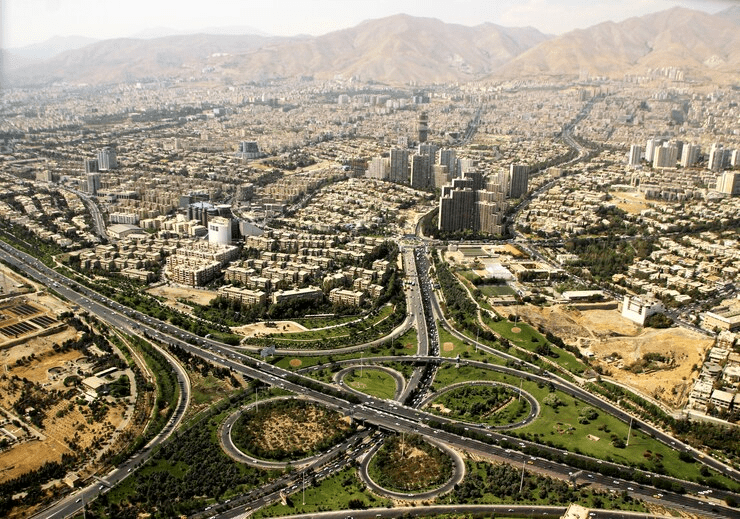
In so many countries, the capital city is the one that gets most of the attention and is usually home to the largest section of the population, major roads, and hence heavy traffic which also makes the city mostly crowded and a little more polluted. Well, this is quite the same case with Tehran. However, Tehran in and of itself is a city you need to experience on your visit to Iran. In fact, it is considered by many travelers the main destination.
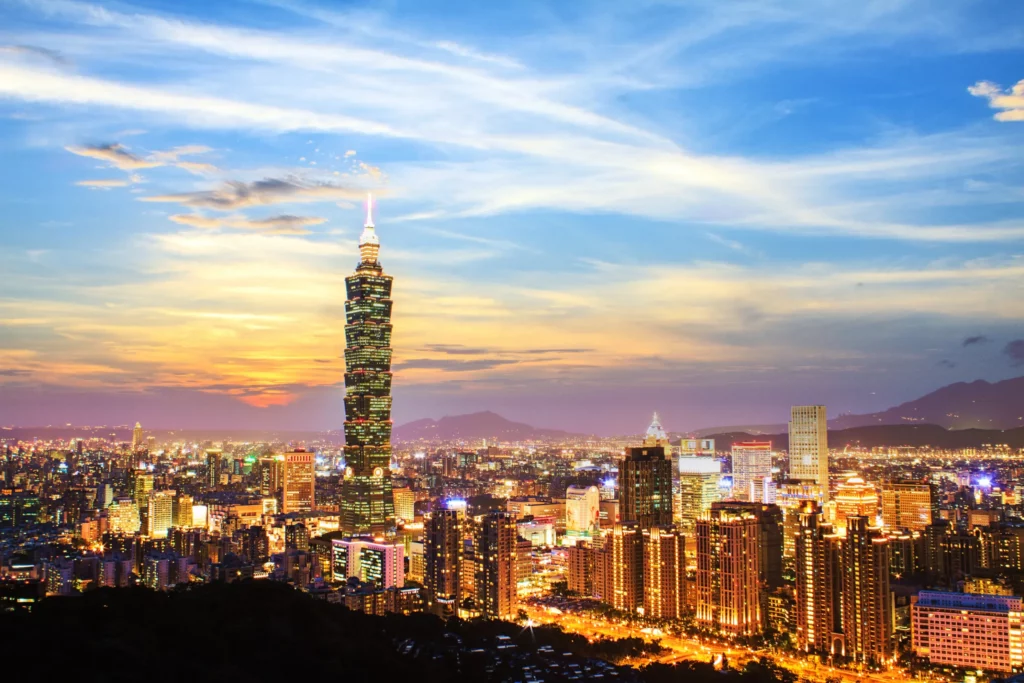
In Iran, Tehran is the center of everything, from culture and economy to politics and history. Located in north-central Iran with an area of 730 km², Tehran is home to 8.7 million people, making it the most inhabited city in western Asia and the most crowded as well. With the largest metro system in the Middle East, Metro Tehran has seven active lines covering 254 km across the city and has been facilitating transportation in the city ever since the first line was opened in March 1999.
Tehran is also passed through by the Jarud River.
What to visit in Tehran
Choosing which tourist attractions to visit in Tehran could be a hard decision to make for the city happens to be very rich in them, with so many different varieties as well. For example, there are around, if not more than, 52 museums and palaces in Tehran only, more than 800 parks, 10 mosques as well as other towers, bazaars, and around 663 mountains with various heights that reach up to 4375 m!
This makes me wonder if there is any space left for people to live in!
As a result of that, a trip to Tehran can never be disappointing. And to help you decide, we have chosen some of the top attractions to help plan your sightseeing tour.
Golestan Palace
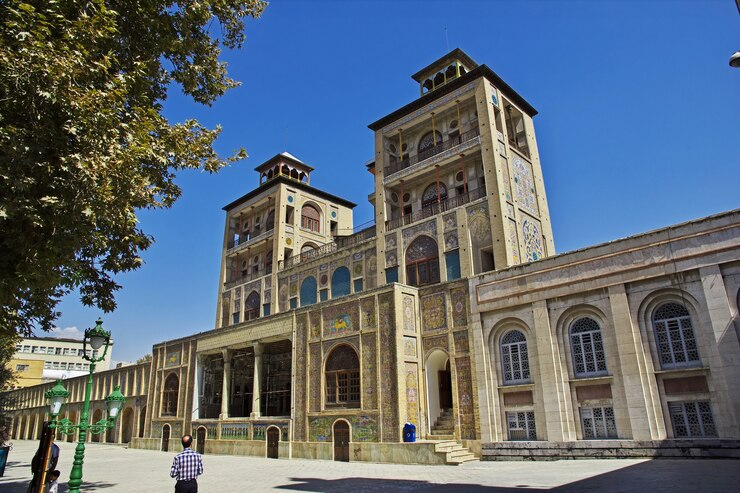
Or the Rose Garden Palace.
Golestan Palace stands as a very distinctive and inspiring universal value due to the outstanding combination of architecture and Persian art and craft which made it a UNESCO World Heritage Site in June 2013. The palace is, in fact, a complex that includes gardens, museums, palaces, and halls. It was once used as the official residence of the rulers during the 18th, 19th, and early 20th centuries. However, it was limited to important royal ceremonies from 1925 on.
Golestan Palace is open all week long from 9:30 am to 6:30 pm in spring and summer and from 9:00 am to 5:00 pm in fall and winter.
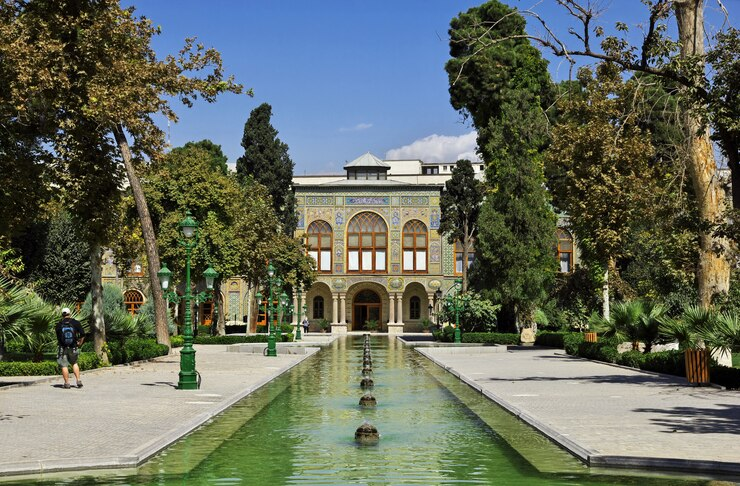
A ticket for the Golestan Palace is worth, well, one million Rials. The entrance fee for each museum and mansion of the complex is 500,000 Rials and two million Rials for the main part of the palace. Please note that these ticket prices might be higher by the time you visit Iran.
Carpet Museum of Iran
One thing about Iran that has crossed seas and mountains to every inch of the world and received a lot of attention is Iranian carpets. Known for their authenticity, exceptional designs, eye-catching patterns, vivid colors, and being made of the finest wool, cotton, and silk, a chance to see a great collection of Iranian carpets and learn about their history that goes back to 2500 years ago is no way to skip.
Iran’s Carpet museum is open every day except for Monday from 9:00 am to 5:00 pm. It is located inside the stunning Laleh Park, Tehran’s biggest park, which makes it a double trip!
Milad Tower
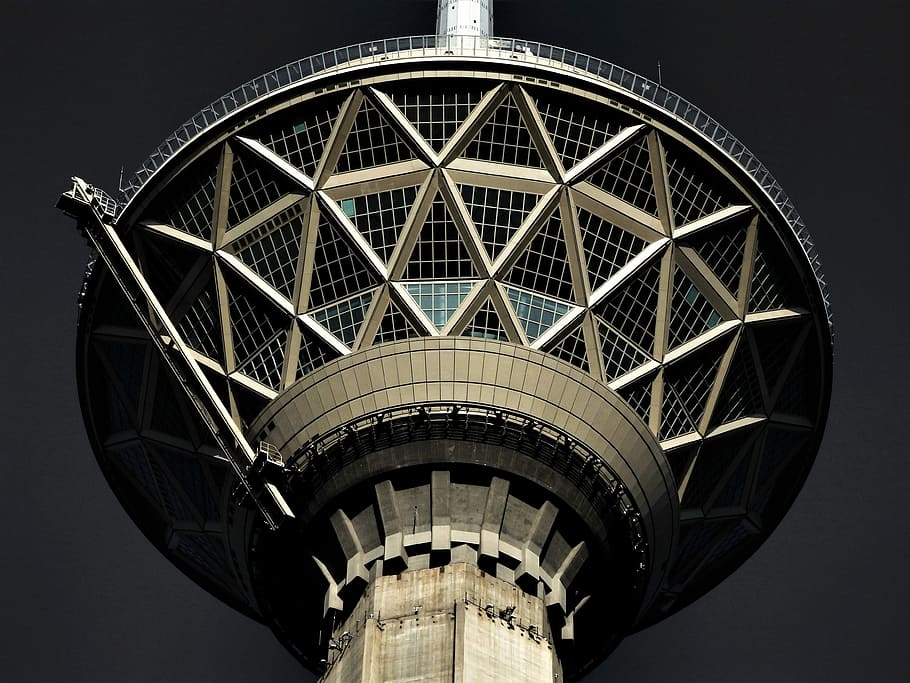
Designed by the Iranian architect Mohammad Reza Hāfezi, Milad tower is the tallest telecommunication tower in Iran. It is 435 meters high and has a lobby structure of six floors, the first three of which have numerous trade units, food courts, an art gallery, a coin museum, as well as a cafeteria, and a commercial products exhibition.
Visitors to Milad Tower can go up to the observation deck where they can view the entire city and maybe have lunch or dinner in the revolving restaurant.
Milad tower can be visited on a daily basis from 9:00 am to 11:00 pm.
It seems like every part of the tower has its own ticket price; yet, visitors can get a full-package ticket for 350.000 Rials to visit the open-air platform, skydome, Municipal Museum, and Museum of Fame. Again, prices may be different by the time you visit.
Treasury of National Jewels
The Treasury of National Jewels is a museum in Tehran that comprises and exhibits the Iranian collection of national jewels such as crowns, necklaces, belts, capes, jeweled swords, shields, precious gems, and different other unimaginable items cast in precious metals and encrusted with gems.
The museum is open for three hours only from Saturday to Tuesday and the tickets are worth 500,000 Rials. Though you might want to check whether or not the museum is open during your time of visit in case there are any Covid-19 restrictions.
Tochal Complex
If you did make it to Tehran in winter which extends from early November to April, then there is no way you can miss a trip or even a few-day residence in Tochal Complex. Located northwest of Tehran in the Velenjak neighborhood, Tochal Complex is named after Mount Tochal, a part of the Alborz mountain range and the highest peak of them all with an elevation of 3,964 m.
The complex was built in the seventies as a recreation place and has four facilities: a gondola lift which is known as Tochal Telecabin, a ski resort, a tennis academy as well as a hotel.
The Tochal telecabin is very long. In fact, it is considered one of the world’s longest gondola lifts’ with a length of 7500 km. It has four stations, some of which, specifically stations 1 and 5 have inns, a restaurant, and a rescue center.
At station 7 of the gondola lift, you can access the ski resort and where the main ski slopes are: the peak and western foothill. Nearby, there is also a tennis academy with two available courts and a 2.4 square kilometer three-star hotel with two floors, 30 rooms, and a restaurant.
To get to Tochal Complex, you should first go to Mount Tochal base. You can take a Snapp directly to the base or use the metro, get off at Tajrish station, then take a Snapp to the base of Tochal mountain.
From there, you can take a small shuttle bus costing around 10,000 Rials or so or walk for 30-60 minutes to reach the gondola lift. Buy a ticket from the ticket booth, line up, take the gondola lift, and tell the operator you are getting off in station 7 where you can access the resort.
During the ski season, temperatures drop to -10°C and sometimes -20°C so make sure you put on heavy winter clothes. Tochal Complex is open from 8:00 am to 3:00 pm all week long except for Monday.
(2) The Athens of Iran: Shiraz
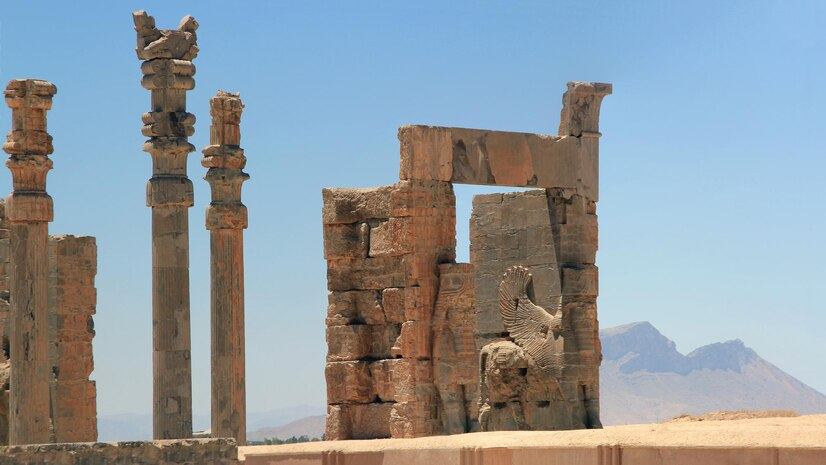
Located nearly a thousand kilometers away from Tehran and residing in the southwest of the country is the city of Shiraz after which one of the cutest, fluffiest, long-haired cat breeds was named. Yet, the distinctiveness of this city is not just limited to cats.
Shiraz is considered to be a city of gardens and flowers. It is famous for fruit trees, green streets, and incredibly huge varieties of flowers that turn the city into an earthly paradise in spring.
Shiraz is also a center of art and literature. It was home to many scholars, philosophers, poets, and mystics whose stay in the city gave it the name of The Athens of Iran. One of the famous Iranian poets who lived in Shiraz is Hafez whose work was widespread across the Persian-speaking nations. Hafez’s words were learned by heart; people even used them in everyday conversations.
Not only for poets is Shiraz considered a cultural hub but also for being inhabited by different ethnic groups who lived together in harmony.
Where to go in Shiraz
If Shiraz is your first destination in Iran then it is better to land at Shiraz International Airport. If you made it to Tehran first, it is better to get a domestic flight for the distance is too long to take by trains or buses. Shiraz also has its very own metro system, though its 20-station line 1 is the only one operating so far.
Shiraz is best visited in spring (March to May) and fall (September to November). Summer is quite hot while average temperatures in winter are below-freezing.
Nasir al-Mulk Mosque
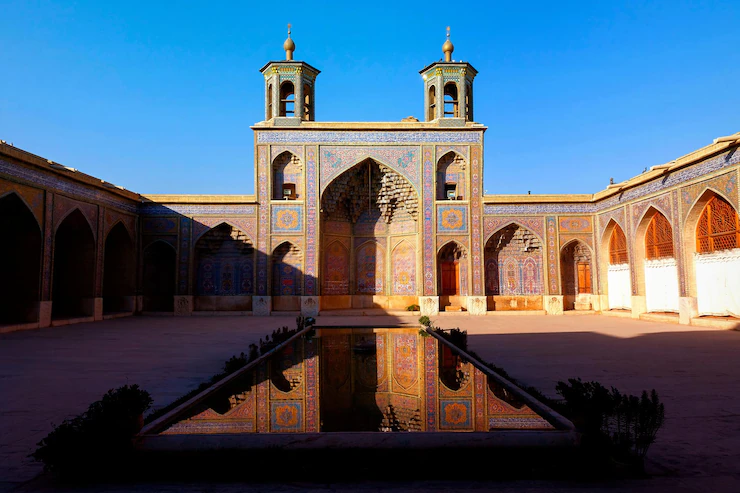
Built in the 19th century and mostly referred to as the Pink Mosque, Nasir al-Mulk Mosque is an integration of creative architecture and genuine Persian art. The mosque is distinctive for its spectacular Orsi windows which are made of both wood and colorful glass. Visitors entering the mosque are welcomed with colorful light that slightly arouses feelings of wonder and daze.
Another side of the mosque’s remarkable architecture is that it features muqarnas, an Islamic architecture hallmark of self-supported arched structure usually applied to the underside of squinches and domes. Nasir al-Mulk mosque is also quite large. It stands on an area of about 2,216 square meters.
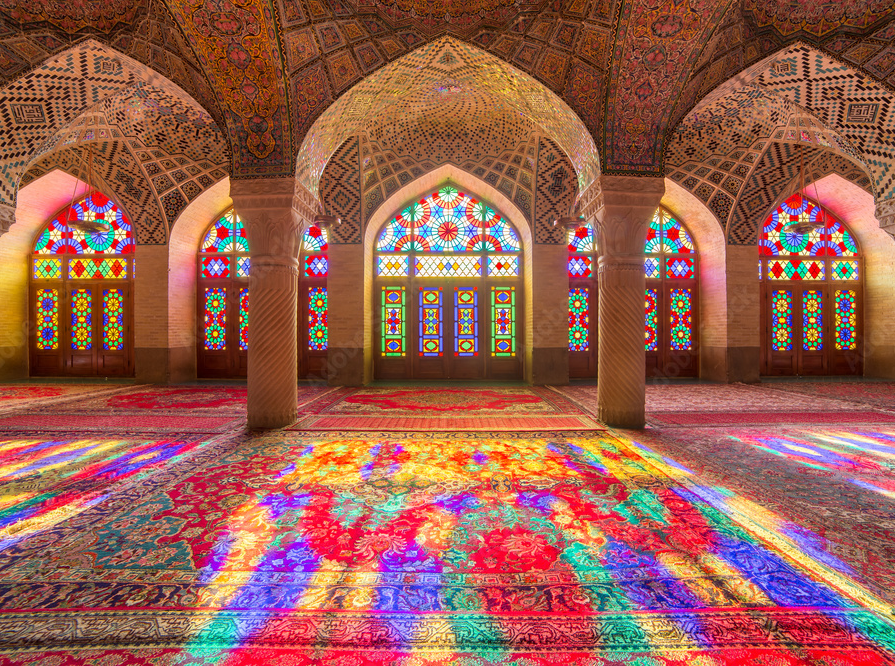
To have the best experience, make sure you visit the mosque on a sunny day and arrive there between 8:00 am and 10:00 am to witness the beautiful reflection of light through the stained-glass windows.
The mosque is usually open from 7:00 am to 6:00 pm in winter and 7:30 am to 7:00 pm in summer. The entrance fee is 500,000 Rials. Though, changes in ticket prices might have been applied due to the lockdown.
Shah Cheragh
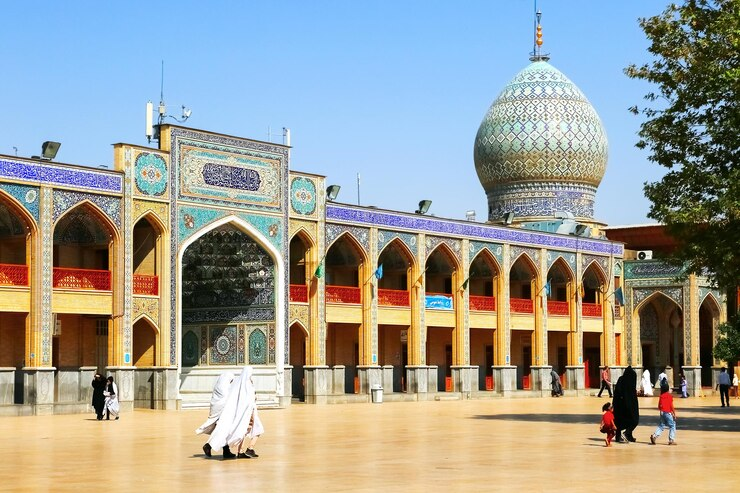
Built a little earlier in time than the Pink Mosque, Shah Cheragh holds special religious importance to the Iranians and is a famous pilgrimage center in Shiraz. It is characterized by its dazzling interior where walls and ceiling are covered with small glittering pieces of glass and mirrors mixed with green-colored tiles. Those glass and mirror pieces reflect light in all directions.
Maybe that is why the mosque was given the name Shah Cheragh which means King of Light in Persian.
The mosque is divided into a female side and a male one and women are usually given chadors to wear before entering. Free tours are offered to tourists.
The mosque is open round the clock.
Eram Garden
A part of Shiraz Botanical Garden of Shiraz University is Eram Garden. It, along with the palace within, is a World Heritage Site (again) and must be on your to-visit list when you are in Shiraz. The garden is one of the famous Persian Gardens known for its very precise geometrical layout and resembles the exceptional development in implementing architecture, water management, and agriculture to create another earthly paradise featuring beautiful lush plants, aesthetic trees, herbs, and flowers. Eram garden serves as a place for leisure, relaxation, and contemplation. The garden is open Monday to Sunday from 8:00 am to 6:30.
(3) Half of The World: Isfahan
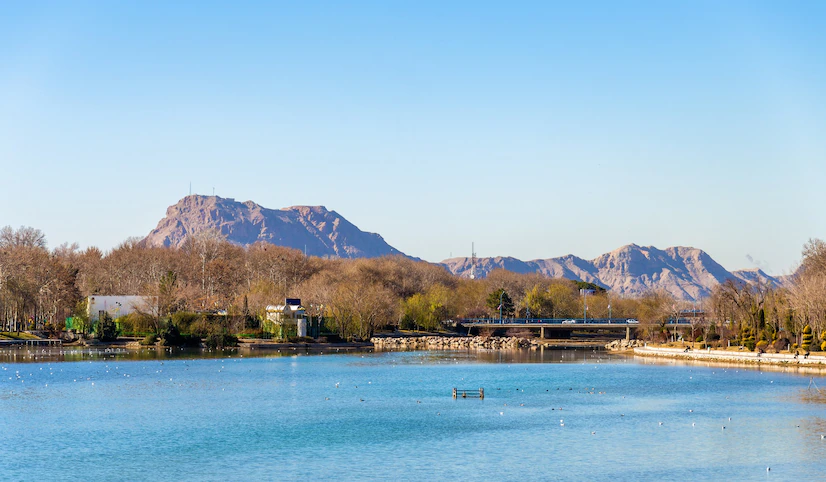
Right at the center of Iran is Isfahan city, one of Iran’s cultural and economic centers. It is about 406 km south of Tehran and around 481.8 km north of Shiraz and spreads over an area of 551 km².
Isfahan is sometimes referred to as ‘half of the world’ or Nesf-e-Jahan due to the high concentration of extraordinary Persian architecture, tourist attractions, and monuments of tiled mosques, places, and minarets, and the great historic value it holds.
The largest river in central Iran, the Zayanderud River, crosses the city of Isfahan and ends at a salty lake southeast of the city called Gavkhooni. The river passing through the city was probably the reason why there are six old bridges that resemble the hallmarks of historic bridge architecture.
Where to go in Isfahan
Getting to Isfahan mainly depends on where it is on your trip. You can travel directly from your country and land at Isfahan International airport. If you are in Iran already, then you can take a train or a bus ride. If you would like to make the most of your time in Iran then a domestic flight is your best option.
You can go around the city in taxis or Snapp rides since the app is operating there as well as in the rest of Iran’s 31 provinces. And just like Tehran and Shiraz, Isfahan has its very own metro system with one active line of two stations and two other lines still in the planning phase.
Since Iran is most beautiful in spring, it is also recommended to visit Isfahan any time between April and May. But bear in mind that this is also the same time when the cost of flights and hotel reservations is at its peak. You would also want to avoid Isfahan in summer as the temperature gets as high as 39°C unless this is no problem for you.
Here are five stunning places you will enjoy visiting during your visit to Isfahan.
Si O Se Pol Bridge
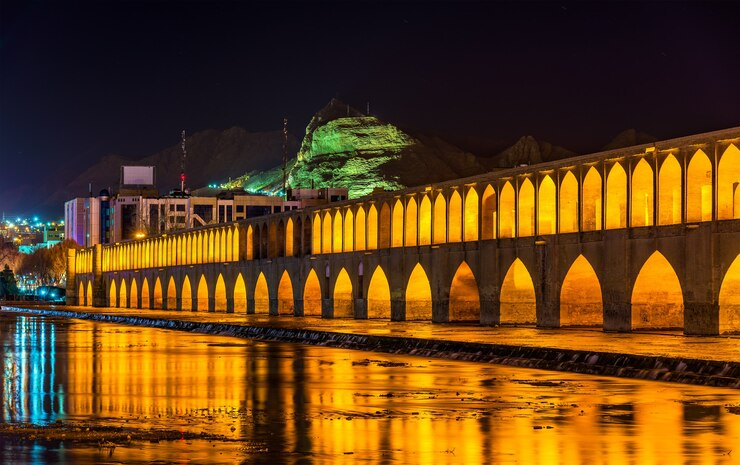
Originally constructed to serve as a bridge and dam, the Allahverdi Khan Bridge, popularly known as Si-o-se-pol Bridge, is also a recreation place of leisure and gathering. Tourists can enjoy a nice short walk of 300 meters and a view of the magical fast-moving river of Zayanderud. The rocky bridge is also characterized by its 33 vaulted-arch spans. And just like London’s famous red bus, Si-o-se-pol is a double-decker.
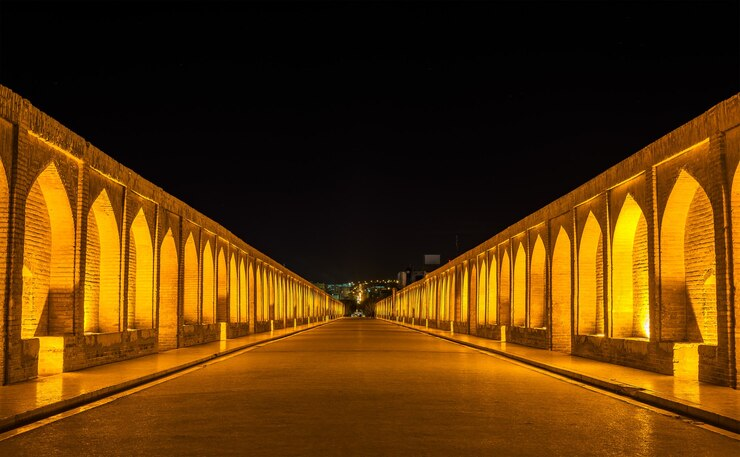
Though you definitely can visit the bridge during the day, do try to go there at night to view the charming lighting of the bridge.
Sheikh Lotffolla Mosque
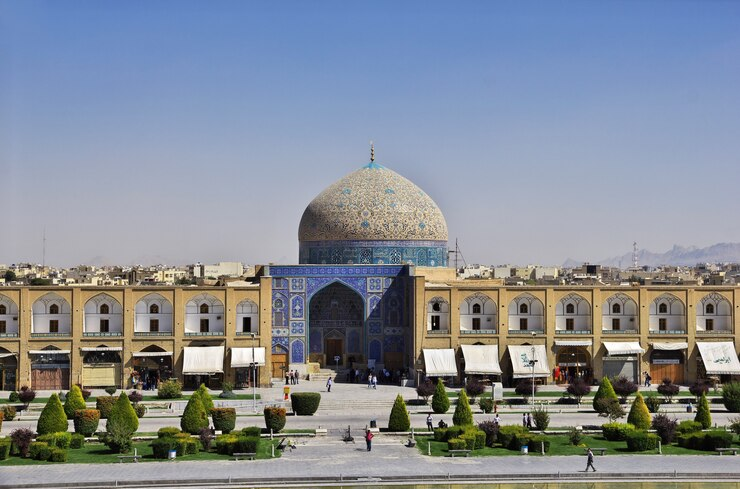
By now you must be familiar with the fact that almost every Iranian city has plenty of uniquely-designed mosques that you can visit. In Isfahan, it is the Sheikh Lotfolla Mosque. Though it may somehow resemble India’s famous Taj Mahal in terms of the dome, entrance, and the artificial small-sized water body in the outer yard, Sheikh Lotfolla Mosque is shorter and spreads over a wider area than Taj Mahal. It is more orange-blue than white as well.
Standing near the center of Isfahan, Sheikh Lotfolla Mosque represents the triumph of Iranian architecture featuring an extraordinarily beautiful interior dome tile whose color changes throughout the day from cream to pink. The mosque is smaller in height than its counterparts and has no minarets which are mainly used to call to prayer. This is because Sheikh Lotfolla Mosque was originally built to be used as a royal court. The mosque was only open to the public centuries after its construction.

What is interesting about this mosque is that it originally had a tunnel linking the mosque to the Ali Qapu Palace, the king’s residence, on the other side of the square. The main purpose of digging this tunnel was to make it easy for the king to go to the mosque without having to walk through the square.
Sheikh Lotfolla Mosque is open daily from 9:00 am to 12:30 pm and again from 2:00 pm to 6:00 pm, though it is better to visit it in the late afternoon to witness the color change. One ticket is worth 200,000 Rials.
Isfahan Seashell Museum
Museums are known to be places that exhibit objects of historic, cultural, or scientific value. Now that the word ‘value’ is relative to each country and how they see, consider, and view their genuine cultural elements, any country is free to have any kind of museum no matter how unusual or even bizarre it might sound to other cultures.
In China, for instance, there is the Beijing Tap Water Museum, in the USA there is the Museum of Bad Art (thanks for being very honest), and in Germany, there is the Bread Museum; however, the existence of the latter is justified as there are over 300 types of bread in Germany!
Isfahan seems to have gone down the same path of building museums for unusual things, for instance, seashells! Though Isfahan is not a coastal city, its Seashell Museum has a colossal number and variety of seashells in so many colors and sizes. Have you ever seen a blue lion paw scallop?
The museum has many vitrines displaying the different groups of seashells, crabs, stars, and others with labels and tombstones, in English, giving information about the displayed items.
Isfahan Seashell Museum is open daily from 8:00 am to 6:00 pm. An adult ticket costs about 80,000 Rials.
Isfahan Aquarium
This could be your next stop after the Seashell Museum, making it a well-spent marine-life day since Isfahan Aquarium is an experience that you will never forget. Visiting Isfahan Aquarium is also a must for it is only 160 meters away from the Seashell Museum!
The aquarium tunnel is 35 meters long and displays aquatic plants, a large distinct variety of fish of different colors, sizes, and patterns, as well as spectral deep-sea animals and sharks.
Isfahan Grand Bazar
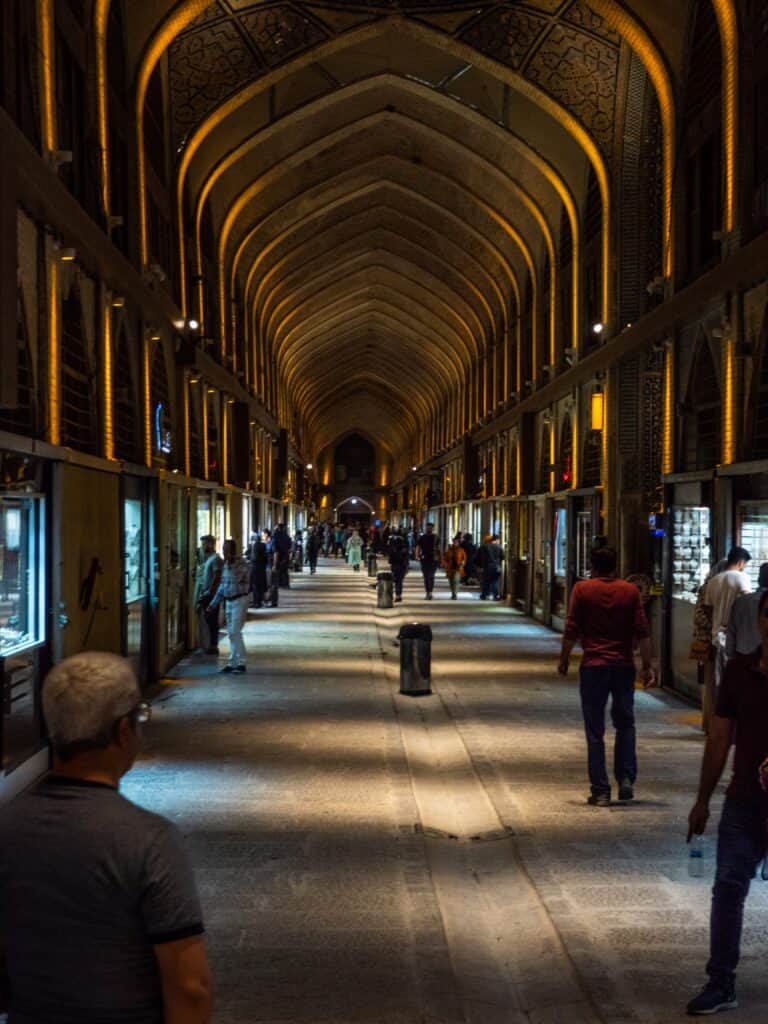
Another distinct site in the city to add to your trip is the Grand Bazaar of Isfahan. Dating back to the 17th century, the Grand Bazar was the greatest trade center in Isfahan and is now a destination for anyone who is interested in buying Iranian carpets and kilims.
Isfahan Grand Bazar is located in the old downtown with numerous shops selling every kind of thing from gold and silver and clothes to herbs and spices. The place is huge with different pathways and streets with domed ceilings that intensify the feeling of walking through a maze.
(4) The City of Firsts: Tabriz
A car ride for around 6 hours and 50 minutes from Tehran to the northwest of Iran will directly take you to Tabriz, the City of Firsts! Tabriz is considered a pioneer in the formation of modern Iran from the late 19th century to the 21st century, mainly due to being closer to Europe than any other city in Iran. For instance, Tabriz was the city where the first primary school in Iran was established in 1893, the first public library (1921), the first publication house, the first telephone system (1901), the first chamber of commerce (1906), and many, many other firsts.
Tabriz is also a hub of history, literature, music, and painting. It even has its very own cuisine. Tabriz Grand Bazaar is a World Heritage Site that will blow your mind.
Preserving one of Iran’s famous hallmarks, Tabriz is home to hand-woven carpets and kilims. Well, it is in fact a great center for handicrafts such as leather, textile, needlework, silverwork, pottery, ceramic, as well as traditional printing all available at Tabriz Grand Bazaar.
Where to go in Tabriz
Just like other major cities, Tabriz has an international airport that facilitates transport either internationally or domestically. You can also wander around using Snapp, the 5-line Tabriz metro, or any other means of transport.
You might want to avoid Tabriz in winter, from December to March or mid-April as it gets freezingly cold. Spring is the best time to visit the city since the weather gets warmer with temperatures ranging from 23°C to 32°C throughout the months from May to August.
That being said, it can get seriously overwhelming to decide where to go or what to visit in Tabriz since the city, just like its counterparts, is pretty abundant in sites of great significance in terms of mosques, museums, more museums, houses, mountains, and many other tourist attractions. However, we have tried to include some interesting sites that will help make your trip to Tabriz even more remarkable.
Sound and Music Museum
Before entering the Sound and Music museum, you will not help but stare in awe at the grand architecture, well-designed wooden doors, and large windows of the museum building. The house which hosts some of the fascinating old as well as modern musical instruments and acoustic equipment in Iran originally belonged to the Qajar Era (1785 –1925). To fit the purpose of the new museum, the house underwent some renovation.
This spectacular museum is open daily from 9:00 to 8:00 pm.
Eil Goli (Shahgoli Park)
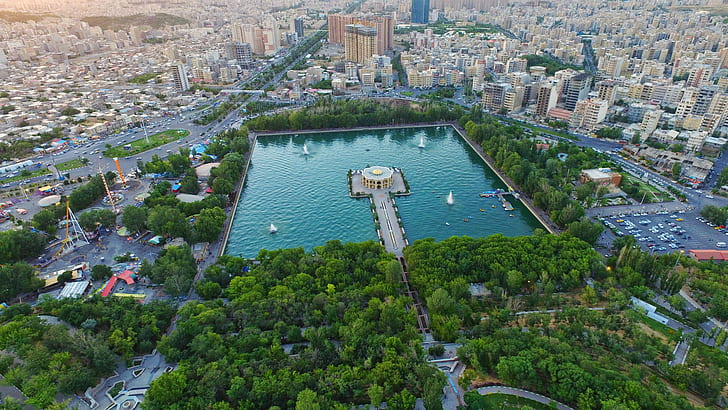
Eil Goli is another out-of-this-world place for relaxation and leisure that will help add some quality break time during a day full of sightseeing and walking around the city. The park was first given the name of Shahgoli which meant the Royal Lake but after the 1979 Ismalic Revolution, the name was changed to Eil Goli which means, yep! You guessed it, the Lake of People.
The park features a stunning artificial lake of 210 meters square right in the middle of it. Floating on the water is a domed circular double-floored pavilion now used as a restaurant that is connected to the park by a causeway.
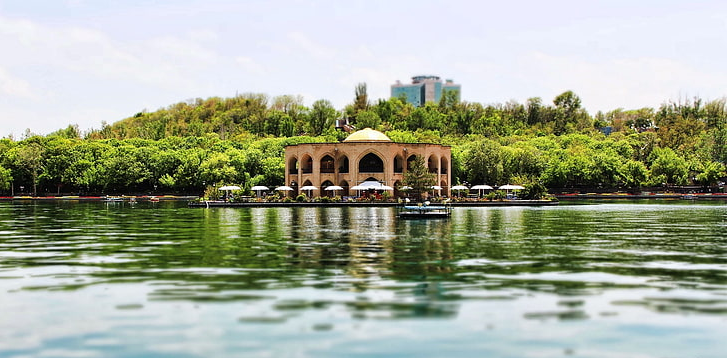
The park is a great place for having a nice walk, enjoying the scenery of beautiful flowers and bushy trees, or having a bike ride. Pedal boats are also available where you can enjoy a nice time on the water.
You can visit the park anytime because it is open all day long, every day of the week.
Tabriz Grand Bazaar
Found right in the city center and listed as a World Heritage Site, Tabriz Grand Bazaar is never to miss while you are in town not. The Grand Bazaar has tens of shops that sell almost everything you can imagine but on top of all is Iran’s pride: carpets. Another reason for the uniqueness of this place is its spectacular architecture of arched ceilings covered in beautiful patterns colored coffee brown and white, the semi-circle entrances to shops, and the lit vitrines displaying jewels, pods, pottery work, and every other kind of thing.
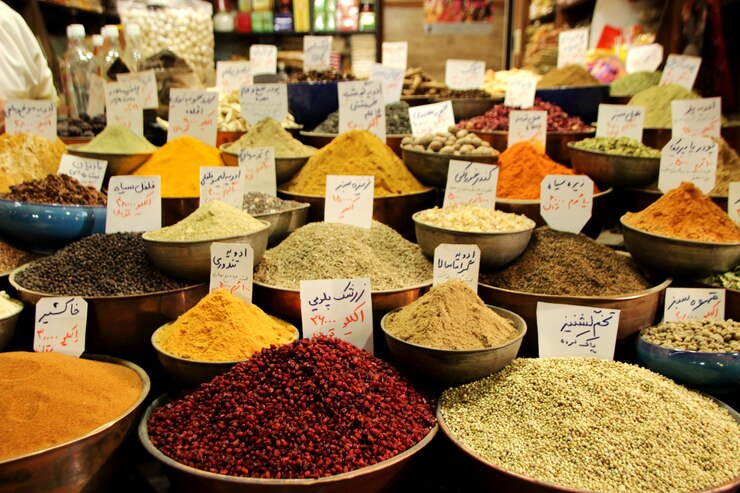
Hours can just go by wandering around this beautiful place, stunned by the variety of everything, the colors, the smells, and even the sizes of displayed items. Since Tabriz is famous for hand-woven rugs and carpets, there are tens of shops selling authentic carpets with beautiful colored striking patterns.
It must be noted here, however, that the bazaar holds many religious ceremonies during which it is usually closed, sometimes up to 10 days. So you may want to check whether or not the day of your visit aligns with one such ceremony.
Coastal Iran
When it comes to beaches, places like the Maldives, Hurghada and Sharm al-Sheikh in Egypt, Phuket in Thailand, and the USA’s Hawaii are usually the first to pop up in mind but not Iran. Well, it is time to change another stereotype about the country because Iran does have some very beautiful beaches.
Bordered to the south by the Persian Gulf as well as the Gulf of Oman and to the north by the Caspian Sea, Iran has got you covered if you want to enjoy a summer treat.
Here are some of the very best beaches you can visit in Iran.
Kish Island
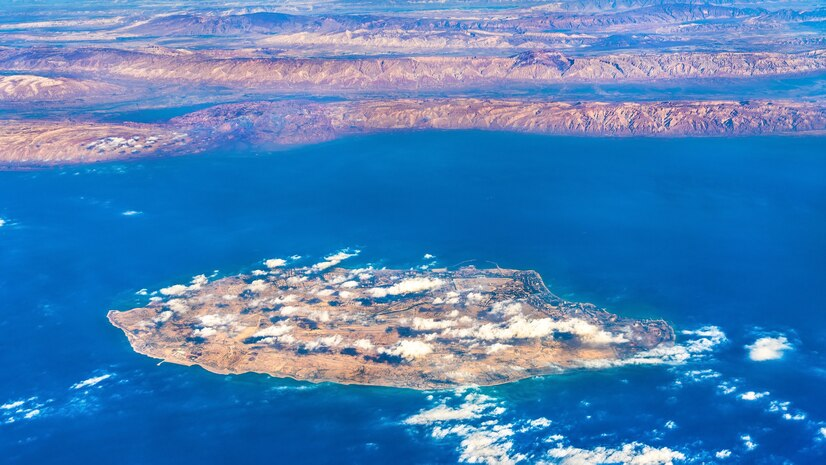
After the adventures you supposedly had all across Iran now, it is time to relax. And there is nowhere you can do that other than Iran’s paradise of Kish Island.
Only 19 km into the Persian Gulf from mainland Iran, Kish Island is there waiting for tourists to have a blast. The island is relatively big, 91 square kilometers, and you might think of it as a countr-ita! (Meaning a small country but in Spanish!)
Years ago, the Iranian government wanted to develop Kish as a tourism hub as well as a free-trade zone to compete with Dubai and Doha which share the same gulf with Kish Island. So they saved no effort to promote it with large and massive construction projects and programs to attract foreign investment. Let me tell you that this maneuver was very very successful.
Kish now has numerous resort hotels, shopping malls, and tourist attractions such as a dolphin park, an aquarium, water and beach sports, a birds garden, and even a Persian Hammam (an old bathroom, you should try it). Tourists can go snorkeling and diving on the coral beach of the island, the Marjan Beach. There is also a university on the island!
Besides such facilities, Kish also has an international airport that provides access to the island without having to land in mainland Iran itself. Tourists are not required to have an entry visa. Instead, they only get a travel permit usually issued at the airport which is valid for a period of two weeks.
Kish is best visited from January to early May when the weather is nice and sunny and suitable for enjoying a beach vacation. And while the rest of Iran is cold and freezing in winter, Kish can also be visited then since the weather is pleasant and cool.
One thing to mention here is that due to the Iranian laws, women are only allowed to swim in the Ladies’ Beach on Kish Island. The Ladies’ Beach is exclusively dedicated to women with no men allowed inside, even husbands. Entry to the Ladies’ beach requires a fee, as well.
Hormuz Island
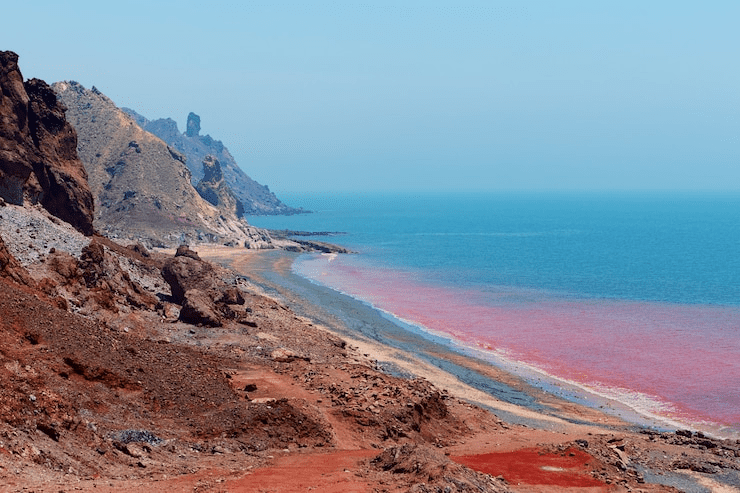
Only 8 km off the Iranian coast, the red Island of Hormuz is located and it is completely different from Kish. Yes, this could mainly be attributed to the relatively small size of Hormuz compared to that of Kish, not being a free trade zone, the population, and its rank on most tourists’ destination lists. However, Hormuz is in a class by itself because it has rainbow beaches!
While Kish is a modernized tourism hub, Hormuz is more of an untouched, plainly natural genuine, and a little primitive place that is absolutely suitable for relaxation and slow-down.
The soil of Hormuz Island, just like that of Mars, has a high concentration of iron oxide which in turn makes the beaches and rocks and even the mountains dazzle in a beautiful mixture of red, orange, and yellow colors.
Hormuz by its very nature, existence, and the little attention it received from the government does not allow as many activities as Kish does. However, you can definitely enjoy swimming on the unique red beach, wandering around, climbing mountains, or even riding bikes.
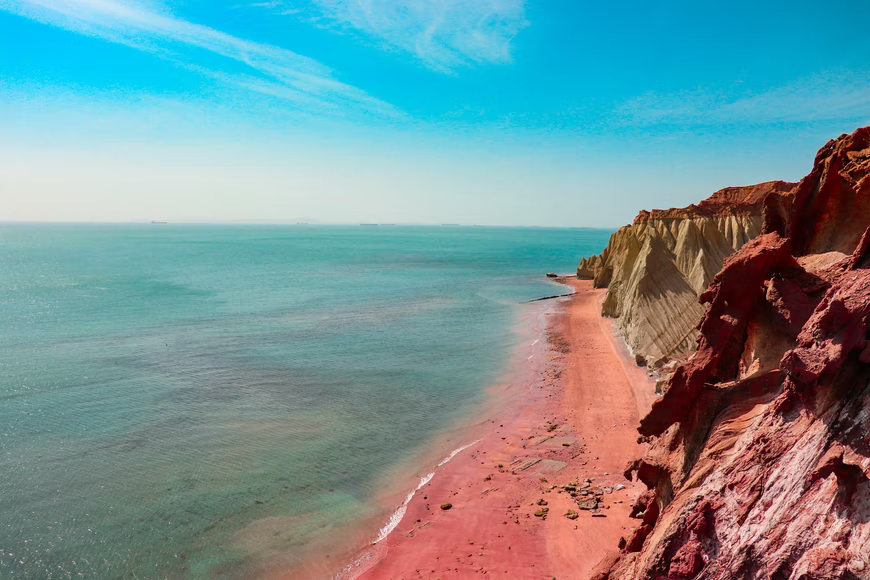
The island has only one main road that goes around it for 30 kilometers. Such distance, according to some travelers, can be cycled in four hours if you have a good fitness level and only when you go clockwise as the road in this direction is less resistant and rocky. However, if not for fun, you can go around the island by rickshaw-like vehicles.
The only way to get to Hormuz is from south Iran, particularly from Qeshm Island or Bandar Abbas, a port city on the Persian Gulf. Ferries leave Qeshm Island at 7:00 am and 2:00 pm and take about an hour to reach Hormuz. Large modern ships, however, can be taken from Shahid Haqani Passenger Port in Bandar Abbas. By such ships, it only takes half an hour to get to Hormuz.
You can spend only one day in Hormuz or choose to spend a few days there. Locals usually offer their guest houses as accommodation and charge tourists accordingly. You can also find hostels in case you want to meet other people. Otherwise, if you are a camping person, you can bring your own tent and set it right in front of the beach.
It is best to visit Hormuz in winter as the weather is warm and the temperature ranges between 23°C to 28°C. It is absolutely to be avoided in summer for the island gets extraordinarily hot with temperatures rising to 45°C.
So it seems..
Iran is a whole different country. Wondrous, diverse, and surprisingly magnificent.
Abundant in history, heritage, art, literature, design, and architecture, Iran is not only a jack of all trades but a master of them all.
We hope this travel guide has given you some useful insights into the country that almost all of us are unaware of its very exquisite existence. Now that you have the information about when to travel to Iran, how to get your visa, where to exchange currency, cities, and the tourist attractions you should visit as well as a proper background about the country’s past and present, you are all set.
So why don’t you start packing?

Top 10 Irish Public Holidays and Traditions to Experience on Your Ireland Holidays
Festivals and Events
18/04/2024

6 Top Mourne Camping Sites for an Unforgettable Experience Under the Stars
Northern Ireland
18/04/2024

Eostre: The Germanic Goddess of Dawn and Spring Equinox Celebrations
Mythology and Folklore
17/04/2024

Explore the Top Hotels in County Cavan for Your Ultimate Getaway
County Cavan
17/04/2024

Irish Golf: Exploring the Top Golf Courses in Ireland
Culture Exploration
17/04/2024