

Updated on:
by
 Ciaran Connolly
 Ciaran Connolly
Article Summary
What this article covers: The history, making and current whereabouts of the Game of Thrones Tapestry, the 87-metre embroidered linen work commissioned in Northern Ireland, with practical advice on seeing it and the filming locations it depicts.
Who this is for: Fans of the HBO series planning a trip to Belfast and Northern Ireland, textile and heritage enthusiasts, and travellers who want to know whether the Game of Thrones Tapestry is on show before they visit.
Key takeaway: The Game of Thrones Tapestry now belongs to National Museums NI and has been resting in climate-controlled storage at the Ulster Museum, so fans should check the museum website before travelling and can view every panel online in the meantime.
Expert insight: “When we filmed the Game of Thrones Tapestry at the Ulster Museum, the detail that stayed with us was where the linen came from. The yarn was supplied from Banbridge, the same County Down town where you can now walk through the Studio Tour, so the craft and the show still sit a few miles apart.” , Ciaran Connolly, Founder of ConnollyCove
Quick facts:
- The Game of Thrones Tapestry measures 87 metres in length, which makes it longer than the roughly 70-metre Bayeux Tapestry that inspired it.
- It was hand-woven from linen yarn supplied by Fergusons of Banbridge and hand-embroidered by museum staff and volunteers from local textile guilds.
- National Museums NI acquired the tapestry in 2020 as a donation from Tourism Ireland, and it is now part of the permanent collection.
Belfast has no shortage of reminders that Game of Thrones was filmed here for a decade, yet the most patient of them is a strip of Irish linen that runs for 87 metres. The Game of Thrones Tapestry retells all eight seasons of the HBO series in the style of an eleventh-century chronicle. Much of its embroidery was stitched by hand in the Ulster Museum while fans looked on. ConnollyCove, the Ireland-based travel and culture platform founded by Ciaran Connolly, has followed the show’s legacy across Northern Ireland, from the Game of Thrones filming locations on the Causeway Coast to the city’s own museums.
This guide explains who commissioned the work, how it was made and where it is today. It also corrects a point that many travel guides still get wrong, because the tapestry is currently off display and the Ulster Museum in Belfast has kept it carefully rolled in storage since its last exhibition run, so knowing your options before you travel will save a wasted afternoon.
ConnollyCove’s own video below was recorded in the gallery while the Game of Thrones Tapestry was on display. It gives a good sense of the scale of the panels and the way the scenes run from one season into the next.
Table of Contents
The Game of Thrones Tapestry at a Glance
The Game of Thrones Tapestry is a hand-woven and hand-embroidered linen narrative that depicts the events, characters and filming locations of the television series across eight sections, one for each season. The table below gathers the main facts in one place, drawn from the Ulster Museum’s own record of the piece.
| Detail | Game of Thrones Tapestry |
|---|---|
| Length | 87 metres when complete |
| Loom width | Around 59 centimetres |
| Sections | Eight, one for each season |
| Commissioned by | Tourism NI and Tourism Ireland |
| Artwork and design | Illustrators at Jelly London |
| Linen yarn | Fergusons of Banbridge, County Down |
| Weaving | Dash and Miller, Bristol |
| Embroidery | National Museums NI staff and volunteers from local textile guilds |
| Embroidery time | More than 1,000 hours of hand stitching |
| First displayed | July 2017, Ulster Museum, Belfast |
| Owner today | National Museums NI (donated by Tourism Ireland in 2020) |
| Current status | In climate-controlled storage; viewable online |
Origins of the Game of Thrones Tapestry
The Game of Thrones Tapestry began as a tourism campaign. Tourism NI and Tourism Ireland commissioned it to mark the way the series had become part of Northern Ireland’s culture and heritage, and it followed an earlier craft project, the Doors of Thrones, in using local materials and makers to tell the story. The first six sections went on show at the Ulster Museum in July 2017 to coincide with the launch of season seven, which corrects the common claim that the work only began after that season ended.
A Bayeux Blueprint for Westeros
The designers at Jelly London studied the Bayeux Tapestry closely and borrowed its visual language, including battle scenes, fallen horses, crowns and shields. The medieval work, around 70 metres long and thought to have been commissioned by Bishop Odo, half-brother of William the Conqueror, records the Norman conquest of England in a continuous strip of scenes.
That format suits a story built on succession disputes and battles for a throne, and the Belfast work adopts the same long horizontal reading order, with decorative borders above and below the main narrative. Strictly speaking, the Bayeux Tapestry is an embroidery on plain linen, whereas its Northern Irish counterpart is closer to a woven textile, because its main imagery was created on the loom and the embroidery was added afterwards as highlights.
Why Banbridge Linen Was Chosen
The choice of linen was deliberate. The yarn came from Fergusons of Banbridge, one of the last surviving linen mills in Northern Ireland, and the Ulster Museum notes that the firm was also the principal supplier of fabrics to the series for costumes and sets. That means some of the same material that dressed the cast ended up in the tapestry. For visitors interested in that industrial history, the Irish Linen Centre and Lisburn Museum explains how flax growing and weaving shaped towns across County Down and County Antrim.
How the Game of Thrones Tapestry Was Made
The Game of Thrones Tapestry was produced in three stages: artwork, weaving and hand embroidery. Production of the first six panels took sixteen weeks in total from design to the final stitch, and the team repeated the process for the season seven panel in 2017 and for season eight in 2019.
Design and Jacquard Weaving
Illustrators at Jelly London produced all of the artwork for the panels. Specialist weavers at Dash and Miller in Bristol then translated that artwork into cloth on a Jacquard loom, working to a width of around 59 centimetres with a limited colour palette. According to the Ulster Museum, the weavers produced around four metres of cloth a day over a few intense weeks in late June and early July 2017, and again in 2019 for the final section.
A Jacquard loom lifts each warp thread individually under the control of a pattern, so figures, sigils and backgrounds can be woven directly into the fabric. This is why the panels have crisp outlines and consistent colour across such a long length, which would have taken years to achieve by hand stitching alone.
Hand Embroidery by Local Stitchers
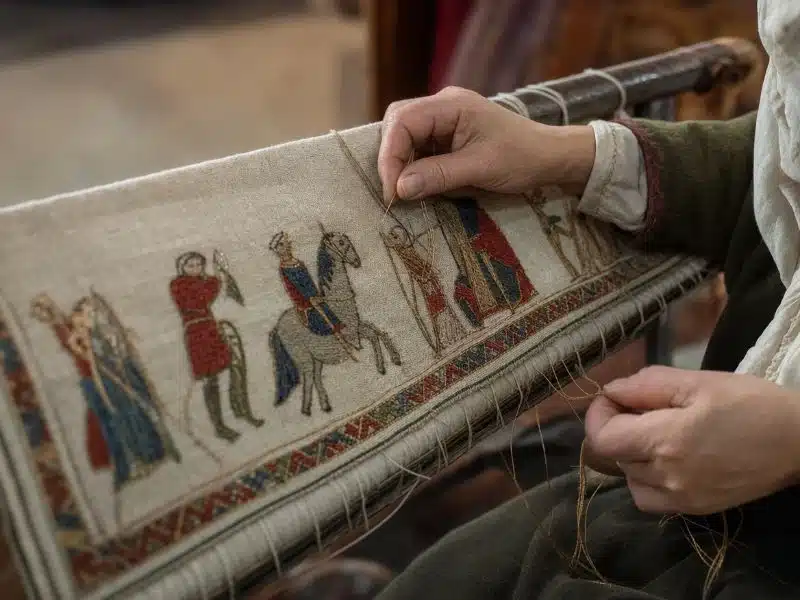
Once the woven panels reached Belfast, a team drawn from National Museums NI staff and volunteers from local textile guilds added more than 1,000 hours of hand-embroidered highlights. Contemporary reporting in The Irish News identified volunteers from The Embroiderers’ Guild and the Northern Ireland Patchwork Guild, with ages ranging from the mid-twenties to 82. The museum also lists a recent textiles graduate from Ulster University, former workers from the local textile industry and a graduate of the Royal School of Needlework among the embroiderers.
The stitches are traditional ones, many of them used on the Bayeux Tapestry: couching, chain stitch, French knots, long and short stitch, satin stitch and stem stitch. The threads are stranded cotton, with metallic embroidery yarns used for selected highlights such as fire and armour. During the 2017 exhibition, visitors could watch stitchers working on the panel for the previous week’s episode, which turned the exhibition into a live craft demonstration.
A Journey Through Westeros in Linen
Walking the length of the panels is like reading the series as a medieval scroll. It opens with King Robert Baratheon riding to Winterfell to visit the Stark family and closes with the final scenes of season eight, so the whole arc of the show is visible in one continuous line.
The Wall appears early as a pale barrier against the threat of the White Walkers, who are shown prowling the lands north of it. Familiar characters, including Jon Snow, Daenerys Targaryen and Tyrion Lannister, are placed against the regions they belong to, so the cloth moves from the snow of the North to the warmer colours of Dorne and Essos.
Epic Battles and Political Intrigues
The panels give a good deal of space to the battles, including the Battle of the Blackwater and the later fighting at Winterfell. The Red Wedding is one of the most discussed scenes, and the embroidery uses red thread to mark the violence in a way that echoes the fallen soldiers along the lower border of the Bayeux Tapestry. The wildfire at King’s Landing is another scene highlighted in the original 2017 reporting.
The political story is told through gatherings and crowns, with Lannister scheming and shifting alliances shown through who sits on which throne at each stage. The design leaves the viewer to follow those reversals panel by panel, which rewards anyone who knows the plot well.
Small Details Worth Looking For
Some of the most enjoyable parts of the work are the small jokes. The season eight section includes the stray takeaway coffee cup that famously appeared on a table at the Winterfell feast, and Reuters photographers captured visitors pointing it out when the tapestry opened in Bayeux. Metallic thread picks out dragon fire and armour, so it is worth viewing the panels from an angle where the light catches the stitching.
The Game of Thrones Tapestry in Bayeux
After the final season aired in 2019, Tourism Ireland shipped the tapestry to Normandy so that it could be shown near the work that inspired it. It went on display at the eighteenth-century Hôtel du Doyen in Bayeux from 13 September to 31 December 2019, a short walk from the museum where the Bayeux Tapestry is kept. The Ulster Museum reports that more than 10,000 people visited in the first few weeks alone. The Bayeux Museum described the Belfast work as a cousin from Northern Ireland, and the comparison below shows how close the two pieces are.
| Feature | Bayeux Tapestry | Game of Thrones Tapestry |
|---|---|---|
| Date | Eleventh century | 2017 to 2019 |
| Length | Around 70 metres | 87 metres |
| Base material | Linen | Linen yarn from Banbridge |
| Main technique | Wool embroidery on plain linen | Jacquard weaving with hand-embroidered highlights |
| Subject | The Norman conquest of England | Eight seasons of the HBO series |
| Where to see it | Bayeux Museum, Normandy | Online; Ulster Museum when exhibited |
Where the Game of Thrones Tapestry Is Now
The Game of Thrones Tapestry is in storage. National Museums NI acquired it in 2020 as a donation from Tourism Ireland, and after five exhibition runs at the Ulster Museum between 2017 and 2022 each panel has been rolled, wrapped and placed in climate-controlled conditions behind the scenes. The museum’s stated aim is to preserve it so that, like the Bayeux Tapestry, it can still be seen centuries from now.
Viewing the Game of Thrones Tapestry Online
While the original rests, you can scroll through every panel on the official online viewer hosted by Ireland.com. The viewer lets you zoom in close enough to see individual stitches, and it is the best way to plan which scenes you want to look for if the panels return to the gallery. The Ulster Museum’s page on the tapestry is the place to check for any future exhibition.
Visiting the Ulster Museum
The Ulster Museum is still well worth a visit for travellers in Belfast. It stands in the Botanic Gardens on Stranmillis Road, beside Queen’s University, and opens from 10am to 5pm Tuesday to Sunday, closing on Mondays. The surrounding Botanic Gardens and Palm House make an easy pairing for a half-day in the south of the city.
Cultural Impact and Tourism
The tapestry was one of several craft campaigns that helped turn filming locations into a tourism trail. Northern Ireland hosted the production for a decade, and Tourism Ireland used the tapestry, carved doors and stained glass to give fans reasons to visit the places where scenes were filmed.
The Wider Thrones Craft Trail in Belfast
The tapestry’s sister projects are easier to see today. The Doors of Thrones are ten carved doors made from beech trees at the Dark Hedges that fell during Storm Gertrude in January 2016, each depicting an episode of season six and hung in a pub or venue near a filming location. The final door is at The Dark Horse in Belfast. The Glass of Thrones trail is a set of six stained-glass windows created in 2019, which Tourism Ireland later gifted to Maritime Belfast Trust, and they are now on permanent display along the Maritime Mile in the Titanic Quarter.
The Studio Tour in Banbridge
The Game of Thrones Studio Tour opened on 4 February 2022 at Linen Mill Studios in Banbridge, one of the series’ original filming bases. It covers around 110,000 square feet and includes original sets, costumes and props, among them the Great Hall at Winterfell. The location adds a neat link to the tapestry, whose linen yarn came from the same County Down town.
Exploring Iconic Game of Thrones Filming Locations
The Game of Thrones Tapestry depicts many places you can still visit, and the table below matches each location to the setting it played on screen. Two claims in older versions of this article have been corrected: the shadow birth scene was filmed at Cushendun Caves, and Dragonstone’s shoreline was filmed at Downhill Strand rather than the Giant’s Causeway.
| Location | Where it is | Stood in for |
|---|---|---|
| Castle Ward | County Down | Winterfell, home of House Stark |
| The Dark Hedges | Near Ballymoney, County Antrim | The Kingsroad |
| Ballintoy Harbour | County Antrim | The Iron Islands, home of House Greyjoy |
| Tollymore Forest Park | County Down | The Haunted Forest and the finding of the direwolf pups |
| Cushendun Caves | County Antrim | The cave where Melisandre gives birth to the shadow |
| Downhill Strand | County Londonderry | The shores of Dragonstone |
| Inch Abbey | County Down | Scenes in the Riverlands |
| Dubrovnik | Croatia | King’s Landing |
| Šibenik | Croatia | Braavos |
| Alcázar of Seville | Spain | The Water Gardens of Dorne |
| Girona | Spain | Streets of Braavos and King’s Landing |
Northern Ireland Locations
The Northern Ireland sites sit within a day’s drive of Belfast, which makes them easy to combine. The Dark Hedges is the avenue of beech trees where Arya Stark travels the Kingsroad after fleeing King’s Landing, and Castle Ward’s courtyard was used for Winterfell in the first season. Ballintoy Harbour and the Dark Hedges pair well on a single Causeway Coast day, while Castle Ward and Tollymore suit a day in County Down.
Locations Beyond Ireland
Dubrovnik’s city walls and steep lanes became King’s Landing, while Šibenik in Croatia played Braavos, where Arya trains with the Faceless Men. In Spain, the Alcázar of Seville provided the Water Gardens of Dorne, and Girona’s old town was used for streets in both Braavos and King’s Landing.
Planning Your Game of Thrones Trip in Northern Ireland
The most useful step is to check the Ulster Museum website before you travel, because the Game of Thrones Tapestry is only on public view when the museum chooses to exhibit it. If it is in storage, use the online viewer first and build your visit around the attractions that are always open: the Glass of Thrones windows in the Titanic Quarter, the Studio Tour in Banbridge, and a coastal day trip to the Dark Hedges and Ballintoy. For an evening in the city afterwards, our guide to dates in Belfast on a budget has ideas that suit friends as well as couples.
ConnollyCove covers Northern Ireland’s filming locations, museums and cultural heritage to help travellers plan their visits with confidence. Explore our guide to Game of Thrones filming locations across Northern Ireland or watch our YouTube videos for walkthroughs of the sites themselves.
Frequently Asked Questions
Where Is the Game of Thrones Tapestry Now?
It is held by National Museums NI at the Ulster Museum in Belfast. It is currently in climate-controlled storage, so check the museum website for any new exhibition dates.
Can You See the Game of Thrones Tapestry Online?
The full tapestry can be viewed online through Ireland.com. The viewer lets you scroll the whole length and zoom in to individual stitches.
How Long Is the Game of Thrones Tapestry?
The finished work is 87 metres long. It was 77 metres when it first went on display in 2017 and reached its full length after the season eight panel was added in 2019.
Who Made the Game of Thrones Tapestry?
Illustrators at Jelly London designed the panels, and Dash and Miller in Bristol wove them from Banbridge linen yarn. National Museums NI staff and volunteers from local textile guilds then added the hand embroidery.
Is the Game of Thrones Tapestry Free to See?
Entry to the Ulster Museum has been free, and previous exhibitions of the tapestry did not need tickets. Confirm current arrangements with the museum before you visit.
How Does the Game of Thrones Tapestry Compare to the Bayeux Tapestry?
The Game of Thrones Tapestry is around 17 metres longer than the Bayeux Tapestry. It also uses Jacquard weaving with embroidered highlights, whereas the medieval work is wool embroidery on plain linen.


