
Article summary
Dunguaire Castle in Kinvara, County Galway, is a tower house built around 1520 by the Ó hEidhin (O’Hynes) clan on the shore of Galway Bay. Its interior has been closed since 2023, but the exterior can still be seen from the road and shore, and this guide covers its history, its legends and how to plan a stop on the west coast of Ireland.
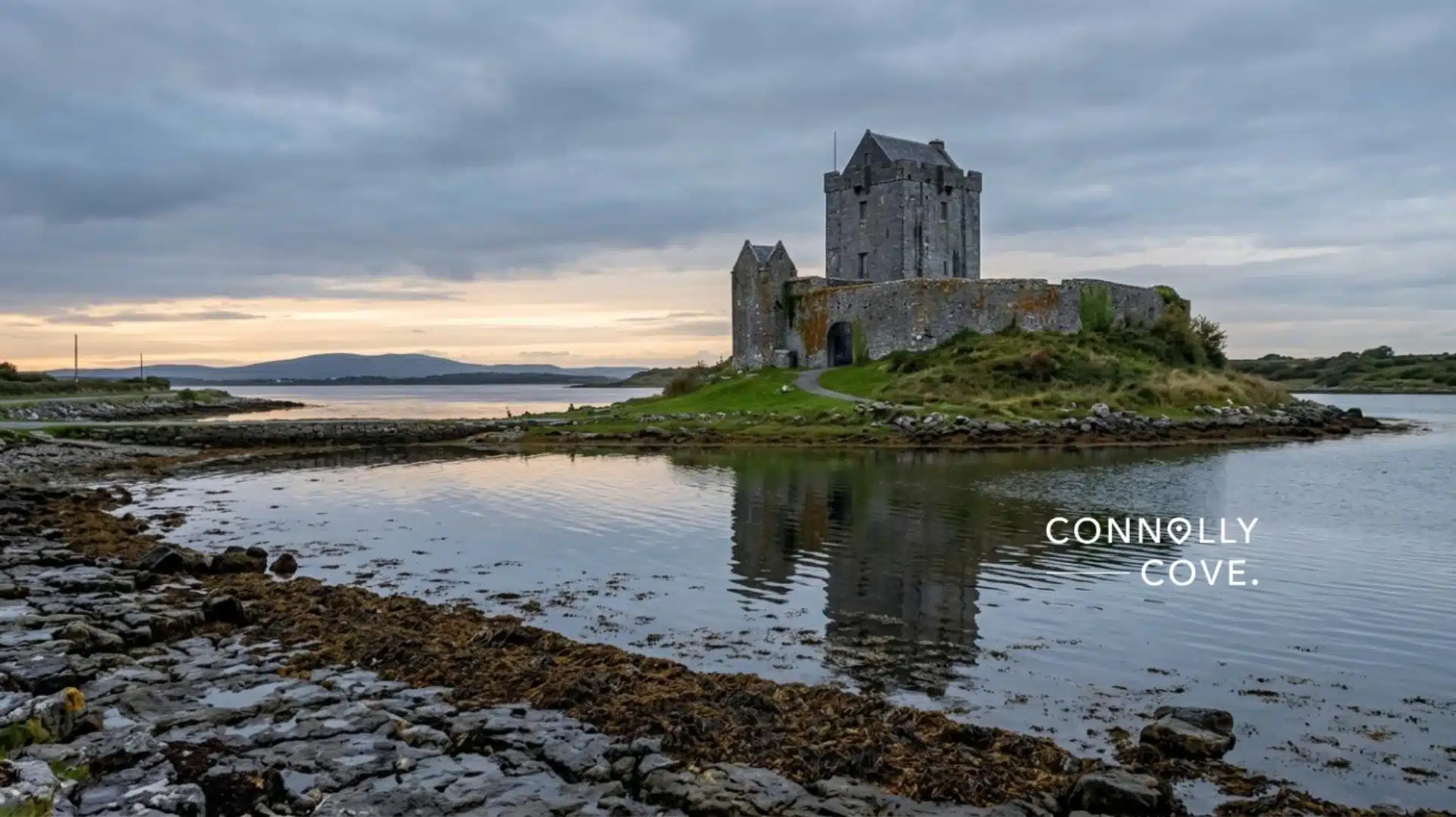
“Most people photograph Dunguaire from the roadside and drive on, but the better view is from the shore at high tide, when the tower and its bawn wall are reflected in the inlet. Even with the gates locked, it is the stop I tell friends not to skip between Galway and the Burren,” says Ciaran Connolly, Founder of ConnollyCove.
- The name comes from the Irish Dún Guaire, meaning the fort of Guaire, after Guaire Aidne mac Colmáin, a 7th-century king of Connacht.
- The tower stands about 23 metres (75 feet) high inside a defensive bawn wall on a knoll surrounded by water on three sides.
- Viewing the exterior costs nothing, although interior tours and the medieval banquets remain suspended.
Dunguaire Castle stands on a rocky knoll at the edge of Kinvara Bay, about a kilometre from the village, with a narrow causeway linking it to the mainland. It is one of the most photographed castles in Ireland, and for anyone driving the coast road from Galway towards County Clare, it is often the first sight of the Burren country, alongside the other castles and historic sites of County Galway.
The castle has been closed since 2023, and many online tour listings have not caught up. At ConnollyCove, the Ireland-based travel and culture platform founded by Ciaran Connolly, we have set out what you can and cannot do at Dunguaire today, together with the history, the stories and the nearby places that make Kinvara worth more than a quick photograph.
Table of Contents
The Castle Interior Is Closed, but the Exterior Is Still Worth the Stop
The interior of Dunguaire Castle and its medieval banquets have been unavailable since the gates were locked in 2023, and no reopening date has been confirmed. Shannon Heritage ran it as a visitor attraction, and its transfer to Galway County Council has stalled over repair costs. The Connacht Tribune reported on 30 September 2026 that the council’s 2026 budget names Dunguaire as a tourism asset it intends to acquire, subject to €5 million in central government support, and that local campaigners want it open in some form by summer 2027.
You can still view the castle from the roadside, the causeway approach and the shore without charge. Any tour that includes Dunguaire can only stop outside, so avoid listings that promise entry to the tower. The castle is a regular stop for people driving the Wild Atlantic Way, and coaches gather at the roadside in summer, so early morning and evening are quieter.
Dunguaire’s History Runs From King Guaire to the Martyns of Galway
The Ó hEidhin clan built Dunguaire around 1520 and claimed descent from Guaire Aidne mac Colmáin, the king of Connacht who died in 663 and whose fort, or dún, gave the site its name. The earthworks on the neighbouring headland are thought to be the remains of that older fort. Strictly speaking, Dunguaire is a tower house, the fortified family home built across the west of Ireland between the 15th and 17th centuries, with a bawn wall to protect people and cattle during raids.
By the early 17th century, the castle belonged to the Martyn family, one of the merchant Tribes of Galway, and Richard Martyn, a former Mayor of Galway, lived there until 1642. The Martyns kept ownership until 1924, although the tower stood roofless for long periods. Dunguaire follows the pattern of many coastal strongholds in our guide to the West of Ireland, where defence decided the location and the view became the attraction centuries later.
Oliver St John Gogarty Brought the Literary Revival to Kinvara
Oliver St John Gogarty, the Dublin surgeon, poet and wit who served as the model for Buck Mulligan in James Joyce’s Ulysses, bought Dunguaire in 1924 and began repairing it. Through Gogarty, the castle became linked with the Irish Literary Revival, and gatherings there are associated with W.B. Yeats, Lady Gregory and George Bernard Shaw.
Yeats spent his summers in the 1920s at Thoor Ballylee near Gort, and Lady Gregory lived at nearby Coole Park, so south Galway was home ground for the poets and playwrights of the revival. Christabel, Lady Ampthill, bought the castle in 1954 and completed the restoration that Gogarty had started, and it later passed to Shannon Development, which introduced the banquets that ran for decades.
Folklore at Dunguaire Centres on the Generosity of King Guaire
The best-known legend tied to Dunguaire concerns King Guaire, whose generosity was so famous in early Irish tradition that one story claims his right arm grew longer than his left from giving to the poor. Another tells how his kinsman, the hermit St Colmán mac Duach, was fasting in the Burren at Easter when the dishes from the king’s banquet rose from the table and flew across the countryside to feed him, with the king’s men riding after them. The route they are said to have taken is still called Bóthar na Mias, the road of the dishes.
The castle banquets drew on this story, and local folklore adds a ghostly noblewoman said to walk the grounds in search of a lost love, although we have not found an early written source for that tale. Stories like these belong with the myths and legends of Ireland’s Atlantic coast, where saints, kings and the sea often share the same tale.
Visiting Dunguaire Castle Is Easiest on Foot From Kinvara Village
Kinvara is about 27 km from Galway City on the N67, a drive of around 45 minutes, and Bus Éireann route 350 serves the village from Galway. The castle is roughly a ten-minute walk from the village centre, and walking is the better choice in summer, when roadside space near the castle fills quickly.
The tide changes the view more than the weather does. At high tide the water fills the inlet around the knoll and gives the reflection that appears in most photographs, while at low tide the shore turns to mud, rock and seaweed, so check a Galway Bay tide table and wear waterproof footwear if you plan to walk down. Kinvara itself deserves an hour or two for its harbour, its pubs and the traditional Galway hooker boats that gather each summer for the Cruinniú na mBád festival. It appears among our charming Irish towns and our seaside escapes in County Galway.
The Burren, Kilmacduagh and Thoor Ballylee are all Close to Dunguaire
Dunguaire works well as the first stop on a day that continues into County Clare or inland towards Gort. Every place below is within two hours by car, and several are under half an hour away.
- The Burren begins just south of Kinvara, with limestone pavements, stone forts and spring wildflowers, and our guide to the Burren covers walks and access points.
- Aillwee Cave near Ballyvaughan in County Clare offers guided tours through a show cave beneath the Burren.
- The Cliffs of Moher, about an hour’s drive south, rise to 214 metres above the Atlantic and rank among the best-known landmarks in Ireland.
- Kilmacduagh near Gort has a leaning round tower and church ruins on the monastic site founded by St Colmán mac Duach, the same saint from the flying dishes legend.
- Thoor Ballylee, the medieval tower that Yeats restored as his summer home, stands beside the Streamstown River near Gort.
- Galway City, around 45 minutes north, has the Latin Quarter, the Claddagh waterfront and plenty of traditional music.
- Connemara National Park at Letterfrack is a longer drive of about two hours, with walking trails on Diamond Hill and a visitor centre.
Before you set off, check the Galway Bay tide times and plan the route around high water at Dunguaire. ConnollyCove’s Irish heritage guides and YouTube videos cover more of this coast.
FAQs About Dunguaire Castle
Dunguaire Castle in Kinvara raises a few practical questions for anyone planning a visit to County Galway. Each answer below is kept short for quick reference on the road.
Is Dunguaire Castle open to the public?
No, the interior has been closed since 2023, and no reopening date has been confirmed. You can still view the exterior from the road and shore free of charge.
Can you go inside Dunguaire Castle?
Not at present, because interior tours and banquets are suspended until repairs are funded and a new operator takes over.
Who built Dunguaire Castle?
The Ó hEidhin (O’Hynes) clan built it around 1520. The Martyn family of Galway owned it from the early 17th century until 1924.
What does the name Dunguaire mean?
It comes from the Irish Dún Guaire, meaning the fort of Guaire, after the 7th-century king of Connacht.